Captured November 4, 2026 at 1440px wide.
Dust plans and prices
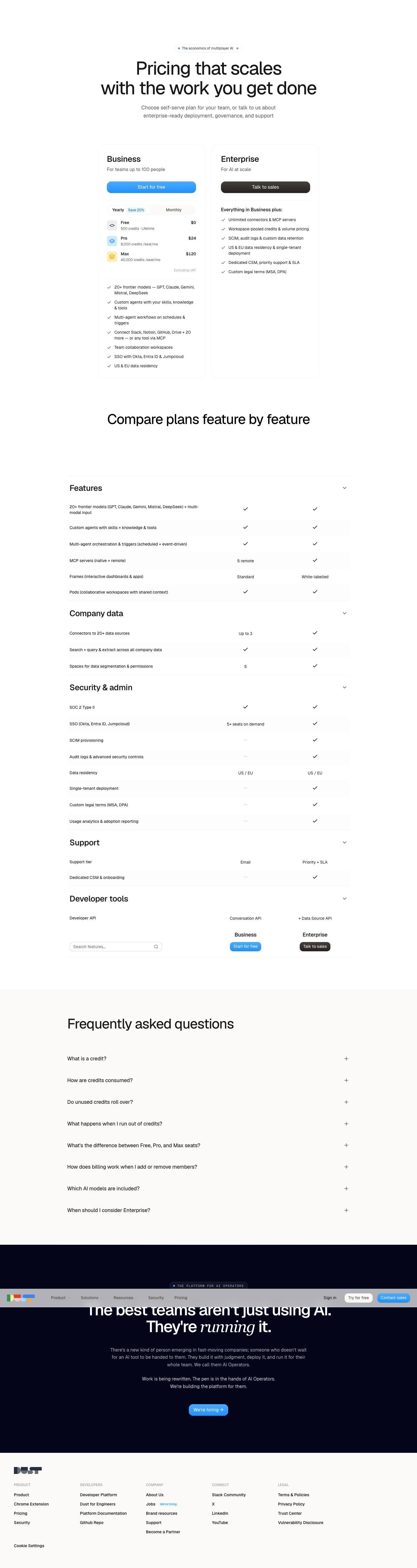
| Plan | Price | Billing |
|---|---|---|
| Free | $0 | 500 credits · Lifetime |
| Pro | $24 | 8,000 credits /seat/mo |
| Max | $120 | 40,000 credits /seat/mo |
| EnterpriseFor AI at scale | — |
As printed on the page captured November 4, 2026.
How does Dust pricing work?
The value metric is a seat with a credit allocation attached. 'A credit is Dust's unit for measuring AI usage', and consumption 'depends on the model used, the complexity of the task, and any tools the agent uses'. The seat type sets the size of each person's allocation, so a team pays for headcount and for intensity at once. Packaging keeps capability flat inside Business: every seat gets '20+ frontier models', custom agents and multi-agent workflows, and the FAQ adds 'No model is locked behind a higher plan, though higher-capability models may consume more credits per message.' What separates Business from Enterprise is scale and control: 'Up to 3' connectors against unlimited, '5 remote' MCP servers, and SCIM, audit logs, single-tenant deployment and 'Custom legal terms (MSA, DPA)' on Enterprise only.
The motion is self-serve for teams and sales-led above 100 people. A link to 'The economics of multiplayer AI' sits above 'Pricing that scales with the work you get done', then two cards: Business with 'Start for free' and a 'Yearly Save 20%' and 'Monthly' switch over the three seat prices, and Enterprise with 'Talk to sales' and 'Everything in Business plus:'. 'Compare plans feature by feature' groups rows into Features, Company data, Security & admin, Support and Developer tools under a sticky header with a 'Search features' field and both buttons. Eight FAQs explain credits, rollover, overage, seat types, proration and models, before a closing section on 'AI Operators'.
Under the hood, Dust runs a credit pool per seat that resets each period, with a capped overage behind it. 'Each seat's monthly credit allocation resets at the start of every billing period', and when it runs out, 'Pro and Max users will be able to continue through workspace overage if enabled by an admin up to a capped amount.' Enterprise changes the shape to 'Workspace-pooled credits & volume pricing', one balance for the company with negotiated rates, and API usage is metered at a 'Programmatic usage rate' of '$0.01 / credit'. Seat changes are prorated, with new members getting 'their full credit allocation immediately'. Worth borrowing: seat types sized by usage, which lets a team buy heavy and light users at different prices inside one plan.
What does Dust's pricing page do well?
- Three seat types sit inside one Business card, each with its credit allocation printed under the price
- The FAQ answers the billing questions in order: 'What is a credit?', 'Do unused credits roll over?' and 'What happens when I run out of credits?'
- The comparison table has a sticky header with a 'Search features' field and both plan buttons
- 'Yearly Save 20%' sits on the switch itself, and the FAQ prints both prices, Pro at '$30/month, or $24/month billed yearly'
- Mid-cycle seat changes are explained in plain terms: prorated, with 'their full credit allocation immediately'
What does Dust's pricing page reveal about its pricing strategy?
- Seat types priced by expected usage let one plan carry occasional users and power users at different rates
- Credits that reset each period, with admin-enabled overage 'up to a capped amount', keep spend bounded for the buyer and the vendor
- 'Workspace-pooled credits & volume pricing' on Enterprise moves from per-seat grants to one company balance with negotiated rates
- A 'Programmatic usage rate' of '$0.01 / credit' prices API usage in the same unit as chat and agent work
- Every model is open on every seat, so credit consumption, not plan gating, carries the cost of frontier models
Learn with Orb
- ProductPrepaid credits Pro at '8,000 credits /seat/mo' and Max at '40,000 credits /seat/mo' are credit allocations attached to seats, the plan structure Orb's prepaid credits product supports, through to Enterprise's 'Workspace-pooled credits & volume pricing'.
- DocsPricing an AI agent Allocations that reset 'at the start of every billing period' and 'workspace overage if enabled by an admin up to a capped amount' map to Orb's worked example of monthly grants, top-ups and expirations that keep liabilities bounded.
- ProductSpend controls Overage capped by an admin and 'Usage analytics & adoption reporting' on Enterprise are the controls Orb's spend controls product provides so usage pricing comes with no surprise bills.
Questions about Dust pricing
How much does Dust cost?
Dust's pricing starts at $24/seat/mo. The page shows 2 plans, including a free plan, with the top plan priced through sales. Paying annually saves 20%.
What pricing model does Dust use?
Dust prices per seat, combined with credits. Buyers can sign up on their own or go through the sales team. Its plans are aimed mainly at small businesses.
Does Dust have a free plan?
Yes, Dust has a free plan. Paid plans start at $24/seat/mo.
Does Dust offer an annual discount?
Yes, paying annually saves 20%. A toggle on the page switches between monthly and annual prices. The listed prices start at $24/seat/mo. Terms for the plans priced through sales are set with the sales team.
How is Dust's pricing page laid out?
The page shows 2 plans and includes a comparison table and an FAQ. The breakdown above marks 14 points on it: 5 things it does well and 9 insights into the pricing.
How are Dust credits consumed?
"A credit is Dust's unit for measuring AI usage", and credits are charged per message based on the model used and the actions performed. A basic chat with a token-efficient model consumes few credits, while a deep research task with multi-step orchestration and tool use consumes more. Usage can be tracked inside Dust by workflow.
Do unused Dust credits roll over, and what happens when they run out?
Credits do not roll over: "Each seat's monthly credit allocation resets at the start of every billing period". When credits run out, a response in progress finishes. Pro and Max users can continue through workspace overage if an admin enables it, up to a capped amount, and Free users are prompted to request an upgrade.
What's the difference between Dust's Free, Pro and Max seats?
They are seat types within the Business plan, assigned per user by expected usage. Free is $0 with 500 credits lifetime, Pro is $30/month or $24/month billed yearly with 8,000 credits a month, and Max is $150/month or $120/month billed yearly with 40,000 credits a month. Seat types can be mixed across a workspace and reassigned anytime.
From the page as captured November 4, 2026. Current prices are on dust.tt
Gamma
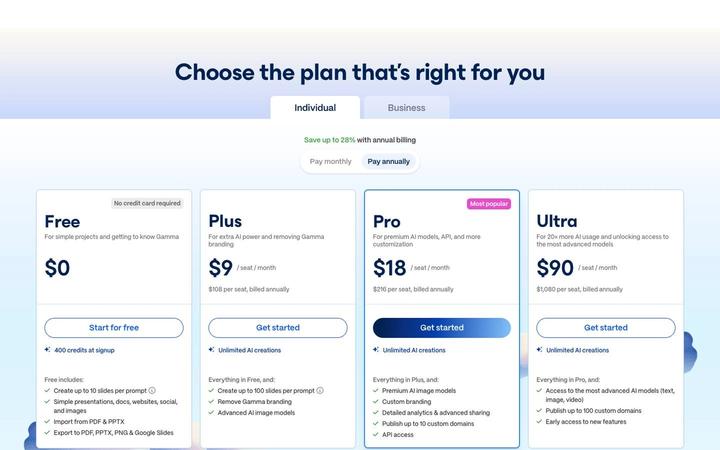
$9/seat/moGamma prices per seat across four plans, $0, $9, $18 and $90 per seat per month on annual billing, and pairs every paid seat with 'Unlimited AI creations' under fair use. Credits run underneath: Free starts with '400 credits at signup', and the footnote states that 'Premium features (Agent, advanced models, & API) require credits'. The page is compact, cards then an eleven-question FAQ, and every plan is bought online.

Jasper
$59/seat/moJasper sells two plans: Pro at $59 per seat per month on the yearly term, scoped to one seat with 2 Brand Voices, 5 Knowledge assets and 3 Audiences, and Business at custom pricing with unlimited customization and team features. The FAQ adds the usage layer: GEO Hub reports and Agents 'run on credits, which sit alongside seat-based pricing on the Business plan', a seat-plus-credits model for AI work.

Perplexity
$34/seat/moPerplexity's Enterprise view prices per seat with a credit allowance attached to each one: Enterprise Pro at '$34 / month per seat when billed annually' with '500 monthly Computer credits/seat', and Enterprise Max at $271 with '15,000 monthly Computer credits/seat'. A third card for 'Additional security and governance' reads 'Custom pricing', and an organization can mix Pro and Max seats in one account.