Pricing pages with an FAQ
Pricing pages that end with questions and answers: billing, limits, overages and what happens at renewal, the details a buyer checks before buying.
Of the 138, 50 price by usage, 95 show a free tier, 92 include a comparison table, 38 a calculator and 116 keep a contact-sales tier.
1Password
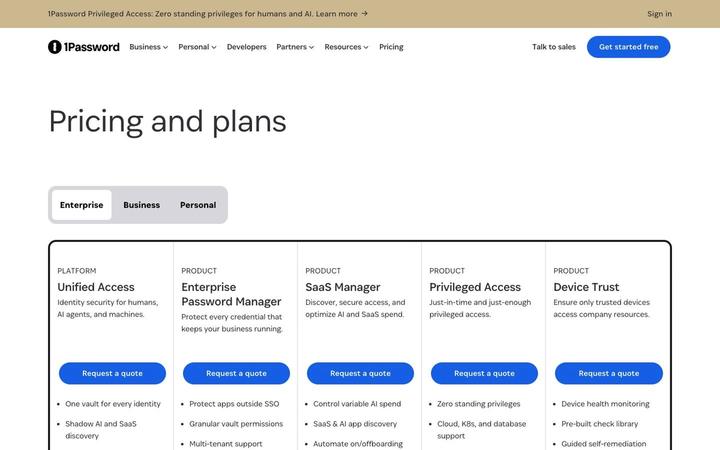
Quote1Password's pricing page opens on its Enterprise tab, where a platform and four products sit side by side and each ends in 'Request a quote'. The packaging is the story: Unified Access is labeled PLATFORM, its four components are labeled PRODUCT, and the FAQ confirms a buyer can take the whole platform or any part of it. Business and Personal tabs carry the self-serve plans on the same URL.

ActiveCampaign
$15/moActiveCampaign prices four plans by contact band, each with a printed starting price and a 'Choose' button, and now adds AI credits as a second meter: every plan includes 500, with more available from checkout or the account. A single contact selector sits above the cards, and each card translates its plan into concrete numbers, from '15,000 email sends / month' to '1 user seat included'. Email sends still scale as a multiple of the contact limit, from '10x' to '15x'.
Adyen
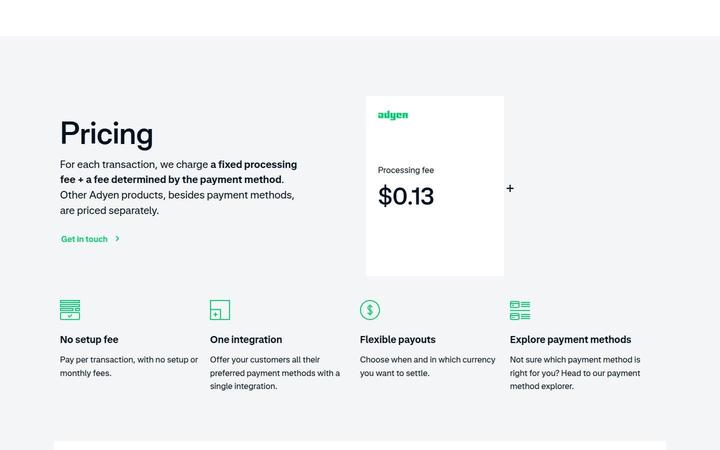
$0.13 + Interchange++ + 0.60%Adyen publishes its tariff as a rate sheet: a fixed '$0.13' processing fee on every transaction plus a fee set by the payment method, across more than a hundred methods. Card networks run on interchange++, 'Interchange+ + 0.60%', which passes network costs through at cost and makes Adyen's own margin a visible line. A Payment / Refund switch publishes refund costs on the same table.
Airtable
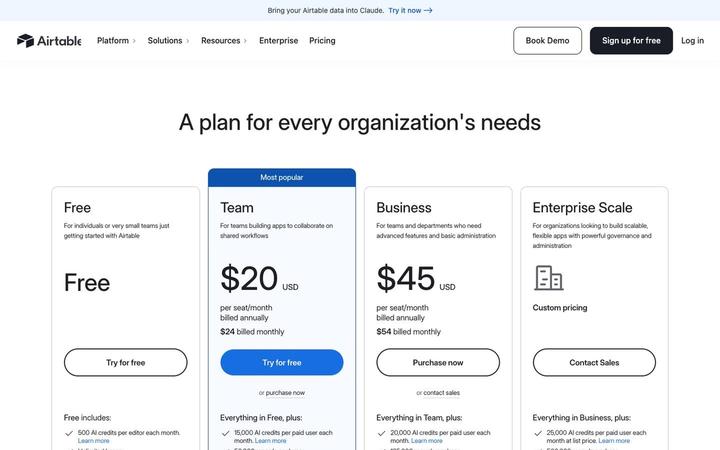
$20/seat/moAirtable prices four plans per seat, Free, Team at $20, Business at $45 and Enterprise Scale on custom pricing, and attaches a monthly pool of AI credits to every seat. Credits are the first bullet on each card and step from 500 per editor on Free to 25,000 per paid user, with top-up packs priced in the table. Annual and monthly prices print together on each card, so the commitment discount is visible at a glance.
Alchemy
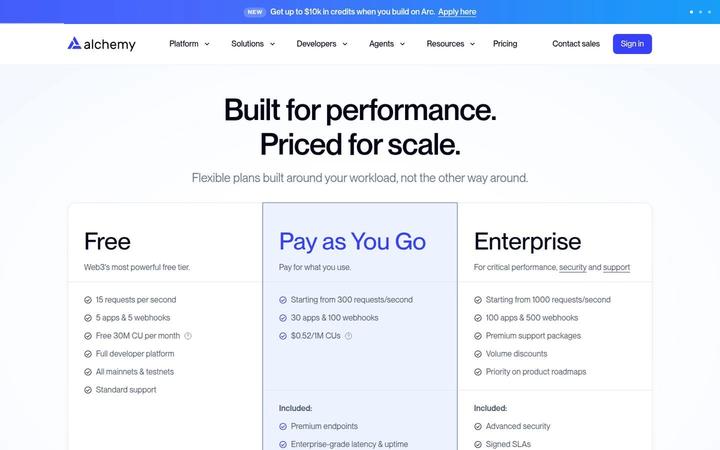
$0.52/1M CUAlchemy prices blockchain infrastructure on one published rate, $0.52 per 1 million compute units, and sells peak throughput as its own meter: $160 for each 5,000 CU/s block above the 300 RPS that Pay as You Go includes. A working estimator itemizes compute, included capacity and overage into a monthly total, so a developer can model the bill before signing up.

Algolia
From $0.50/1K search requests (after 10K free)Algolia prices hosted search on two meters, search requests and records, and prints the included allowance and the overage rate for both on every pay-as-you-go card. Grow and Grow Plus share the same allowances and record rate, and the request rate carries the AI: '$0.50 per additional 1K search requests' for keyword search, '$1.75' for keyword search with AI capabilities. A usage estimator with sliders for both meters now turns those rates into a starting monthly price per plan, while Elevate sits apart as an annual plan with volume-based discounts.
Amplitude
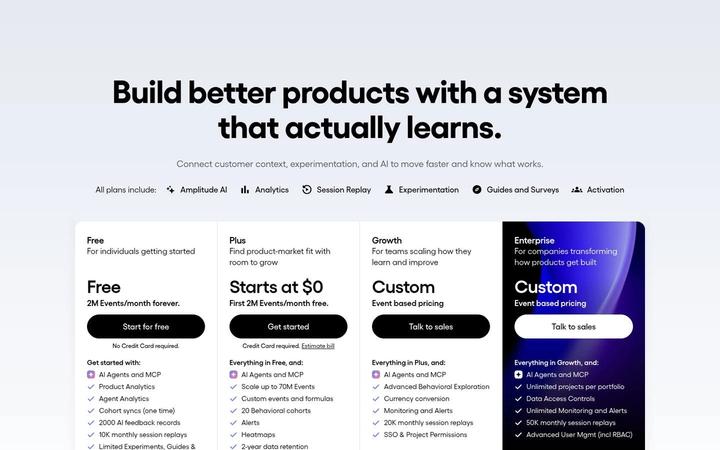
From $0/moAmplitude meters on events and nothing else, under a headline that sells outcomes: 'Build better products with a system that actually learns.' Free gives '2M Events/month forever.', Plus 'Starts at $0' with the first 2M events free and scales to 70M, and Growth and Enterprise move to 'Event based pricing' set through 'Talk to sales'. Further down, an 'Annual Plus Plan Comparison' chart plots what Plus costs across event volumes from 1.5M to 20M.
Anthropic (Claude)
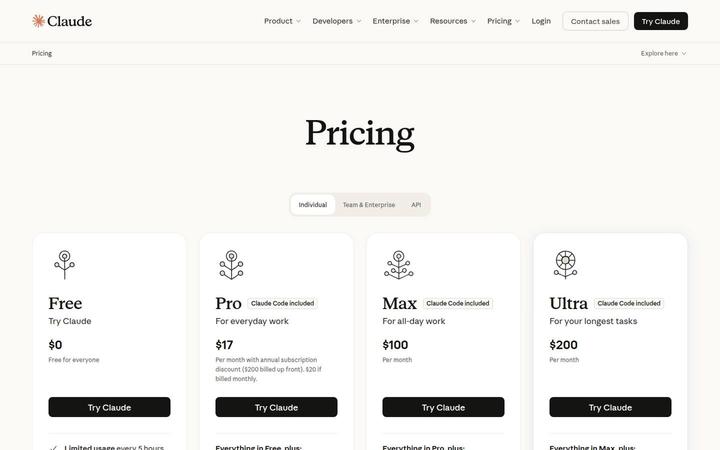
$17/moClaude sells four individual plans, Free, Pro at $17 a month on annual, Max at $100 and Ultra at $200, and what separates them is usage itself. Max is 5x Pro in both the five-hour and weekly windows, Ultra is 10x Pro weekly with no 5-hour limit for verified accounts, and both top plans carry a monthly API credit. One URL carries individual, team and API pricing, and the FAQ prints the enterprise rate.
Asana
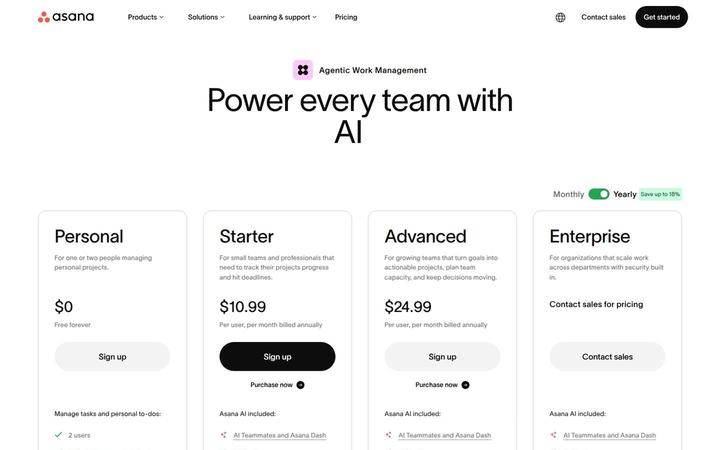
$10.99/user/moAsana pairs a per-user ladder, Personal at $0, Starter at $10.99, Advanced at $24.99 and Enterprise through sales, with a metered AI layer priced in the open. Each paid plan includes a pool of AI requests, and more cost $0.50 each in prepaid usage packs or $0.60 each pay as you go, under the banner 'One flat rate for every AI request'. Seats price the work management product, requests price the work AI Teammates and Asana Dash do, and optional modules such as Timesheets and Budgets extend down to Starter.

AssemblyAI
$0.15/hrAssemblyAI bills speech-to-text by the hour of audio, the unit a transcription team already uses, and the default view shows two rates: Universal-3.5 Pro at $0.21 /hr and Universal-2 at $0.15 /hr. A selector across eight APIs, grouped under TRANSCRIBE, UNDERSTAND and INTERACT, swaps the rate table, so each product is priced in its own unit, from audio hours to LLM tokens to input characters. The FAQ carries the billing mechanics in plain words, including the new Text-to-Speech API at $15 per 1M characters.

Attio
$35/user/moAttio prices its CRM per user and runs usage on credits in two pools: seat credits that grow with headcount, from 100 to 2,500 per user per month, and a shared workspace pool. A published top-up ladder sells more workspace credits from +5,000 a month at $70 annually to +50,000 at $475, so a growing bill can be modeled from the page. Credits open the comparison table, ahead of every feature.

Augment Code
$20/mo flatAugment Code sells a flat team subscription with usage inside it: Standard is '$20/month flat, no per-seat charge' and Business '$100/month flat', each covering up to 50 seats and loading the same dollar amount of usage every month. Usage is measured in dollars, and the FAQ publishes the formula: LLM inference at 'the provider's public API list price', 'a flat 40% fee on LLM usage (no fee on compute)', and Cosmos compute time. The plan is a prepaid wallet shared by the whole team.
Auth0
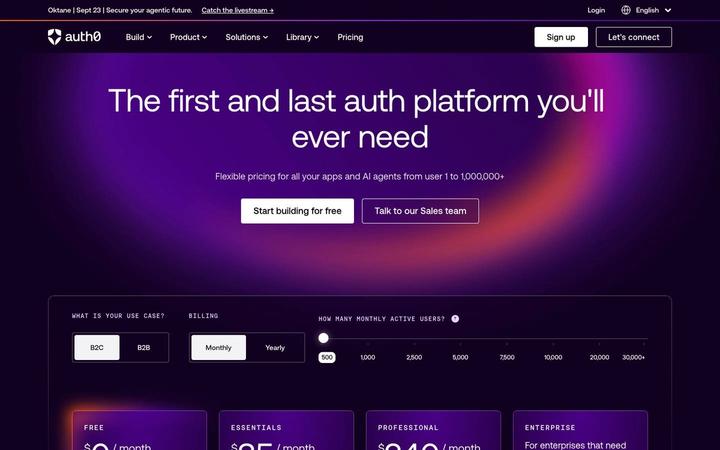
$35/mo (up to 500 MAU)Auth0 prices customer identity on monthly active users, and a three-part configurator, B2C or B2B, Monthly or Yearly, and an MAU slider from 500 to 30,000+, reprices the cards live. Free carries 'Up to 25,000 monthly active users' with 'No credit card needed to sign up', and the paid plans start at $35 a month and $240 a month at 500 MAU and scale with the slider. Feature depth, from MFA to AI agent security, separates the plans.
Basecamp
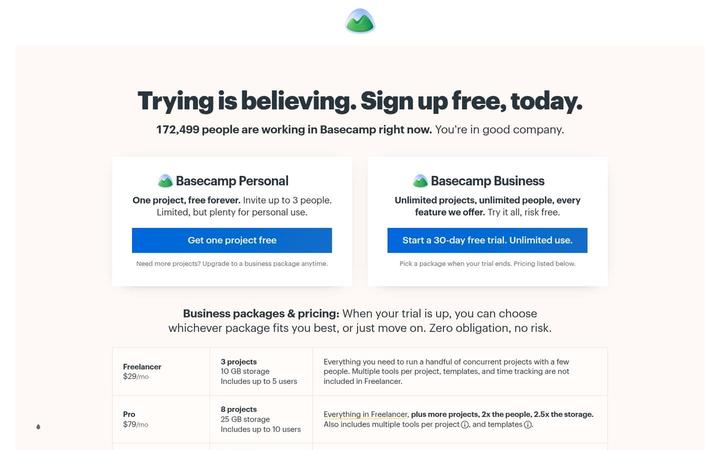
$29/moBasecamp leads with the trial: 'Trying is believing. Sign up free, today.' A free Basecamp Personal card sits beside a 30-day Basecamp Business trial with every feature, and a four-row table sets out the packages to choose from when the trial ends, from Freelancer at '$29/mo' to Pro Unlimited at '$199/mo, billed annually'. Each step adds projects, users and storage, and the upper packages add tools, time tracking and admin services.

Baseten
From $0.01/1M tokensBaseten layers a three-tier service ladder over published rate sheets. Basic is '$0 per month, pay as you go', and Pro and Enterprise carry 'Volume discounts available' with 'GET A QUOTE'. Underneath sit three meters: Model APIs per 1M tokens across 19 model rows with Input, Cache Input and Output columns, opening with joey-1 at $0.01 input, dedicated GPU and CPU instances billed 'down to the minute', and the same GPU grid for training.
BigCommerce
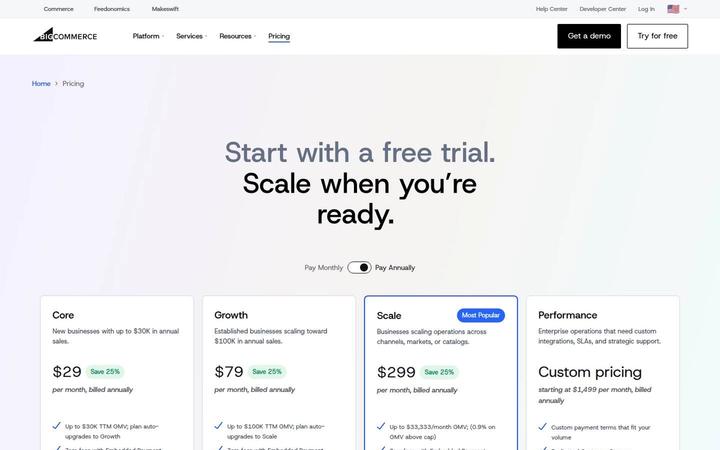
$29/moBigCommerce prices its plans by how much a store sells: Core covers 'Up to $30K TTM GMV', Growth 'Up to $100K TTM GMV' and Scale 'Up to $33,333/month GMV' with a '0.9%' overage above the cap, and each band moves a store up automatically as its sales grow. The upper cards name their buyer by operations, from multichannel scaling on Scale to 'custom integrations, SLAs, and strategic support' on Performance, and the footnotes spell out the GMV formula, the monthly list prices and the card processing rate.
Bolt
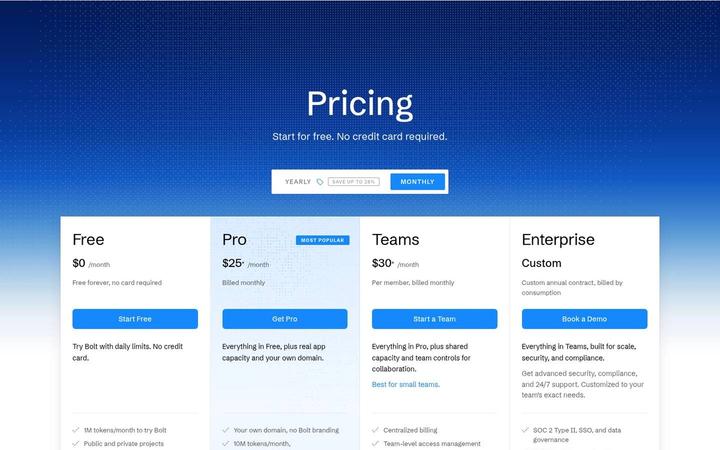
$25/moBolt sells its AI app builder on tokens, the unit of model work behind every prompt. Free offers '1M tokens/month to try Bolt', Pro at $25 a month carries the MOST POPULAR badge with '10M tokens/month, rollover included', Teams adds a per-member price, and Enterprise moves to 'Unlimited tokens, priced by consumption'. The page now runs from cards through logos, security credentials and a full Compare table to a closing call to action, so one URL serves the solo builder and the procurement team.
Braintrust
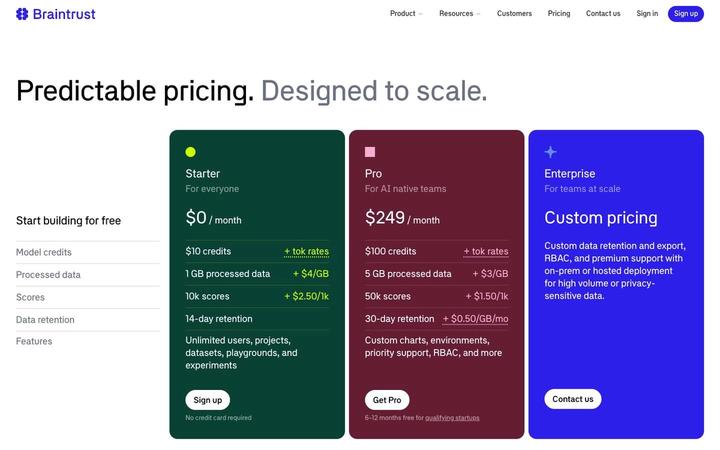
$249/moBraintrust pairs a flat platform fee, $0 on Starter and $249 a month on Pro, with four metered dimensions: model credits, processed data, scores and data retention. Each included allowance sits on the card beside its overage rate, and users, projects and experiments are Unlimited on every tier, so the bill follows traced traffic while headcount stays free.
Braze
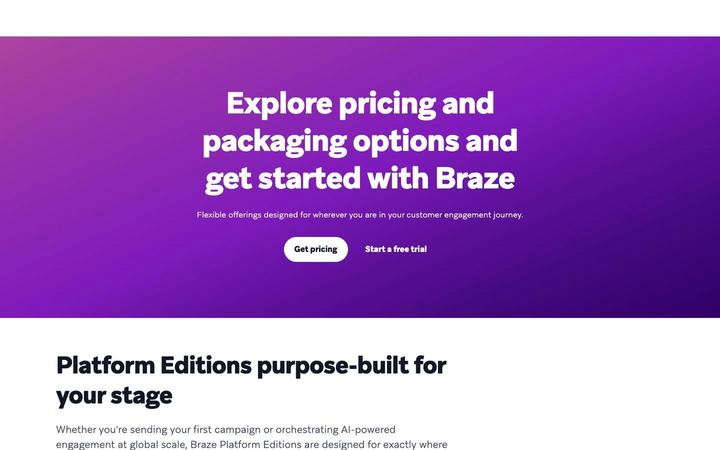
QuoteBraze prices on two axes: Monthly Active Users set the scale of the subscription, and Action Credits are a pooled currency spent across every channel and certain BrazeAI products. Four Platform Editions, Go, Select, Pro and Enterprise, are named for company stage, and every edition is priced in a conversation, which lets each contract fit the brand's audience and channel mix.
Brevo
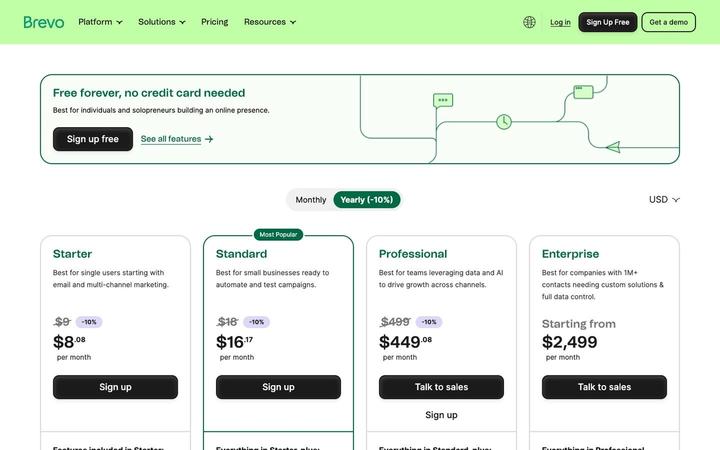
$9/mo for 5,000 emailsBrevo bills on monthly email volume, with contacts included at no charge, and the 'Customize your plan' configurator turns that meter into a live total with a slider from 5k to 100k emails. The card ladder, Starter $9, Standard $18, Professional $499 and Enterprise 'Starting from $2,499 per month', separates on capability, while volume is sized inside each plan.

Calendly
$10/seat/moCalendly sells four plans, Free, Standard at $10/seat/mo, Teams at $16/seat/mo and Enterprise from $15k a year with a 50-seat floor, and it defines a seat on every paid card: hosts need one, invitees do not. The page leads with its AI add-on, Notetaker and Callie, sold as a switch inside the Standard and Teams cards, which shows a scheduling tool growing into a seat price plus an AI layer.
Canva
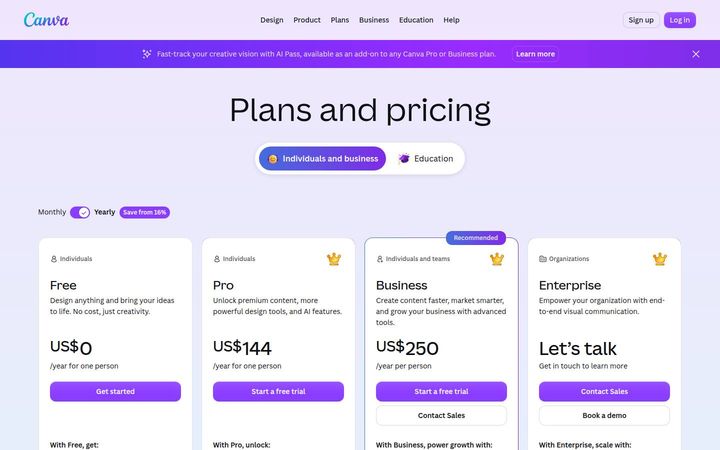
US$144/person/yrCanva sells a seat ladder, Free, Pro at US$144 a year for one person, Business at US$250 a year per person and Enterprise on 'Let’s talk', and inside every seat sits a shared AI allowance. Allowances are stated as multiples, 10x and 20x more AI than Canva Free, and a footnote explains that Standard, Premium and Ultra AI tools draw on the pool at different rates, a credit system running behind a seat price.
Chroma
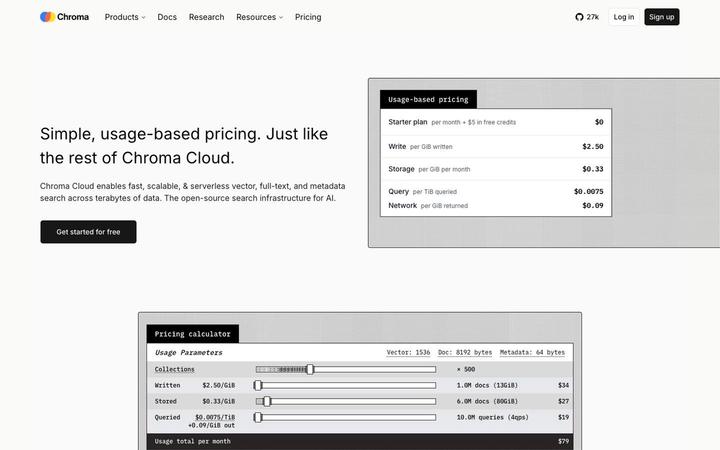
$250/mo + usageChroma prints all four metered rates in the hero, Write at $2.50 per GiB, Storage at $0.33 per GiB per month, Query at $0.0075 per TiB and Network at $0.09 per GiB returned, then hands the reader a calculator that turns documents and queries into a $79 monthly total. Plans sit on top of the meter: Starter at $0 plus usage, Team at $250 a month plus usage with $100 in credits, and Enterprise on custom terms.
CircleCI
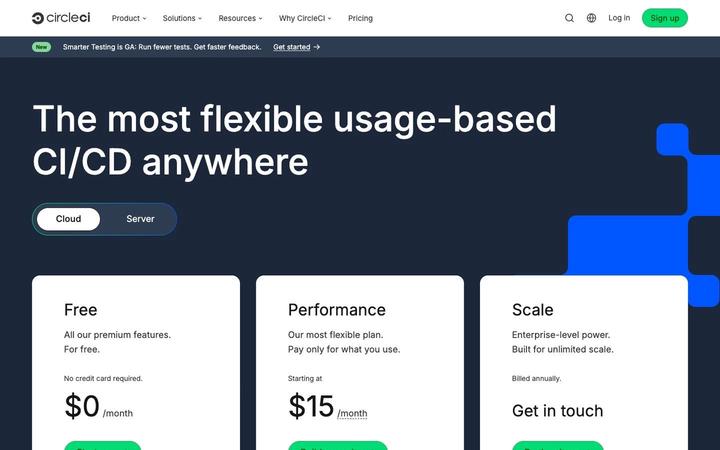
$15/moCircleCI sells one currency: credits that pay for compute, seats and features alike. Free includes '30,000 free credits/month', Performance is 'Starting at $15 /month' behind a 'Build your plan' configurator, and Scale is 'Billed annually.' with 'Get in touch'. A three-step explainer, 'Buy', 'Build' and 'Repeat', sets out the model before the comparison table.
Clay
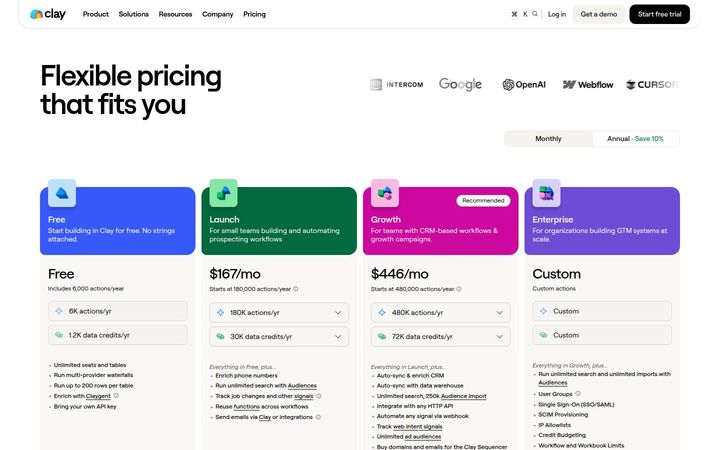
$167/moClay prices on two meters and no seats. Every plan carries unlimited seats and tables, and the bill is Actions for work done on the platform plus Data Credits for data bought from its marketplace. Each paid card is a live configurator whose two dropdowns add up to the headline price, and Enterprise is now packaged as a governance tier built around access controls and credit budgeting.
ClickHouse
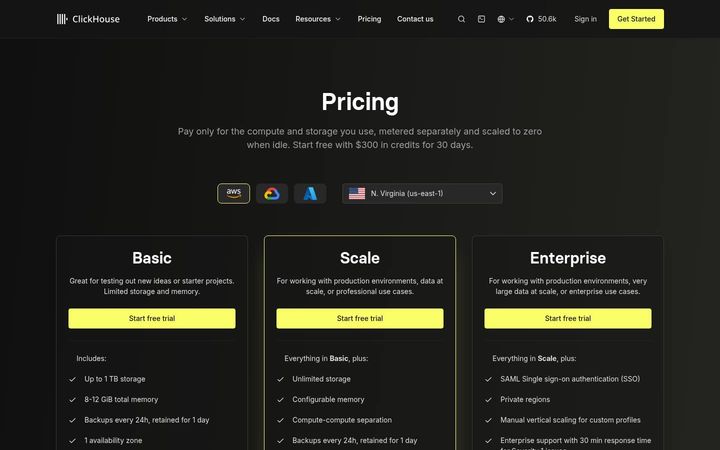
$0.2181/compute unit/hrClickHouse opens with its model in one line, 'Pay only for the compute and storage you use, metered separately and scaled to zero when idle.', sets the cloud and region, then gives every tier the same two meters: storage flat at '$25.30 Per 1TB / mo' and compute at $0.2181, $0.2985 and $0.3903 per unit per hour. The estimator opens pre-filled with a 1 TB real-time analytics workload at '$658' a month, and an eight-question FAQ explains each line that can appear on the bill.

ClickUp
$9/seat/moClickUp prices on seats with AI built into every plan: Free Forever at $0, Core at $9 and Business at $17 per 'user / mo · billed yearly' against struck regular prices, Enterprise at 'Custom', and a MAX plan at $100. Each tier carries its own pooled credit allowance, with top-ups at '$10 per 10K credits', framed by a '100% Money-back Guarantee', a written 'SUPER FAIR BILLING POLICY' and a savings calculator that ends in 'Get a quote'.

Close
$9/user/moClose sells four per-user plans, Solo at $9 through Scale at $139 per user per month on annual billing, and attaches a pool of AI credits to every seat, from 500 to 2,000 a month. Its AI sales agent, Chloe, is included on every plan and paid for by the work she does, while calling and SMS pass through at cost.
Cohere
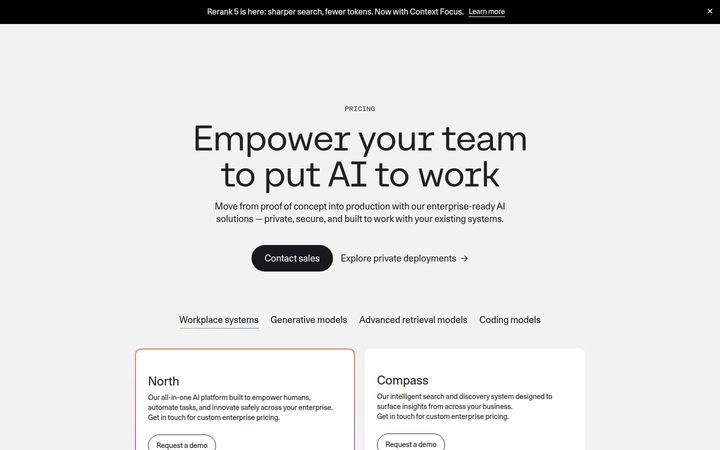
$3.00/instance/hrCohere prices for the enterprise in three shapes: custom contracts for its North and Compass platforms, reserved capacity on Model Vault at $3.00 to $7.00 an hour or $2,000 to $4,300 a month per instance, and pay-as-you-go tokens behind a Production API key. A four-way toggle sorts the page by buying job, and the FAQ carries the billing mechanics, down to an invoice at month end or at $250 of outstanding balance.
Confluent
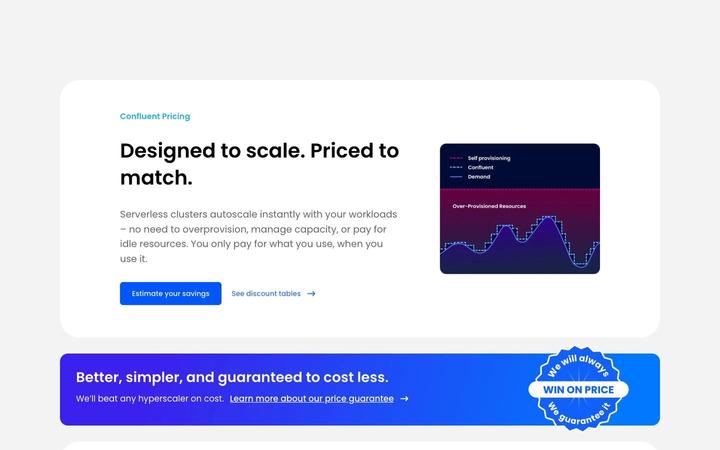
~$385/moConfluent prices serverless Kafka on a composite meter, eCKU-hours plus data in and out per GB plus storage per GB-month, and closes its rate table with an 'Estimated Monthly Starting Cost' of $0, $385, $895 and $2,300 that turns an hourly unit into a budget number. Behind it sit two discount structures and an annual commitment that can be spent across the whole Confluent Cloud stack.
Contentful
$300/moContentful sells its Platform in three bundles, Free at '$0 / forever', Lite at '$300 / month' and Enterprise at Custom, each defined by allowances of users, roles, locales, API calls and CDN bandwidth. The page frames buying as two steps, 'Step 1: Pick a Platform plan' and 'Step 2: Add to your Enterprise plan', where Personalization, AI Actions and Studio join the top plan as modules: a content platform sold as a core plus products.

Contentsquare
$39/moContentsquare prices on monthly sessions and splits its lineup across two products: Experience Analytics, with Free at '$0 / forever' and Growth from $39 a month, and the sales-led Experience Platform, with Pro and Enterprise at 'Custom'. The page also serves visitors arriving from Hotjar's old pricing URL, so the self-serve analytics plans and the enterprise platform share one entry point.

Cursor
$8/moCursor sells AI usage in multiples of one plan: Free is $0 /month, Plus $8 /month, Premium $30 /month and Super $100 /month on the cards, with Ultra at $200/month, Teams at $30+/user/month and a Custom Enterprise tier in the comparison table. Each paid step is defined as more usage compared to Plus, and the subscription bundles Cursor, Grok and X benefits into one plan. Third-party models sit outside the price at API list rates, which keeps pass-through cost apart from the bundle.

Customer.io
$100/mo for 5k profilesCustomer.io meters on profiles, people plus objects, and starts at '$100 per month / billed monthly for 5k profiles' with a profile selector built into the entry card. Seats are unlimited on every plan, and the Usage + Billing block prints the marginal rates: $0.009 per additional profile, $0.12 per additional 1,000 emails and $10 / 100K AI credits. From Premium up, profile and email volume are priced per customer, which is where the sales team shapes each deal.
Databricks
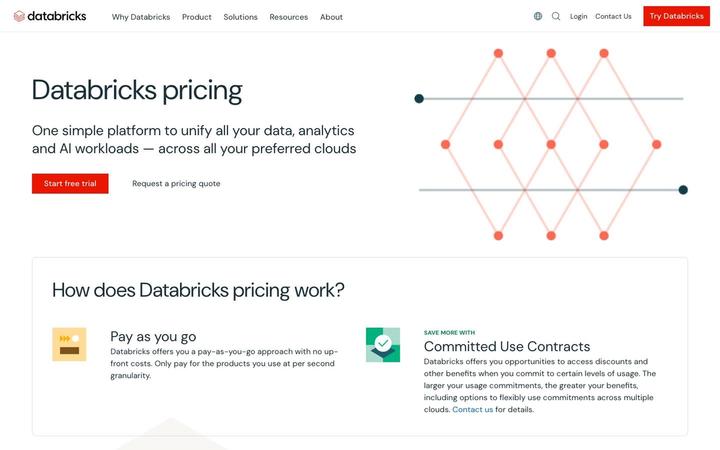
From $0.069/CUDatabricks prices a whole data platform on one consumption unit, the DBU, with seven workload tiles that each print a 'Starting at' rate and link to a full SKU price list. Billing runs 'at per second granularity' on pay-as-you-go, and Committed Use Contracts trade larger commitments for discounts that can flex across clouds. The page works as the front door to a rate table, organized by the job a customer is doing.

Datadog
$15/host/moDatadog publishes a rate card per product, with every billable SKU listed in a left-hand navigator from AI Credits to Workflow Automation. Infrastructure Monitoring prices per host across three host levels: Basic, set with sales, beside Pro starting at $ 15 and Enterprise at $ 23 billed annually, with on-demand rates printed beside them and allotments of containers, custom metrics and custom events attached to each paid host. The bill is the sum of the products a customer adopts, and Basic hosts let one account price noncritical workloads at their own level.
Deel
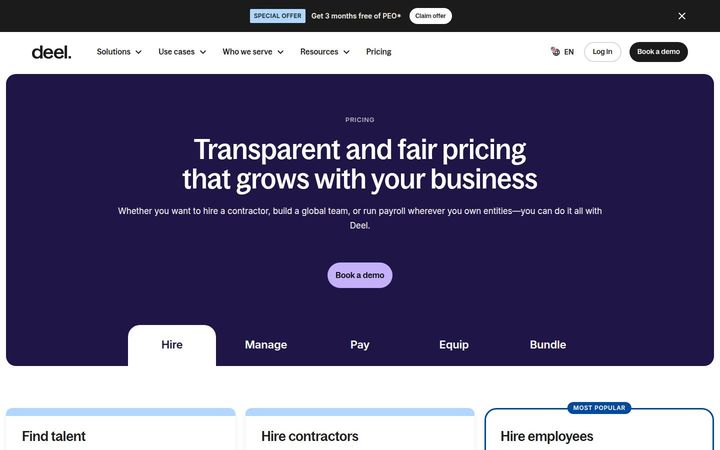
From $14/worker/moDeel prices per worker, and the price climbs with how much employment risk Deel takes on: starting at $14 per worker per month to source, $49 to manage and pay a contractor, $325 for a contractor of record, $125 for a US PEO employee and $599 for an EOR employee. Every rate carries a 'Starting at' label, so the five printed figures under 'Transparent and fair pricing that grows with your business' are floors, with the final rate set per country and per hire. Every card leads to 'Book a demo', since each hire involves contracts, benefits and compliance in a specific country.
Deepgram
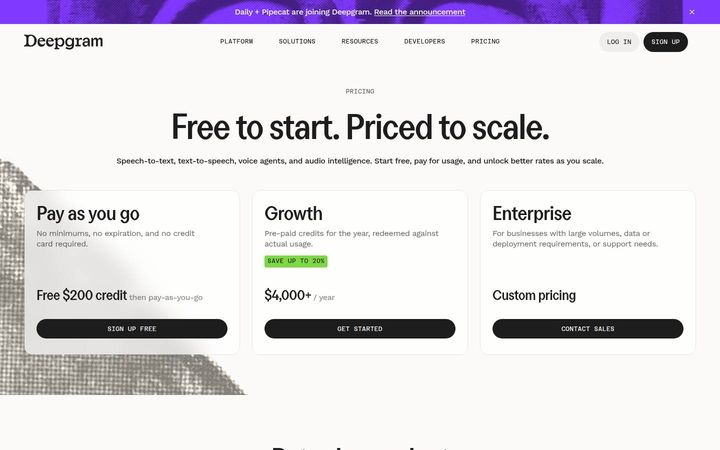
$0.0077/minDeepgram's page opens on "Free to start. Priced to scale." and three cards: Pay as you go with a Free $200 credit, Growth at $4,000+ / year in pre-paid credits for up to 20% off, and Enterprise at Custom pricing. A tabbed "Rates by product" section names the meter for each product, per second of audio, per 1,000 characters, or per minute of connection time, and a sixteen-question FAQ carries the billing mechanics, from hourly rates to the 10% overage premium.

Descript
$16/person/moDescript prices per person and attaches two monthly allowances to every seat, media hours and AI credits: Hobbyist at $16 with '10 media hours / month' and '400 AI credits / month', Creator at $24 with 30 and 800, Business at $50 with 40 and 1500, on annual billing. Each paid plan also caps team size, and Enterprise is 'Custom', with 'AI credits and media hours: sized to your team'.
Devin
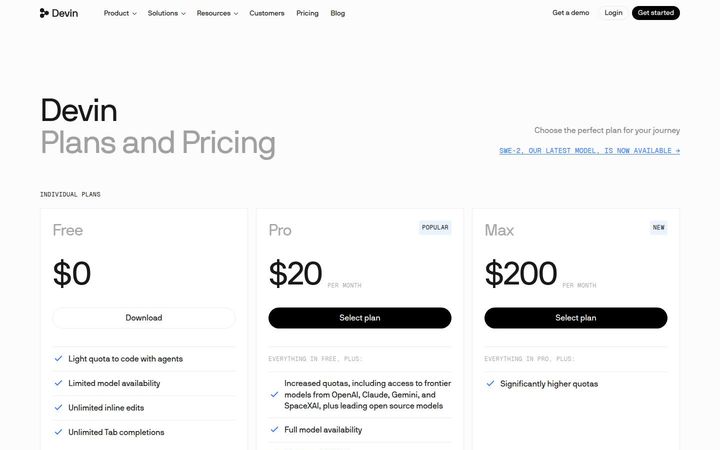
$20/moDevin sells agent usage as subscription quotas: Free, Pro at $20, Max at $200, a Teams plan at $80 per month plus $40 per full dev seat for up to 200 users, and Enterprise by conversation. Each paid plan carries an allowance that refreshes daily and weekly, and usage past it is bought 'at API pricing', so the subscription covers typical work and the meter covers the heavy days. The Teams line prints a two-part tariff, a platform fee plus a seat price, in one sentence, and a 200-user ceiling marks where Enterprise begins.
Docusign
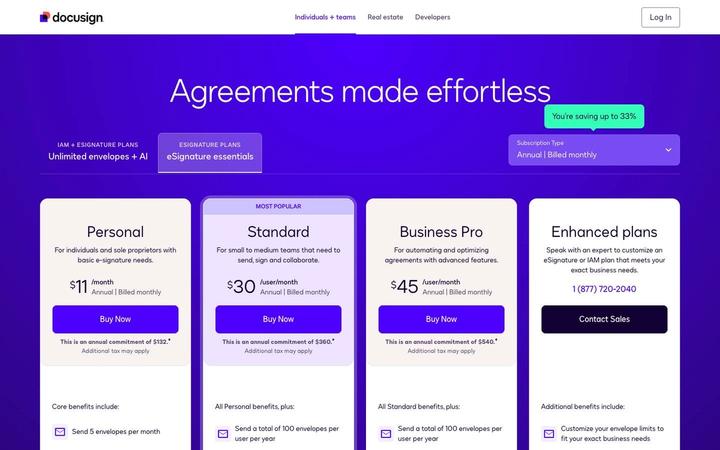
$11/moDocusign sells eSignature per user with an envelope allowance as the second meter: Personal is $11 /month for 5 envelopes a month, Standard (MOST POPULAR) and Business Pro are $30 and $45 /user/month with 100 envelopes per user per year, and Enhanced plans run through a phone number and Contact Sales. Every paid card prints its full annual commitment under the price. The upgrade beyond eSignature is IAM, sold on 'Unlimited envelopes + AI', so envelope volume is the axis that moves a customer up the product line.
ElevenLabs
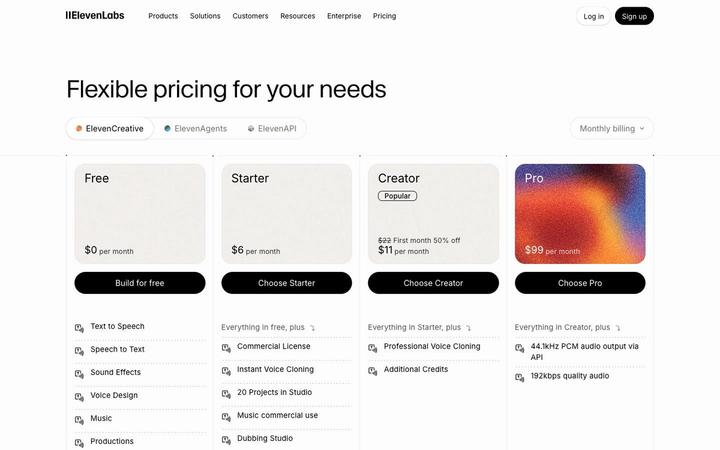
$6/moElevenLabs sells monthly credit bundles across seven plans, from Free with 10k credits per month to Business at $990 per month with 6M credits and 10 seats, split into an individual row and a For Businesses row. One credit currency meters speech, music, dubbing, image and video, and the page translates it into minutes of audio twice: in a calculator that recommends a plan and in a table that prints the price of an extra minute for every tier. Seats arrive at Scale, so the model is credits first with team access layered on for businesses.
Expensify
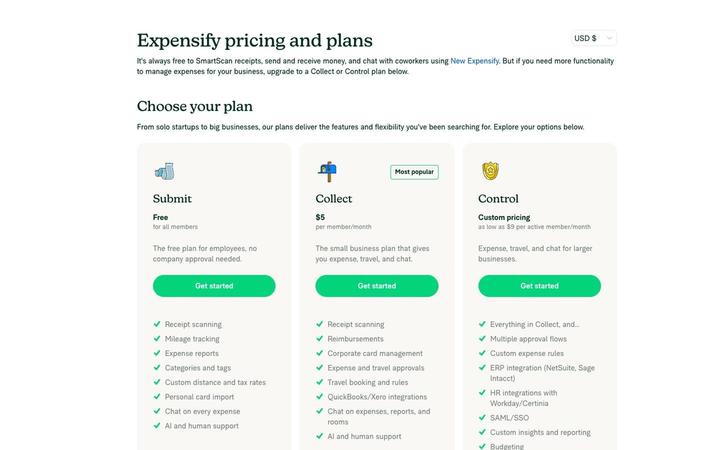
$5/member/moExpensify prices per member, with a free Submit plan for employees, Collect at $5 per member/month and Control on custom pricing from $9 per active member/month. The Expensify Card runs through the whole page: it earns cash back, unlocks savings of up to 50% on the subscription on Control, and backs an FAQ line that ties discounts to card use.
Factory
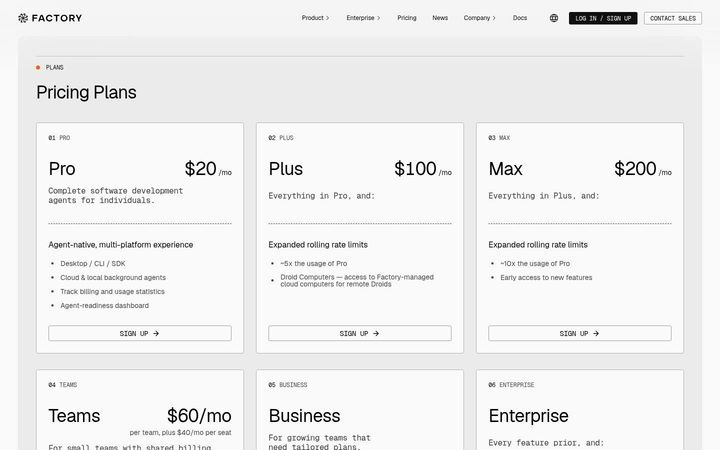
$20/moFactory sells its software development agents as six numbered plans: three individual subscriptions at $20, $100 and $200 a month, a Teams plan at $60/mo per team plus $40/mo per seat, and Business and Enterprise shaped with sales. The individual ladder is one rate sold in three sizes: Plus is "~5x the usage of Pro" for five times the price and Max is "~10x the usage of Pro" for ten times, so every step holds at $20 per multiple of Pro. A five-question FAQ now opens on model support and names the billing edges a buyer checks, from using your own keys to exceeding limits.

Figma
$3/seat/moFigma prices a matrix: four plans, Starter, Professional, Organization and Enterprise, by three seat types, Full, Dev and Collab, with every price printed down to Enterprise at $90/mo for a Full seat. Each seat carries a monthly allotment of AI credits, which makes a credit pool attached to each seat the second layer of the model.
Fivetran
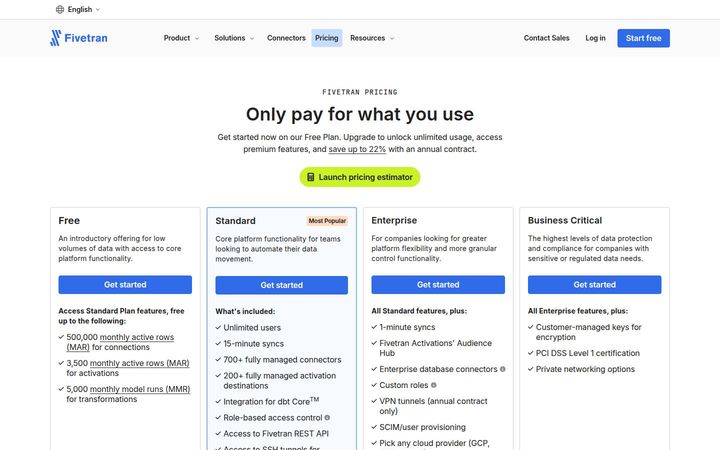
QuoteFivetran meters three products, Connections, Transformations and Activations, on monthly active rows and monthly model runs, and sells them under one plan with consolidated usage-based pricing. The four plan cards separate capability, and the dollars arrive through a pricing estimator and a worked example that totals four named connectors to $511.15.

Framer
$10/moFramer sells a flat site subscription at $0, $10 and $30 a month and Custom, and layers a monthly AI credit allowance that the buyer picks from a dropdown inside each paid card, with '2× credits first month' on both paid plans. Its comparison table prints overage rates and hard ceilings together, such as '150 then $20 per 100 (700 max)' for pages, so a buyer can model both the next increment and the worst case.
Freshdesk
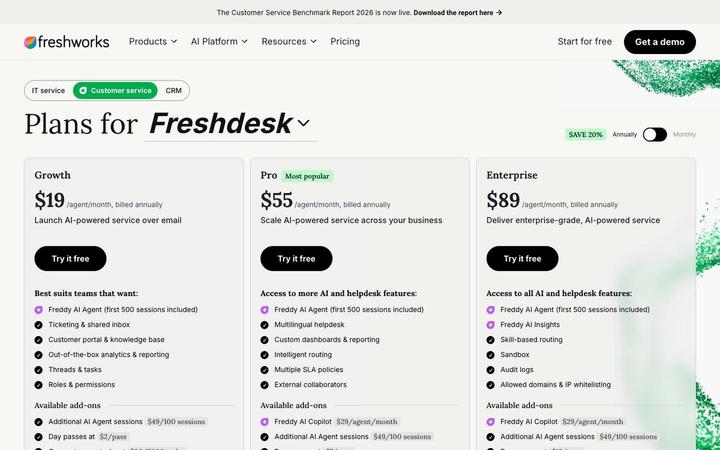
$19/agent/moFreshdesk prices per agent across three plans at $19, $55 and $89 per agent per month billed annually, and puts a metered AI layer on every one: 500 Freddy AI Agent sessions included, then printed rates for more sessions, MCP actions and connector tasks. Each card carries its own add-on list, so the seat, the AI meters and part-time access are priced side by side.

Front
$25/seat/moFront prices three seat tiers at $25, $65 and $105 per seat per month and layers Front AI on top: Copilot at $20 per seat on Starter and Professional, and Autopilot metered at $0.05 per conversation. Every rate is printed, Enterprise included, and Enterprise carries Copilot, Smart QA and Smart CSAT in its seat price, which makes the top tier the home of the full AI suite. External AI agents and Compass are included on every plan.
Gamma
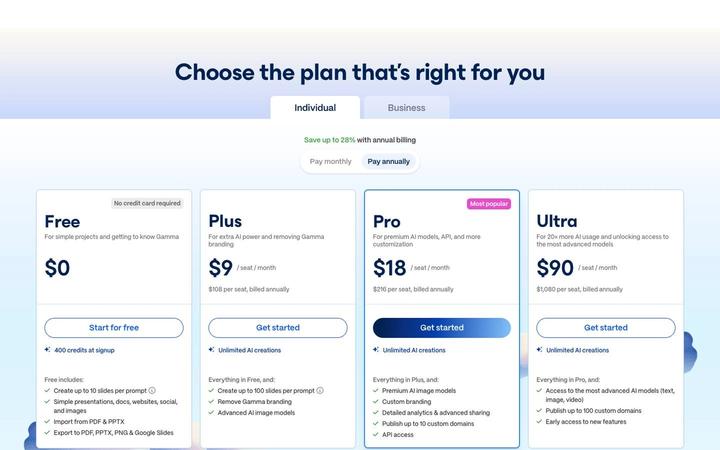
$9/seat/moGamma prices per seat across four plans, $0, $9, $18 and $90 per seat per month on annual billing, and pairs every paid seat with 'Unlimited AI creations' under fair use. Credits run underneath: Free starts with '400 credits at signup', and the footnote states that 'Premium features (Agent, advanced models, & API) require credits'. The page is compact, cards then an eleven-question FAQ, and every plan is bought online.
GitLab
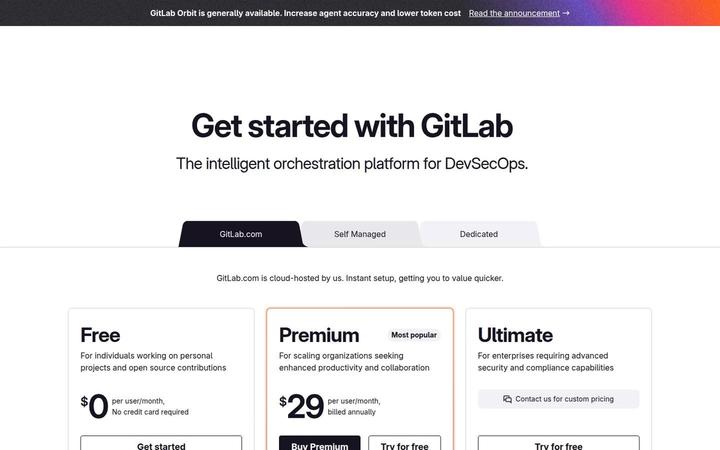
$29/user/moGitLab runs a seat license at its core, $0 Free and $29 per user per month for Premium, with Ultimate set through 'Contact us for custom pricing'. Around the seats sit priced meters for AI, CI, storage and now platform capacity: GitLab Credits at $1 each, compute minutes at $10 per 1,000, storage at $5 per 10GiB and a Coming soon Advanced Capacity add-on at $12,000 per top-level group per year. GitLab Orbit, sold in query packs, and GitLab Flex, one annual commitment for seats and credits, complete a catalog built for agent-scale workloads.
Grafana
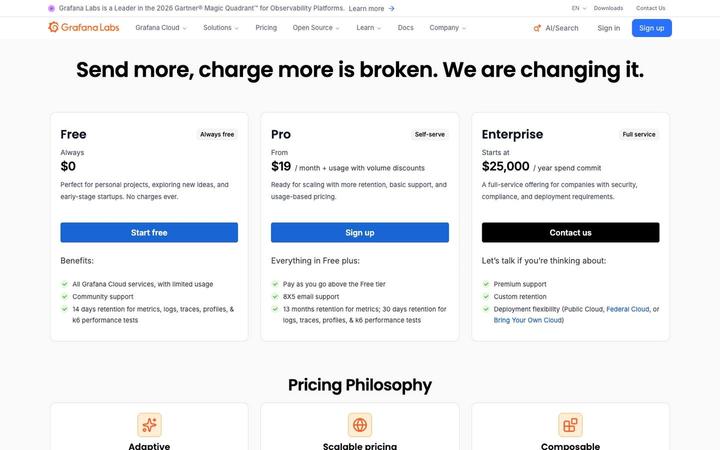
$19/moGrafana Cloud prices on a $19 per month platform fee that carries an allowance on every product, then a usage meter chosen per product, with volume tiers that lower the marginal rate as a customer grows. The hero states the thesis, 'Send more, charge more is broken. We are changing it.', and the page backs it with an embedded calculator that draws the tier curve and a cost-reduction band under the rates. Enterprise prints its entry point: 'Starts at $25,000 / year spend commit'.

Grammarly
$12/seat/moGrammarly sells three plans, Free, Pro and Enterprise, and measures the step between them in AI prompts: 100 a month on Free, 2,000 per member per month on Pro and unlimited on Enterprise. The page is built around the Pro trial, with '$12 USD' struck through beside a 'Try for free' chip and the trial terms written into the card. Enterprise is 'available through Superhuman Go', which places the top plan inside the wider Superhuman platform.

Gusto
$49/mo + $6/person/moGusto prices payroll as a platform fee plus a per-person fee on every plan, from "$49/mo + $6/mo per person" on Simple to "$180/mo + $22/mo per person" on Premium. Below the plans sits a full add-on catalog with a published price for nearly every service, each unit matched to the work it covers: per payment, per payroll, per state, per submission, per participant, or a share of tax credits found.

HashiCorp
$0.10/resource/moHashiCorp prices HCP Terraform per managed resource, a quantity every Terraform user already tracks, and prints each rate twice: '$0.10 per month per resource' with '*Rated hourly at $0.00013 per hour' beneath it. Above the products, a band sets the contract shape first, Pay-as-You-Go, Flex or Enterprise Self Managed, so the page separates how a customer commits from what it buys.
Help Scout
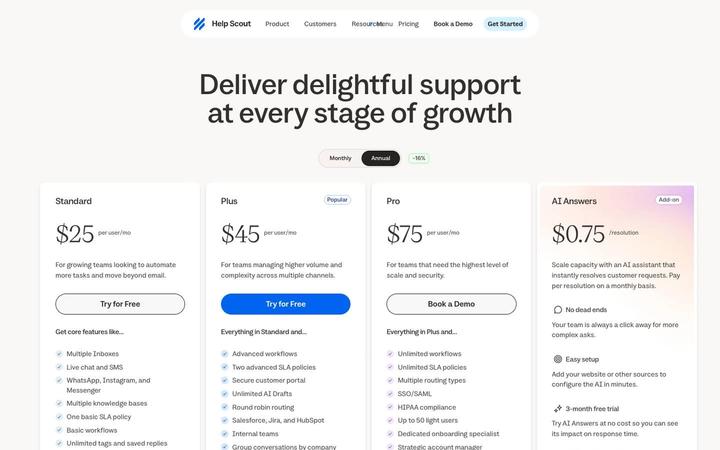
$25/user/moHelp Scout prices the helpdesk per user, Standard at $25, Plus at $45 and Pro at $75 per user/mo on annual billing, and sells its AI agent as a fourth card, AI Answers at $0.75 per resolution. A savings calculator, a monthly spending cap and a 3-month free trial all serve the outcome meter, and a free plan for 5 users sits one line below the cards.

Hex
$36/editor/moHex bills per Editor, "$36 per Editor / month" on Professional and "$75 per Editor / month" on Team, and opens its comparison table with "Unlimited users", so the people who read published apps carry no seat cost. Alongside the seat, AI credits and compute profiles step up by plan, from Limited to Premium credits and from Small compute to advanced compute add-ons, a hybrid of seats for builders and capacity for the work they run.
HeyGen
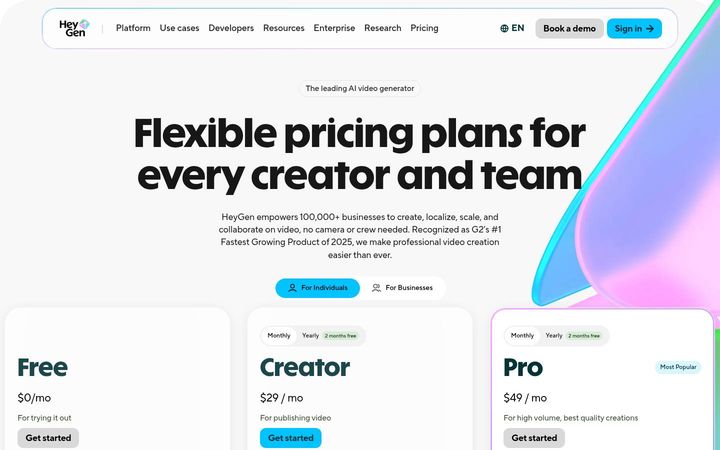
$29/moHeyGen prices AI video on credits, a monthly allocation spent across every feature, and packages its three individual plans around which AI models each one unlocks. Free caps output at '3 videos a month, watermarked', Creator at '$29 / mo' carries '600 credits' and 'Avatar V, with limited usage', and Pro at '$49 / mo' wears the 'Most Popular' badge, opens a dropdown of credit tiers and adds a 'PRO ONLY FEATURES' panel with Seedance 2.5 and Cinematic Avatars.

HubSpot Credits
$10/1,000 creditsA launch page for a pricing model: HubSpot Credits are announced like a product, with the controls around spend as the headline. Three principles, one public rate of $10/1,000 credits, an outcomes-first estimator and four controls customers hold themselves make the case that credits are safe to adopt.
Intercom
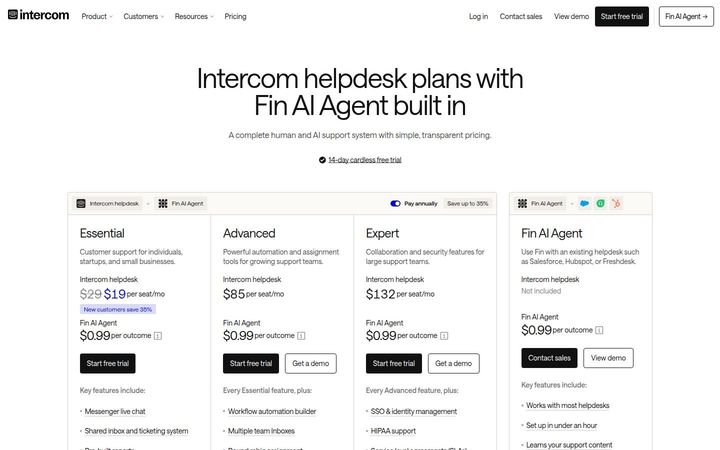
$19/seat/moIntercom prints two price lines on every card: an Intercom helpdesk seat price of $19, $85 or $132 per seat/mo with 'Pay annually' on, and 'Fin AI Agent $0.99 per outcome' for the AI agent's resolved work. A fourth card sells Fin on its own with the helpdesk 'Not included', and a live cost estimator plus a section of outcome rules sit between the cards and the add-ons.

Ironclad
QuoteIronclad sells through a tailored quote and uses its pricing page to lay out the structure of the deal: pick your products, pick your deployment partner, then add extras such as API access, additional instances and an enhanced success plan. The hero names the price drivers outright, 'your products, users, workflows, and growth', and the rest of the page builds the value case with a Forrester study citing a 314% ROI and testimonials that quantify outcomes.

Jasper
$59/seat/moJasper sells two plans: Pro at $59 per seat per month on the yearly term, scoped to one seat with 2 Brand Voices, 5 Knowledge assets and 3 Audiences, and Business at custom pricing with unlimited customization and team features. The FAQ adds the usage layer: GEO Hub reports and Agents 'run on credits, which sit alongside seat-based pricing on the Business plan', a seat-plus-credits model for AI work.

Jira
$8.48/user/moJira prices per user with volume tiers. The page opens with a 'Team size' input and a Monthly or Annually switch that reprice the cards in place: Standard at '$8.48 per user / month' and Premium at '$15.56 per user / month' for the team size entered. Each seat carries automation steps and Rovo AI credits per user per month, and data analysis now runs through the tiers, from 'Cross-source data analysis' on Standard to 'Advanced data analysis' on Enterprise.
Kit
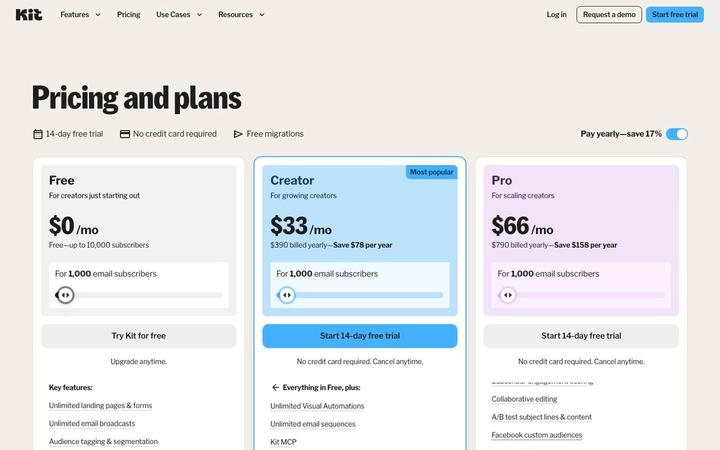
$33/mo for 1,000 subscribersKit prices on email subscribers and puts a slider inside every card, so all three prices move together as a creator drags their list size. Free carries a list of up to 10,000 subscribers, Creator is '$33/mo' and Pro '$66/mo' at 1,000 subscribers, and paid plans sell automation, analytics and team access, so the free plan builds the audience and the paid plans grow the business on top of it.
Klaviyo
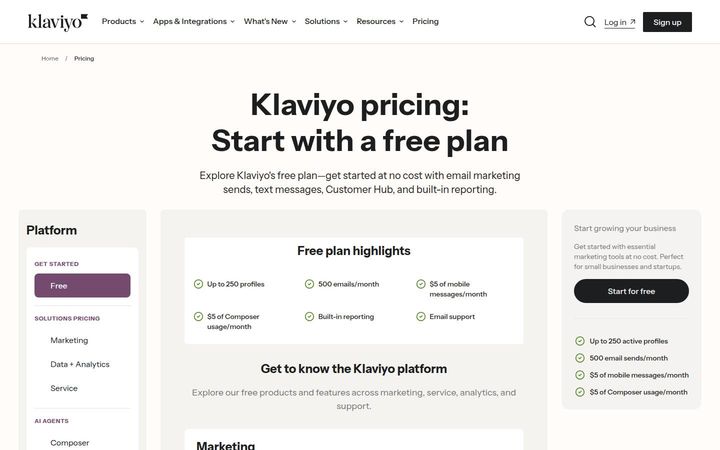
FreeKlaviyo's pricing page opens on 'Klaviyo pricing: Start with a free plan' and presents a single plan in depth: Free, with 'Up to 250 active profiles', '500 email sends/month' and dollar allowances of '$5 of mobile messages/month' and '$5 of Composer usage/month'. A Platform sidebar routes paid pricing to product pages for Marketing, Data + Analytics, Service, Composer and Customer Agent, and a 'Build a plan' button opens the composable path.

LangChain
$39/seat/moLangSmith sells three plans: Developer at $0 per seat, Plus at $39 per seat and a custom Enterprise, with the two self-serve plans followed by 'then pay as you go'. Every service beyond the seat meters in one unit, 'LangChain Standard Units. $1.00 / LSU', at a published rate per resource. A usage calculator built as a stack picker turns those rates into a monthly estimate a buyer can share.

Lemon Squeezy
5% + 50¢Lemon Squeezy prices its merchant-of-record commerce at one rate, '5% + 50¢' per transaction with no monthly fee, and sells email marketing on a separate subscriber meter that is free for up to 500 subscribers. The most interesting thing on the page is a cost table that prices the do-it-yourself stack line by line, so the take rate is read against the whole cost of selling online.
Lob
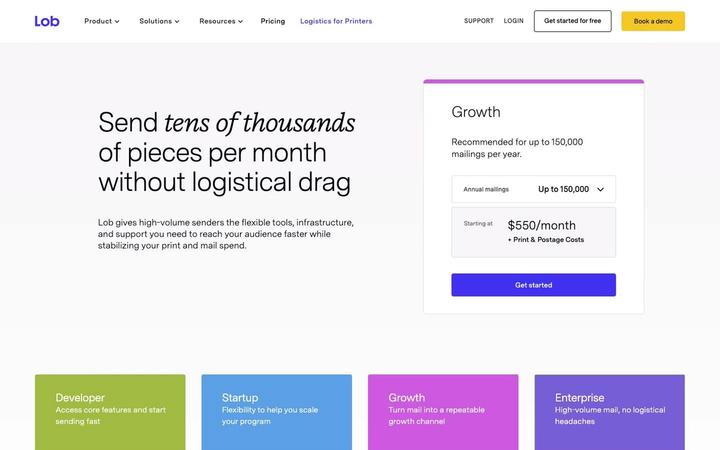
$260/moLob prices direct mail as a two-part bill and says so: a platform subscription from $0 to $550 per month, plus an all-in per-piece rate for print, postage and envelope that falls as the plan rises. A hero volume selector recommends a plan from annual mailings, and per-format rate rows, postcards from $0.905 down to $0.615, let a buyer turn a mail program into a budget.

Loom
$18/user/moLoom prices per user across four plans, and its AI is a tier of its own: Business at '$18 per user / month' and Business + AI at '$24 per user / month', marked 'MOST POPULAR'. Starter is free with '25 videos' and '5 minute screen recordings', Enterprise is a conversation, and a dedicated Loom AI band sells the AI tier between the cards and a long comparison table.
Lovable
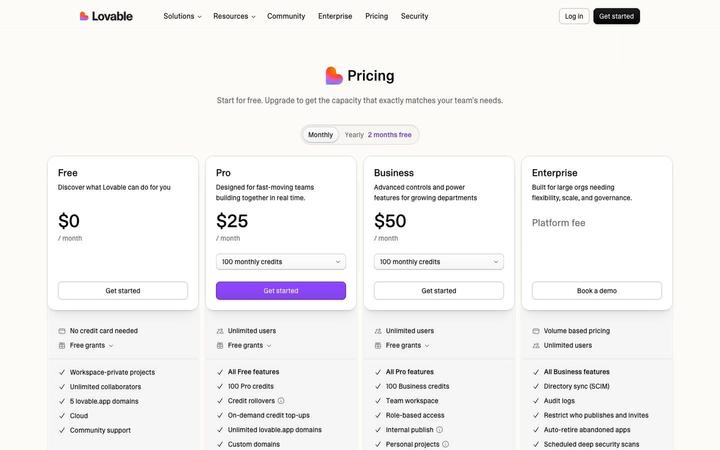
$25/moLovable prices per workspace, not per seat: Pro at $25 / month and Business at $50 / month each carry 'Unlimited users' and a dropdown that sets monthly credits, starting at 100. The tier sets the features and the dropdown sets the capacity, so a team chooses its controls and its volume as two separate decisions, and Enterprise pairs a 'Platform fee' with 'Volume based pricing'.
Mailchimp
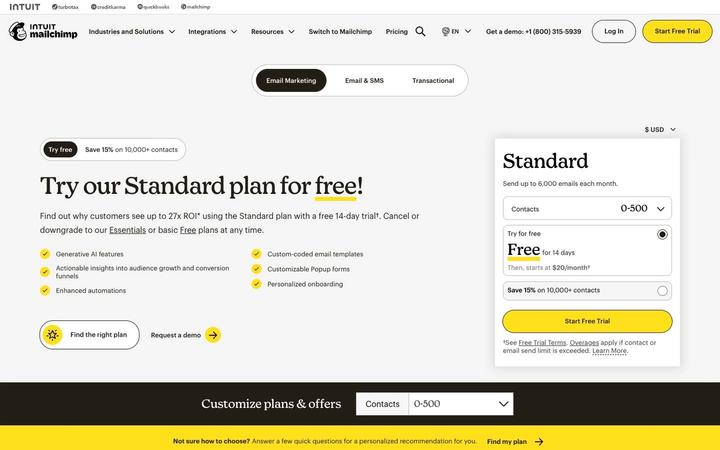
$13/moMailchimp prices email marketing by contact band, twenty of them from '0-500' to '1,000,000+', and sets sending capacity as a multiple of the same number: '15X contacts', '12X contacts' or '10X contacts' a month by plan. The page is built as a trial funnel around Standard, which is the hero offer, the 'Best value' plan and the default 14-day trial.
Mailgun
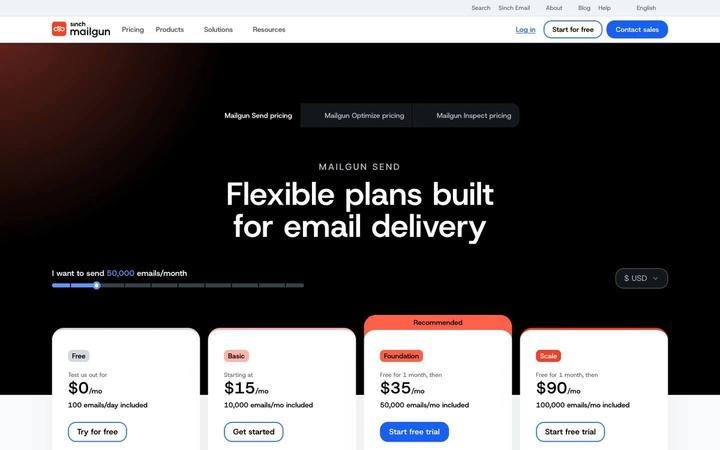
$15/moMailgun sells email sending as prepaid monthly allowances with an overage rate printed on every paid card, falling from $1.80 to $1.30 to $1.10 per 1,000 emails as the commitment rises. A hero slider, 'I want to send 50,000 emails/month', starts the page from volume, and a free month on Foundation and Scale lets a sender try the higher tiers at real volume.

Make
$12/moMake sells credits, one per module action, and lets the buyer set the volume first with a 'How many credits per month?' slider above five plans. Each paid card prints its rate per 1,000 credits, '$1.20' on Core, '$2.10' on Pro and '$3.80' on Teams, so the plans price their features through the cost of a credit rather than a separate platform fee.
Miro
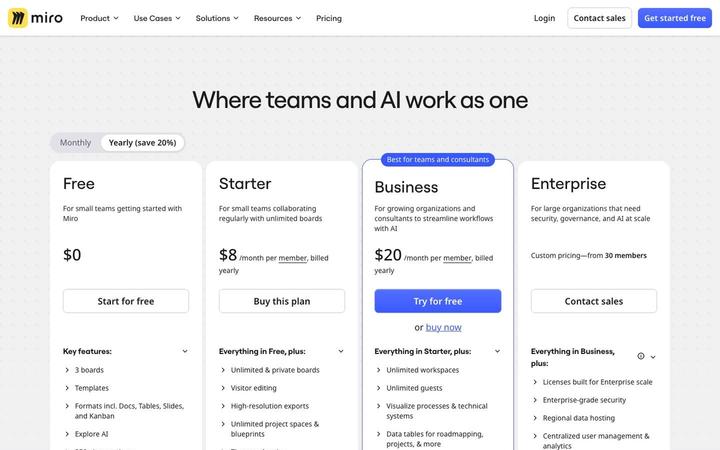
$8/member/moMiro sells seats with AI on top: Starter at $8 and Business at $20 per member per month billed yearly, each adding AI credits per member and a daily allowance of MCP calls for connected AI tools. At Enterprise, from 30 members, the credits become an org-wide pool that 'Starts from 2500 credits per month', a clear view of seat pricing taking on AI usage.
Mistral AI
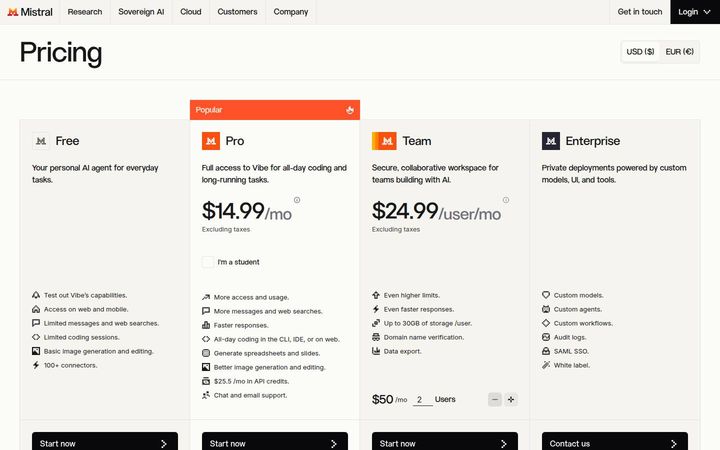
$14.99/moMistral's pricing page sells Vibe through plans that are bands of usage: Free is a capped entry, Pro at '$14.99 /mo' includes '$25.5 /mo in API credits', and Team at '$24.99 /user/mo' adds 'Even higher limits.' and workspace controls. Allowances written as multiples of Free, an included API credit allowance and a pay-as-you-go row tie each subscription to the token meter the FAQ sets out.
Mixpanel
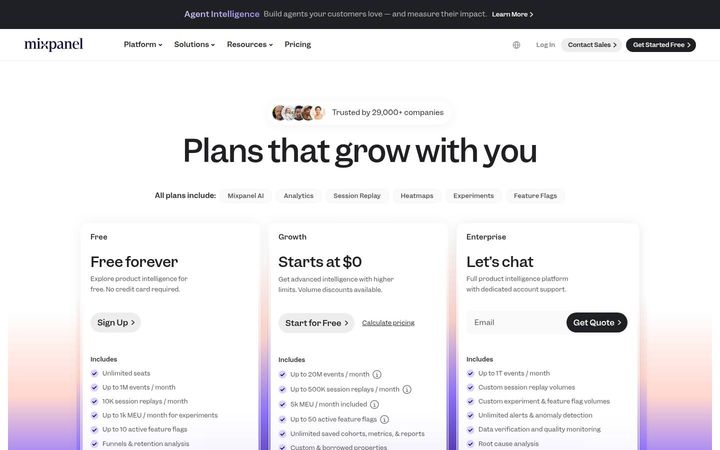
From $0/mo (Growth, first 1M events free)Mixpanel prices product analytics on monthly events, with unlimited seats on every plan, so the bill follows how much a product is instrumented and used, not how many people read the reports. Growth 'Starts at $0' with the first 1M events free, and a slider turns event volume into a dollar figure: '$100 / month' on yearly billing at 1.5M events a month, shown as '18M events per year' with a '$1,200 total annual cost'.

Modal
$250 + compute/moModal bills GPU, CPU, memory and storage by the second or month, and network egress at '$0.04 / GiB', with the full rate card under the promise of paying for 'just actual compute time, by the CPU cycle'. Plans are a platform fee plus that usage: Starter at $0 with $30 of monthly credits and 1 TiB of egress, Team at $250 with $100 and 10 TiB, and a custom Enterprise with 100 TiB. A worked comparison makes the serverless case on utilization, with a $3.95 GPU-hour that totals '12% lower cost' than $3 GPU-hours provisioned around the clock.
MongoDB
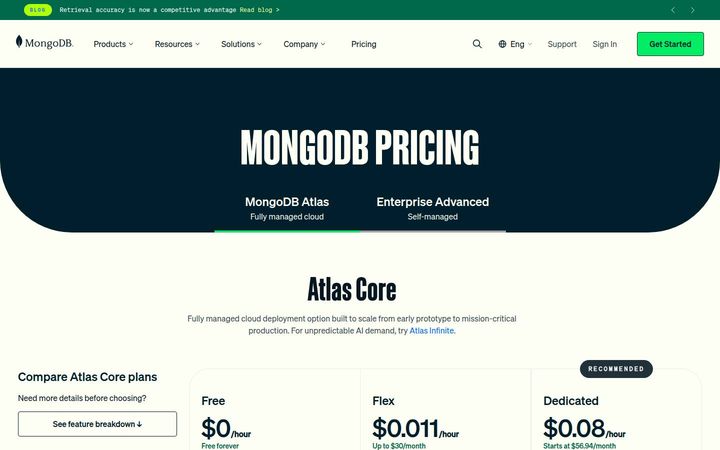
$0.011/hourMongoDB Atlas prices two product lines by the hour, each translated into a monthly figure. Atlas Core keeps Free at $0, Flex at $0.011 an hour with 'Up to $30/month', and Dedicated at $0.08 an hour that 'Starts at $56.94/month', while Atlas Infinite adds a public-preview tier at '$0.09 /hour' that 'starts at $65/month' for elastic AI workloads. Flex remains the design to study, a usage tier with a printed ceiling, and Infinite shows a premium tier layered on the same hourly meter.
Mux
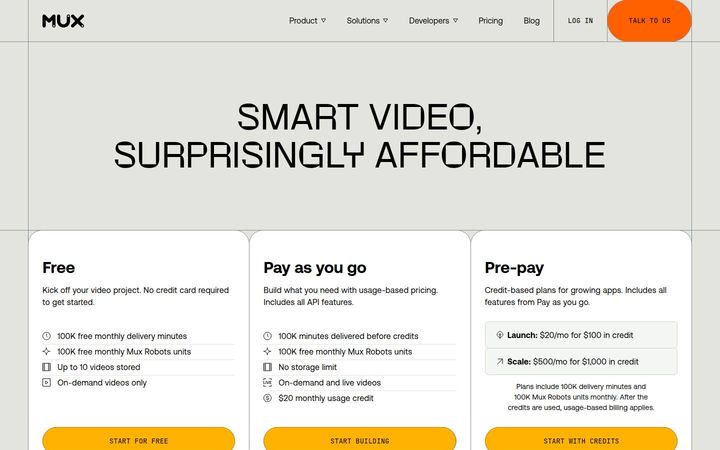
$20/moMux prices video by the minute and teaches the unit on the page: a 'What the minute?' explainer, a scenario switcher for what $100 of credit buys, a full rate sheet and an inline estimator with SHOW ME THE MATH. Every plan includes 100K free delivery minutes and 100K Mux Robots units a month, resolution and quality work as multipliers on one base rate, and a dedicated 'AI workflows (Mux Robots)' list prices thirteen AI jobs by minute, job and, for generated text, artifact.

Neo4j
From $0.09/GB/hrNeo4j AuraDB prices on one metric, provisioned memory, now printed in the unit it is metered in: 'Starting at $0.09 /GB/hour*' on Professional and 'Starting at $0.20 /GB/hour*' on Business Critical. Storage, IO, backups and data transfer ride inside the rate, so a graph database bill is GB times hours times one number, and pausing a database cuts its running cost by 80%.

Neon
$0.106/CU-hourNeon prices serverless Postgres on raw resources, $0.106 per CU-hour and $0.35 per GB-month on Launch, and turns those rates into a budget with a Typical spend figure on each paid card, set by a workload dropdown. Compute scales to zero when idle, so the meter follows real work, and the Free plan states every allowance per project. A rewritten 'Included in every Neon project' section and new FAQ answers on Free plan limits, Claimable Neon and idle compute frame the backend around the database as part of every plan.

Netlify
$9/moNetlify prices its platform in credits and keeps headcount out of the bill: Pro is '$20 /month with unlimited members', and what scales is a monthly credit allowance. Five infrastructure meters, from production deploys to web requests, draw down that one balance, and a dropdown on the Pro card lets a team choose its credit tier from 3,000 to 20,000 a month.
New Relic
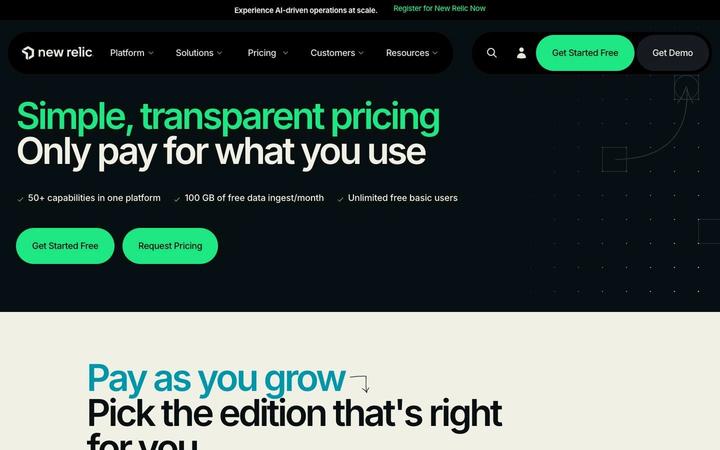
From $10/user/mo + $0.40/GB (Standard)New Relic bills observability on three components: data ingest at $0.40/GB beyond a free 100 GB, users priced by type, and Advanced Compute in compute capacity units. Hosts are free, 'unlimited hosts at no additional cost', so the bill follows the two things that grow with an observability practice, the data flowing in and the people who work with it.
Notion
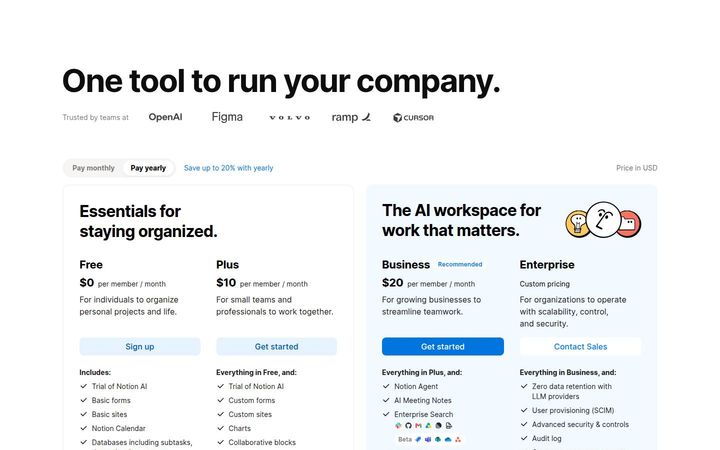
$10/seat/moNotion sells four per-member plans in two framed groups, 'Essentials for staying organized' for Free and Plus and 'The AI workspace for work that matters' for Business and Enterprise, so the line between organizing and AI runs straight through the plan row. AI agents carry their own meter: Custom Agents are 'Free to try, then $10 per 1,000 monthly Notion credits', and the Workers beta runs on the same credits, which lets autonomous work scale apart from seats.

Numeral
$75 per filingNumeral prices sales tax compliance on the work it performs, '$75 per filing' and '$150 per registration', so the bill follows the states a seller files in rather than its transaction volume. A hero guarantee to pay penalties and interest on any late filing stands behind that work, and the FAQ spells out the formula, month-to-month terms and cancellation at any time.
Okta
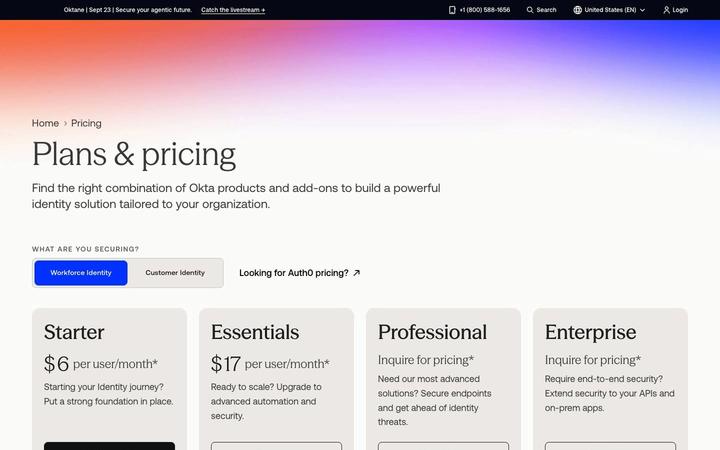
$6/user/moOkta sells Workforce Identity as per-user suites billed annually: Starter at $6 per user a month, Core Essentials at $14, Essentials at $17, and Professional and Enterprise at 'Inquire for pricing*'. Every product in a suite shares one license count, and a catalog of add-ons lets a buyer build out any suite, so the bill grows with headcount and with the depth of identity security a company takes on.

OpenAI
$0.10/1M input tokensOpenAI's API tab is a rate card for four models, GPT-6 Astra, GPT-6.1 Sol, GPT-6.1 Terra and GPT-6 Luna, each priced per million input, cached input and output tokens, from $10.00 down to $0.10 per 1M input tokens. A 'Choose your processing mode' switch reprices every card in place, 'Batch -50%' or 'Data residency +10%', and output runs at five times input on every model.

OpenRouter
5.5% platform feeOpenRouter prices its router as a platform fee on top of pass-through inference: N/A on Free, 5.5% on Standard, 8% on Business, and 'Fee discounts available' on Enterprise. The page opens straight into a four-column comparison table with the fee as its first row, because for a router the margin on other providers' models is the product. Enterprise now sets its BYOK allowance as 'Custom' and carries Private Endpoints as an 'Add on'.
Orb
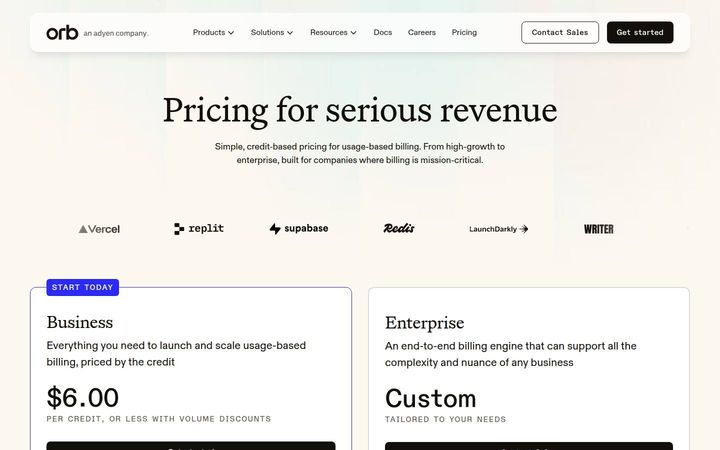
$6.00/creditOrb sells two plans: a self-serve Business plan at '$6.00' 'PER CREDIT, OR LESS WITH VOLUME DISCOUNTS' and a custom-priced Enterprise plan, with an Enterprise Support Bundle sold as an add-on. The FAQ ties the credit to the meter, 'The cost of 1 credit works out to 0.60% of billing volume, plus event ingestion and other metered dimensions', so Orb's revenue still grows with the revenue its customers bill.

Paddle
5% + 50¢Paddle prices its merchant-of-record service as one line, '5% + 50¢ per Checkout transaction', and a Custom pricing card for larger sellers. Because Paddle becomes the legal seller on every sale, that rate carries payments, subscription billing, sales tax and VAT compliance, fraud protection and chargeback handling, and the 'What's included?' grid lays out the whole bundle.

Perplexity
$34/seat/moPerplexity's Enterprise view prices per seat with a credit allowance attached to each one: Enterprise Pro at '$34 / month per seat when billed annually' with '500 monthly Computer credits/seat', and Enterprise Max at $271 with '15,000 monthly Computer credits/seat'. A third card for 'Additional security and governance' reads 'Custom pricing', and an organization can mix Pro and Max seats in one account.

Pipedrive
$14/seat/moPipedrive sells four per-seat plans, Lite at US$ 14 through Ultimate at US$ 79 per seat per month billed annually, and every card leads to the same 'Free 14-day trial. No credit card required.' Packaging stacks cleanly, each plan opening with the one below it plus a short list, and five add-ons with 'Starting from' prices, Projects now at $16, extend any plan without moving the buyer up a tier.
Plaid
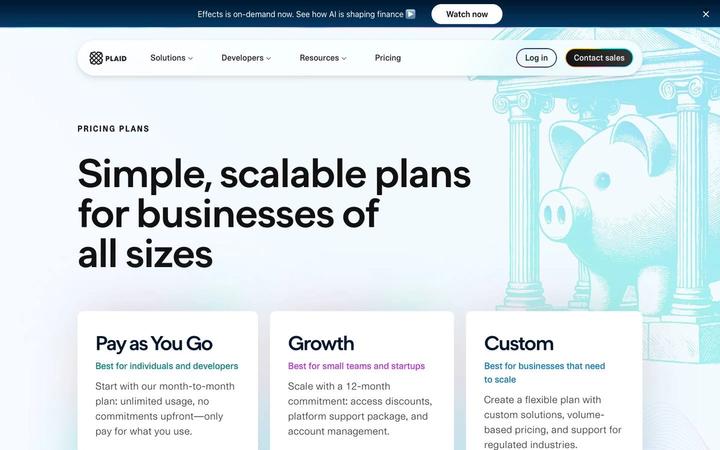
QuotePlaid sells three plans defined by contract shape: Pay as You Go month to month, Growth on a 12-month commitment with 'Discounted product rates', and Custom with 'Volume discounts' and support for regulated industries. Rates are set per product and per customer, and the FAQ names the three billing models behind them: one-time per connected account, subscription per connected account, and per successful API call.

PostHog
From $0.000198/event (after 1M free)PostHog prices a suite of developer tools as one signup with two states, Free and Pay-as-you-go, and a monthly free allowance on every product. Each product meters in its own unit, from 1M analytics events to 10 GB of logs, with per-unit rates such as '$0.000198 each after the first 1M' and a Logs custom retention rate of '$0.05' per GB for every month kept. 'Set billing limits' is the primary button on the paid card.

Postman
$9/moPostman sells seats with AI credits attached: Free at $0, Solo at $9 a month and Team at $19 per user a month billed annually, with Enterprise set through 'Contact sales for pricing'. Overage steps down by plan, from '$0.05 / credit' on Solo to '$0.035 / credit (volume pricing available)' on Enterprise, and a new Context Graph meter adds included API queries on every plan, then '$0.01 / query'.
Qdrant
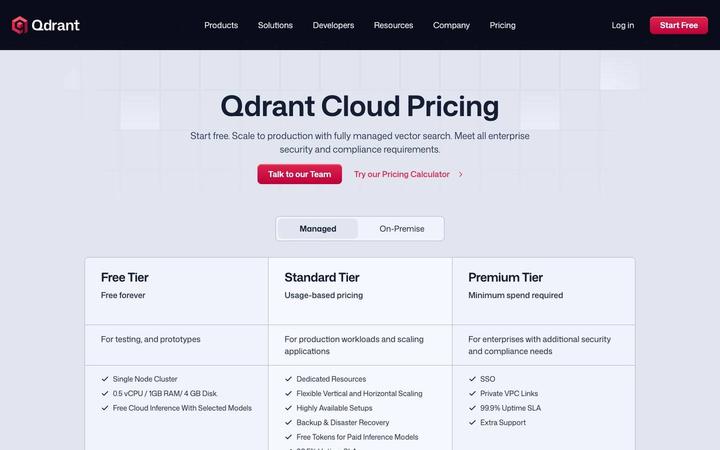
QuoteQdrant Cloud bills on the resources a cluster consumes, metered hourly across compute, memory, storage, backups and paid inference tokens. The page sells the shape of the deal: a free tier stated as hardware, a usage-based Standard tier and a Premium tier with a minimum spend, with dollar figures handed to a dedicated pricing calculator.
Railway
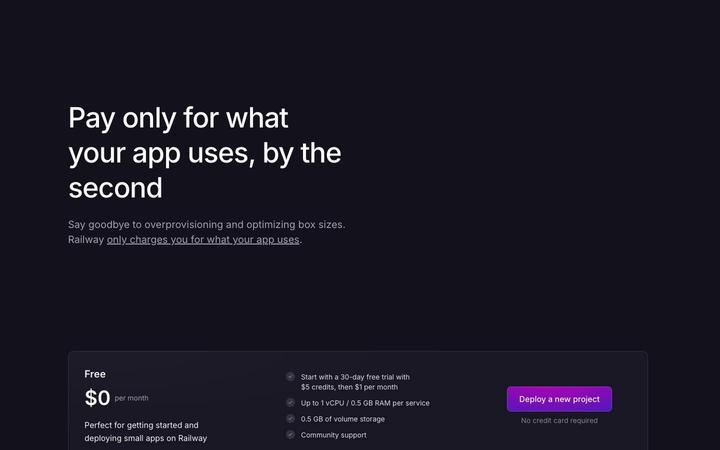
$5/mo minimum usageRailway bills compute by the second and wraps that meter in plans defined by a minimum usage floor that comes back in full as credits: '$5 minimum usage' on Hobby and '$20 minimum usage' on Pro. Further down, an 'Unlock more as you grow' ladder turns enterprise features into published monthly commitments, from $1,000 for HIPAA BAAs to $10,000 for Dedicated VMs.
Ramp
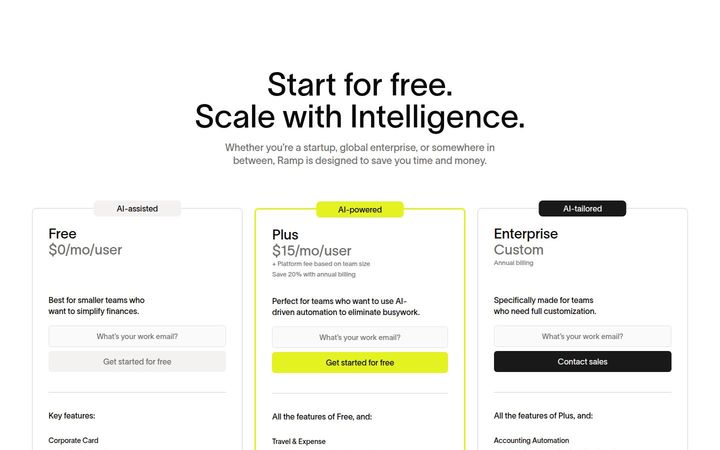
$15/seat/moRamp prices spend management per user with a platform fee on top: Free at '$0/mo/user', Plus at '$15/mo/user' plus a 'Platform fee based on team size', and a custom Enterprise. The Free column now carries Accounts Receivable alongside unlimited cards, bill pay and banking yield, while revenue recognition and recurring billing sit behind an 'Accounts Receivable Add-on'.

Remote
$29/employee/moRemote prices per person employed or paid, and the rate climbs with how much legal responsibility Remote carries: $29 per month to run payroll or manage a contractor, $99 for a US PEO employee or a contractor with indemnity, $325 for a contractor of record and $599 for an employee of record. Six products each print a 'Starting at' price, every card leads to 'Book a demo', and each one closes on the same line, 'Remote Platform included, no base fee'.
Render
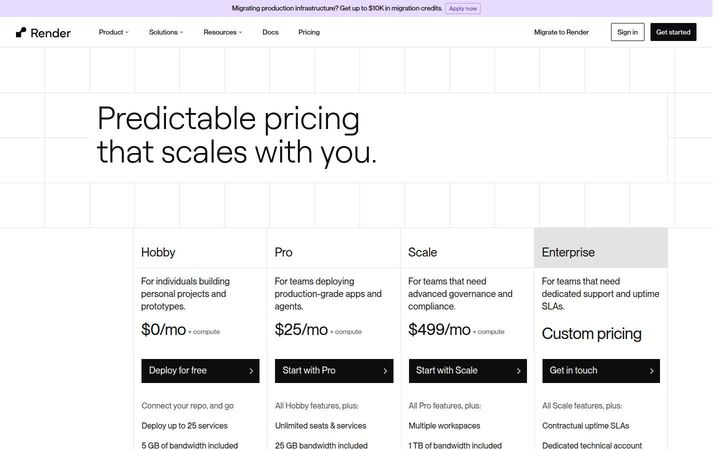
$25/mo + computeRender prices in two layers: a flat workspace plan, from '$0/mo + compute' on Hobby to '$499/mo + compute' on Scale and 'Custom pricing' on Enterprise, and per-service compute printed as rate tables for each service type. The newest table, Sandboxes BETA, meters '$0.12 / active CPU hour' plus an hourly memory rate, and the workspace plans set how many sandboxes run at once and for how long.

Replit
$18/mo (billed annually)Replit sells subscriptions that carry a dollar allowance for AI models, '$20 towards more powerful models' on Core and '$100 towards most powerful models' on Pro, with metering behind it on Effort-Based Pricing. The Pro card holds a credit dropdown that steps from '$90 / month' to '$2,000 / month', and the Enterprise card reads as a governance package led by 'SSO, SCIM & audit logs'.
Resend
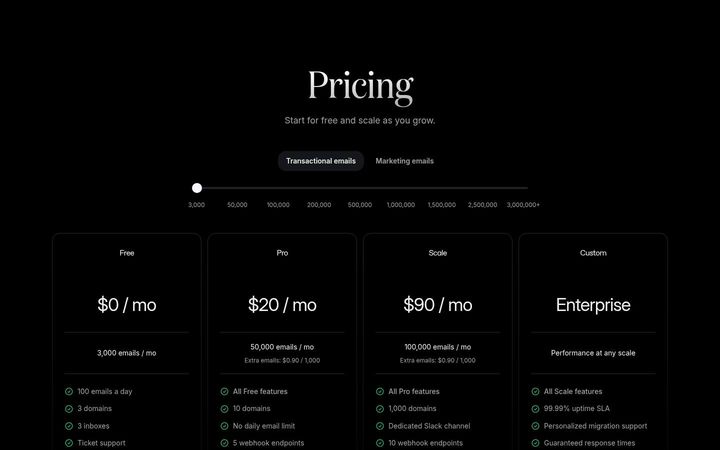
$20/mo (50,000 emails)Resend sells email volume in monthly quotas, '$0 / mo' for 3,000, '$20 / mo' for 50,000 and '$90 / mo' for 100,000, with one overage rate, 'Extra emails: $0.90 / 1,000', printed on both paid cards. Overage is opt-in through 'Enable pay-as-you-go' switches that now cover three meters, emails, automation runs and inboxes at '$1 / inbox', and a volume slider above the cards points each buyer to the tier that fits.

Retool
$10/builder/moRetool prices two seat types as a sum on each card, $10 a month per builder plus $5 a month per internal user on Team and $50 plus $15 on Business, and layers workflow runs, pooled AI credits and agent hours on top. The cards read as aligned checklists of included and not-included features, and the comparison table publishes the secondary meters, from an external user volume curve to additional workflow runs at '$75 per 5,000 runs per month'.
Rippling
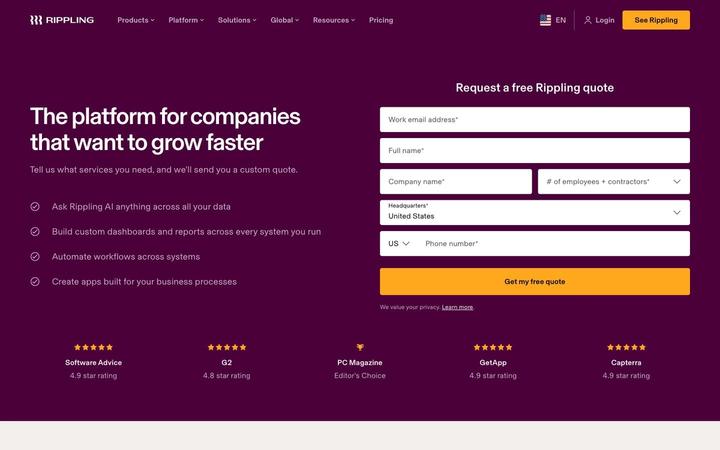
QuoteRippling's pricing page is a quote request: 'Tell us what services you need, and we'll send you a custom quote.' The form asks for headcount in five bands and a headquarters country, the two inputs a modular HR, IT, payroll and finance suite needs to build a price, and the page backs the ask with third-party ratings and named customer results.
Runway
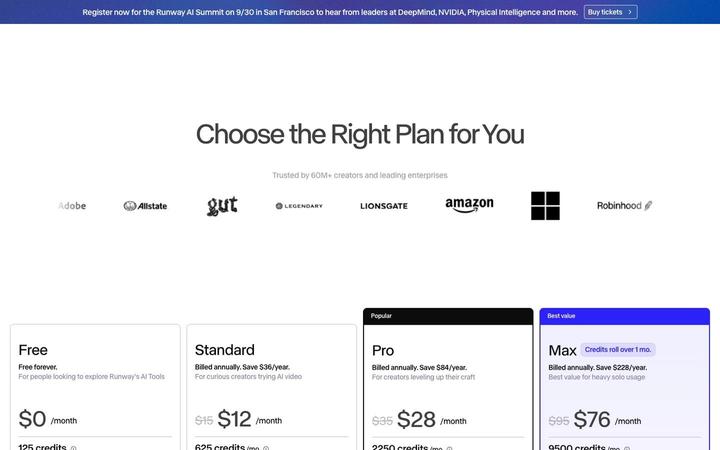
$12/moRunway sells monthly credit allowances on four individual plans, Free, Standard at $12, Pro at $28 and Max at $76 a month billed annually, and translates every allowance into output on the card: '625 credits monthly = 52s of Gen-4.5, 104s of Gen-4 Turbo, or 78 Gen-4 Images (1080p).' One credit currency covers Runway's own models and partner models such as Kling, Seedance and Nano Banana Pro.
Salesforce
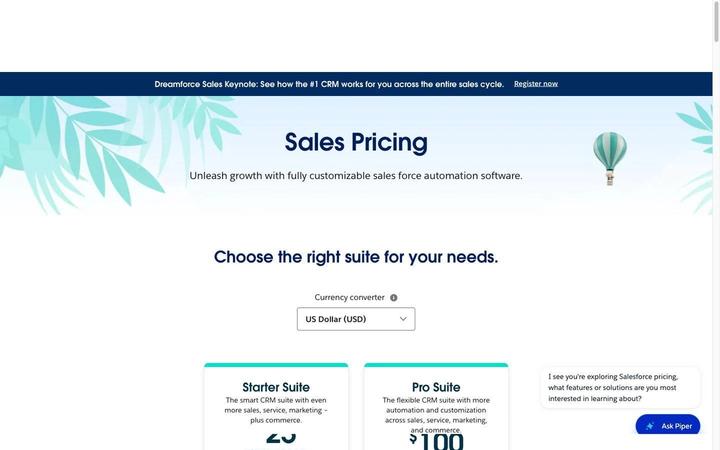
$25/user/moSalesforce prints a per-user list price for every Sales Cloud edition, from Starter Suite at $25 to Max at $550 USD/User/Month, then prices the layers around the seat: add-ons with 'From' floors, a Premier Success Plan at '30% of net license fees', and '2.75M Flex Credits per org per year' on Max. The seat stays the core metric while AI arrives as a consumption meter alongside it.
Sanity
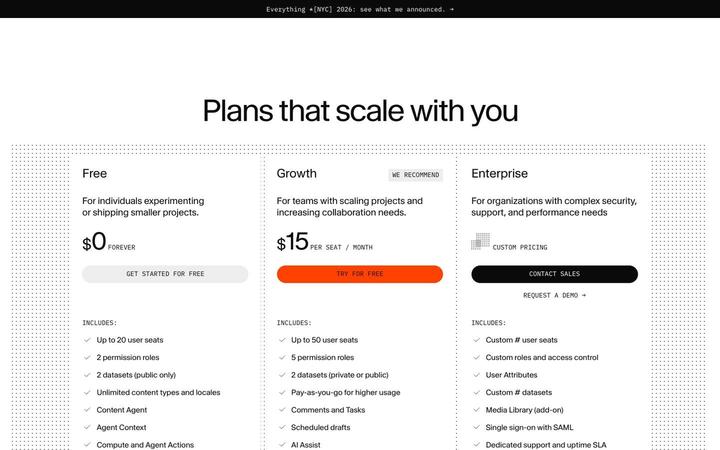
$15/seat/moSanity charges '$15 PER SEAT / MONTH' on Growth and meters the content platform underneath: documents, API requests, bandwidth, assets, embeddings, AI credits, functions and compute each carry a printed overage rate in the comparison table. Seats price the editorial team, usage prices the delivery workload, and three add-ons price support, quota and datasets as fixed monthly blocks.

Segment
QuoteTwilio Segment's Customer Data pricing page is a router between two products: a Customer Data Pipeline built on Connections, priced on its own plans page, and a Customer Data Platform that adds Unify and Engage and is quoted by sales. The metric is Monthly tracked users, set as 'Custom volume' on both offers with unlimited seats, which keeps every Platform deal open to shaping around the customer's audience size.
Shopify
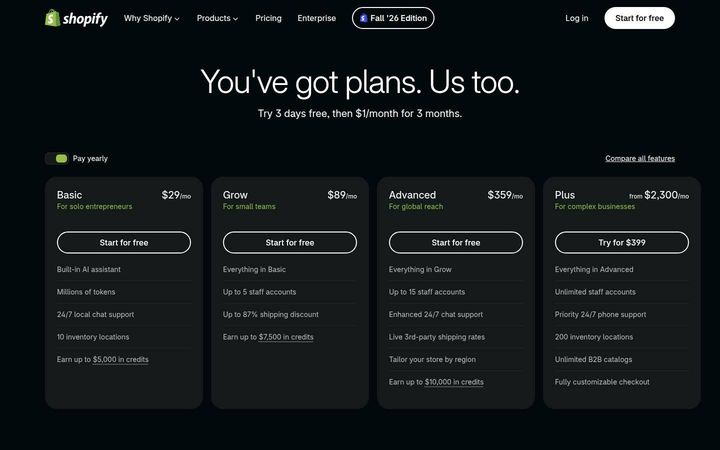
$29/moShopify sells four flat monthly plans on yearly billing, Basic at $29/mo, Grow at $89/mo, Advanced at $359/mo and Plus from $2,300/mo, and pairs each with a payment take rate that falls as the plan fee rises, from 2.9% + 30¢ down to 2.25% + 30¢. The cards sell operations, staff accounts, support level and inventory locations, while the comparison table carries the full rate card, so the plan decision blends team size with sales volume.
Slack
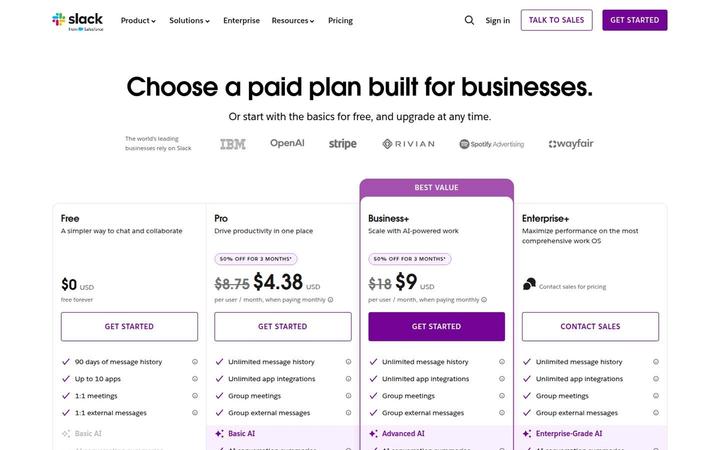
$8.75/user/moSlack sells a four-plan per-user ladder, Free, Pro at $8.75 and Business+ at $18, with Enterprise+ priced through sales, and names an AI band on every paid card: Basic AI, Advanced AI and Enterprise-Grade AI. A launch offer of 50% off for three months brings Pro to $4.38 per user per month for the first quarter, and the comparison table closes with Success Plans, three support levels that are included or sold as add-ons by plan.
Snyk
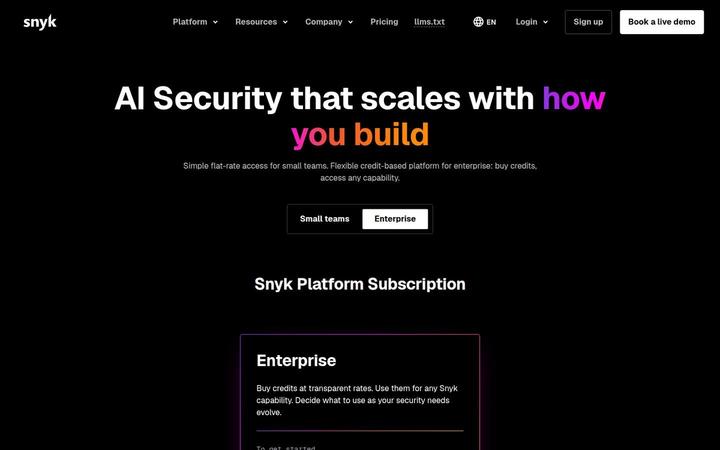
$1/creditSnyk now presents its platform as one Enterprise Snyk Platform Subscription bought in prepaid credits, where '1 credit = $1' and a Platform Rate Card prices each capability in its own unit, from 'per Active Contributor / per Day' to 'per Assessment'. A Small teams tab sits beside it, and the page is built to explain the credit pool step by step: buy credits, use any capability, read the rate.

Socure
$0.80 per evaluationSocure prices identity verification per evaluation, and each evaluation is a bundle of named checks: $0.80 for document verification, $0.90 with a watchlist screen, $1.00 for KYC, fraud and watchlist with a document step-up, and $1.30 with prefill added. Socure Launch tops that with $1,000 in free credits every month, and Socure Enterprise moves to volume and spend-based pricing for the full RiskOS platform.
Square
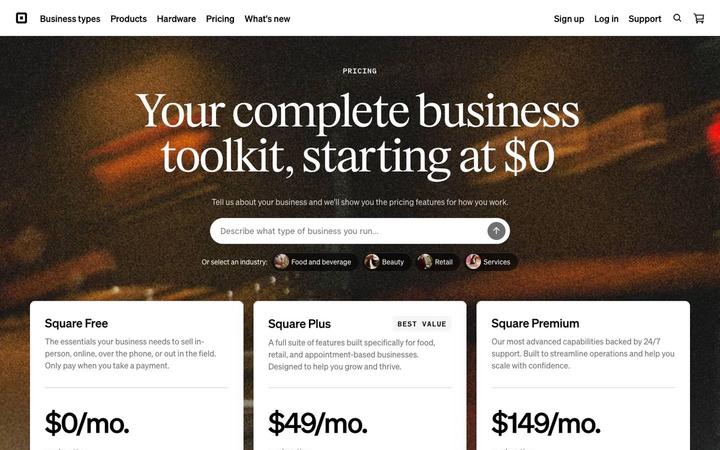
2.6% + 15¢Square sells a software subscription and a processing rate as one package: Square Free at $0, Plus at $49 and Premium at $149 per month per location, each card printing its own in-person and online rates under the price. The subscription buys software and basis points together, and a printed threshold of $250,000 a year marks where custom pricing begins.
Squarespace
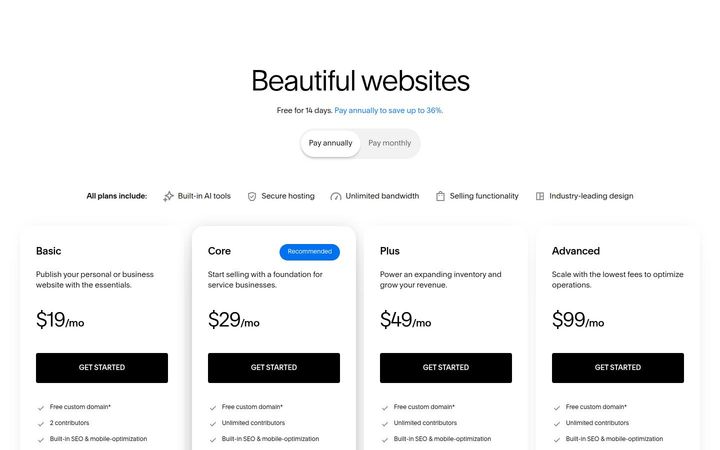
$19/moSquarespace sells four flat plans at $19, $29, $49 and $99 a month with Core recommended, and each card pairs the subscription with a falling card rate, from 2.9% + $0.30 down to 2.5% + $0.30, and a growing AI credit allowance, from 10 one-time credits to 120 a month. Higher plans buy down the share Squarespace takes on sales and add commerce tools, and every plan is bought online through the same 'GET STARTED' button.

Statsig
$150/moStatsig prices its whole product suite, experimentation, flags, analytics and session replay, on one meter, Metered Events, and includes unlimited seats. Developer is free with 2M events a month, Pro is $150 a month with 5M events and $0.05 per 1K after that, and Enterprise moves to event or experiment based contracts. The FAQ states the philosophy behind it: charge for what costs Statsig money and creates value for the customer.
Storyblok
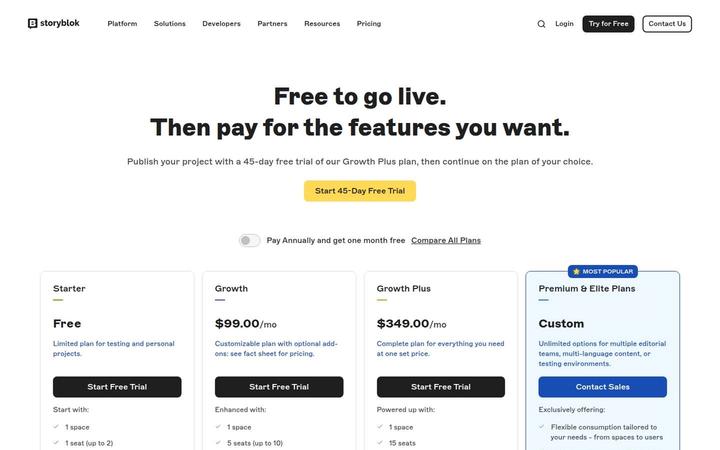
$99/moStoryblok prices its headless CMS as a base plan plus five meters, seats, traffic, API requests, locales and AI credits, and each card prints the allowance with its ceiling. Growth at $99.00 /mo is a 'Customizable plan with optional add-ons: see fact sheet for pricing.', Growth Plus at $349.00 /mo is a fixed bundle positioned as 'Complete value', and the 'MOST POPULAR' star sits on the custom Premium & Elite plans.

Stripe
2.9% + 30¢Stripe sells payments through two doors: Standard at 2.9% + 30¢ per successful domestic card transaction with no setup or monthly fees, and Custom for large volume with IC+ pricing, volume, multi-product and country-specific rates. Below them, every product in the platform carries its own rate card, with surcharges printed as additions to the base rate, so any scenario can be priced as a sum.

Suno
$8/mo billed yearlySuno sells music generation on credits, with three plans that pair a credit allowance with download counts and commercial rights. Free refills '50 credits per day', Pro at '$8 /month' carries '2,500 credits per month' and the 'MOST POPULAR' badge, and Premier at '$24 /month' carries '10,000 credits per month' and Suno Studio, with annual billing selected by default at 'SAVE 20%'.
Supabase
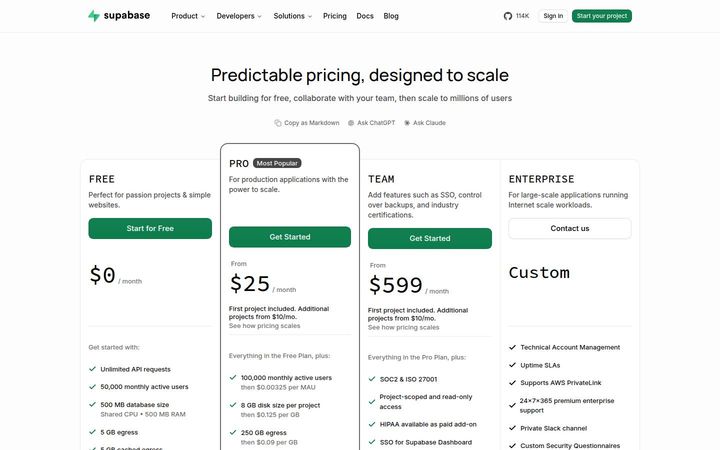
From $25/moSupabase prices its Postgres platform as a plan fee plus metered usage: Free at $0, Pro from $25 a month, Team from $599 and Enterprise on contact, with every metered line on the Pro card printing the included quota and the rate beyond it. Compute is a published ladder from Micro at $10 to 16XL at $3,730, a $10 monthly credit covers the first instance, and logs are now metered too, with Log Ingestion at '20 GB included then $0.50 per GB' on paid plans. A spend cap on by default makes 'Predictable pricing, designed to scale' a literal promise.

Synthesia
$14/moSynthesia sells AI video on a credit pool that sits on top of a free monthly allowance, and every paid card converts its credits into minutes of video, minutes of dubbing, survey responses and Syren videos. Basic is $0 with 500 credits a month, Starter is $14/mo ($168 billed yearly) with 15,000 credits a year, Pro is $59/mo ($708 billed yearly) with 72,000 credits a year at a selectable credit level, and Enterprise moves to custom credit volumes. The cards lead straight into a 'Compare plans' table, an API pricing band and an Enterprise block.
Temporal
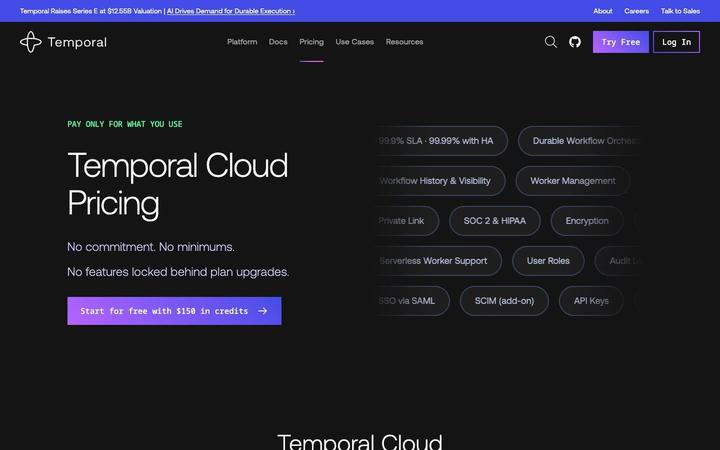
$50/M actionsTemporal sells Temporal Cloud on one meter, the Action, and prints both ends of the self-serve curve: 'STARTING AT $50 per million actions' and 'SELF SERVICE DOWN TO $25 per million actions', with storage priced separately for open and closed workflows. Every feature comes with every account, stated in the hero as 'No features locked behind plan upgrades', so the commercial levers are volume and support, and support is priced as a share of usage.
Tinybird
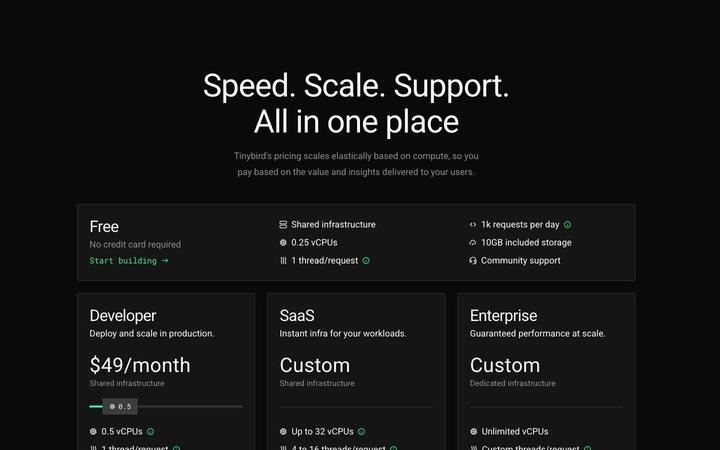
$25/moTinybird prices managed ClickHouse on compute, and the vCPU slider inside the Developer card puts that metric in the buyer's hand: the card reads $49/month at 0.5 vCPUs and moves as the slider does. Around compute sit flat unit rates that hold across every paid plan, storage at $0.058/GB and three egress rates, with vCPU overages at $0.0002/second on Developer and SaaS, while SaaS and Enterprise are priced as Custom with a yearly commitments discount.

Twilio
$0.0083/segmentTwilio's US SMS page is a rate sheet built in layers under the headline 'SMS and RCS pricing built to break even fast': $0.0083 per segment for SMS on every number type, carrier fees passed through per carrier, and a monthly lease for the number itself. The page says outright that 'Phone number charges are added to your message volume and carrier costs for your total price', and each layer is published down to a $0.001 processing fee keyed to a message's final status, a 'Pricing current as of October 2026' stamp, and a Traffic Optimization Engine 'Starting at $300 /month'.
Upstash
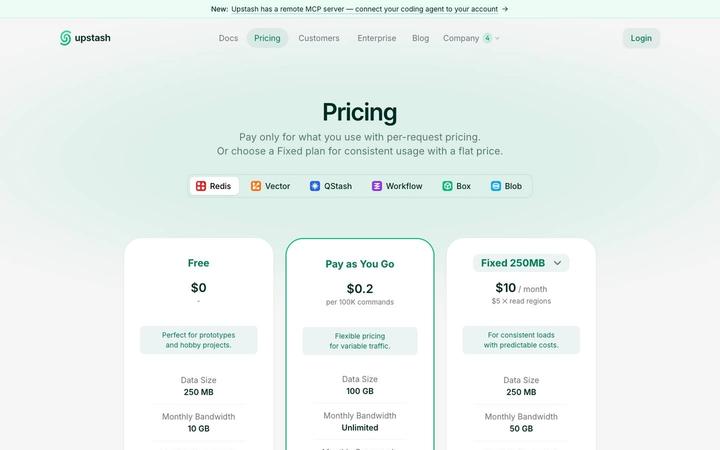
$0.2/100K commandsUpstash prices Redis two ways side by side: 'Pay as You Go' at '$0.2 per 100K commands' for variable traffic, and Fixed plans picked from a size dropdown that starts at '$10 / month' for steady loads. Production features sit in a separate 'Prod Pack' at '+$200/month per database', and a long FAQ prints the billing mechanics down to how replicated writes count.
Vercel
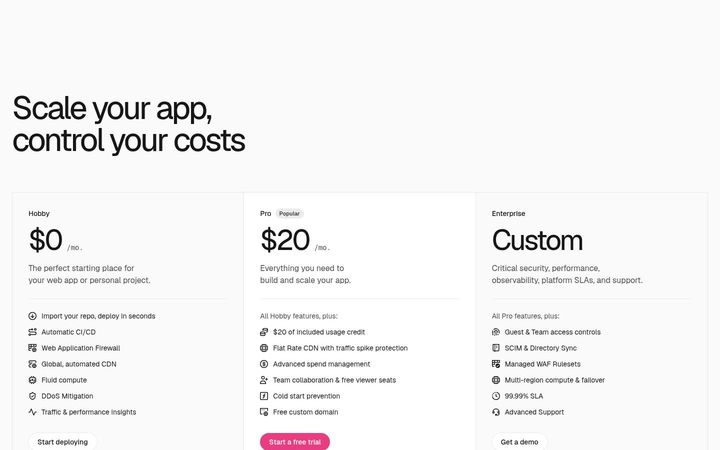
$20/moVercel prices a cloud platform as a seat plus usage: Pro is $20 a month per developer seat and includes '$20 of included usage credit', so the seat fee doubles as a usage allowance before metered rates apply. Beneath three plan cards sits a full rate card in which every metered resource prints its included quota and its overage price on the same row, from CDN Requests to build minutes, and it now extends to Vercel Drives, Vercel Daemons, Deployment Storage and Tracing Spans.
Warp
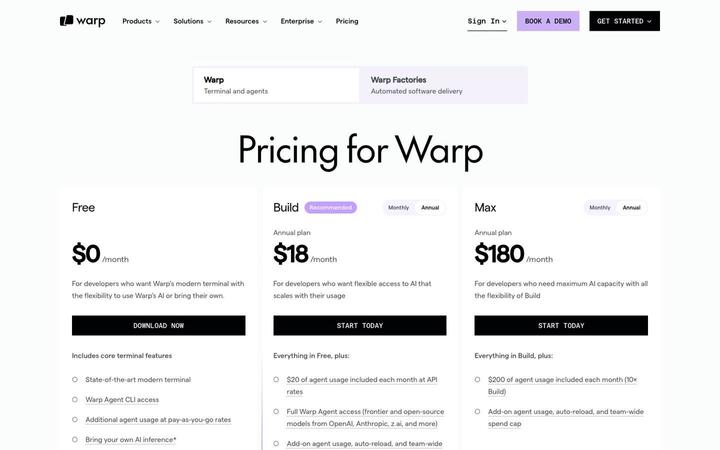
$18/moWarp prices AI work as a dollar balance converted to credits: Build at $18 a month includes '$20 of agent usage included each month at API rates', Max at $180 includes $200, and Business at $45 per user includes $20 per seat. The free plan keeps the terminal and opens AI through pay-as-you-go top-ups or the buyer's own inference, so the subscription prices access and the credits price the agent's work.

Weaviate
From $45/moWeaviate bills its vector database on total vector dimensions stored, plus storage, backup and data transfer, above a $45 monthly minimum on Flex, with Premium's floor now set with sales. The three plans are three ways to buy, labeled Forever, Pay-as-you-go and Prepaid contract, and a dated 'Weaviate Cloud pricing update: September 2026' FAQ explains a rebased backup rate and a new RQ-4 compression price.

Webflow
$15/site/moWebflow prices per site: Starter is free, Basic is $15/mo and Premium $25/mo billed yearly, and Platform plans begin with Team at $2,500/mo on an annual contract before a custom Enterprise. Premium carries a bandwidth dropdown from 50 GB to 2.5 TB, and the add-ons are metered on their own units, page views, sessions and locales, so traffic and reach set the bill alongside the plan.
Weights & Biases
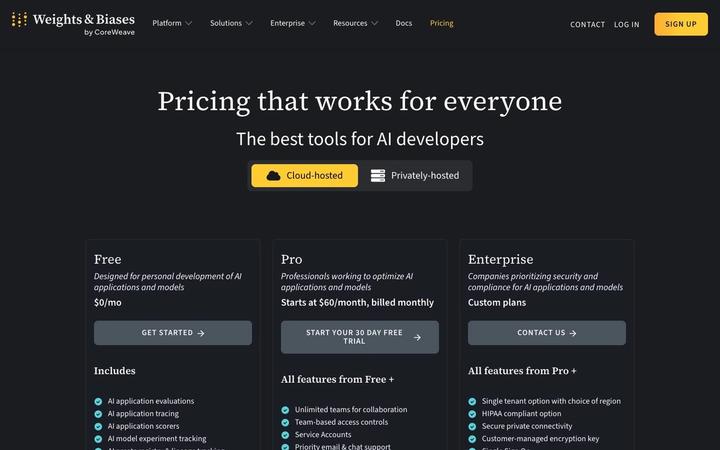
From $60/moWeights & Biases pairs seats with usage: Pro 'Starts at $60/month, billed monthly' with up to 10 Model seats, then storage at $0.03/GB above 100 GB and Weave data ingestion at $0.10/MB above 1.5 GB a month. The model splits the seat by workload, Model seats for training and fine-tuning and Weave seats for GenAI applications, and a Cloud-hosted and Privately-hosted toggle settles deployment before any price appears.
WorkOS
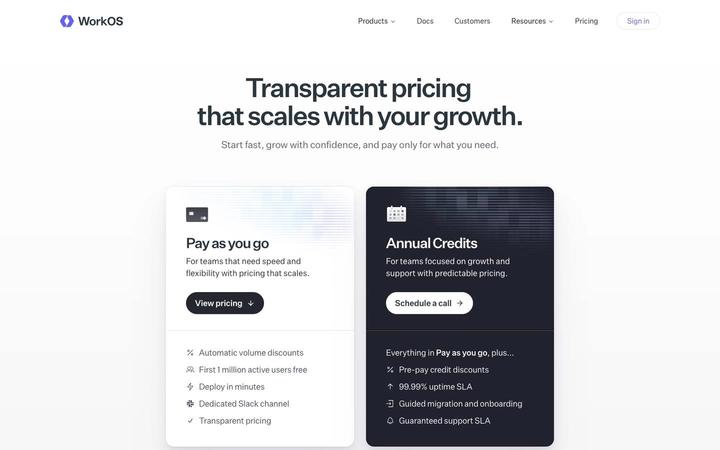
$125/connection/moWorkOS turns its pricing page into a live estimator: six product modules, each with a slider, a rate panel and a running monthly total. SSO and Directory Sync are priced per connection, $125 each and falling to $65 at 51 to 100 connections, and AuthKit is free to 1 million monthly active users, so the meter is the enterprise customer a WorkOS user has just signed.
Writer
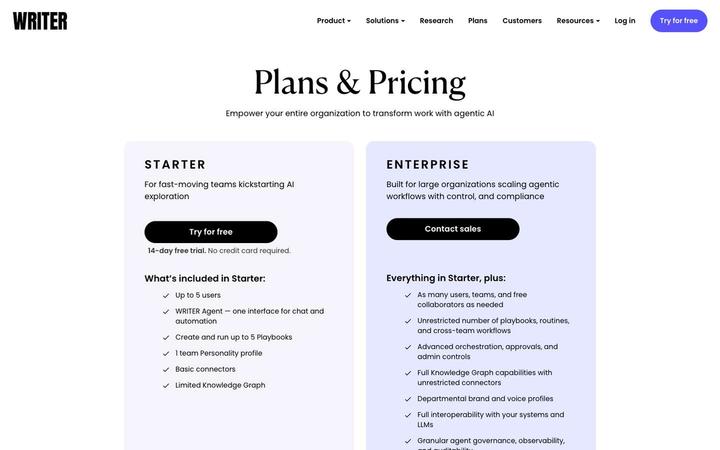
QuoteWriter sells two plans, Starter for a team of up to five and Enterprise for the whole organization, and presents them through capability: two cards, a long matrix in seven blocks and a FAQ that states the model. Per the FAQ, Starter is 'monthly or annual per-seat plans with fixed credit limits', and Enterprise adds unlimited free users, a Lite seat for new users, and solution packs and services as the account grows.
Zapier
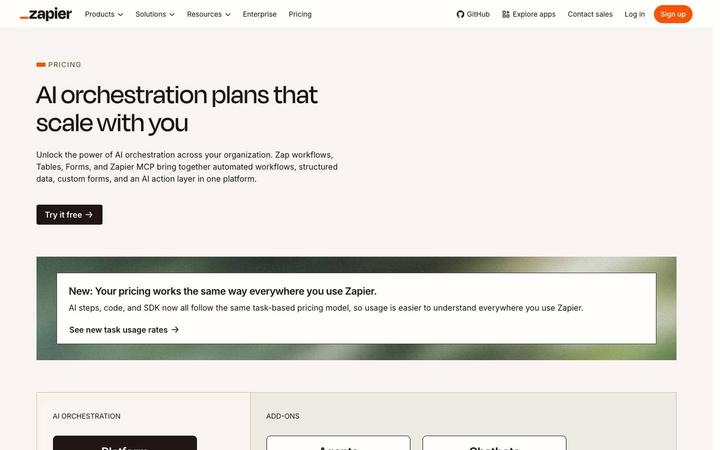
From $19.99/moZapier prices its whole platform on one unit, the task, drawn from a single pool by Zap workflows, AI steps, code, MCP and SDK. A slider from 100 to 2M tasks sits above four plans, Free at '$0 /month', Professional 'Starting from $19.99 /month', Team 'Starting from $69 /month' and Enterprise 'Contact for pricing', and a launch banner announces that AI steps, code and SDK now follow the same task-based model.

Zendesk
$19/agent/moZendesk sells four per-agent plans, from Support Team at $19 to Suite Professional at $115, marked MOST POPULAR, and Suite Enterprise + Copilot through sales, and prints its add-ons at $50, $50 and $83 per agent. Beneath the seat price sits an outcome meter: AI agents come with every plan and bill by the Automated Resolution, a request the AI resolved with no escalation to a human agent.
Zoom
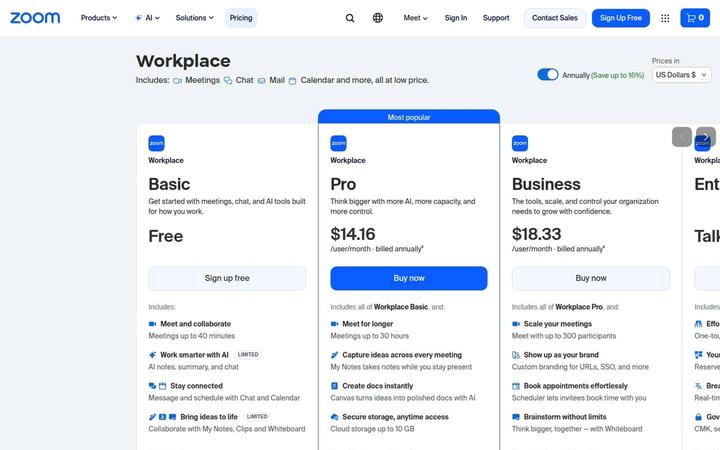
$14.16/user/moZoom Workplace sells a per-user suite on four plans, Basic free, Pro at $14.16, Business at $18.33 and Enterprise through sales, each price the monthly equivalent of an annual upfront charge. Each plan card leads with a tagline and four benefit-led rows while the comparison table carries the exact limits, and a catalog of seventeen add-ons, from ZoomMate at $20 to Zoom Mesh through sales, lets a paid account grow capacity, AI and governance one line at a time.

dbt
$100/user/modbt sells developer seats with a models-built allowance attached, from a free Developer plan to Starter at $100 per user/month and two custom Enterprise tiers. The two products whose cost tracks workload, dbt State and dbt Wizard, sit in their own add-on section under 'No seats, no minimums.', and can be bought even by teams running self-hosted dbt. dbt State introduces a new unit, the Daily Active Target Table, defines it in one sentence and prices it at $0.094.
monday.com
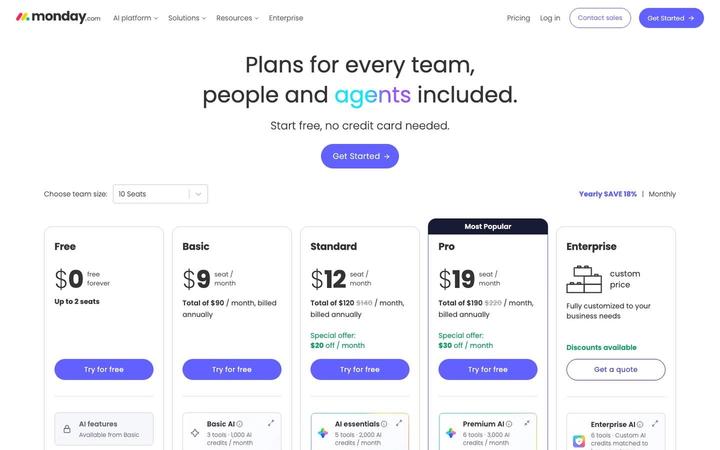
$9/seat/momonday.com prices work management per seat with a pool of AI credits on every paid plan, and the headline says why: 'Plans for every team, people and agents included.' A team-size selector turns each seat price into a monthly total, so Basic at $9 a seat reads 'Total of $90 / month, billed annually' at 10 seats. The same page carries full pricing for monday CRM, monday service and monday dev.

n8n
$20/mon8n prices on one unit, the workflow execution, and states the rule in its second line: 'Pricing based on monthly workflow executions, regardless of complexity.' Users, workflows and integrations are unlimited on every plan, so four tiers from '$20' to 'Contact Sales' separate by execution volume, governance and where n8n runs, Cloud or self-hosted.
turbopuffer
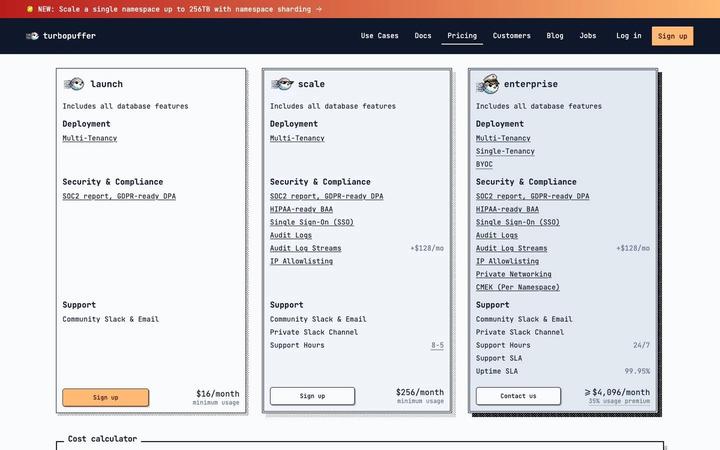
$16/mo minimumturbopuffer meters its search database on three resources, data stored per GB, data written per GB and data queried per PB, and its three plans differ in deployment, compliance and support while every one 'Includes all database features'. Each plan is a monthly minimum, $16, $256 and $4,096 and up, and the enterprise card prints its '35% usage premium' outright.