The pages where revenue gets built.
See how leading companies package and price, what each page does well, and which moves are worth building into your own.


Walkthroughs

1Password
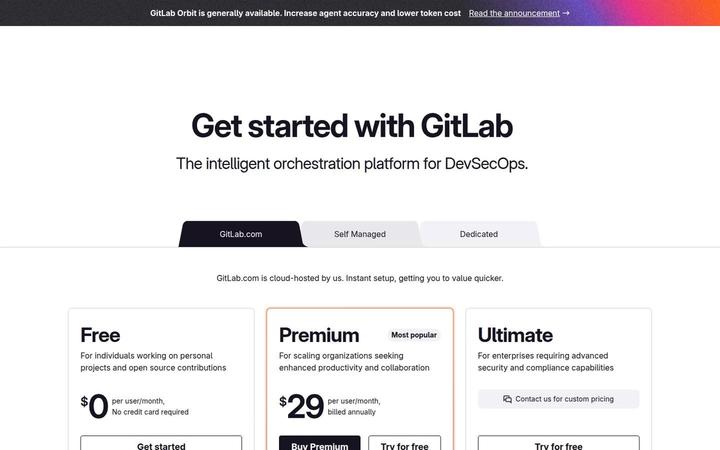
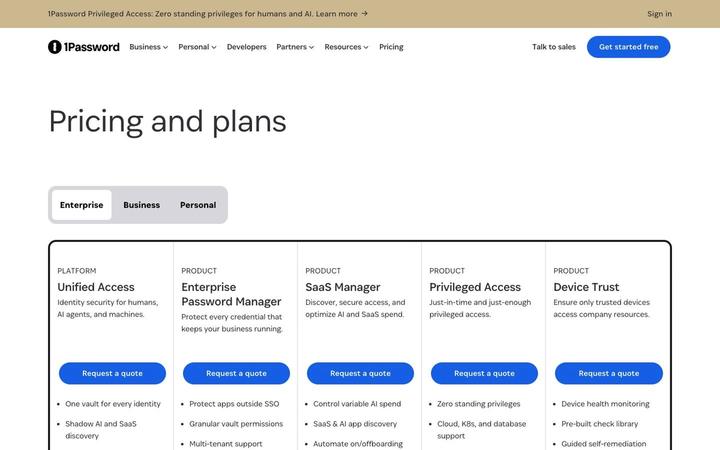
Quote1Password's pricing page opens on its Enterprise tab, where a platform and four products sit side by side and each ends in 'Request a quote'. The packaging is the story: Unified Access is labeled PLATFORM, its four components are labeled PRODUCT, and the FAQ confirms a buyer can take the whole platform or any part of it. Business and Personal tabs carry the self-serve plans on the same URL.

ActiveCampaign
$15/moActiveCampaign prices four plans by contact band, each with a printed starting price and a 'Choose' button, and now adds AI credits as a second meter: every plan includes 500, with more available from checkout or the account. A single contact selector sits above the cards, and each card translates its plan into concrete numbers, from '15,000 email sends / month' to '1 user seat included'. Email sends still scale as a multiple of the contact limit, from '10x' to '15x'.
Adyen
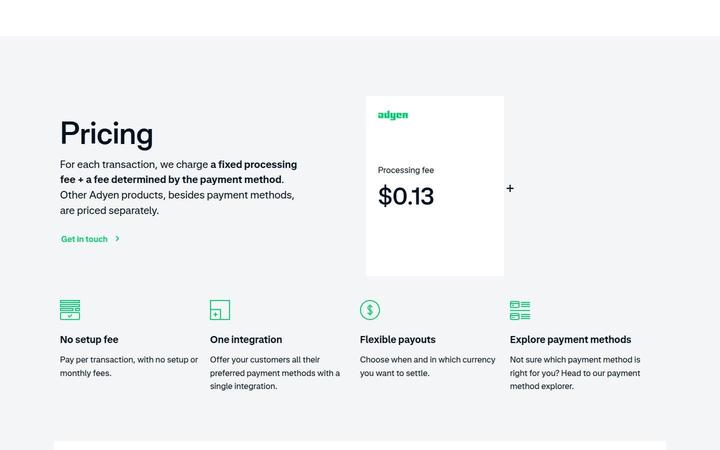
$0.13 + Interchange++ + 0.60%Adyen publishes its tariff as a rate sheet: a fixed '$0.13' processing fee on every transaction plus a fee set by the payment method, across more than a hundred methods. Card networks run on interchange++, 'Interchange+ + 0.60%', which passes network costs through at cost and makes Adyen's own margin a visible line. A Payment / Refund switch publishes refund costs on the same table.
Airtable
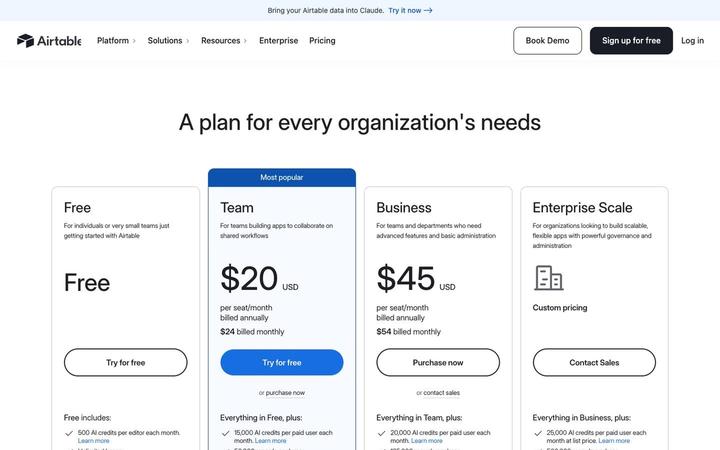
$20/seat/moAirtable prices four plans per seat, Free, Team at $20, Business at $45 and Enterprise Scale on custom pricing, and attaches a monthly pool of AI credits to every seat. Credits are the first bullet on each card and step from 500 per editor on Free to 25,000 per paid user, with top-up packs priced in the table. Annual and monthly prices print together on each card, so the commitment discount is visible at a glance.
Alchemy
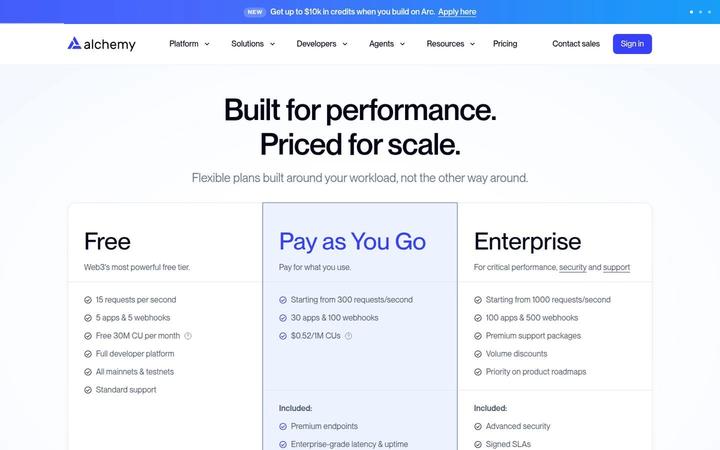
$0.52/1M CUAlchemy prices blockchain infrastructure on one published rate, $0.52 per 1 million compute units, and sells peak throughput as its own meter: $160 for each 5,000 CU/s block above the 300 RPS that Pay as You Go includes. A working estimator itemizes compute, included capacity and overage into a monthly total, so a developer can model the bill before signing up.

Algolia
From $0.50/1K search requests (after 10K free)Algolia prices hosted search on two meters, search requests and records, and prints the included allowance and the overage rate for both on every pay-as-you-go card. Grow and Grow Plus share the same allowances and record rate, and the request rate carries the AI: '$0.50 per additional 1K search requests' for keyword search, '$1.75' for keyword search with AI capabilities. A usage estimator with sliders for both meters now turns those rates into a starting monthly price per plan, while Elevate sits apart as an annual plan with volume-based discounts.
Amplitude
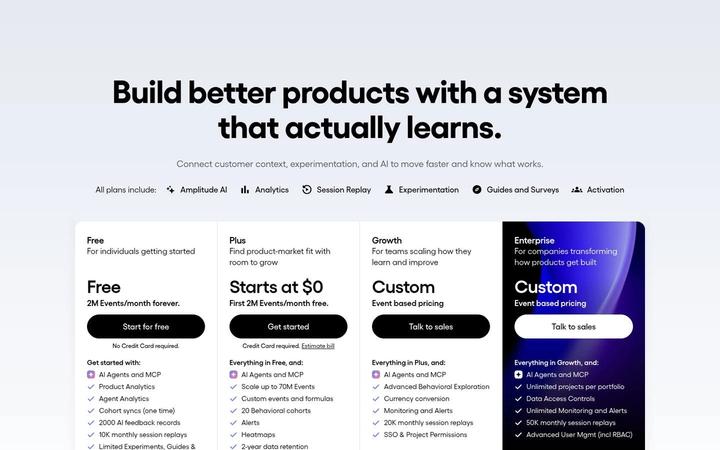
From $0/moAmplitude meters on events and nothing else, under a headline that sells outcomes: 'Build better products with a system that actually learns.' Free gives '2M Events/month forever.', Plus 'Starts at $0' with the first 2M events free and scales to 70M, and Growth and Enterprise move to 'Event based pricing' set through 'Talk to sales'. Further down, an 'Annual Plus Plan Comparison' chart plots what Plus costs across event volumes from 1.5M to 20M.
Anthropic (Claude)
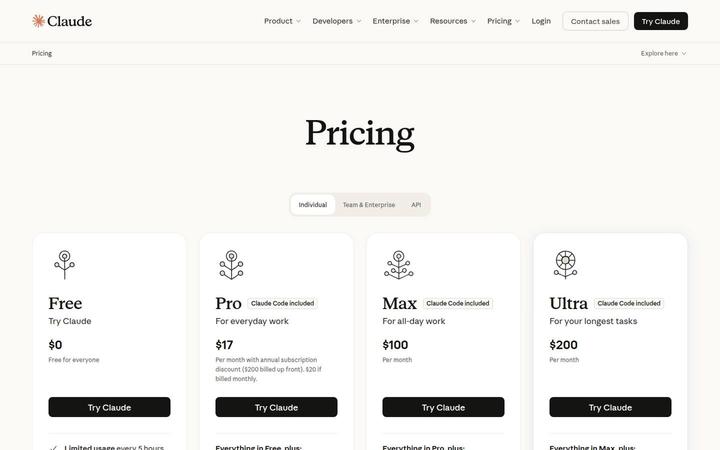
$17/moClaude sells four individual plans, Free, Pro at $17 a month on annual, Max at $100 and Ultra at $200, and what separates them is usage itself. Max is 5x Pro in both the five-hour and weekly windows, Ultra is 10x Pro weekly with no 5-hour limit for verified accounts, and both top plans carry a monthly API credit. One URL carries individual, team and API pricing, and the FAQ prints the enterprise rate.
Asana
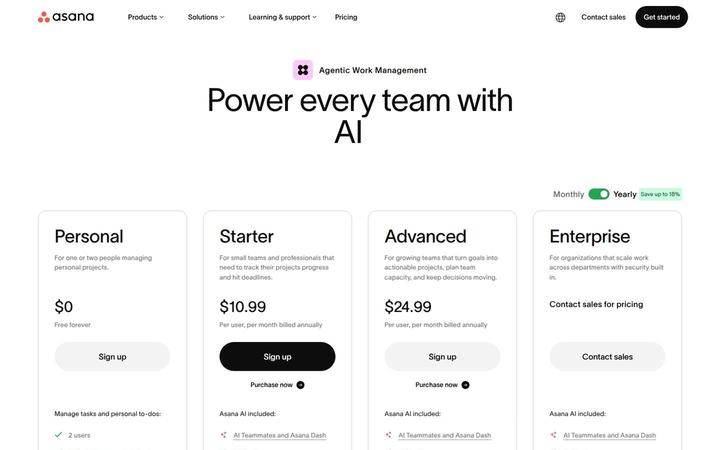
$10.99/user/moAsana pairs a per-user ladder, Personal at $0, Starter at $10.99, Advanced at $24.99 and Enterprise through sales, with a metered AI layer priced in the open. Each paid plan includes a pool of AI requests, and more cost $0.50 each in prepaid usage packs or $0.60 each pay as you go, under the banner 'One flat rate for every AI request'. Seats price the work management product, requests price the work AI Teammates and Asana Dash do, and optional modules such as Timesheets and Budgets extend down to Starter.

AssemblyAI
$0.15/hrAssemblyAI bills speech-to-text by the hour of audio, the unit a transcription team already uses, and the default view shows two rates: Universal-3.5 Pro at $0.21 /hr and Universal-2 at $0.15 /hr. A selector across eight APIs, grouped under TRANSCRIBE, UNDERSTAND and INTERACT, swaps the rate table, so each product is priced in its own unit, from audio hours to LLM tokens to input characters. The FAQ carries the billing mechanics in plain words, including the new Text-to-Speech API at $15 per 1M characters.

Attio
$35/user/moAttio prices its CRM per user and runs usage on credits in two pools: seat credits that grow with headcount, from 100 to 2,500 per user per month, and a shared workspace pool. A published top-up ladder sells more workspace credits from +5,000 a month at $70 annually to +50,000 at $475, so a growing bill can be modeled from the page. Credits open the comparison table, ahead of every feature.

Augment Code
$20/mo flatAugment Code sells a flat team subscription with usage inside it: Standard is '$20/month flat, no per-seat charge' and Business '$100/month flat', each covering up to 50 seats and loading the same dollar amount of usage every month. Usage is measured in dollars, and the FAQ publishes the formula: LLM inference at 'the provider's public API list price', 'a flat 40% fee on LLM usage (no fee on compute)', and Cosmos compute time. The plan is a prepaid wallet shared by the whole team.
Auth0
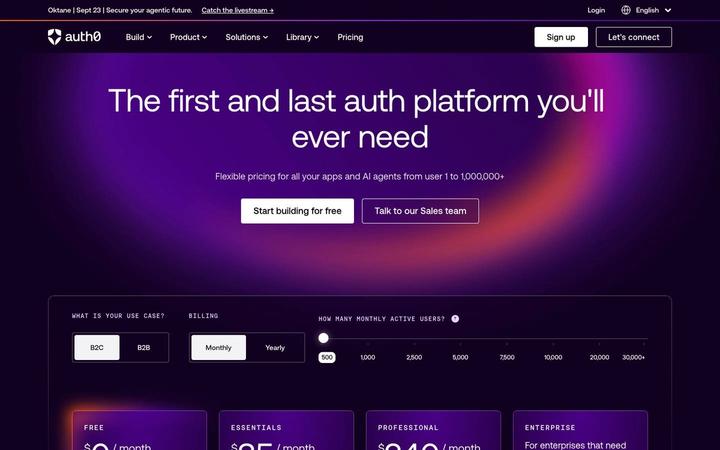
$35/mo (up to 500 MAU)Auth0 prices customer identity on monthly active users, and a three-part configurator, B2C or B2B, Monthly or Yearly, and an MAU slider from 500 to 30,000+, reprices the cards live. Free carries 'Up to 25,000 monthly active users' with 'No credit card needed to sign up', and the paid plans start at $35 a month and $240 a month at 500 MAU and scale with the slider. Feature depth, from MFA to AI agent security, separates the plans.
Basecamp
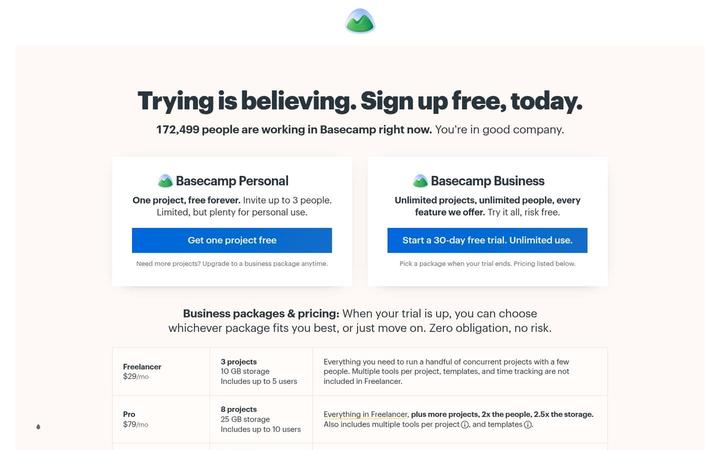
$29/moBasecamp leads with the trial: 'Trying is believing. Sign up free, today.' A free Basecamp Personal card sits beside a 30-day Basecamp Business trial with every feature, and a four-row table sets out the packages to choose from when the trial ends, from Freelancer at '$29/mo' to Pro Unlimited at '$199/mo, billed annually'. Each step adds projects, users and storage, and the upper packages add tools, time tracking and admin services.

Baseten
From $0.01/1M tokensBaseten layers a three-tier service ladder over published rate sheets. Basic is '$0 per month, pay as you go', and Pro and Enterprise carry 'Volume discounts available' with 'GET A QUOTE'. Underneath sit three meters: Model APIs per 1M tokens across 19 model rows with Input, Cache Input and Output columns, opening with joey-1 at $0.01 input, dedicated GPU and CPU instances billed 'down to the minute', and the same GPU grid for training.
BigCommerce
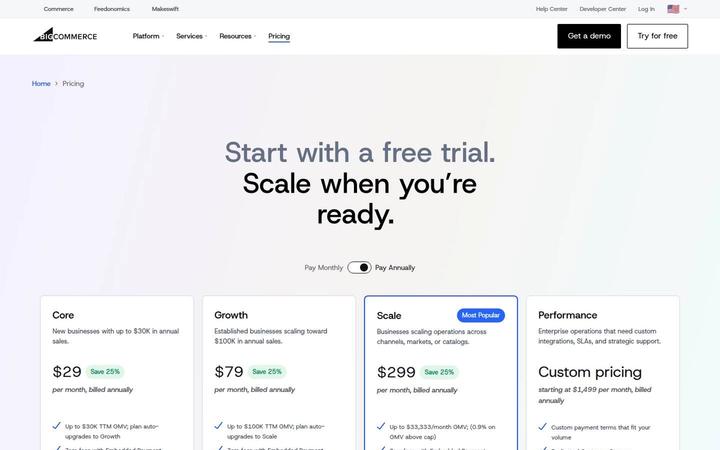
$29/moBigCommerce prices its plans by how much a store sells: Core covers 'Up to $30K TTM GMV', Growth 'Up to $100K TTM GMV' and Scale 'Up to $33,333/month GMV' with a '0.9%' overage above the cap, and each band moves a store up automatically as its sales grow. The upper cards name their buyer by operations, from multichannel scaling on Scale to 'custom integrations, SLAs, and strategic support' on Performance, and the footnotes spell out the GMV formula, the monthly list prices and the card processing rate.
Bolt
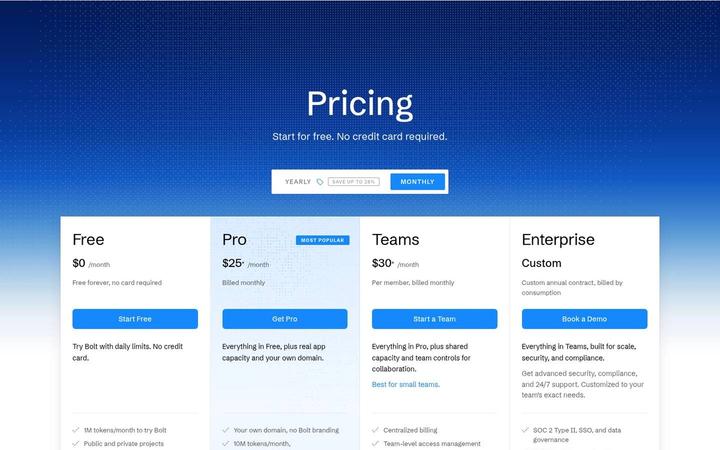
$25/moBolt sells its AI app builder on tokens, the unit of model work behind every prompt. Free offers '1M tokens/month to try Bolt', Pro at $25 a month carries the MOST POPULAR badge with '10M tokens/month, rollover included', Teams adds a per-member price, and Enterprise moves to 'Unlimited tokens, priced by consumption'. The page now runs from cards through logos, security credentials and a full Compare table to a closing call to action, so one URL serves the solo builder and the procurement team.
Braintrust
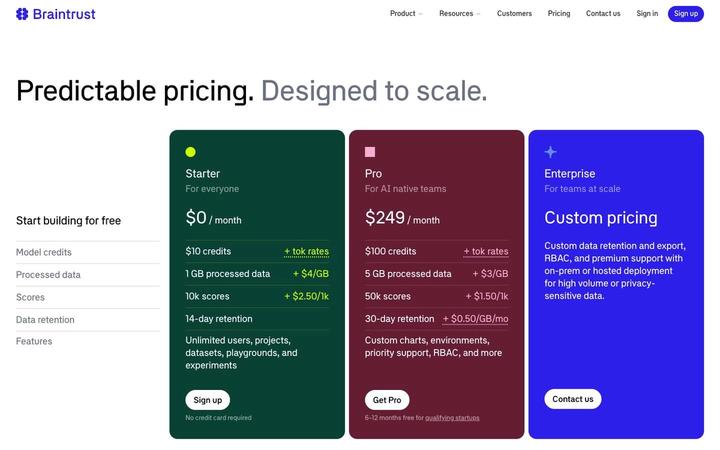
$249/moBraintrust pairs a flat platform fee, $0 on Starter and $249 a month on Pro, with four metered dimensions: model credits, processed data, scores and data retention. Each included allowance sits on the card beside its overage rate, and users, projects and experiments are Unlimited on every tier, so the bill follows traced traffic while headcount stays free.
Braze
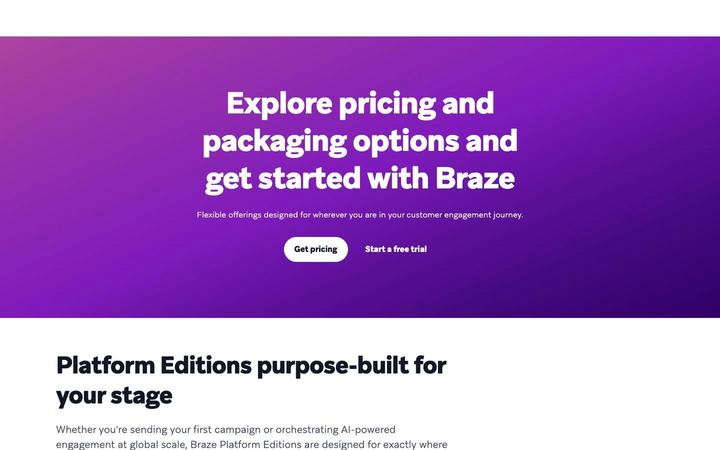
QuoteBraze prices on two axes: Monthly Active Users set the scale of the subscription, and Action Credits are a pooled currency spent across every channel and certain BrazeAI products. Four Platform Editions, Go, Select, Pro and Enterprise, are named for company stage, and every edition is priced in a conversation, which lets each contract fit the brand's audience and channel mix.
Brevo
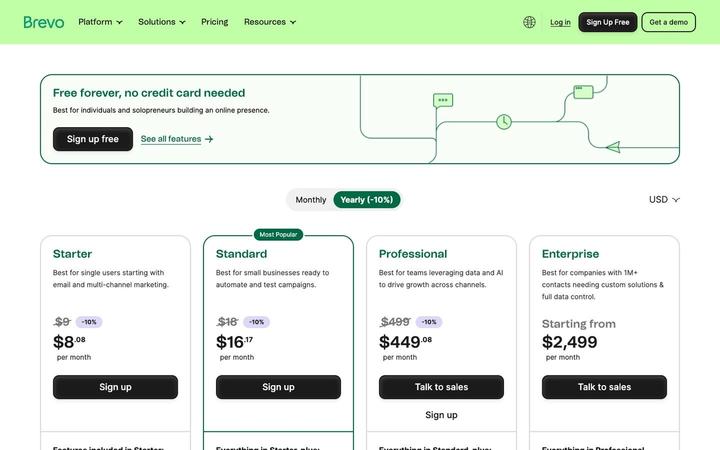
$9/mo for 5,000 emailsBrevo bills on monthly email volume, with contacts included at no charge, and the 'Customize your plan' configurator turns that meter into a live total with a slider from 5k to 100k emails. The card ladder, Starter $9, Standard $18, Professional $499 and Enterprise 'Starting from $2,499 per month', separates on capability, while volume is sized inside each plan.

Calendly
$10/seat/moCalendly sells four plans, Free, Standard at $10/seat/mo, Teams at $16/seat/mo and Enterprise from $15k a year with a 50-seat floor, and it defines a seat on every paid card: hosts need one, invitees do not. The page leads with its AI add-on, Notetaker and Callie, sold as a switch inside the Standard and Teams cards, which shows a scheduling tool growing into a seat price plus an AI layer.
Canva
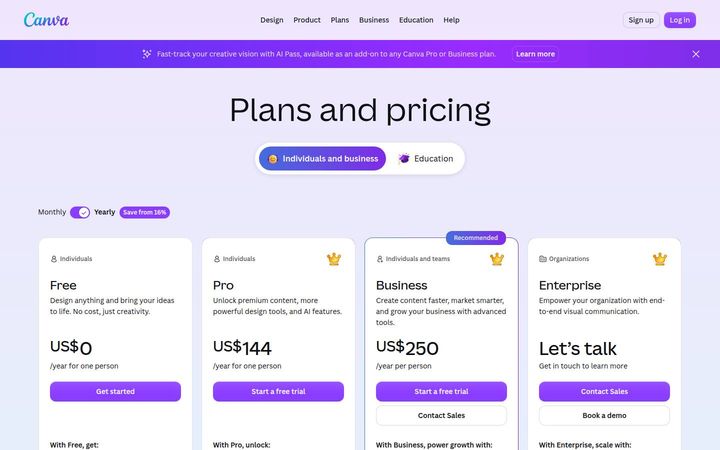
US$144/person/yrCanva sells a seat ladder, Free, Pro at US$144 a year for one person, Business at US$250 a year per person and Enterprise on 'Let’s talk', and inside every seat sits a shared AI allowance. Allowances are stated as multiples, 10x and 20x more AI than Canva Free, and a footnote explains that Standard, Premium and Ultra AI tools draw on the pool at different rates, a credit system running behind a seat price.
Chroma
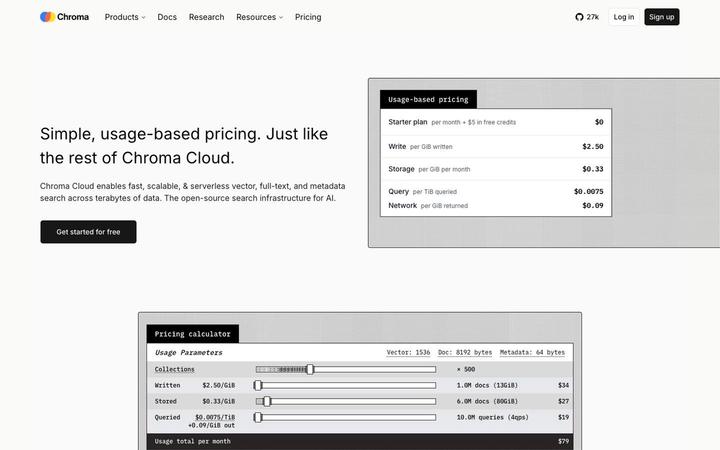
$250/mo + usageChroma prints all four metered rates in the hero, Write at $2.50 per GiB, Storage at $0.33 per GiB per month, Query at $0.0075 per TiB and Network at $0.09 per GiB returned, then hands the reader a calculator that turns documents and queries into a $79 monthly total. Plans sit on top of the meter: Starter at $0 plus usage, Team at $250 a month plus usage with $100 in credits, and Enterprise on custom terms.
CircleCI
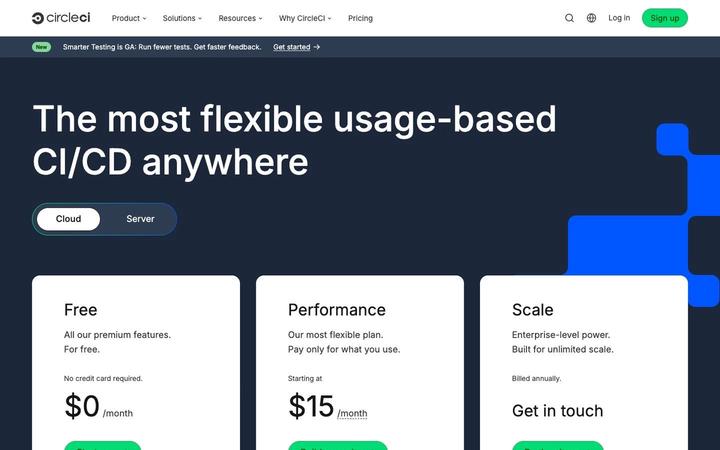
$15/moCircleCI sells one currency: credits that pay for compute, seats and features alike. Free includes '30,000 free credits/month', Performance is 'Starting at $15 /month' behind a 'Build your plan' configurator, and Scale is 'Billed annually.' with 'Get in touch'. A three-step explainer, 'Buy', 'Build' and 'Repeat', sets out the model before the comparison table.