How Cloudinary prices
Captured September 18, 2026 at 1440px wide.
Cloudinary plans and prices
| Plan | Price | Billing |
|---|---|---|
| FreeStart exploring Image and Video APIs today. | $0 | Free forever |
| PlusHighlightedExtend your team’s digital media capabilities for websites & apps. | $89 | Per month |
| AdvancedEngaging visual experiences with advanced features. | $224 | Per month |
| EnterpriseFor organizations requiring digital media at scale. | — |
As printed on the page captured September 18, 2026.
How does Cloudinary pricing work?
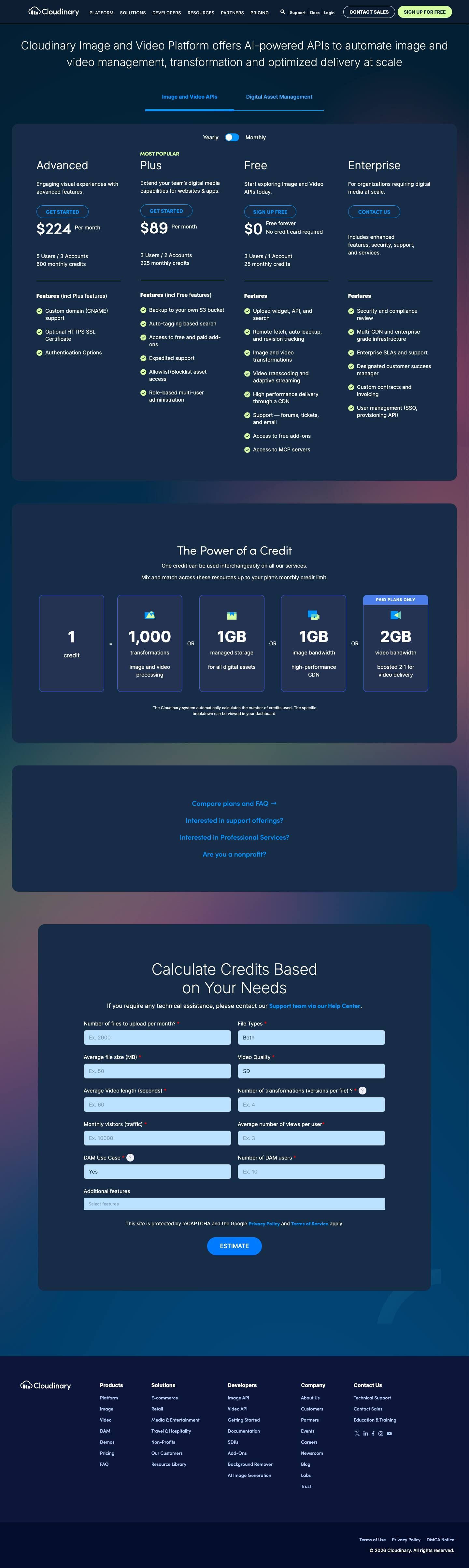
The value metric is the credit, a single currency across the resources a media platform consumes. "One credit can be used interchangeably on all our services. Mix and match across these resources up to your plan’s monthly credit limit." Storage, processing and delivery scale differently from one customer to the next, and one unit lets each buyer mix them freely. Packaging is a four-card row: Advanced at '$224 Per month' with '5 Users / 3 Accounts' and '600 monthly credits', Plus at '$89 Per month' with '3 Users / 2 Accounts' and '225 monthly credits' under 'MOST POPULAR', Free at '$0' with '25 monthly credits', and Enterprise on 'CONTACT US'. That works out to about $0.40 per credit on Plus and $0.37 on Advanced.
The motion is self-serve through Advanced and sales-led at Enterprise, which carries 'Security and compliance review', 'Multi-CDN and enterprise grade infrastructure', 'Enterprise SLAs and support', a designated customer success manager and 'Custom contracts and invoicing'. The page opens with a positioning line and an Image and Video APIs / Digital Asset Management tab, then a Yearly and Monthly toggle inside the card panel. The cards run from Advanced down to Free with Enterprise last, so the fullest self-serve plan is the first price a reader sees. 'The Power of a Credit' follows, then links to 'Compare plans and FAQ', support, Professional Services and nonprofit pricing, and a 'Calculate Credits Based on Your Needs' estimator.
Under the hood, each plan is a monthly credit limit, and the steps between plans are where growth shows up: 25, 225, 600, then Enterprise. Seats and accounts climb alongside, from '3 Users / 1 Account' to '5 Users / 3 Accounts', so a plan sizes both the media workload and the team around it. The exchange rates carry strategy too: video bandwidth is 'boosted 2:1 for video delivery' on paid plans, so a credit buys twice as much video delivery as image delivery once a customer pays. 'The Cloudinary system automatically calculates the number of credits used.' with the breakdown in the dashboard. A fungible credit with published exchange rates is a model worth borrowing for any platform whose customers consume a mix of resources.
What does Cloudinary's pricing page do well?
- 'The Power of a Credit' states 1 credit = 1,000 transformations OR 1GB managed storage OR 1GB image bandwidth OR 2GB video bandwidth in one visual row
- Plus carries a 'MOST POPULAR' label with '$89 Per month' and '225 monthly credits' printed together, giving the mid-tier a defined anchor
- The Free card prints 'Free forever' and 'No credit card required' beside $0, with 25 monthly credits and a full feature list including CDN delivery and 'Access to MCP servers'
- The estimator asks for real workload inputs, files per month, average file size, transformations per file and monthly visitors, that map directly to credit consumption
- Image and Video APIs and Digital Asset Management sit on separate tabs, so each product line gets its own price sheet
What does Cloudinary's pricing page reveal about its pricing strategy?
- One fungible credit stands in for four meters, letting each customer spend its allowance on its own mix of processing, storage and delivery
- Plans are monthly credit limits with seats and accounts attached, so the ladder scales workload and team together
- Video bandwidth at 2GB per credit on paid plans gives video-heavy customers a better rate once they pay
- Starting the row with Advanced at $224 sets the fullest self-serve plan as the first price a buyer reads
- Enterprise adds multi-CDN, SLAs and custom contracts and invoicing, the terms that shape a large media account
Learn with Orb
- ProductPrepaid credits One credit equals 1,000 transformations, 1GB of storage or 1GB of image bandwidth, allocated at 25, 225 and 600 a month; Orb's prepaid credits product covers how credit rates and allocations capture value.
- ProductExperience Kit The estimator asks for files per month, file size, transformations per file and monthly visitors, then maps them to credits; Orb's Experience Kit builds calculators like this so customers can plan spend.
Questions about Cloudinary pricing
How much does Cloudinary cost?
Cloudinary's pricing starts at $89/mo. The page shows 4 plans, including a free plan, with the top plan priced through sales.
What pricing model does Cloudinary use?
Cloudinary prices with credits, combined with flat-rate tiers. Buyers can sign up on their own or go through the sales team. Its plans are aimed mainly at developers.
Does Cloudinary have a free plan?
Yes, Cloudinary has a free plan. Paid plans start at $89/mo.
Does Cloudinary offer an annual discount?
Cloudinary offers monthly and annual billing; the page doesn't state the discount. The listed prices start at $89/mo. Terms for the plans priced through sales are set with the sales team.
How is Cloudinary's pricing page laid out?
The page shows 4 plans, highlights Plus, and includes a calculator. The breakdown above marks 14 points on it: 5 things it does well and 9 insights into the pricing.
What is a Cloudinary credit worth?
On Cloudinary, 1 credit equals 1,000 transformations for image and video processing, 1GB of managed storage, or 1GB of image bandwidth through the high-performance CDN. On paid plans, a credit also covers 2GB of video bandwidth, "boosted 2:1 for video delivery". "One credit can be used interchangeably on all our services", so customers can mix and match across these resources up to their plan's monthly credit limit.
How does Cloudinary track how many credits I use?
"The Cloudinary system automatically calculates the number of credits used", and the specific breakdown can be viewed in your dashboard. To plan ahead, the page offers a "Calculate Credits Based on Your Needs" estimator that asks for files uploaded per month, average file size, transformations per file, monthly visitors and average views per user. It also includes options for video quality, DAM use and additional features such as analytics and backup storage.
What does Cloudinary Enterprise include?
Cloudinary Enterprise is for "organizations requiring digital media at scale" and is available through a Contact Us option. It includes a security and compliance review, multi-CDN and enterprise grade infrastructure, enterprise SLAs and support, and a designated customer success manager. It also offers custom contracts and invoicing, plus user management with SSO and a provisioning API.
From the page as captured September 18, 2026. Current prices are on cloudinary.com
Lovable
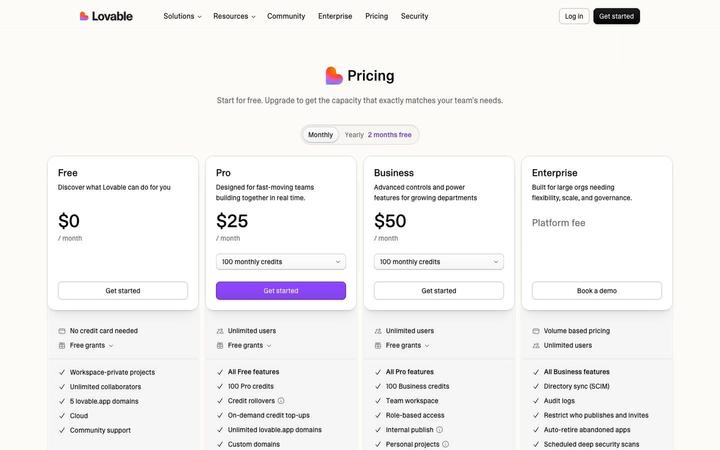
$25/moLovable prices per workspace, not per seat: Pro at $25 / month and Business at $50 / month each carry 'Unlimited users' and a dropdown that sets monthly credits, starting at 100. The tier sets the features and the dropdown sets the capacity, so a team chooses its controls and its volume as two separate decisions, and Enterprise pairs a 'Platform fee' with 'Volume based pricing'.

Netlify
$9/moNetlify prices its platform in credits and keeps headcount out of the bill: Pro is '$20 /month with unlimited members', and what scales is a monthly credit allowance. Five infrastructure meters, from production deploys to web requests, draw down that one balance, and a dropdown on the Pro card lets a team choose its credit tier from 3,000 to 20,000 a month.
Bolt
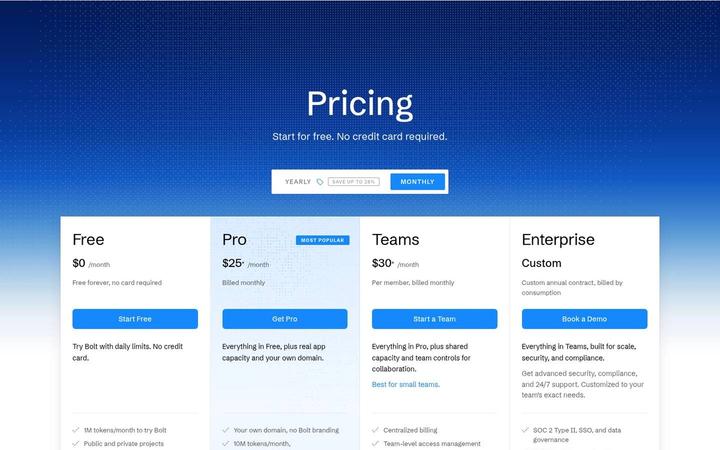
$25/moBolt sells its AI app builder on tokens, the unit of model work behind every prompt. Free offers '1M tokens/month to try Bolt', Pro at $25 a month carries the MOST POPULAR badge with '10M tokens/month, rollover included', Teams adds a per-member price, and Enterprise moves to 'Unlimited tokens, priced by consumption'. The page now runs from cards through logos, security credentials and a full Compare table to a closing call to action, so one URL serves the solo builder and the procurement team.