How Confluent prices
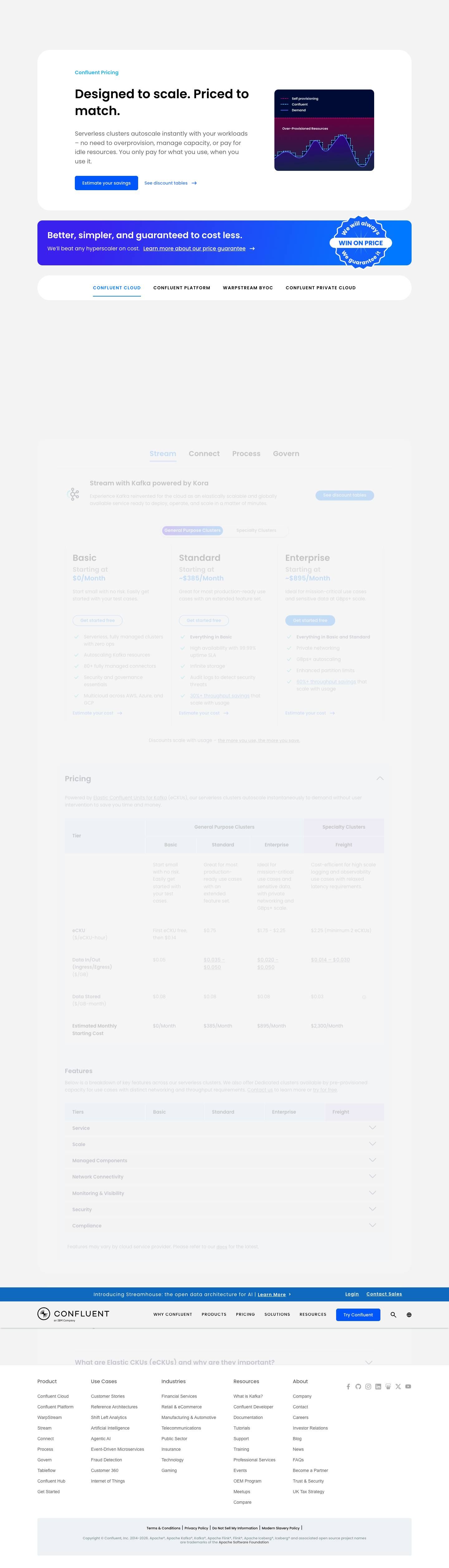
Captured September 18, 2026 at 1440px wide.
Confluent plans and prices
| Plan | Price | Billing |
|---|---|---|
| BasicStart small with no risk. | $0 | /Month |
| StandardGreat for most production-ready use cases with an extended feature set. | ~$385 | /Month |
| EnterpriseHighlightedIdeal for mission-critical use cases and sensitive data at GBps+ scale. | ~$895 | /Month |
As printed on the page captured September 18, 2026.
How does Confluent pricing work?
The value metric is the Elastic Confluent Unit for Kafka, billed per eCKU-hour, stacked with Data In/Out per GB and Data Stored per GB-month. Basic is 'First eCKU free, then $0.14', Standard is $0.75, Enterprise is '$1.75 - $2.25', and the Freight specialty cluster is '$2.25 (minimum 2 eCKUs)'. An autoscaling capacity unit fits the hero's promise, 'You only pay for what you use, when you use it.', because the meter scales down with the workload. Tiers price the same metric at different rates: Standard adds a '99.99% uptime SLA', infinite storage and audit logs, and Enterprise adds private networking, 'GBps+ autoscaling' and a partition limit of 96,000, all carried inside the unit rate. Ranges resolve by location, since 'Prices vary by cloud region.'
The motion is self-serve with sales at scale. Every card carries 'Get started free', with Enterprise filled in blue as the default for production buyers, and an 'Estimate your cost' link. The page opens on 'Designed to scale. Priced to match.' with 'Estimate your savings' and 'See discount tables', then a price-guarantee band, 'We’ll beat any hyperscaler on cost.' Deployment tabs, Confluent Cloud, Confluent Platform, WarpStream BYOC and Confluent Private Cloud, sit above pillar tabs, Stream, Connect, Process and Govern, and a General Purpose and Specialty Clusters switch sits above the cards. The rate table, a Features breakdown in six sections and a four-question FAQ follow.
Under the hood, the FAQ lays out the full bill and the commercial levers. Each pillar has its own meter: connectors at '$/task/hour' plus throughput, Flink in CFUs per minute, Tableflow per topic-hour and per GB, and governance per environment-hour. Two discount structures run in parallel: volume-based discounts 'negotiated upfront based on your planned annual consumption', and automatic tiered pricing where 'Deeper discounts are automatically applied as usage grows'. An annual commitment to a minimum spend can then be drawn down 'across the entire Confluent Cloud stack, including any Kafka cluster type, Connect, Flink, Stream Governance, and Support.' A commitment that spans every product is the burndown model usage-based platforms are converging on, and it rewards a customer for adopting more of the stack.
What does Confluent's pricing page do well?
- The rate table prints all three meters per tier and closes with an 'Estimated Monthly Starting Cost' row of $0, $385, $895 and $2,300
- 'First eCKU free, then $0.14' states the free allowance and the rate beyond it in the same cell
- Automatic tiered discounts are quantified on the cards as '30%+ throughput savings that scale with usage' and '60%+ throughput savings'
- The FAQ breaks the bill down by pillar with the exact meter for each and pins down units and time zone: 1 GB is 2^30 bytes, and billing runs in UTC
- Enterprise carries the one filled button in the row, a clear default for production buyers
What does Confluent's pricing page reveal about its pricing strategy?
- One autoscaling unit priced differently by tier puts SLA, networking and scale inside the rate per eCKU-hour
- Two discount paths run in parallel: negotiated volume discounts on a committed term, and automatic tiered pricing as usage grows
- An annual commitment can be spent across clusters, Connect, Flink, Stream Governance and Support, a burndown that rewards adopting more of the stack
- Rates resolve by cloud region, which is what the published ranges express
- A public price guarantee against hyperscalers frames the managed service as the cost-efficient choice
Learn with Orb
- DocsConfiguring plans: minimums and plan phases An annual commitment can be spent across clusters, Connect, Flink, Stream Governance and Support; Orb models a dollar commitment as a minimum that bills any shortfall, with plan phases stepping it up.
- ProductPrice modeling Each tier stacks eCKU-hours, data in and out per GB, and storage per GB-month, with automatic tiered discounts as usage grows; Orb's price modeling handles dimensional rates like these.
Questions about Confluent pricing
How much does Confluent cost?
Confluent's pricing starts at ~$385/mo. The page shows 3 plans, including a free plan.
What pricing model does Confluent use?
Confluent prices by usage, combined with flat-rate tiers. Buyers can sign up on their own or go through the sales team. Its plans are aimed mainly at enterprises.
Does Confluent have a free plan?
Yes, Confluent has a free plan. Paid plans start at ~$385/mo.
Does Confluent offer an annual discount?
Confluent's pricing page shows a single billing period. The listed prices start at ~$385/mo.
How is Confluent's pricing page laid out?
The page shows 3 plans, highlights Enterprise, and includes a comparison table and an FAQ. The breakdown above marks 14 points on it: 8 things it does well and 6 insights into the pricing.
What is an eCKU in Confluent pricing?
Elastic Confluent Units for Kafka (eCKUs) are Confluent Cloud's unit of horizontal scalability. They are billed per eCKU-hour and autoscale up to meet spikes in demand and back down based on workload with no user intervention required. Basic is "First eCKU free, then $0.14", Standard is $0.75, and Enterprise is "$1.75 - $2.25" per eCKU-hour, with rates set by cloud region.
How is a Confluent Cloud monthly bill calculated?
Confluent bills on resource consumption, with a meter for each product pillar. Kafka clusters are billed for eCKUs/CKUs ($/hour), networking ($/GB) and storage ($/GB-hour), while connectors are billed on throughput ($/GB) plus a task base price ($/task/hour). Flink is calculated on CFUs ($/minute), Tableflow on number of topics ($/hr) and data processed ($/GB), and Stream Governance per environment ($/hour). Storage and throughput are measured in binary gigabytes, where 1 GB is 2^30 bytes, and all billing runs in UTC.
What is the Confluent Freight cluster used for?
Freight is a specialty cluster that Confluent describes as "Cost-efficient for high scale logging and observability use cases with relaxed latency requirements". It runs at "$2.25 (minimum 2 eCKUs)" per eCKU-hour, with Data In/Out at $0.014 to $0.030 per GB and storage at $0.03 per GB-month. Because Freight delivers direct-to-object storage, its price is shown as an effective pre-replication price for accurate comparison.
From the page as captured September 18, 2026. Current prices are on confluent.io
Chroma
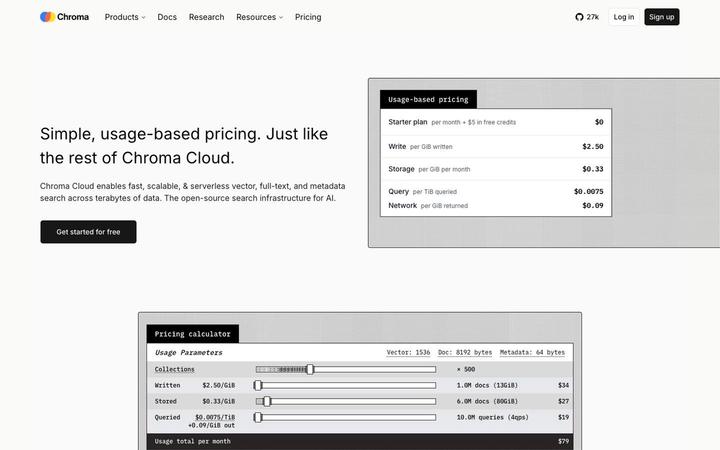
$250/mo + usageChroma prints all four metered rates in the hero, Write at $2.50 per GiB, Storage at $0.33 per GiB per month, Query at $0.0075 per TiB and Network at $0.09 per GiB returned, then hands the reader a calculator that turns documents and queries into a $79 monthly total. Plans sit on top of the meter: Starter at $0 plus usage, Team at $250 a month plus usage with $100 in credits, and Enterprise on custom terms.

Datadog
$15/host/moDatadog publishes a rate card per product, with every billable SKU listed in a left-hand navigator from AI Credits to Workflow Automation. Infrastructure Monitoring prices per host across three host levels: Basic, set with sales, beside Pro starting at $ 15 and Enterprise at $ 23 billed annually, with on-demand rates printed beside them and allotments of containers, custom metrics and custom events attached to each paid host. The bill is the sum of the products a customer adopts, and Basic hosts let one account price noncritical workloads at their own level.
Fly.io
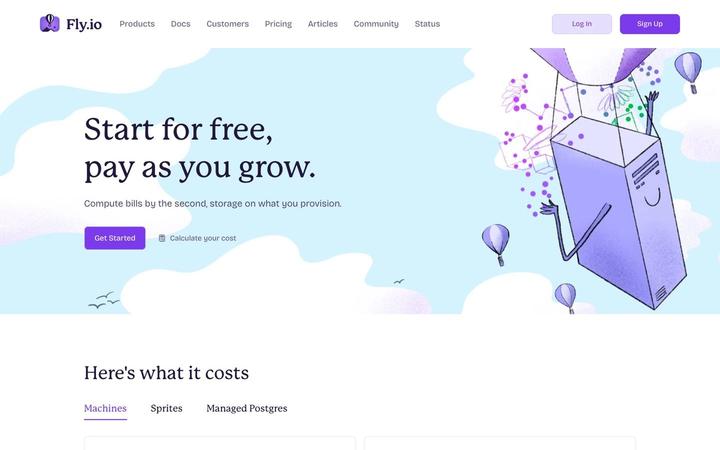
From $0.0030/hr (shared-cpu-1x, 256MB)Fly.io prices raw infrastructure: Machines 'Billed by the second while a Machine runs', volumes on provisioned capacity, and egress by region, with prices set per region through a selector. Support is sold as its own ladder at '$29 / mo', '$199 / mo' and 'From $2,500 / mo', compliance is a '$99/mo' add-on, and a Custom plan covers committed spend and volume discounts.
Grafana
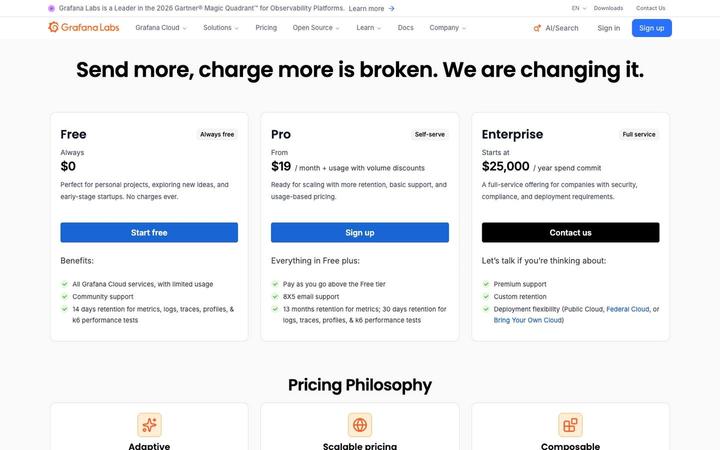
$19/moGrafana Cloud prices on a $19 per month platform fee that carries an allowance on every product, then a usage meter chosen per product, with volume tiers that lower the marginal rate as a customer grows. The hero states the thesis, 'Send more, charge more is broken. We are changing it.', and the page backs it with an embedded calculator that draws the tier curve and a cost-reduction band under the rates. Enterprise prints its entry point: 'Starts at $25,000 / year spend commit'.

Modal
$250 + compute/moModal bills GPU, CPU, memory and storage by the second or month, and network egress at '$0.04 / GiB', with the full rate card under the promise of paying for 'just actual compute time, by the CPU cycle'. Plans are a platform fee plus that usage: Starter at $0 with $30 of monthly credits and 1 TiB of egress, Team at $250 with $100 and 10 TiB, and a custom Enterprise with 100 TiB. A worked comparison makes the serverless case on utilization, with a $3.95 GPU-hour that totals '12% lower cost' than $3 GPU-hours provisioned around the clock.
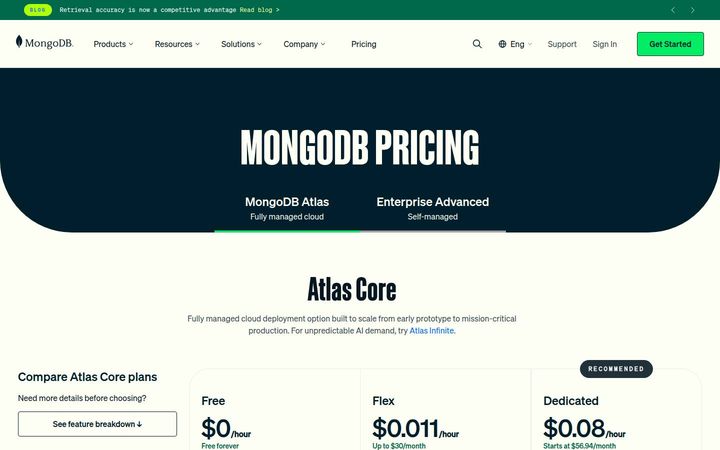
MongoDB
$0.011/hourMongoDB Atlas prices two product lines by the hour, each translated into a monthly figure. Atlas Core keeps Free at $0, Flex at $0.011 an hour with 'Up to $30/month', and Dedicated at $0.08 an hour that 'Starts at $56.94/month', while Atlas Infinite adds a public-preview tier at '$0.09 /hour' that 'starts at $65/month' for elastic AI workloads. Flex remains the design to study, a usage tier with a printed ceiling, and Infinite shows a premium tier layered on the same hourly meter.