Infrastructure & Data pricing pages
28 Infrastructure & Data pricing pages, from Chroma, ClickHouse, Cloudflare and more, each captured in full and annotated.
Of the 28, 25 price by usage, 19 show a free tier, 20 include a comparison table, 9 a calculator and 26 keep a contact-sales tier.
Chroma
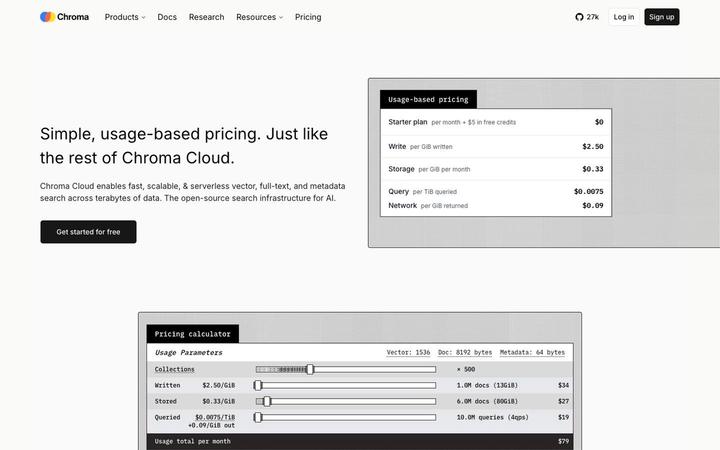
$250/mo + usageChroma prints all four metered rates in the hero, Write at $2.50 per GiB, Storage at $0.33 per GiB per month, Query at $0.0075 per TiB and Network at $0.09 per GiB returned, then hands the reader a calculator that turns documents and queries into a $79 monthly total. Plans sit on top of the meter: Starter at $0 plus usage, Team at $250 a month plus usage with $100 in credits, and Enterprise on custom terms.
ClickHouse
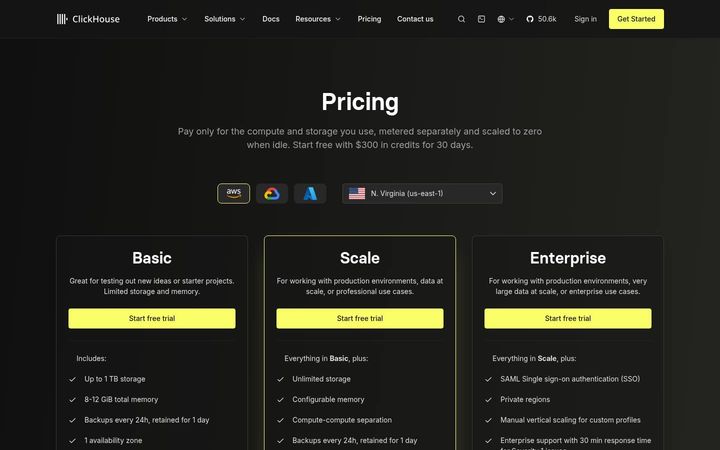
$0.2181/compute unit/hrClickHouse opens with its model in one line, 'Pay only for the compute and storage you use, metered separately and scaled to zero when idle.', sets the cloud and region, then gives every tier the same two meters: storage flat at '$25.30 Per 1TB / mo' and compute at $0.2181, $0.2985 and $0.3903 per unit per hour. The estimator opens pre-filled with a 1 TB real-time analytics workload at '$658' a month, and an eight-question FAQ explains each line that can appear on the bill.
Cloudflare
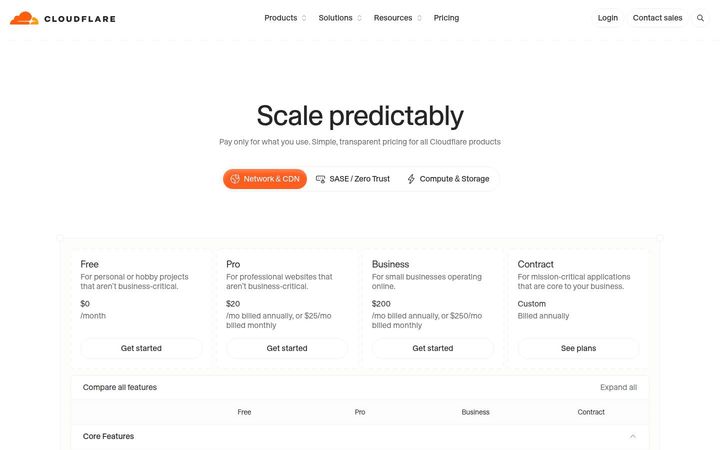
$20/moCloudflare runs three pricing models on one page, each behind its own tab: flat site plans at $0, $20, $200 and Custom for Network & CDN, $7 /user/month for SASE / Zero Trust, and a metered rate card with free allowances for the Compute & Storage primitives, now including Basin's per-stage data rates. Each business line gets the value metric that fits its cost, and the default tab prints both billing cadences on every card.
Confluent
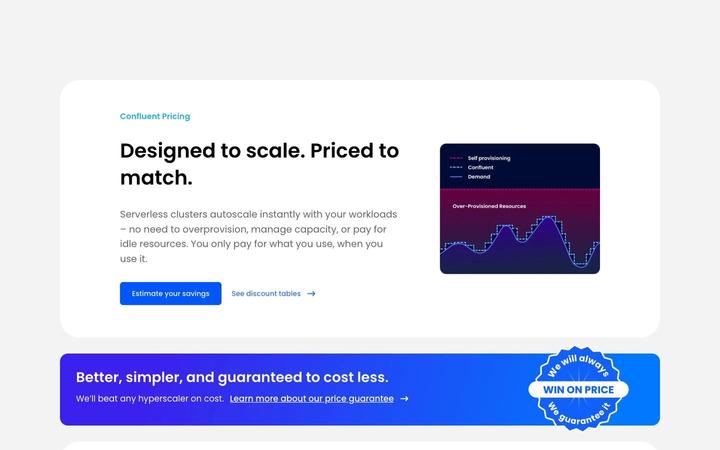
~$385/moConfluent prices serverless Kafka on a composite meter, eCKU-hours plus data in and out per GB plus storage per GB-month, and closes its rate table with an 'Estimated Monthly Starting Cost' of $0, $385, $895 and $2,300 that turns an hourly unit into a budget number. Behind it sit two discount structures and an annual commitment that can be spent across the whole Confluent Cloud stack.

CoreWeave
From $6.50/instance/hrCoreWeave publishes a full rate card: twelve GPU instance types and ten CPU types, each priced per hour on-demand and spot for North America and Europe, then storage, networking, Direct Connect and managed Kubernetes. The unit is a fully specified instance-hour, with GPU count, VRAM, vCPUs, system RAM and local storage printed beside every rate. Reserved capacity, the newest silicon and every next step run through the sales team, which is where a GPU cloud shapes committed deals.
Databricks
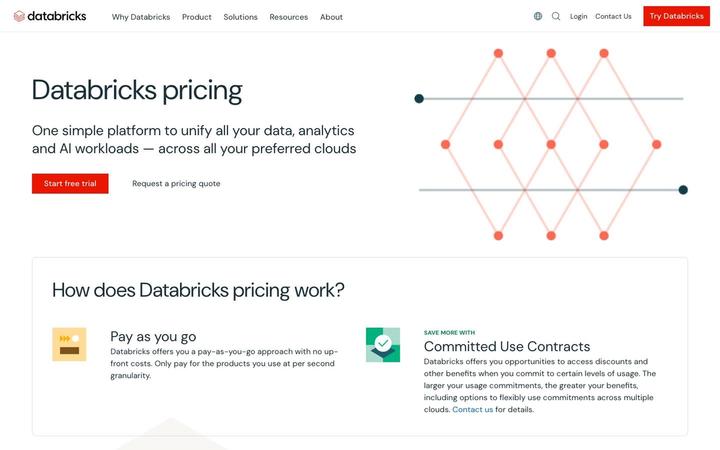
From $0.069/CUDatabricks prices a whole data platform on one consumption unit, the DBU, with seven workload tiles that each print a 'Starting at' rate and link to a full SKU price list. Billing runs 'at per second granularity' on pay-as-you-go, and Committed Use Contracts trade larger commitments for discounts that can flex across clouds. The page works as the front door to a rate table, organized by the job a customer is doing.

Datadog
$15/host/moDatadog publishes a rate card per product, with every billable SKU listed in a left-hand navigator from AI Credits to Workflow Automation. Infrastructure Monitoring prices per host across three host levels: Basic, set with sales, beside Pro starting at $ 15 and Enterprise at $ 23 billed annually, with on-demand rates printed beside them and allotments of containers, custom metrics and custom events attached to each paid host. The bill is the sum of the products a customer adopts, and Basic hosts let one account price noncritical workloads at their own level.

Dremio
$0.20/DCUDremio prices its lakehouse on one compute meter, '$0.20 per DCU (Dremio Compute Unit)', and organizes the page around a deployment choice: Dremio Cloud, fully managed on AWS, or Dremio Enterprise, self-managed anywhere. Both options are 'Consumption based', so the decision is about who runs the infrastructure. Every path leads to a conversation, including a Cloud trial that comes with '$400 credit for 30 days'.
Fivetran
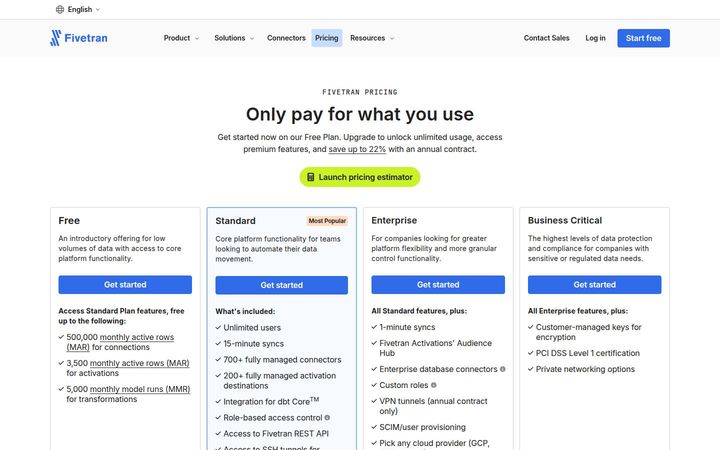
QuoteFivetran meters three products, Connections, Transformations and Activations, on monthly active rows and monthly model runs, and sells them under one plan with consolidated usage-based pricing. The four plan cards separate capability, and the dollars arrive through a pricing estimator and a worked example that totals four named connectors to $511.15.
Fly.io
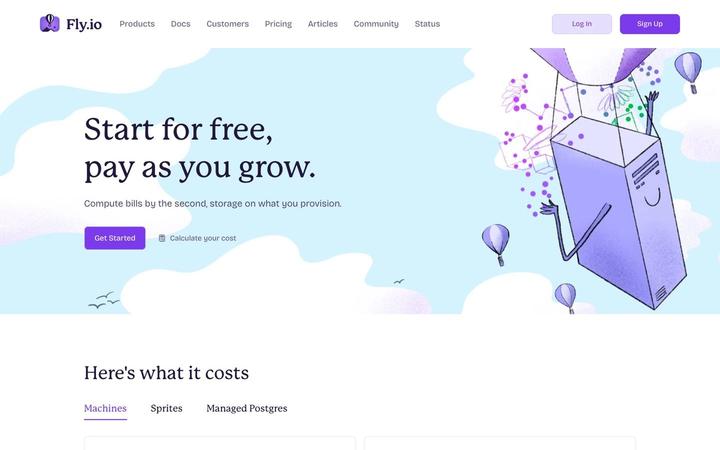
From $0.0030/hr (shared-cpu-1x, 256MB)Fly.io prices raw infrastructure: Machines 'Billed by the second while a Machine runs', volumes on provisioned capacity, and egress by region, with prices set per region through a selector. Support is sold as its own ladder at '$29 / mo', '$199 / mo' and 'From $2,500 / mo', compliance is a '$99/mo' add-on, and a Custom plan covers committed spend and volume discounts.
Grafana
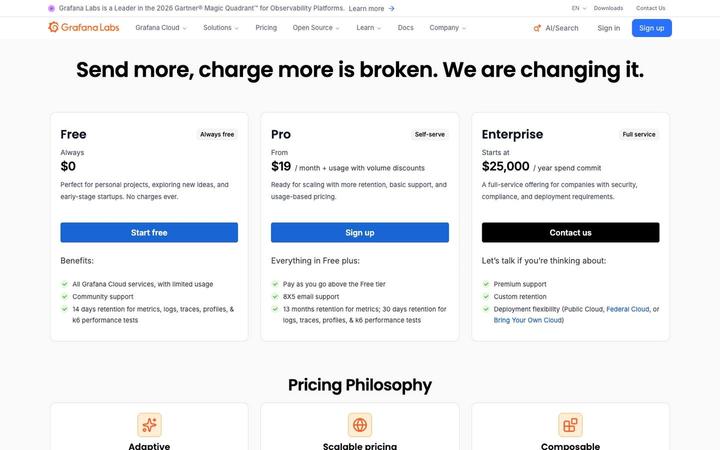
$19/moGrafana Cloud prices on a $19 per month platform fee that carries an allowance on every product, then a usage meter chosen per product, with volume tiers that lower the marginal rate as a customer grows. The hero states the thesis, 'Send more, charge more is broken. We are changing it.', and the page backs it with an embedded calculator that draws the tier curve and a cost-reduction band under the rates. Enterprise prints its entry point: 'Starts at $25,000 / year spend commit'.

HashiCorp
$0.10/resource/moHashiCorp prices HCP Terraform per managed resource, a quantity every Terraform user already tracks, and prints each rate twice: '$0.10 per month per resource' with '*Rated hourly at $0.00013 per hour' beneath it. Above the products, a band sets the contract shape first, Pay-as-You-Go, Flex or Enterprise Self Managed, so the page separates how a customer commits from what it buys.

Lambda
$0.79/GPU/hrLambda prices everything in one unit, PRICE/GPU/HR, across two products: 1-Click Clusters of 16 to 256+ B200 GPUs booked for '2 weeks – 1 year', and self-serve Instances from $6.69 per GPU-hour for a B200 to $0.79 for a V100. The cluster table publishes its volume curve, $9.86 at 16 GPUs falling to $8.87 at 256+, so a buyer sees the reward for scale before the first conversation.

Modal
$250 + compute/moModal bills GPU, CPU, memory and storage by the second or month, and network egress at '$0.04 / GiB', with the full rate card under the promise of paying for 'just actual compute time, by the CPU cycle'. Plans are a platform fee plus that usage: Starter at $0 with $30 of monthly credits and 1 TiB of egress, Team at $250 with $100 and 10 TiB, and a custom Enterprise with 100 TiB. A worked comparison makes the serverless case on utilization, with a $3.95 GPU-hour that totals '12% lower cost' than $3 GPU-hours provisioned around the clock.
MongoDB
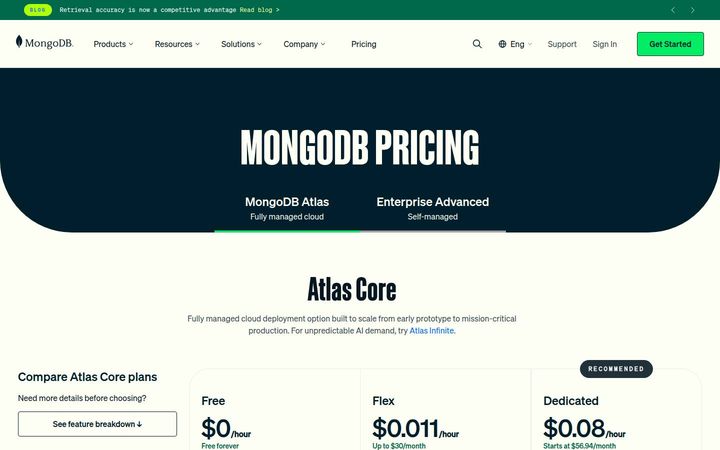
$0.011/hourMongoDB Atlas prices two product lines by the hour, each translated into a monthly figure. Atlas Core keeps Free at $0, Flex at $0.011 an hour with 'Up to $30/month', and Dedicated at $0.08 an hour that 'Starts at $56.94/month', while Atlas Infinite adds a public-preview tier at '$0.09 /hour' that 'starts at $65/month' for elastic AI workloads. Flex remains the design to study, a usage tier with a printed ceiling, and Infinite shows a premium tier layered on the same hourly meter.

Neo4j
From $0.09/GB/hrNeo4j AuraDB prices on one metric, provisioned memory, now printed in the unit it is metered in: 'Starting at $0.09 /GB/hour*' on Professional and 'Starting at $0.20 /GB/hour*' on Business Critical. Storage, IO, backups and data transfer ride inside the rate, so a graph database bill is GB times hours times one number, and pausing a database cuts its running cost by 80%.
New Relic
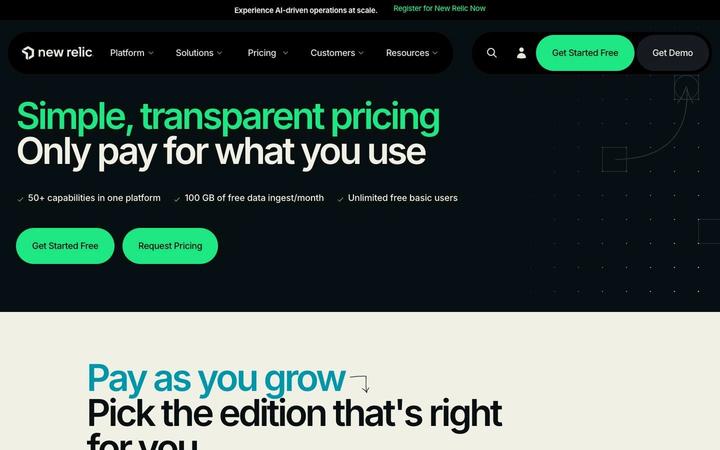
From $10/user/mo + $0.40/GB (Standard)New Relic bills observability on three components: data ingest at $0.40/GB beyond a free 100 GB, users priced by type, and Advanced Compute in compute capacity units. Hosts are free, 'unlimited hosts at no additional cost', so the bill follows the two things that grow with an observability practice, the data flowing in and the people who work with it.
Pinecone
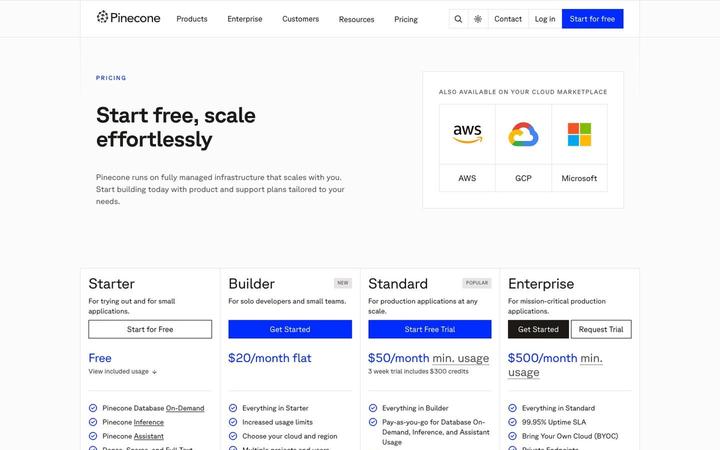
$20/mo flatPinecone runs a four-step ladder for its vector database: Starter free, Builder at '$20/month flat', and Standard and Enterprise at $50 and $500 a month minimum usage, each card explaining that usage above the minimum is pay as you go. Read units, write units and storage are the meters, and a set of worked Starter workloads turns those units into recommendations and searches per day.
Qdrant
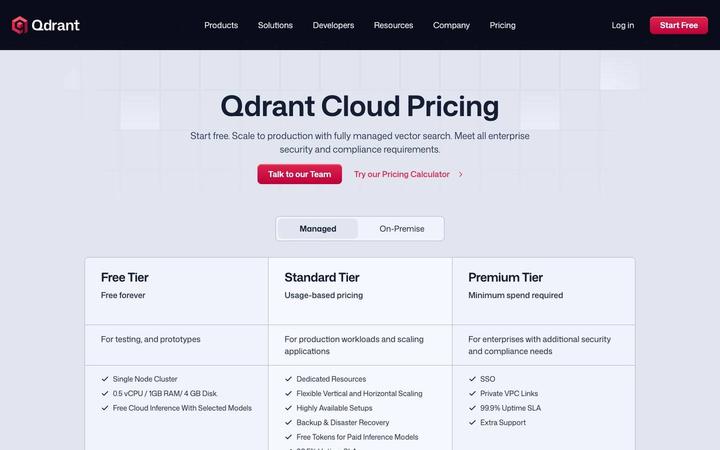
QuoteQdrant Cloud bills on the resources a cluster consumes, metered hourly across compute, memory, storage, backups and paid inference tokens. The page sells the shape of the deal: a free tier stated as hardware, a usage-based Standard tier and a Premium tier with a minimum spend, with dollar figures handed to a dedicated pricing calculator.

Redis
From $0.007/hourRedis Cloud bills database capacity by the hour, scaling with memory: Free at 'Always $0' for 30 MB, Essentials 'From $0.007 /hour' with 'Total $5/month' beside it, and Pro 'From $0.014 /hour' with a $200 monthly minimum. The most interesting choice is the Pro offer, 'FIRST $200 FREE', a credit sized to exactly the plan's monthly minimum.
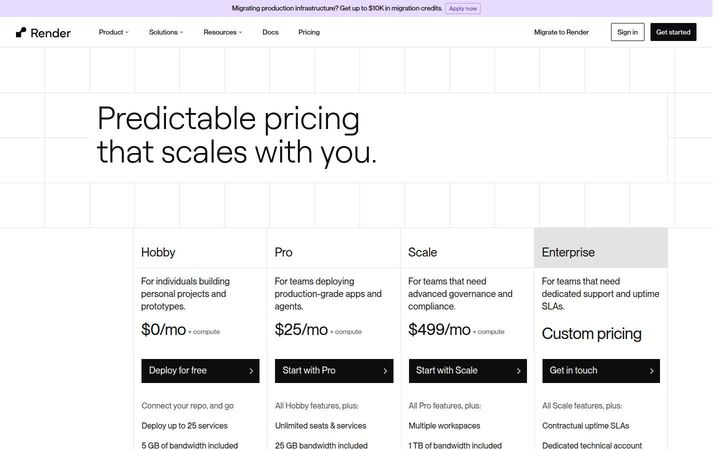
Render
$25/mo + computeRender prices in two layers: a flat workspace plan, from '$0/mo + compute' on Hobby to '$499/mo + compute' on Scale and 'Custom pricing' on Enterprise, and per-service compute printed as rate tables for each service type. The newest table, Sandboxes BETA, meters '$0.12 / active CPU hour' plus an hourly memory rate, and the workspace plans set how many sandboxes run at once and for how long.
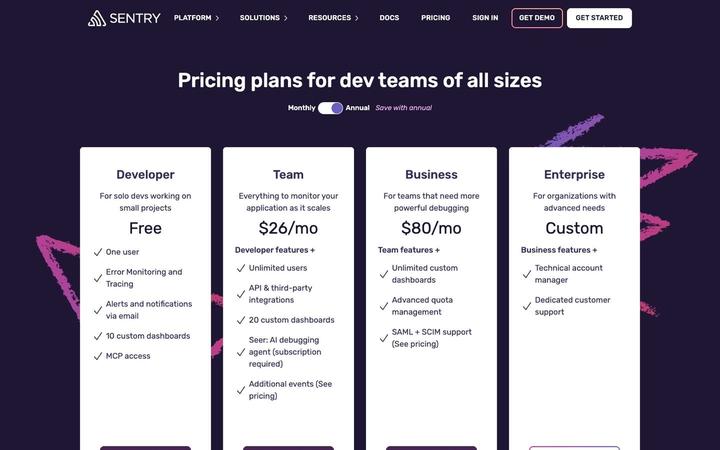
Sentry
$26/mo (Team, annual)Sentry sells a base plan with a quota on every telemetry type, Developer free, Team '$26/mo', Business '$80/mo' and Enterprise 'Custom', and bills usage above the quota at published pay-as-you-go rates, with errors priced on five volume tiers. The comparison table prints each quota and its overage rate in the same cell, and the estimator turns usage into an itemized receipt, so the base plan, the meters and the bill all read off one page.
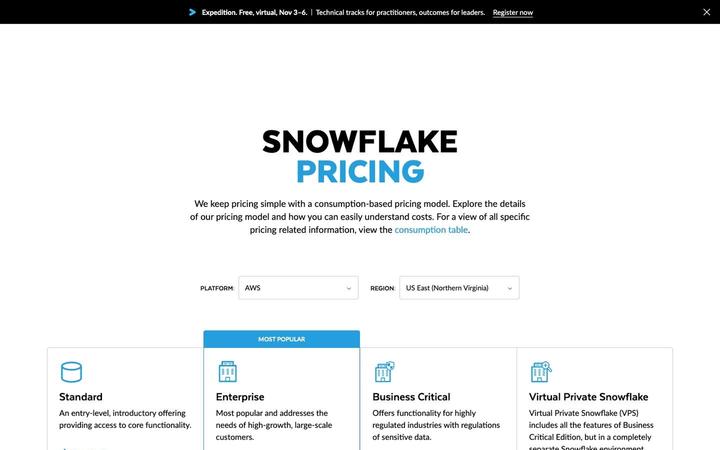
Snowflake
$2/creditSnowflake prices compute in credits and charges more per credit as the edition adds governance: Standard at $2.00, Enterprise at $3.00, Business Critical at $4.00, and Virtual Private Snowflake through sales. Storage is a second, separate meter at $23.00 per TB per month, and platform and region selectors localize every figure, so the page reads as a live rate card for one deployment.
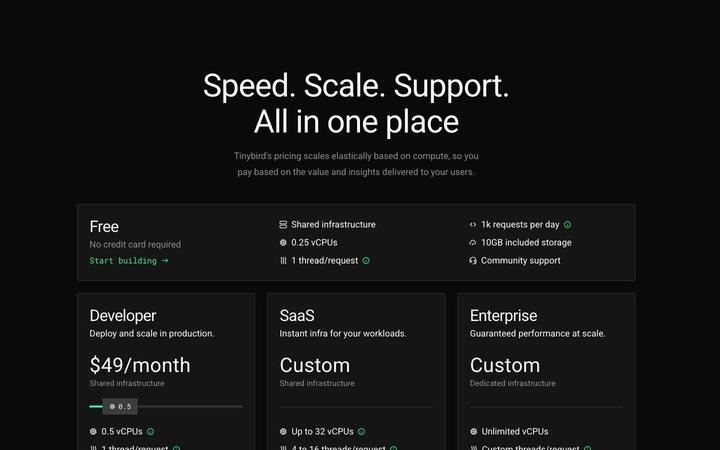
Tinybird
$25/moTinybird prices managed ClickHouse on compute, and the vCPU slider inside the Developer card puts that metric in the buyer's hand: the card reads $49/month at 0.5 vCPUs and moves as the slider does. Around compute sit flat unit rates that hold across every paid plan, storage at $0.058/GB and three egress rates, with vCPU overages at $0.0002/second on Developer and SaaS, while SaaS and Enterprise are priced as Custom with a yearly commitments discount.
Upstash
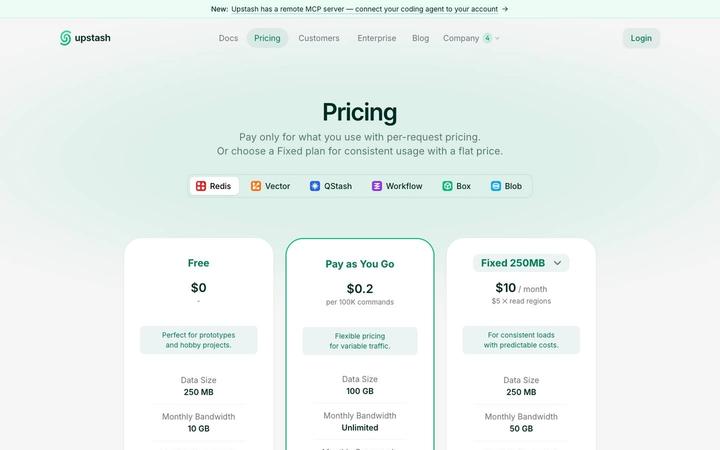
$0.2/100K commandsUpstash prices Redis two ways side by side: 'Pay as You Go' at '$0.2 per 100K commands' for variable traffic, and Fixed plans picked from a size dropdown that starts at '$10 / month' for steady loads. Production features sit in a separate 'Prod Pack' at '+$200/month per database', and a long FAQ prints the billing mechanics down to how replicated writes count.

Weaviate
From $45/moWeaviate bills its vector database on total vector dimensions stored, plus storage, backup and data transfer, above a $45 monthly minimum on Flex, with Premium's floor now set with sales. The three plans are three ways to buy, labeled Forever, Pay-as-you-go and Prepaid contract, and a dated 'Weaviate Cloud pricing update: September 2026' FAQ explains a rebased backup rate and a new RQ-4 compression price.

dbt
$100/user/modbt sells developer seats with a models-built allowance attached, from a free Developer plan to Starter at $100 per user/month and two custom Enterprise tiers. The two products whose cost tracks workload, dbt State and dbt Wizard, sit in their own add-on section under 'No seats, no minimums.', and can be bought even by teams running self-hosted dbt. dbt State introduces a new unit, the Daily Active Target Table, defines it in one sentence and prices it at $0.094.
turbopuffer
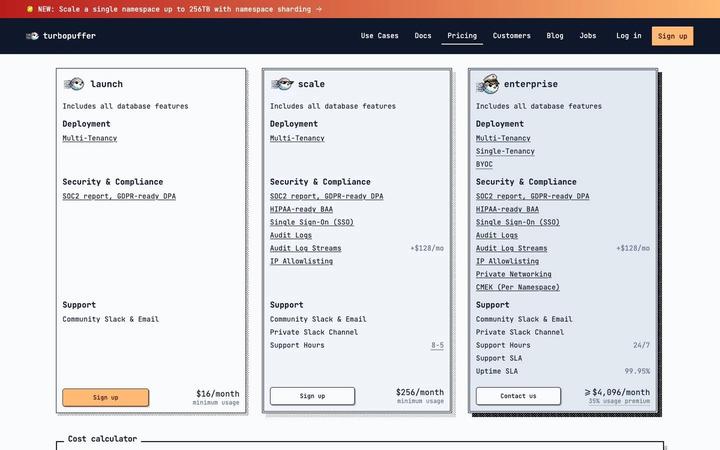
$16/mo minimumturbopuffer meters its search database on three resources, data stored per GB, data written per GB and data queried per PB, and its three plans differ in deployment, compliance and support while every one 'Includes all database features'. Each plan is a monthly minimum, $16, $256 and $4,096 and up, and the enterprise card prints its '35% usage premium' outright.