How Mux prices

Captured November 2, 2026 at 1440px wide. The page continues below the crop (13,064px in total).
Mux plans and prices
| Plan | Price | Billing |
|---|---|---|
| FreeKick off your video project. | Free | |
| Pay as you goBuild what you need with usage-based pricing. | usage-based | |
| Pre-payCredit-based plans for growing apps. | $20 | /mo |
As printed on the page captured November 2, 2026.
How does Mux pricing work?
The minute of video is the value metric, 'one minute of your content' priced by duration, 'not file size', and Mux adds that it does not 'round up to the nearest minute'. Base Pricing sets Input 'Starting at Free' and Storage 'Starting at $0.0024' per minute, and Video delivery gives '100k free minutes / month then starting at $0.0008'. Workflows price separately: the 'AI workflows (Mux Robots)' list runs on two-part rates such as 'Summarization $0.0003 / min + $0.005 / job' and 'Analyze structure $0.0050 / min + $0.0300 / job', and 'Generate contextual text $0.00010 / min + $0.0050 / job + $0.0025/ artifact' adds a third part per artifact. Mux Data and Mux Player are free, Live captions run '6k free minutes / month then $0.024', with 'Media-grade DRM $100 / month + $0.003 / play', MP4s & static renditions 'starting at $0.0006' per minute and Custom domains at '$100 / month'. Resolution scales the base, '1.25× base price' for 1080p, 2× for 2K and 4× for 4K, and quality adds its own input rate, Plus at 'Input starting at $0.025/min for 720p' and Premium at 'Input starting at $0.0375/min for 720p', with Premium applying '1.5x resolution pricing' to storage and delivery.
The motion is developer-led with a clear line to sales. Three plans carry their own verbs: Free with 'START FOR FREE', Pay as you go with 'START BUILDING' and a '$20 monthly usage credit', and Pre-pay with 'START WITH CREDITS', where 'Launch: $20/mo for $100 in credit' and 'Scale: $500/mo for $1,000 in credit'. An enterprise strip reads 'Steeper discounts over $3k/month.' with 'TALK TO US'. The page then translates credit into outcomes, shows customer stories built around cost, offers 'free migration options', defines the minute, lists the rate sheet, runs the estimator, answers 'How is it so cheap?' and closes on an FAQ with a resolution price table.
Under the hood, a base rate per minute carries the whole model, and resolution, quality and workflows are multipliers and modules on top of it. Pre-pay credits are applied automatically to usage, 'After the credits are used, usage-based billing applies', so a credit plan is a monthly commitment with metered overage. Launch returns $100 of credit for $20 a month, an entry offer that makes a first commitment easy, and Scale sizes the commitment for growing apps. Above that, the FAQ separates automatic volume discounts in the pricing guide from 'custom contract pricing for larger workloads' above $3,000 a month. The AI rate list now stands as its own labeled section, and the per-artifact part on Generate contextual text points to billing that follows generated output as well as media length. The estimator carries a Mux Robots checklist that runs from Caption translation to Audio translation with stated assumptions for each workflow, so AI spend is modeled in the same place as storage and delivery. The 'How is it so cheap?' section ties the rates to just-in-time encoding, a cost structure passed through as lower input and storage prices, and that link between infrastructure and price is worth borrowing.
What does Mux's pricing page do well?
- 'What the minute?' defines the billing unit in plain language, states pricing is by duration, and says Mux does not round up
- The $100 credit switcher, COMPANY WEBSITE, USER-GENERATED, LIVE STREAM and GEN AI, converts credit into outcomes such as 'Upload 100 5-minute videos' and 'Stream 168k minutes'
- The inline estimator returns a per month figure, covers ten Mux Robots workflows, and lists every assumption under 'HOW ARE WE DOING THE MATH?'
- Free allowances are printed in the meter's own unit on every card: '100K free monthly delivery minutes' and '100K free monthly Mux Robots units'
- The 'AI workflows (Mux Robots)' list prints each job with its own units, from '$0.001 / sample' to '$0.0025/ artifact'
What does Mux's pricing page reveal about its pricing strategy?
- One base rate per minute, with resolution and quality as multipliers, keeps a complex product on a single pricing spine
- Pre-pay is a monthly commitment applied to usage, with metered billing after the credits run out
- Launch returns five times its price in credit, an entry offer that lowers the first commitment
- Mux Robots price AI per minute processed plus per job, and Generate contextual text adds a per-artifact part that tracks generated output
- Just-in-time encoding is the cost structure behind low input and storage prices, and the page names it
Learn with Orb
- GuideAn AI founder's guide to prepaid credits Pre-pay plans, $20 a month for $100 in credit and $500 for $1,000, are commitments that earn a better rate; Orb's CTO covers that choice and how usage past the credit bills.
- ProductExperience Kit The inline estimator with every assumption listed and the $100 credit switcher translate minutes into a monthly budget, the calculators Experience Kit builds on one source of pricing truth.
- ProductPrice modeling Resolution and quality work as multipliers on one per-minute base rate, a dimensional rate structure Orb's price modeling represents and changes without re-engineering billing.
Questions about Mux pricing
How much does Mux cost?
Mux's pricing starts at $20/mo. The page shows 3 plans, including a free plan, with the top plan priced through sales.
What pricing model does Mux use?
Mux prices by usage, combined with credits. Buyers can sign up on their own or go through the sales team. Its plans are aimed mainly at developers.
Does Mux have a free plan?
Yes, Mux has a free plan. Paid plans start at $20/mo.
Does Mux offer an annual discount?
Mux's pricing page shows a single billing period. The listed prices start at $20/mo. Terms for the plans priced through sales are set with the sales team.
How is Mux's pricing page laid out?
The page shows 3 plans and includes a calculator and an FAQ. The breakdown above marks 14 points on it: 8 things it does well and 6 insights into the pricing.
How does Mux price higher resolutions like 1080p and 4K?
Mux applies a multiplier to its base per-minute rate: 1080p is priced at 1.25× base price, 2K at 2× and 4K at 4×. In the FAQ resolution pricing, storage runs from $0.0024 per minute at 720p to $0.0096 at 4K, and delivery runs from $0.0008 to $0.0032. Input is free at every listed resolution, and the first 100K delivery minutes are free each month.
What happens when Mux pre-pay credits run out?
Mux applies monthly credits to your usage automatically, and the page states that "After the credits are used, usage-based billing applies". The Launch plan is "$20/mo for $100 in credit" and Scale is "$500/mo for $1,000 in credit". Usage past the credit is billed at the listed rates, or as the page puts it, "Just pay for what you use".
How much do Mux Robots AI workflows cost?
The "AI workflows (Mux Robots)" list prices most jobs per minute processed plus per job, such as Summarization at "$0.0003 / min + $0.005 / job" and Analyze structure at "$0.0050 / min + $0.0300 / job". Generate contextual text adds a third part, "$0.00010 / min + $0.0050 / job + $0.0025/ artifact", while Content moderation is "$0.001 / sample" and Translate audio is "$0.7000 / min". Every plan includes 100K free monthly Mux Robots units, and the cost estimator lets you select workflows to model them alongside storage and delivery.
From the page as captured November 2, 2026. Current prices are on mux.com
Alchemy
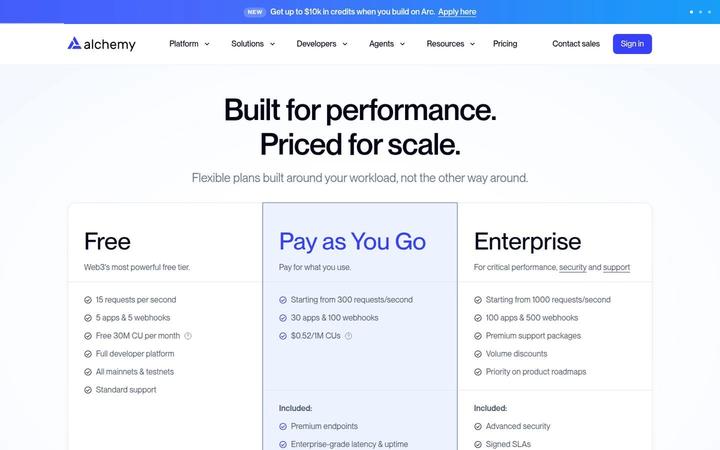
$0.52/1M CUAlchemy prices blockchain infrastructure on one published rate, $0.52 per 1 million compute units, and sells peak throughput as its own meter: $160 for each 5,000 CU/s block above the 300 RPS that Pay as You Go includes. A working estimator itemizes compute, included capacity and overage into a monthly total, so a developer can model the bill before signing up.
Braintrust
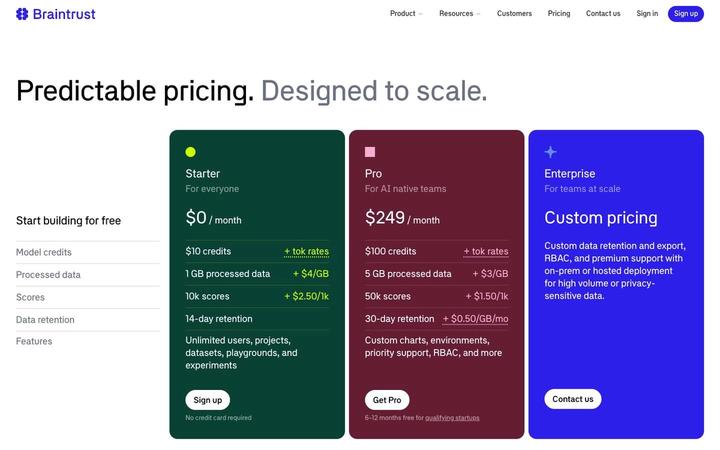
$249/moBraintrust pairs a flat platform fee, $0 on Starter and $249 a month on Pro, with four metered dimensions: model credits, processed data, scores and data retention. Each included allowance sits on the card beside its overage rate, and users, projects and experiments are Unlimited on every tier, so the bill follows traced traffic while headcount stays free.

Neon
$0.106/CU-hourNeon prices serverless Postgres on raw resources, $0.106 per CU-hour and $0.35 per GB-month on Launch, and turns those rates into a budget with a Typical spend figure on each paid card, set by a workload dropdown. Compute scales to zero when idle, so the meter follows real work, and the Free plan states every allowance per project. A rewritten 'Included in every Neon project' section and new FAQ answers on Free plan limits, Claimable Neon and idle compute frame the backend around the database as part of every plan.

Algolia
From $0.50/1K search requests (after 10K free)Algolia prices hosted search on two meters, search requests and records, and prints the included allowance and the overage rate for both on every pay-as-you-go card. Grow and Grow Plus share the same allowances and record rate, and the request rate carries the AI: '$0.50 per additional 1K search requests' for keyword search, '$1.75' for keyword search with AI capabilities. A usage estimator with sliders for both meters now turns those rates into a starting monthly price per plan, while Elevate sits apart as an annual plan with volume-based discounts.

Augment Code
$20/mo flatAugment Code sells a flat team subscription with usage inside it: Standard is '$20/month flat, no per-seat charge' and Business '$100/month flat', each covering up to 50 seats and loading the same dollar amount of usage every month. Usage is measured in dollars, and the FAQ publishes the formula: LLM inference at 'the provider's public API list price', 'a flat 40% fee on LLM usage (no fee on compute)', and Cosmos compute time. The plan is a prepaid wallet shared by the whole team.

Convex
$25/developer/moConvex pairs a developer seat with a full resource rate card. Free & Starter runs at 'Free or $0/month and pay as you go', Professional is '$25 per developer/month' with larger allowances and lower unit rates, and Business & Enterprise opens at a '$2,500 monthly minimum'. Below the cards, every compute, storage, I/O and egress meter is priced per plan, with a region selector that sets the multiplier.