How Neon prices

Captured November 2, 2026 at 1440px wide.
Neon plans and prices
| Plan | Price | Billing |
|---|---|---|
| FREEBuild and learn free with no time limits and no credit card required. | $0 | |
| LAUNCH | $0.106 | per CU-hr |
| SCALE | $0.222 | per CU-hr |
As printed on the page captured November 2, 2026.
How does Neon pricing work?
The value metric sits close to the underlying resource. A CU 'allocates approximately 4 GB of RAM, along with associated CPU', compute bills by the CU-hour, and storage bills by the GB-month. Free is '$0' with '100 CU-hrs monthly per project' and '1 GB of storage per project' across 100 projects, and its backend allowances read the same way: 'Up to 60k MAUs per project' and '1M invocations per project'. Launch charges '$0.106 per CU-hr' with sizes up to 16 CU, and Scale charges '$0.222 per CU-hr' with sizes up to 56 CU and 'SLAs, HIPAA, private network'. Storage holds at '$0.35 per GB-month' on both paid plans, so the step between them lands on compute and on the operational guarantees that come with larger databases. Launch is the highlighted middle.
The motion is self-serve from the first card. 'Get started for free. Pay per usage as you grow.' sets the billing shape in the subhead, Free reads 'no time limits and no credit card required', and both paid cards open with 'Get started'. A banner across the top announces 'Managed Better Auth is now an OAuth provider, with MCP support'. A Special programs band routes app generation platforms, early-stage startups and open source projects to their own terms, from 'Custom rates and limits for thousands of databases' to 'up to $100k in credits'. After a logo strip and a long comparison table stamped 'Last updated on October 31, 2026', the page lists what is 'Included in every Neon project, on every plan, by default.' in nine cards, from Branching and the Data API to Compliance, and closes with an FAQ and an AI assistant.
Under the hood, Neon runs a multi-meter rate table: branch-hours at $0.002, history at $0.20 per GB-month, snapshots at $0.09/GB-month, Functions at $0.10 per active capacity-hour and $0.60 per 1M invocations, object storage at $0.023 per GB-month, and egress at $0.10/GB beyond 500 GB per project. The FAQ ties the newer backend services back to those meters: 'The Data API and Realtime run queries against your database, so the database compute they use counts toward your CU-hours like any other query.' It also gives the formula Monthly CU-hours = average CU size x hours, explains the workload presets behind each Typical spend figure, and spells out Free plan limits in operational terms. Pairing a published formula with named presets and plain limit behavior is a pattern worth borrowing for any usage-priced product: the buyer gets a number to budget, the math to check it, and a clear picture of what happens at the edge of the free allowance.
What does Neon's pricing page do well?
- Typical spend: $15 /mo on Launch and $701 /mo on Scale, each with a Based on workload dropdown, put a budget number on a usage-priced card
- Every metered row in the comparison table prints its unit price, from $0.002 per branch-hour to $0.60 per 1M invocations
- The FAQ gives the billing formula and explains how each Typical spend workload estimate is calculated
- Free allowances are stated in the paid meter's own units and per project, 100 CU-hrs and 1 GB of storage, so the upgrade point is easy to predict
- The FAQ describes Free plan limits in operational terms, stating 'none of them delete your data' and 'Upgrading to a paid plan lifts these limits immediately.'
What does Neon's pricing page reveal about its pricing strategy?
- Scale-to-zero makes the CU-hour a measure of work done, which is what lets a free plan carry 100 projects at 100 CU-hours each
- Storage holds at $0.35 per GB-month on both paid plans, so the Scale premium sits on compute alongside larger sizes, SLAs, HIPAA and private networking
- The included section now reads 'Included in every Neon project', which makes the project the unit Neon packages, meters and provisions against
- The Data API and Realtime draw on database CU-hours, so new backend surfaces launch on a meter that already exists
- Claimable Neon hands an agent a Postgres project before any account exists, a land motion built for agent-driven signups that converts when the project is claimed
Learn with Orb
- ProductExperience Kit Typical spend figures on Launch and Scale, set by a workload dropdown, put a budget on usage-priced cards, the calculator work Experience Kit does on one source of pricing truth.
- GuidePay-as-you-go pricing for SaaS A free plan with no time limits and per-usage billing as a team grows is a pay-as-you-go structure; Orb's guide covers its lower barrier to entry and revenue that scales with use.
- ProductPrepaid credits AI Gateway bills through prepaid credits, a funded balance beside the metered database, which is the credit model Orb's prepaid credits product covers.
Questions about Neon pricing
How much does Neon cost?
Neon's pricing starts at $0.106/CU-hour. The page shows 3 plans, including a free plan, with the top plan priced through sales.
What pricing model does Neon use?
Neon prices by usage, combined with credits. Buyers can sign up on their own or go through the sales team. Its plans are aimed mainly at developers.
Does Neon have a free plan?
Yes, Neon has a free plan. Paid plans start at $0.106/CU-hour.
Does Neon offer an annual discount?
Neon's pricing page shows a single billing period. The listed prices start at $0.106/CU-hour. Terms for the plans priced through sales are set with the sales team.
How is Neon's pricing page laid out?
The page shows 3 plans, highlights Launch, and includes a comparison table, a calculator and an FAQ. The breakdown above marks 14 points on it: 7 things it does well and 7 insights into the pricing.
How does Neon bill for compute with CU-hours?
A CU is Neon's unit of Postgres compute size, and "Each CU allocates approximately 4 GB of RAM, along with associated CPU." Compute bills by the CU-hour at "$0.106 per CU-hour" on Launch and "$0.222 per CU-hour" on Scale. The page gives the formula as Monthly CU-hours = [average CU size] × [number of hours the compute runs in the month]. When a database is idle, compute can scale down to zero, so the bill follows the compute actually used.
Can I try Neon without creating an account?
Yes. "Claimable Neon gives you, or an AI agent working for you, an instant Postgres project with no account and no credit card." You claim it to a Neon account within 72 hours to keep it. "Unclaimed projects are capped at 100 MB of storage and 1 GB of network transfer."
Does Neon pause databases when they are idle?
Neon keeps Free projects in place through inactivity, with no restore step. An idle database's compute scales to zero after 5 minutes and starts again on the next query, typically within a few hundred milliseconds, with the same project, data and connection string. "Compute is suspended only if a project uses up its monthly 100 CU-hours or 5 GB of network transfer." It resumes at the start of the next billing period, or as soon as you upgrade.
From the page as captured November 2, 2026. Current prices are on neon.com
Alchemy
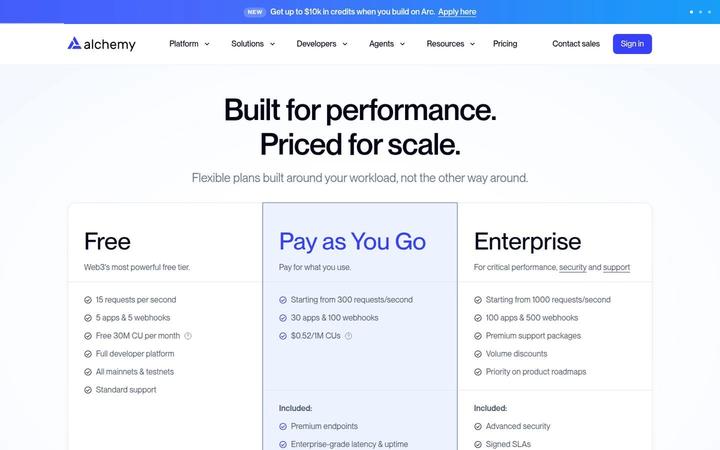
$0.52/1M CUAlchemy prices blockchain infrastructure on one published rate, $0.52 per 1 million compute units, and sells peak throughput as its own meter: $160 for each 5,000 CU/s block above the 300 RPS that Pay as You Go includes. A working estimator itemizes compute, included capacity and overage into a monthly total, so a developer can model the bill before signing up.
Braintrust
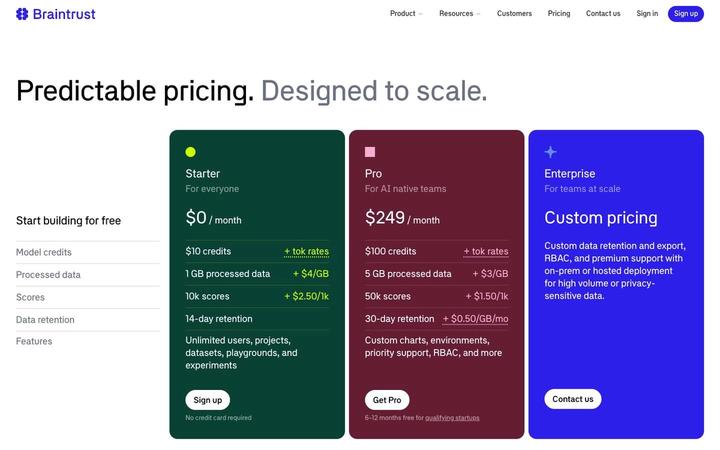
$249/moBraintrust pairs a flat platform fee, $0 on Starter and $249 a month on Pro, with four metered dimensions: model credits, processed data, scores and data retention. Each included allowance sits on the card beside its overage rate, and users, projects and experiments are Unlimited on every tier, so the bill follows traced traffic while headcount stays free.

Mux
$20/moMux prices video by the minute and teaches the unit on the page: a 'What the minute?' explainer, a scenario switcher for what $100 of credit buys, a full rate sheet and an inline estimator with SHOW ME THE MATH. Every plan includes 100K free delivery minutes and 100K Mux Robots units a month, resolution and quality work as multipliers on one base rate, and a dedicated 'AI workflows (Mux Robots)' list prices thirteen AI jobs by minute, job and, for generated text, artifact.

Algolia
From $0.50/1K search requests (after 10K free)Algolia prices hosted search on two meters, search requests and records, and prints the included allowance and the overage rate for both on every pay-as-you-go card. Grow and Grow Plus share the same allowances and record rate, and the request rate carries the AI: '$0.50 per additional 1K search requests' for keyword search, '$1.75' for keyword search with AI capabilities. A usage estimator with sliders for both meters now turns those rates into a starting monthly price per plan, while Elevate sits apart as an annual plan with volume-based discounts.

Augment Code
$20/mo flatAugment Code sells a flat team subscription with usage inside it: Standard is '$20/month flat, no per-seat charge' and Business '$100/month flat', each covering up to 50 seats and loading the same dollar amount of usage every month. Usage is measured in dollars, and the FAQ publishes the formula: LLM inference at 'the provider's public API list price', 'a flat 40% fee on LLM usage (no fee on compute)', and Cosmos compute time. The plan is a prepaid wallet shared by the whole team.

Convex
$25/developer/moConvex pairs a developer seat with a full resource rate card. Free & Starter runs at 'Free or $0/month and pay as you go', Professional is '$25 per developer/month' with larger allowances and lower unit rates, and Business & Enterprise opens at a '$2,500 monthly minimum'. Below the cards, every compute, storage, I/O and egress meter is priced per plan, with a region selector that sets the multiplier.