How Alchemy prices

Captured November 2, 2026 at 1440px wide. The page continues below the crop (9,413px in total).
Alchemy plans and prices
| Plan | Price | Billing |
|---|---|---|
| FreeWeb3's most powerful free tier. | Free | 30M CU per month |
| Pay as You GoHighlightedPay for what you use. | $0.52 | /1M CUs |
| EnterpriseFor critical performance, security and support | Custom |
As printed on the page captured November 2, 2026.
How does Alchemy pricing work?
The value metric is the compute unit, a weighted measure of what each request costs to serve, and Alchemy commits to one rate for it: '$0.52/1M CUs' on the Pay as You Go card, in the 'Detailed pricing' rate card and in the FAQ. Free includes '30M CU per month', and archival data bills at the same CU rate. Capacity is a second meter. Free gets '300 CU/s (15)' requests per second, Pay as You Go gets '10,000 CU/s (300)', and each further '5,000 CU/s block costs $160 per month'. Two smaller meters complete the model: Solana gRPC 'Starting at $75/TB' and gas sponsorship at an '8%' admin fee.
'Built for performance. Priced for scale.' sets the promise, and the plans follow it: Free to get running, Pay as You Go for teams that want spend to rise and fall with their usage, and Enterprise for security, support and scale. That shape suits a customer base full of startups, who value paying only for what they use while their business finds its footing. Pay as You Go is the filled, recommended card. Below the cards sit a guided plan recommender, a feature grid whose Developer tools section spells out spend and access controls plan by plan, the 'Detailed pricing' rate card, Bronze, Silver and Gold support packages, the estimator, a four-step 'How pricing works' explainer and eight FAQ items.
Splitting consumption from peak concurrency mirrors what RPC infrastructure costs to run: a spiky app costs more to serve than a steady one at the same volume, and the capacity meter prices that directly. The estimator turns the blend into a number, with Starter, Growth and Scale presets, sliders for monthly usage and peak throughput, and a default of 27 CUs per request. Its breakdown reads 'Compute usage 270M CU · $0.52 / 1M CUs $140.4' and shows '300 RPS covered · $320 rate waived', which puts a value on the included capacity. 'How pricing works' closes on 'Self-serve capacity ends at 30,000 CU/s', the line where the motion hands over to sales.
What does Alchemy's pricing page do well?
- One published unit rate, '$0.52/1M CUs', appears on the card, in the rate card, in the estimator breakdown and in the FAQ
- The estimator itemizes the bill: compute usage, capacity included with the '$320 rate waived' made explicit, capacity overage, and a total of '$140.4/month'
- Peak throughput is its own meter with a printed block price, '$160 per month' per additional 5,000 CU/s, so spiky workloads can be modeled up front
- 'How pricing works' states the self-serve ceiling outright, so high-throughput teams know where Enterprise begins
- The feature grid lists spend controls row by row, with 'Account spend cap' on the paid plans and 'Admin API requests per month' set at '500' on Free
What does Alchemy's pricing page reveal about its pricing strategy?
- A blended metric: compute units carry consumption, CU/s carries peak load, and apps and webhooks set each plan's shape
- Free throughput is sized at '300 CU/s (15)', a development allowance that points production traffic toward Pay as You Go and its included 300 RPS
- The included 300 RPS is a capacity allowance worth $320 a month, which the estimator surfaces as a waived line item
- An 'Account spend cap' on usage-billed plans gives a team a ceiling on the bill, while 'Per-app CU limits' on Enterprise route through 'Contact sales'
- Support is its own dial: Bronze, Silver and Gold packages with 12, 4 and 2 hour response times sit apart from usage
Learn with Orb
- ProductExperience Kit The estimator itemizes compute, waived capacity and overage into a monthly total; Orb's Experience Kit builds calculators like this from one source of pricing truth so customers can plan spend.
- GuidePay-as-you-go pricing for SaaS Pay as You Go lets startups scale spend up and down at one published rate per million compute units, the structure Orb's pay-as-you-go guide walks through for growing companies.
- ProductPrice modeling Compute units carry consumption and $160 blocks of CU/s carry peak throughput; Orb's price modeling covers multi-dimensional logic like this and changing it without re-engineering billing.
Questions about Alchemy pricing
How much does Alchemy cost?
Alchemy's pricing starts at $0.52/1M CU. The page shows 3 plans, including a free plan, with the top plan priced through sales.
What pricing model does Alchemy use?
Alchemy prices by usage, combined with credits. Buyers can sign up on their own or go through the sales team. Its plans are aimed mainly at developers.
Does Alchemy have a free plan?
Yes, Alchemy has a free plan. Paid plans start at $0.52/1M CU.
Does Alchemy offer an annual discount?
Alchemy's pricing page shows a single billing period. The listed prices start at $0.52/1M CU. Terms for the plans priced through sales are set with the sales team.
How is Alchemy's pricing page laid out?
The page shows 3 plans, highlights Pay as You Go, and includes a comparison table, a calculator and an FAQ. The breakdown above marks 14 points on it: 8 things it does well and 6 insights into the pricing.
What is an Alchemy compute unit and how many CUs does a request use?
Compute Units (CUs) measure the computational resources your application consumes, and each API request uses a number of CUs based on its complexity. Alchemy's FAQ gives the example that a simple JSON-RPC call might use 10 CUs, while more complex operations may use 100+ CUs. For estimating, Alchemy suggests assuming an average of 27 CUs per request, which reflects the most common traffic patterns on its platform. Compute usage on Pay as You Go costs $0.52 per 1 million CUs.
What happens when my Alchemy app goes over 300 requests per second?
Pay as You Go includes 300 RPS (10,000 CU/s), which the estimator shows as a "$320 rate waived" line item. Above that, each additional 5,000 CU/s block costs $160 per month. Self-serve capacity extends up to 30,000 CU/s, and teams that need more can contact sales for a custom capacity quote. Throughput is measured over a rolling 10-second window.
What usage and spend controls does each Alchemy plan include?
The Developer tools grid lists an Account spend cap on Pay as You Go and Enterprise, and Per-app CU limits on Enterprise through Contact sales. Request-log history runs 1 hour on Free and 7 days on Pay as You Go and Enterprise. Free includes 500 Admin API requests per month, while the paid plans show No monthly quota.
From the page as captured November 2, 2026. Current prices are on alchemy.com
Braintrust
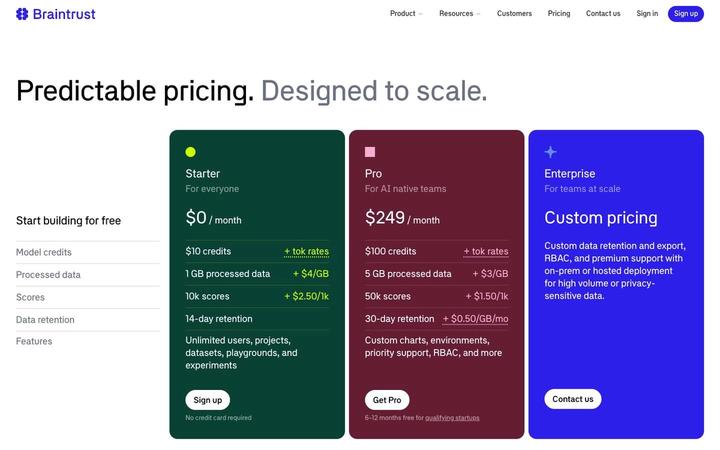
$249/moBraintrust pairs a flat platform fee, $0 on Starter and $249 a month on Pro, with four metered dimensions: model credits, processed data, scores and data retention. Each included allowance sits on the card beside its overage rate, and users, projects and experiments are Unlimited on every tier, so the bill follows traced traffic while headcount stays free.
Mux
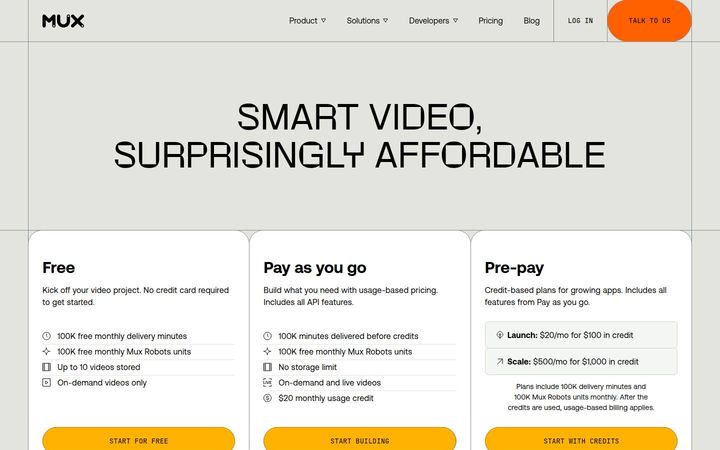
$20/moMux prices video by the minute and teaches the unit on the page: a 'What the minute?' explainer, a scenario switcher for what $100 of credit buys, a full rate sheet and an inline estimator with SHOW ME THE MATH. Every plan includes 100K free delivery minutes and 100K Mux Robots units a month, resolution and quality work as multipliers on one base rate, and a dedicated 'AI workflows (Mux Robots)' list prices thirteen AI jobs by minute, job and, for generated text, artifact.

Neon
$0.106/CU-hourNeon prices serverless Postgres on raw resources, $0.106 per CU-hour and $0.35 per GB-month on Launch, and turns those rates into a budget with a Typical spend figure on each paid card, set by a workload dropdown. Compute scales to zero when idle, so the meter follows real work, and the Free plan states every allowance per project. A rewritten 'Included in every Neon project' section and new FAQ answers on Free plan limits, Claimable Neon and idle compute frame the backend around the database as part of every plan.

Algolia
From $0.50/1K search requests (after 10K free)Algolia prices hosted search on two meters, search requests and records, and prints the included allowance and the overage rate for both on every pay-as-you-go card. Grow and Grow Plus share the same allowances and record rate, and the request rate carries the AI: '$0.50 per additional 1K search requests' for keyword search, '$1.75' for keyword search with AI capabilities. A usage estimator with sliders for both meters now turns those rates into a starting monthly price per plan, while Elevate sits apart as an annual plan with volume-based discounts.

Augment Code
$20/mo flatAugment Code sells a flat team subscription with usage inside it: Standard is '$20/month flat, no per-seat charge' and Business '$100/month flat', each covering up to 50 seats and loading the same dollar amount of usage every month. Usage is measured in dollars, and the FAQ publishes the formula: LLM inference at 'the provider's public API list price', 'a flat 40% fee on LLM usage (no fee on compute)', and Cosmos compute time. The plan is a prepaid wallet shared by the whole team.

Convex
$25/developer/moConvex pairs a developer seat with a full resource rate card. Free & Starter runs at 'Free or $0/month and pay as you go', Professional is '$25 per developer/month' with larger allowances and lower unit rates, and Business & Enterprise opens at a '$2,500 monthly minimum'. Below the cards, every compute, storage, I/O and egress meter is priced per plan, with a region selector that sets the multiplier.