
Captured September 19, 2026 at 1440px wide.
Temporal plans and prices
| Plan | Price | Billing |
|---|---|---|
| Pay-As-You-GoHighlighted | $50 | per million actions |
| Volume DiscountsThe more you run, the less the actions cost. | $25 | per million actions |
As printed on the page captured September 19, 2026.
How does Temporal pricing work?
The value metric is the Action, defined on the page as 'billable operations between your application and Temporal Cloud' and listed as Workflow, Activity, Timer, Signal, Query and Schedule. It sits close to the work the product does: each Action is a step of durable execution. Two storage meters follow the lifecycle of a workflow, $0.042 per GB-hour for Active storage on open workflows and $0.00105 per GB-hour for Retained storage on closed ones, so running work and keeping its history are priced as the two different costs they are. Packaging is a single plan. Pay-As-You-Go starts at $50 per million actions with 'No base monthly fee', Volume Discounts runs self-serve down to $25 per million, and 'Higher Volumes? Larger discounts available via a commit.' opens the sales conversation above that.
The motion is self-serve first with sales at scale. 'No commitment. No minimums. No features locked behind plan upgrades.' leads the hero with 'Start for free with $150 in credits', and the Pay-As-You-Go card carries the gradient 'Get started for free' button and 'Free $150 credits for 90 days'. At the starting rate, $150 covers three million actions. Volume Discounts and every support tier route to Contact Sales, which is where commitments and progressive discounts are shaped. Below the cards sit a link to the page 'in Markdown for easy reference and AI agents', a Support Add-Ons band, a Pricing Structure section that defines Actions and Storage, a tabbed Feature Overview under 'EVERYTHING INCLUDED', a live 'Crash the Worker' demo, eleven FAQs and a closing 'Start free with $150 in credits'.
Under the hood, the price per action falls with volume along a schedule that sits behind 'The more you run, the less the actions cost. +', which points to tiered rate bands between $50 and $25 per million. Support is its own commercial layer. Pay-As-You-Go lists 'Developer support for 10% of usage', and Business is the 'Greater of $500/mo or 10% of usage', a platform fee with a percentage floor that scales with the account. Business includes 2.5M Actions, 2.5M GB Active Storage and 100 GB Retained Storage, and Enterprise and Mission Critical include 10M Actions, 10M GB Active Storage, 400 GB Retained Storage and SCIM, so a support contract carries a block of usage with it. That pairing turns support into a natural home for a commitment, and it is a pattern worth borrowing for any infrastructure product where support cost grows with the size of the deployment.
What does Temporal's pricing page do well?
- Both ends of the self-serve curve are printed, 'STARTING AT $50 per million actions' and 'SELF SERVICE DOWN TO $25 per million actions', so a buyer sees the starting rate and the self-serve floor together
- The billing unit is defined and then enumerated: Workflow, Activity, Timer, Signal, Query and Schedule, which lets a developer map their own code to the meter
- Storage is split by workflow lifecycle, $0.042/GBhr Active for open workflows and $0.00105/GBhr Retained for closed ones
- A Markdown version of the pricing is linked under the cards 'for easy reference and AI agents', a low-cost way to serve buyers who research with software
- A live 'Crash the Worker' demo sits on the pricing page and shows a workflow resuming after its worker is terminated
What does Temporal's pricing page reveal about its pricing strategy?
- With every feature included for every account, the price per action and the support tier carry the whole commercial model, so packaging stays a single plan
- Support priced as the 'Greater of $500/mo or 10% of usage' is a platform fee with a floor that grows with consumption, keeping support revenue in step with the size of the deployment
- Support tiers that include 2.5M or 10M Actions bundle usage with service, which makes the support contract the natural vehicle for a commitment
- The collapsed schedule behind 'The more you run, the less the actions cost.' points to tiered rate bands that step the price from $50 toward $25 per million
- Two storage rates that differ by a factor of 40 price the cost of running a workflow apart from the cost of keeping its history
Learn with Orb
- DocsConfiguring plans: minimums and plan phases Business support bills the greater of $500/mo or 10% of usage, a floor under the account; Orb represents a floor like this as a minimum, adding the difference to the invoice when usage falls short.
- GuideAn AI founder's guide to prepaid credits Volume Discounts run self-serve from $50 down to $25 per million actions, with larger discounts via a commit; the guide covers how commitments earn a better rate and how usage past them bills at overage.
- GuidePay-as-you-go pricing for SaaS Pay-As-You-Go has no base monthly fee and opens with $150 in credits for 90 days; Orb's guide covers pay-as-you-go as a lower barrier to entry with revenue that scales with use.
Questions about Temporal pricing
How much does Temporal cost?
Temporal's pricing starts at $50/M actions. The page shows 2 plans, with the top plan priced through sales.
What pricing model does Temporal use?
Temporal prices by usage. Buyers can sign up on their own or go through the sales team. Its plans are aimed mainly at developers.
Does Temporal have a free plan?
Temporal has no free plan, but its paid plans offer a free trial. The lowest paid plan starts at $50/M actions.
Does Temporal offer an annual discount?
Temporal's pricing page shows a single billing period. The listed prices start at $50/M actions. Terms for the plans priced through sales are set with the sales team.
How is Temporal's pricing page laid out?
The page shows 2 plans, highlights Pay-As-You-Go, and includes an FAQ. The breakdown above marks 14 points on it: 7 things it does well and 7 insights into the pricing.
What counts as an Action in Temporal Cloud pricing?
Temporal defines Actions as "billable operations between your application and Temporal Cloud" and lists them as Workflow, Activity, Timer, Signal, Query and Schedule. Pay-As-You-Go starts at $50 per million actions. Volume Discounts bring the self-service rate down to $25 per million actions, and larger discounts are available via a commit.
How much does Temporal Cloud charge for storage?
Temporal stores workflow event history in two tiers. Active storage for open workflows is $0.042/GBhr, and Retained storage for closed workflows is $0.00105/GBhr. This prices running workflows separately from keeping the history of completed ones.
What do Temporal Cloud support add-ons include?
Pay-As-You-Go comes with "Developer support for 10% of usage". The Business support add-on is priced at the "Greater of $500/mo or 10% of usage" and includes a 2 Hour P0 SLA, 2.5M Actions, 2.5M GB Active Storage and 100 GB Retained Storage. Enterprise and Mission Critical are available through Contact Sales, with a 30 Min P0 SLA 24/7 (15 Min with Mission Critical), 10M Actions, 10M GB Active Storage, 400 GB Retained Storage and SCIM.
From the page as captured September 19, 2026. Current prices are on temporal.io
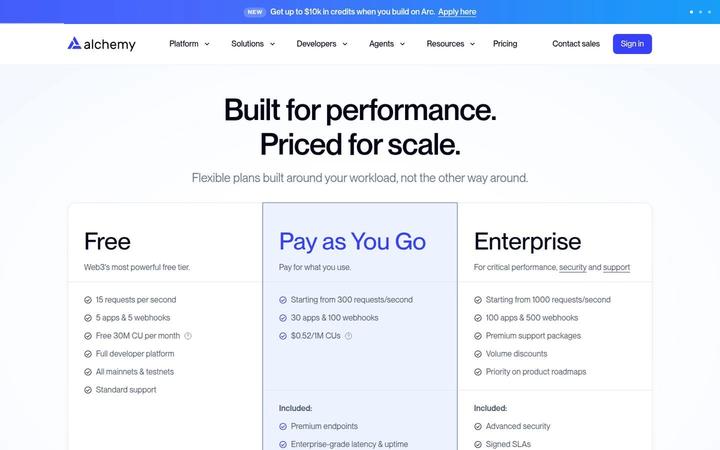
Alchemy
$0.52/1M CUAlchemy prices blockchain infrastructure on one published rate, $0.52 per 1 million compute units, and sells peak throughput as its own meter: $160 for each 5,000 CU/s block above the 300 RPS that Pay as You Go includes. A working estimator itemizes compute, included capacity and overage into a monthly total, so a developer can model the bill before signing up.

Algolia
From $0.50/1K search requests (after 10K free)Algolia prices hosted search on two meters, search requests and records, and prints the included allowance and the overage rate for both on every pay-as-you-go card. Grow and Grow Plus share the same allowances and record rate, and the request rate carries the AI: '$0.50 per additional 1K search requests' for keyword search, '$1.75' for keyword search with AI capabilities. A usage estimator with sliders for both meters now turns those rates into a starting monthly price per plan, while Elevate sits apart as an annual plan with volume-based discounts.

Augment Code
$20/mo flatAugment Code sells a flat team subscription with usage inside it: Standard is '$20/month flat, no per-seat charge' and Business '$100/month flat', each covering up to 50 seats and loading the same dollar amount of usage every month. Usage is measured in dollars, and the FAQ publishes the formula: LLM inference at 'the provider's public API list price', 'a flat 40% fee on LLM usage (no fee on compute)', and Cosmos compute time. The plan is a prepaid wallet shared by the whole team.
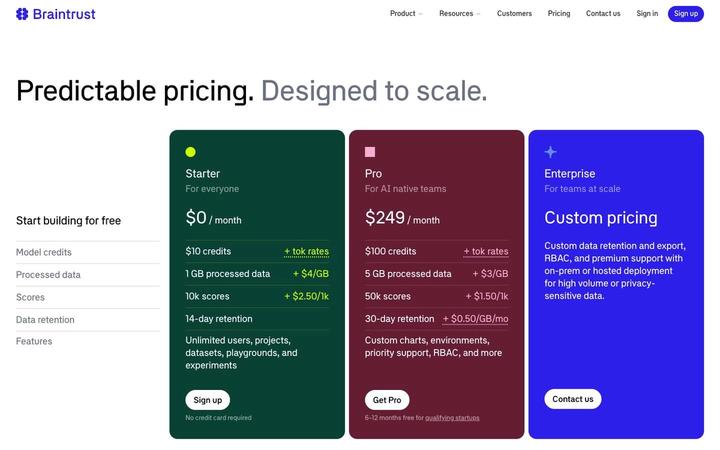
Braintrust
$249/moBraintrust pairs a flat platform fee, $0 on Starter and $249 a month on Pro, with four metered dimensions: model credits, processed data, scores and data retention. Each included allowance sits on the card beside its overage rate, and users, projects and experiments are Unlimited on every tier, so the bill follows traced traffic while headcount stays free.

Convex
$25/developer/moConvex pairs a developer seat with a full resource rate card. Free & Starter runs at 'Free or $0/month and pay as you go', Professional is '$25 per developer/month' with larger allowances and lower unit rates, and Business & Enterprise opens at a '$2,500 monthly minimum'. Below the cards, every compute, storage, I/O and egress meter is priced per plan, with a region selector that sets the multiplier.

LaunchDarkly
$10/Service Connection/moLaunchDarkly prices the software it serves rather than the people who use it: Developer is '$0 / mo, forever' with 'Unlimited seats', Foundation is pay as you go with 'No platform or seat fees', and Enterprise is custom with a trial. Foundation meters three things, '$10 per Service Connection / mo', '$8.33 per 1k client-side MAU / mo' on yearly billing and '$5 per additional 1k runs' of AI, and the comparison table spells out what happens at each plan's limit.