
Captured September 18, 2026 at 1440px wide. The page continues below the crop (12,433px in total).
Tinybird plans and prices
| Plan | Price | Billing |
|---|---|---|
| FreeNo credit card required | Free | |
| DeveloperHighlightedDeploy and scale in production. | $49 | /month |
| SaaSInstant infra for your workloads. | Custom | |
| EnterpriseGuaranteed performance at scale. | Custom |
As printed on the page captured September 18, 2026.
How does Tinybird pricing work?
Compute is the value metric, stated in the subhead as 'Tinybird's pricing scales elastically based on compute'. Plans step up by vCPU capacity: Free on 0.25 vCPUs with 1k requests per day and 10GB included storage, Developer at '0.25 to 8 vCPUs' and 'Starting at $25/month', SaaS 'Up to 32 vCPUs' with 500GB included storage, and Enterprise with 'Unlimited vCPUs' on dedicated infrastructure. Pricing compute rather than queries fits a ClickHouse service, where the cost of a query varies widely with the data it scans, and every paid plan lists 'Unlimited' queries per day. Commodity rates sit beside the compute ladder and stay the same in every paid column: $0.058/GB storage, $0.01/GB intra-cloud egress, $0.10/GB inter-cloud egress, $0.016/GB private networking, with vCPU overages at $0.0002/second on Developer and SaaS.
The motion runs self-serve through Developer and turns to a conversation from SaaS up. Free sits in a full-width banner with 'No credit card required' and 'Start building', Developer carries the filled green 'Start building' button and a live slider, and SaaS and Enterprise read 'Custom' with 'Estimate your price', which keeps room to set capacity, support level and a yearly commitment for each account. Below the cards come 'Compare plans', a customer logo strip, a comparison table in labeled sections from Infra through Organization features with the plan row repeated at its foot, an OSS program, an 'ENTERPRISE READY' band with 'Contact sales', compliance cards, nine FAQs and a closing 'Deploy your first ClickHouse project now'.
Under the hood, the bill is a capacity fee plus metered rates. The Developer card shows $49/month at the default 0.5 vCPUs while the table header reads 'Starting at $25/month' against a '0.25 to 8 vCPUs' range, which points to a price that tracks the slider position from the bottom of that range upward. Overages on compute are billed per second at $0.0002, so a burst above provisioned capacity is charged for the time it runs. The table also quantifies the operational limits that shape a deployment, threads and memory per request, Events API throughput, Kafka topics, sink pipes and data branches, and prices AI as its own line with '$100' and '$200' of LLM credits included plus 'LLM usage based'. Pricing AI features in the same table as compute and storage is a pattern worth borrowing as data products add agents and MCP servers.
What does Tinybird's pricing page do well?
- A live vCPU slider on the Developer card ties the price to the exact resource the product bills for, so one interaction teaches the model
- Free is a full-width banner with concrete limits: 0.25 vCPUs, 1 thread/request, 1k requests per day, 10GB included storage and community support
- Unit rates are identical across the paid plans, $0.058/GB storage and $0.01, $0.10 and $0.016/GB for the three transfer types, so a buyer can model them before choosing a plan
- The comparison table quantifies operational limits per plan, such as '10MB req / table 100 req / sec' on the Events API and 3, 6 or 15 data branches
- The plan row with prices and buttons repeats at the foot of the comparison table, giving a second place to act after reading the rows
What does Tinybird's pricing page reveal about its pricing strategy?
- Pricing on compute rather than per query keeps the bill tied to Tinybird's own cost, and it lets every paid plan carry unlimited queries per day
- Flat storage and egress rates across plans make the plan decision about capacity and support, with data volume billed the same way at every tier
- Overages at $0.0002/second price bursts above provisioned vCPUs by the second, a fine-grained meter that matches how analytical load spikes
- 'Custom' with 'Yearly commitments discount' on SaaS and Enterprise points to a commit-and-discount motion for the capacity where deals grow
- LLM credits of $100 and $200 included per plan, with usage beyond that metered, treat AI features as a pass-through cost with a starter allowance
Learn with Orb
- ProductExperience Kit A vCPU slider inside the Developer card moves the price from $49/month as capacity changes; Experience Kit builds pricing calculators like this on one source of pricing truth so customers can plan spend.
- Guide14 usage-based pricing examples Tinybird meters compute in vCPUs, with per-second overages at $0.0002 and unlimited queries per day on paid plans; Orb's fourteen examples show what other usage-based companies choose to meter.
- GuideAn AI founder's guide to prepaid credits SaaS and Enterprise read Custom with a yearly commitments discount; Orb's CTO covers how a commitment earns a better rate and how usage past the commitment bills at an overage rate.
Questions about Tinybird pricing
How much does Tinybird cost?
Tinybird's pricing starts at $25/mo. The page shows 4 plans, including a free plan, with the top plan priced through sales.
What pricing model does Tinybird use?
Tinybird prices by usage. Buyers can sign up on their own or go through the sales team. Its plans are aimed mainly at developers.
Does Tinybird have a free plan?
Yes, Tinybird has a free plan. Paid plans start at $25/mo.
Does Tinybird offer an annual discount?
Tinybird's pricing page shows a single billing period. The listed prices start at $25/mo. Terms for the plans priced through sales are set with the sales team.
How is Tinybird's pricing page laid out?
The page shows 4 plans, highlights Developer, and includes a comparison table, a calculator and an FAQ. The breakdown above marks 14 points on it: 8 things it does well and 6 insights into the pricing.
How much does Tinybird charge for vCPU overages?
Tinybird bills vCPU overages at $0.0002/second on both the Developer and SaaS plans. Developer covers "0.25 to 8 vCPUs" and SaaS goes "Up to 32 vCPUs", so usage above provisioned compute is metered by the second. Enterprise lists "Unlimited vCPUs" on dedicated infrastructure.
What does Tinybird charge for storage and data transfer?
Storage costs $0.058/GB on every paid plan, with 25GB included on Developer, a starting point of 500GB on SaaS, and "Bottomless storage" on Enterprise. Data transfer uses three flat rates across the paid plans: $0.01/GB for intra-cloud egress, $0.10/GB for inter-cloud egress, and $0.016/GB for private networking. The Free plan includes 10GB of storage.
Does Tinybird include LLM credits for its AI features?
Yes, Tinybird includes LLM credits with its paid plans: $100 on Developer and $200 on both SaaS and Enterprise. Usage beyond the included credits is listed as "LLM usage based". The AI Features section of the comparison table also lists Explorations and a Remote MCP server.
From the page as captured September 18, 2026. Current prices are on tinybird.co
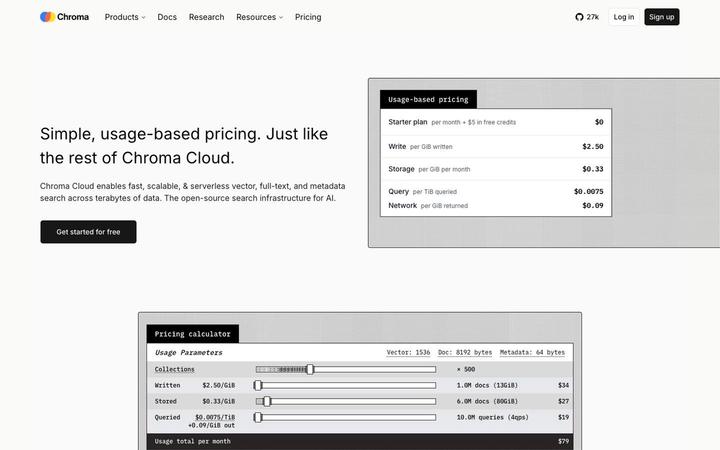
Chroma
$250/mo + usageChroma prints all four metered rates in the hero, Write at $2.50 per GiB, Storage at $0.33 per GiB per month, Query at $0.0075 per TiB and Network at $0.09 per GiB returned, then hands the reader a calculator that turns documents and queries into a $79 monthly total. Plans sit on top of the meter: Starter at $0 plus usage, Team at $250 a month plus usage with $100 in credits, and Enterprise on custom terms.
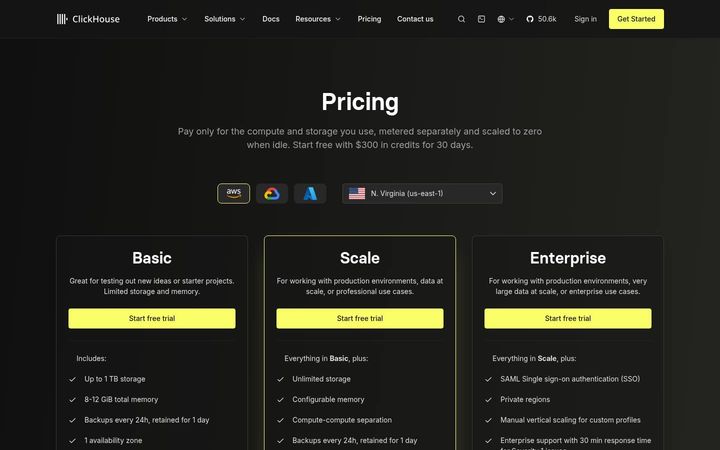
ClickHouse
$0.2181/compute unit/hrClickHouse opens with its model in one line, 'Pay only for the compute and storage you use, metered separately and scaled to zero when idle.', sets the cloud and region, then gives every tier the same two meters: storage flat at '$25.30 Per 1TB / mo' and compute at $0.2181, $0.2985 and $0.3903 per unit per hour. The estimator opens pre-filled with a 1 TB real-time analytics workload at '$658' a month, and an eight-question FAQ explains each line that can appear on the bill.
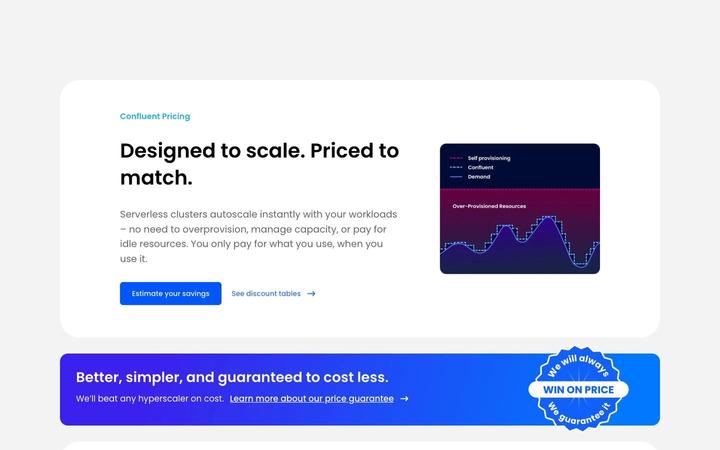
Confluent
~$385/moConfluent prices serverless Kafka on a composite meter, eCKU-hours plus data in and out per GB plus storage per GB-month, and closes its rate table with an 'Estimated Monthly Starting Cost' of $0, $385, $895 and $2,300 that turns an hourly unit into a budget number. Behind it sit two discount structures and an annual commitment that can be spent across the whole Confluent Cloud stack.

CoreWeave
From $6.50/instance/hrCoreWeave publishes a full rate card: twelve GPU instance types and ten CPU types, each priced per hour on-demand and spot for North America and Europe, then storage, networking, Direct Connect and managed Kubernetes. The unit is a fully specified instance-hour, with GPU count, VRAM, vCPUs, system RAM and local storage printed beside every rate. Reserved capacity, the newest silicon and every next step run through the sales team, which is where a GPU cloud shapes committed deals.
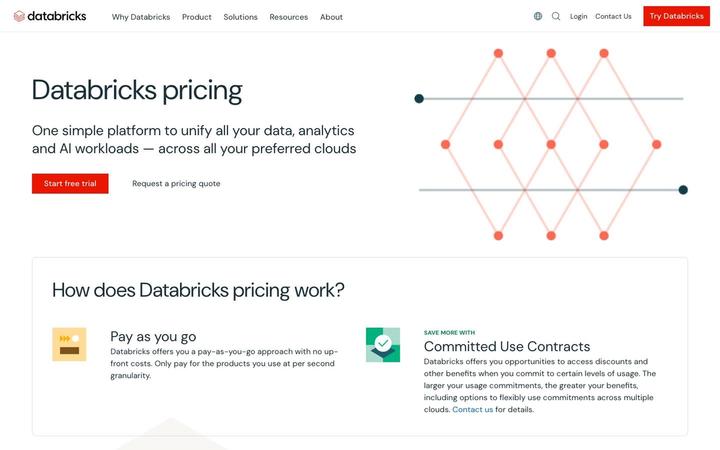
Databricks
From $0.069/CUDatabricks prices a whole data platform on one consumption unit, the DBU, with seven workload tiles that each print a 'Starting at' rate and link to a full SKU price list. Billing runs 'at per second granularity' on pay-as-you-go, and Committed Use Contracts trade larger commitments for discounts that can flex across clouds. The page works as the front door to a rate table, organized by the job a customer is doing.

Datadog
$15/host/moDatadog publishes a rate card per product, with every billable SKU listed in a left-hand navigator from AI Credits to Workflow Automation. Infrastructure Monitoring prices per host across three host levels: Basic, set with sales, beside Pro starting at $ 15 and Enterprise at $ 23 billed annually, with on-demand rates printed beside them and allotments of containers, custom metrics and custom events attached to each paid host. The bill is the sum of the products a customer adopts, and Basic hosts let one account price noncritical workloads at their own level.