How Factory prices
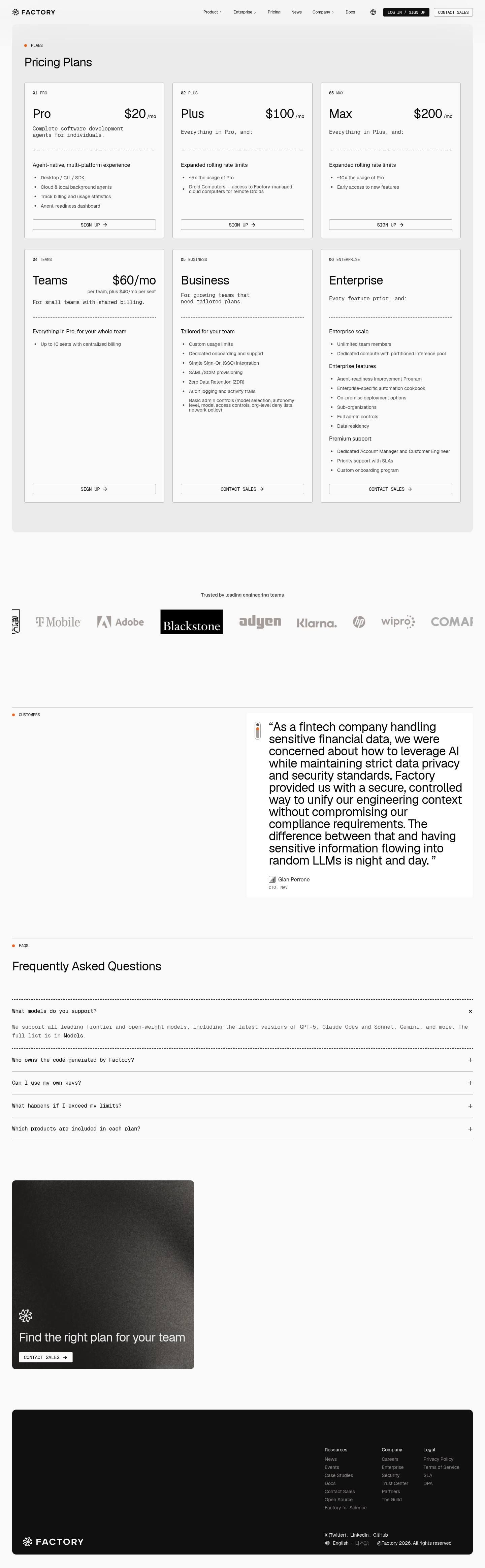
Captured November 2, 2026 at 1440px wide.
Factory plans and prices
| Plan | Price | Billing |
|---|---|---|
| ProComplete software development agents for individuals. | $20 | /mo |
| Plus | $100 | /mo |
| Max | $200 | /mo |
| TeamsFor small teams with shared billing. | $60 | /mo per team, plus $40/mo per seat |
| BusinessFor growing teams that need tailored plans. | — | |
| Enterprise | — |
As printed on the page captured November 2, 2026.
How does Factory pricing work?
Usage of Factory's agents is the value metric, sold in flat subscription sizes and, for teams, combined with seats. Pro at $20/mo is the base unit and carries the full agent experience: Desktop / CLI / SDK, cloud and local background agents, and usage statistics. Plus at $100/mo adds "Expanded rolling rate limits" at "~5x the usage of Pro" and access to Factory-managed cloud computers for remote Droids, and Max at $200/mo reaches "~10x the usage of Pro" with "Early access to new features". The price per multiple of Pro usage stays at $20 on all three, so a developer scales capacity at a constant rate. Teams prices a shared workspace at "$60/mo per team, plus $40/mo per seat" for up to 10 seats, Business is "Tailored for your team" and leads with "Custom usage limits", and Enterprise offers "Unlimited team members".
The motion is hybrid and the line falls at team size. Pro, Plus, Max and Teams end in SIGN UP, so an individual developer or a team of up to ten buys online, and Business and Enterprise end in CONTACT SALES, where seat counts, usage limits and deployment are set per account. The page is compact and engineered in tone: a "Pricing Plans" heading, a 3x2 grid of cards with monospace eyebrows numbered 01 PRO through 06 ENTERPRISE, a logo band under "Trusted by leading engineering teams" with T-Mobile, Adobe, Blackstone, Adyen, Klarna, HP, Wipro and Comarch, a single quote from the CTO of NAV on data privacy, a Frequently Asked Questions section of five expandable questions with the first one open, and a closing tile, "Find the right plan for your team". The upper tiers lead with control, from SSO and Zero Data Retention to data residency and on-premise deployment, which signals a buyer in regulated industries.
Under the hood, the bill stays flat and capacity is what scales. "Expanded rolling rate limits" describe an allowance that refills over a time window, so heavy use is managed by plan choice and the invoice stays predictable, and the FAQ names the edge of that allowance directly with "What happens if I exceed my limits?". The open answer, "We support all leading frontier and open-weight models, including the latest versions of GPT-5, Claude Opus and Sonnet, Gemini, and more.", sits beside "Can I use my own keys?", which points to model access as a layer that can run apart from the subscription, keeping pass-through model cost separate from the agent platform Factory charges for. Teams is a platform fee plus seats: the $60 team fee carries the shared workspace and centralized billing, and each $40 seat adds a person. Business lists "Custom usage limits" as its first line and prints no seat range, and Enterprise adds "Dedicated compute with partitioned inference pool", inference capacity sold as reserved compute. Worth borrowing: expressing each tier as a multiple of a base plan at a constant rate makes the upgrade math something a buyer does in their head.
What does Factory's pricing page do well?
- Monospace eyebrows numbered 01 PRO through 06 ENTERPRISE present six plans as one ordered ladder
- Plus and Max are priced as multiples of Pro at a constant $20 per multiple, so the upgrade math is immediate
- Four of six plans end in SIGN UP, so an individual or a team of up to ten buys without a conversation
- Teams states its ceiling, "Up to 10 seats with centralized billing", so a growing team sees exactly where self-serve hands off to Business
- The FAQ opens "What models do you support?" with its answer already expanded and a link to the full Models list
What does Factory's pricing page reveal about its pricing strategy?
- Usage is sold as a multiple of the base plan, "~5x" and "~10x" the usage of Pro, which keeps the offer simple for agent work whose cost varies by task
- Rolling rate limits point to an allowance that refills over a time window, and "What happens if I exceed my limits?" makes the edge of that allowance a named FAQ topic
- "Can I use my own keys?" beside a multi-model answer places model access as a layer the plans sit above: Factory prices the agent and keeps model choice open
- Business opens on "Custom usage limits" and prints no seat range, so usage and team size are both terms sales shapes for each account
- "Dedicated compute with partitioned inference pool" on Enterprise sells reserved inference capacity, the resource that drives cost at scale
Learn with Orb
- GuideBuild a pricing and packaging strategy in 9 steps Six numbered plans run from Pro to Enterprise, with Teams up to 10 seats and Business up to 150, the who-each-plan-is-for and lineup scaling that Orb's packaging guide covers.
- GuidePricing AI agents: plans, costs and monetization models Plus and Max sell agent usage as multiples of Pro at a constant $20 per multiple, one of the models for pricing AI agents that Orb's guide lays out with how to meter the work.
- GuideAn expert's guide to enterprise pricing for SaaS Business sets custom usage limits and Enterprise adds dedicated compute with a partitioned inference pool, the terms Orb's enterprise pricing guide covers when prices are set deal by deal.
Questions about Factory pricing
How much does Factory cost?
Factory's pricing starts at $20/mo. The page shows 6 plans, with the top plan priced through sales.
What pricing model does Factory use?
Factory prices on a hybrid of seats and usage, combined with flat-rate tiers. Buyers can sign up on their own or go through the sales team. Its plans are aimed mainly at developers.
Does Factory have a free plan?
Factory's pricing page shows no free plan or free trial. The lowest paid plan starts at $20/mo.
Does Factory offer an annual discount?
Factory's pricing page shows a single billing period. The listed prices start at $20/mo. Terms for the plans priced through sales are set with the sales team.
How is Factory's pricing page laid out?
The page shows 6 plans and includes an FAQ. The breakdown above marks 14 points on it: 6 things it does well and 8 insights into the pricing.
How much more usage do Factory Plus and Max include than Pro?
Factory Plus at $100/mo includes "~5x the usage of Pro" and Max at $200/mo includes "~10x the usage of Pro", both with "Expanded rolling rate limits". Plus also adds Droid Computers, "access to Factory-managed cloud computers for remote Droids", and Max adds "Early access to new features". Each step works out to $20 per multiple of Pro usage.
How does Factory Teams pricing work and how many seats does it include?
Factory Teams is priced at "$60/mo per team, plus $40/mo per seat" and is built "For small teams with shared billing." It includes "Everything in Pro, for your whole team" and supports "Up to 10 seats with centralized billing". Teams is self-serve with a SIGN UP button, and larger teams move to Business.
Which AI models can I use with Factory's plans?
Factory's FAQ answers: "We support all leading frontier and open-weight models, including the latest versions of GPT-5, Claude Opus and Sonnet, Gemini, and more." The full list sits on a linked Models page. On Business, admin controls include model selection and model access controls, so an organization sets which models its team uses.
From the page as captured November 2, 2026. Current prices are on factory.com
Hugging Face
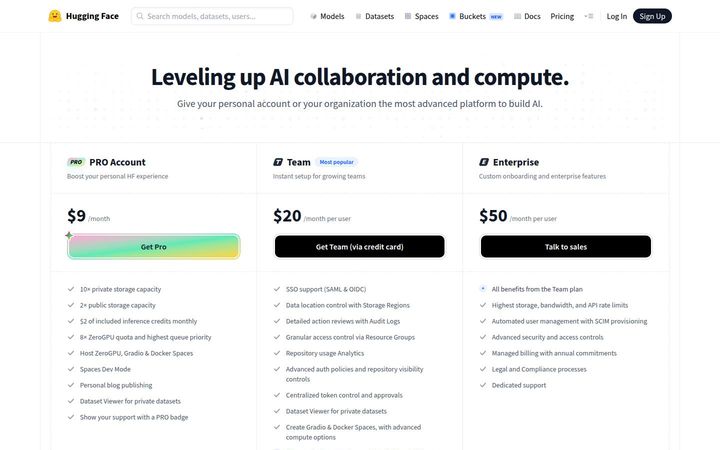
$9/moHugging Face publishes four price lists on one page: seats at $9, $20 and $50 per month, storage from $8 to $18 per TB with volume breaks, Spaces hardware by the hour from FREE, and Inference Endpoints from $0.033 per hour. PRO now includes '$2 of included inference credits monthly', a dollar-denominated allowance beside its storage multiples. The seat buys governance and collaboration, while the meters carry the cost of storing and running models, so the account scales with the AI workload it hosts.
Weights & Biases
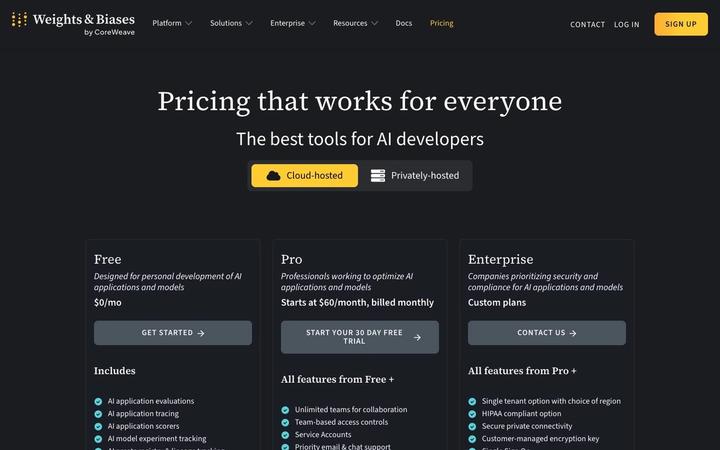
From $60/moWeights & Biases pairs seats with usage: Pro 'Starts at $60/month, billed monthly' with up to 10 Model seats, then storage at $0.03/GB above 100 GB and Weave data ingestion at $0.10/MB above 1.5 GB a month. The model splits the seat by workload, Model seats for training and fine-tuning and Weave seats for GenAI applications, and a Cloud-hosted and Privately-hosted toggle settles deployment before any price appears.

Baseten
From $0.01/1M tokensBaseten layers a three-tier service ladder over published rate sheets. Basic is '$0 per month, pay as you go', and Pro and Enterprise carry 'Volume discounts available' with 'GET A QUOTE'. Underneath sit three meters: Model APIs per 1M tokens across 19 model rows with Input, Cache Input and Output columns, opening with joey-1 at $0.01 input, dedicated GPU and CPU instances billed 'down to the minute', and the same GPU grid for training.