8 SaaS pricing best practices with concrete examples
Eight practices with examples, from understanding the customer base to free plans generous enough to attract users and limited enough to prompt an upgrade.
Pricing pages that combine a seat price with metered usage: a platform fee per person, and a rate for the work the product does on top. A common shape for software adding AI features to a seat-based product.
Of the 25, 17 show a free tier, 16 include a comparison table, 6 a calculator and 21 keep a contact-sales tier.

Attio prices its CRM per user and runs usage on credits in two pools: seat credits that grow with headcount, from 100 to 2,500 per user per month, and a shared workspace pool. A published top-up ladder sells more workspace credits from +5,000 a month at $70 annually to +50,000 at $475, so a growing bill can be modeled from the page. Credits open the comparison table, ahead of every feature.

Cursor sells AI usage in multiples of one plan: Free is $0 /month, Plus $8 /month, Premium $30 /month and Super $100 /month on the cards, with Ultra at $200/month, Teams at $30+/user/month and a Custom Enterprise tier in the comparison table. Each paid step is defined as more usage compared to Plus, and the subscription bundles Cursor, Grok and X benefits into one plan. Third-party models sit outside the price at API list rates, which keeps pass-through cost apart from the bundle.
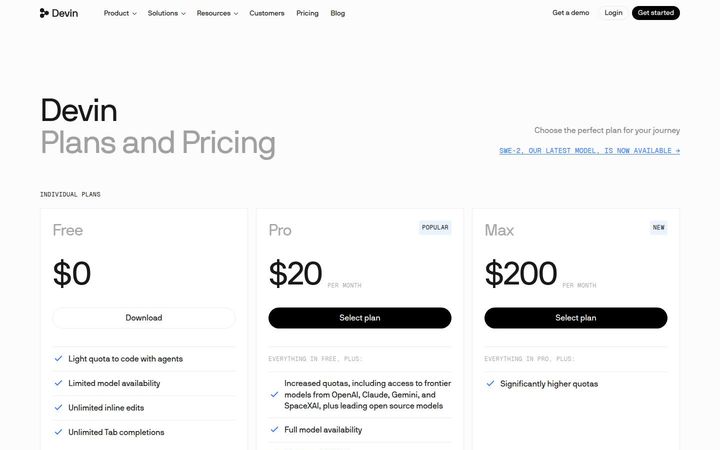
Devin sells agent usage as subscription quotas: Free, Pro at $20, Max at $200, a Teams plan at $80 per month plus $40 per full dev seat for up to 200 users, and Enterprise by conversation. Each paid plan carries an allowance that refreshes daily and weekly, and usage past it is bought 'at API pricing', so the subscription covers typical work and the meter covers the heavy days. The Teams line prints a two-part tariff, a platform fee plus a seat price, in one sentence, and a 200-user ceiling marks where Enterprise begins.
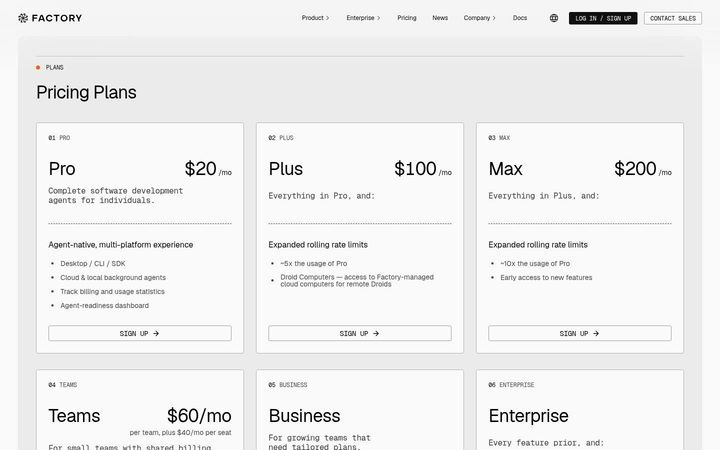
Factory sells its software development agents as six numbered plans: three individual subscriptions at $20, $100 and $200 a month, a Teams plan at $60/mo per team plus $40/mo per seat, and Business and Enterprise shaped with sales. The individual ladder is one rate sold in three sizes: Plus is "~5x the usage of Pro" for five times the price and Max is "~10x the usage of Pro" for ten times, so every step holds at $20 per multiple of Pro. A five-question FAQ now opens on model support and names the billing edges a buyer checks, from using your own keys to exceeding limits.

Front prices three seat tiers at $25, $65 and $105 per seat per month and layers Front AI on top: Copilot at $20 per seat on Starter and Professional, and Autopilot metered at $0.05 per conversation. Every rate is printed, Enterprise included, and Enterprise carries Copilot, Smart QA and Smart CSAT in its seat price, which makes the top tier the home of the full AI suite. External AI agents and Compass are included on every plan.

Gusto prices payroll as a platform fee plus a per-person fee on every plan, from "$49/mo + $6/mo per person" on Simple to "$180/mo + $22/mo per person" on Premium. Below the plans sits a full add-on catalog with a published price for nearly every service, each unit matched to the work it covers: per payment, per payroll, per state, per submission, per participant, or a share of tax credits found.

Hex bills per Editor, "$36 per Editor / month" on Professional and "$75 per Editor / month" on Team, and opens its comparison table with "Unlimited users", so the people who read published apps carry no seat cost. Alongside the seat, AI credits and compute profiles step up by plan, from Limited to Premium credits and from Small compute to advanced compute add-ons, a hybrid of seats for builders and capacity for the work they run.
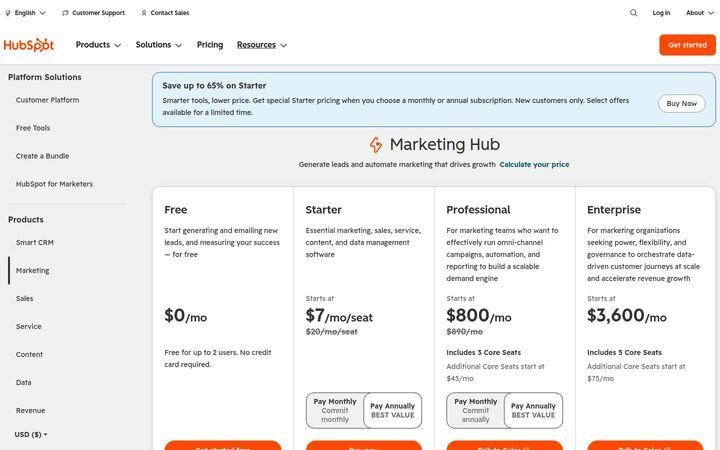
HubSpot's Marketing Hub blends four meters into one plan, a platform price, Core Seats, a marketing contact tier and a pool of HubSpot Credits for AI agents, and adds a one-time onboarding fee at Professional and Enterprise. Seat expansion, onboarding fees and the Enterprise floor are all printed, and the HubSpot Credits section frames AI usage around buying choice and control: 'Buy credits in packs to easily plan your spend or Pay-as-You-Go for added flexibility', backed by action-level spend limits.
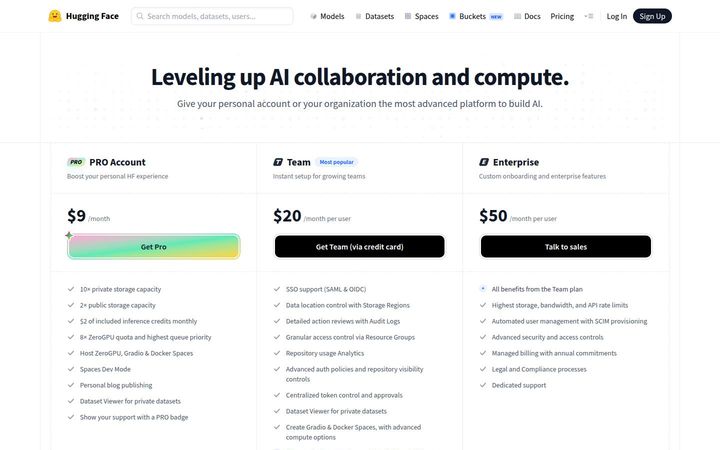
Hugging Face publishes four price lists on one page: seats at $9, $20 and $50 per month, storage from $8 to $18 per TB with volume breaks, Spaces hardware by the hour from FREE, and Inference Endpoints from $0.033 per hour. PRO now includes '$2 of included inference credits monthly', a dollar-denominated allowance beside its storage multiples. The seat buys governance and collaboration, while the meters carry the cost of storing and running models, so the account scales with the AI workload it hosts.
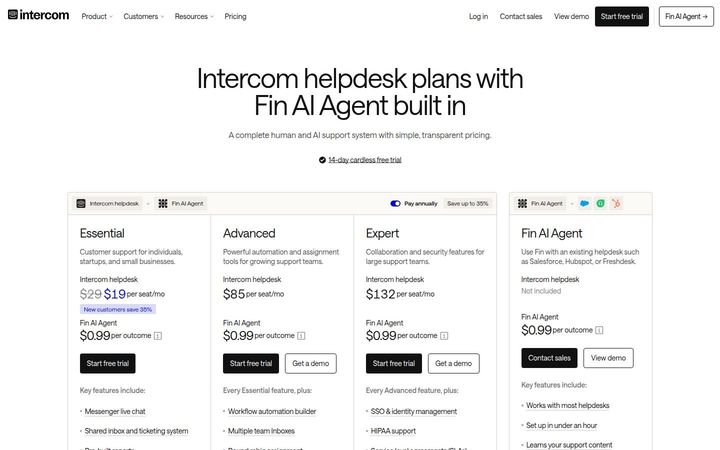
Intercom prints two price lines on every card: an Intercom helpdesk seat price of $19, $85 or $132 per seat/mo with 'Pay annually' on, and 'Fin AI Agent $0.99 per outcome' for the AI agent's resolved work. A fourth card sells Fin on its own with the helpdesk 'Not included', and a live cost estimator plus a section of outcome rules sit between the cards and the add-ons.

LangSmith sells three plans: Developer at $0 per seat, Plus at $39 per seat and a custom Enterprise, with the two self-serve plans followed by 'then pay as you go'. Every service beyond the seat meters in one unit, 'LangChain Standard Units. $1.00 / LSU', at a published rate per resource. A usage calculator built as a stack picker turns those rates into a monthly estimate a buyer can share.
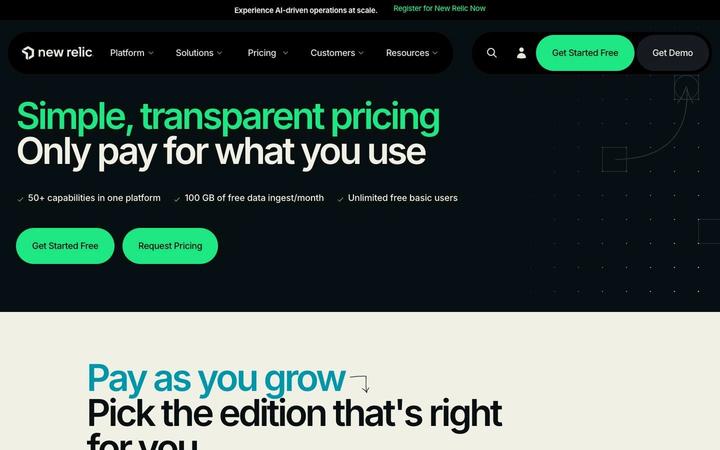
New Relic bills observability on three components: data ingest at $0.40/GB beyond a free 100 GB, users priced by type, and Advanced Compute in compute capacity units. Hosts are free, 'unlimited hosts at no additional cost', so the bill follows the two things that grow with an observability practice, the data flowing in and the people who work with it.

Replit sells subscriptions that carry a dollar allowance for AI models, '$20 towards more powerful models' on Core and '$100 towards most powerful models' on Pro, with metering behind it on Effort-Based Pricing. The Pro card holds a credit dropdown that steps from '$90 / month' to '$2,000 / month', and the Enterprise card reads as a governance package led by 'SSO, SCIM & audit logs'.

Retool prices two seat types as a sum on each card, $10 a month per builder plus $5 a month per internal user on Team and $50 plus $15 on Business, and layers workflow runs, pooled AI credits and agent hours on top. The cards read as aligned checklists of included and not-included features, and the comparison table publishes the secondary meters, from an external user volume curve to additional workflow runs at '$75 per 5,000 runs per month'.
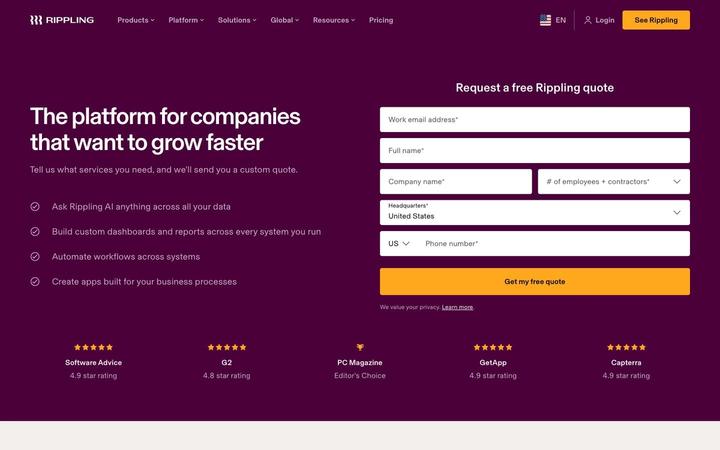
Rippling's pricing page is a quote request: 'Tell us what services you need, and we'll send you a custom quote.' The form asks for headcount in five bands and a headquarters country, the two inputs a modular HR, IT, payroll and finance suite needs to build a price, and the page backs the ask with third-party ratings and named customer results.
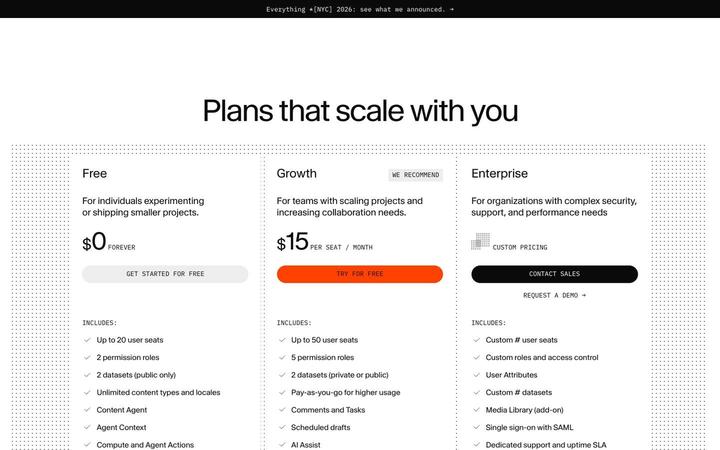
Sanity charges '$15 PER SEAT / MONTH' on Growth and meters the content platform underneath: documents, API requests, bandwidth, assets, embeddings, AI credits, functions and compute each carry a printed overage rate in the comparison table. Seats price the editorial team, usage prices the delivery workload, and three add-ons price support, quota and datasets as fixed monthly blocks.
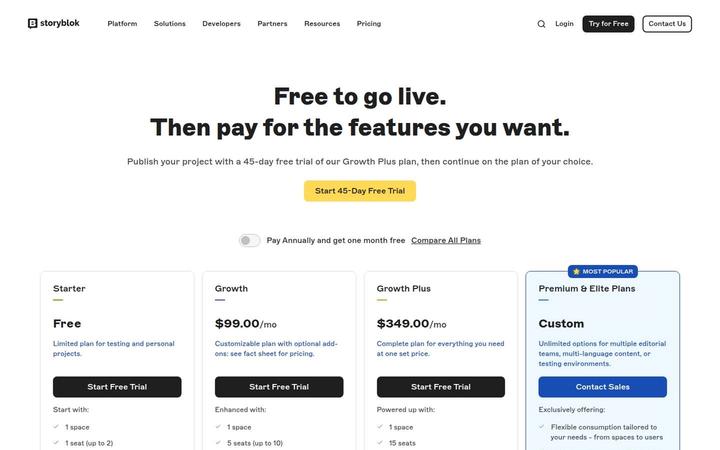
Storyblok prices its headless CMS as a base plan plus five meters, seats, traffic, API requests, locales and AI credits, and each card prints the allowance with its ceiling. Growth at $99.00 /mo is a 'Customizable plan with optional add-ons: see fact sheet for pricing.', Growth Plus at $349.00 /mo is a fixed bundle positioned as 'Complete value', and the 'MOST POPULAR' star sits on the custom Premium & Elite plans.
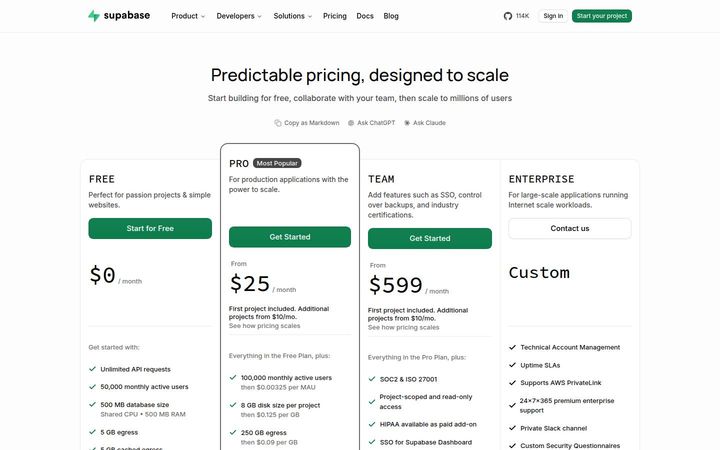
Supabase prices its Postgres platform as a plan fee plus metered usage: Free at $0, Pro from $25 a month, Team from $599 and Enterprise on contact, with every metered line on the Pro card printing the included quota and the rate beyond it. Compute is a published ladder from Micro at $10 to 16XL at $3,730, a $10 monthly credit covers the first instance, and logs are now metered too, with Log Ingestion at '20 GB included then $0.50 per GB' on paid plans. A spend cap on by default makes 'Predictable pricing, designed to scale' a literal promise.
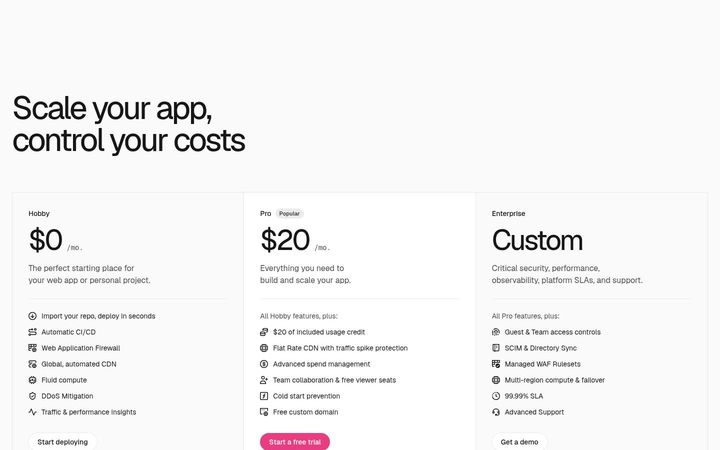
Vercel prices a cloud platform as a seat plus usage: Pro is $20 a month per developer seat and includes '$20 of included usage credit', so the seat fee doubles as a usage allowance before metered rates apply. Beneath three plan cards sits a full rate card in which every metered resource prints its included quota and its overage price on the same row, from CDN Requests to build minutes, and it now extends to Vercel Drives, Vercel Daemons, Deployment Storage and Tracing Spans.
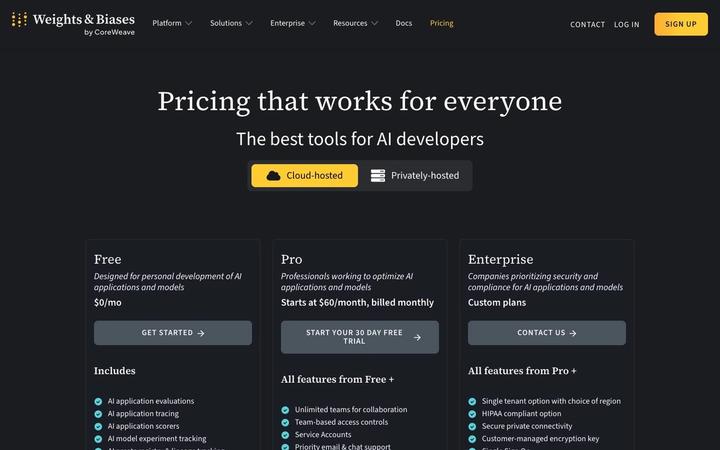
Weights & Biases pairs seats with usage: Pro 'Starts at $60/month, billed monthly' with up to 10 Model seats, then storage at $0.03/GB above 100 GB and Weave data ingestion at $0.10/MB above 1.5 GB a month. The model splits the seat by workload, Model seats for training and fine-tuning and Weave seats for GenAI applications, and a Cloud-hosted and Privately-hosted toggle settles deployment before any price appears.

dbt sells developer seats with a models-built allowance attached, from a free Developer plan to Starter at $100 per user/month and two custom Enterprise tiers. The two products whose cost tracks workload, dbt State and dbt Wizard, sit in their own add-on section under 'No seats, no minimums.', and can be bought even by teams running self-hosted dbt. dbt State introduces a new unit, the Daily Active Target Table, defines it in one sentence and prices it at $0.094.

ClickUp prices on seats with AI built into every plan: Free Forever at $0, Core at $9 and Business at $17 per 'user / mo · billed yearly' against struck regular prices, Enterprise at 'Custom', and a MAX plan at $100. Each tier carries its own pooled credit allowance, with top-ups at '$10 per 10K credits', framed by a '100% Money-back Guarantee', a written 'SUPER FAIR BILLING POLICY' and a savings calculator that ends in 'Get a quote'.
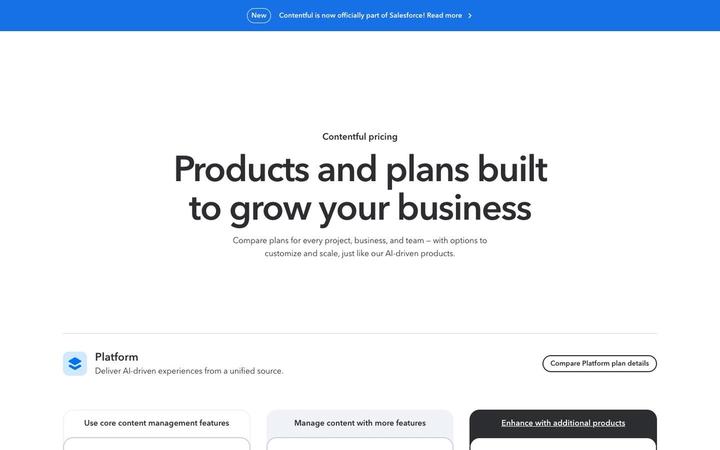
Contentful sells its Platform in three bundles, Free at '$0 / forever', Lite at '$300 / month' and Enterprise at Custom, each defined by allowances of users, roles, locales, API calls and CDN bandwidth. The page frames buying as two steps, 'Step 1: Pick a Platform plan' and 'Step 2: Add to your Enterprise plan', where Personalization, AI Actions and Studio join the top plan as modules: a content platform sold as a core plus products.
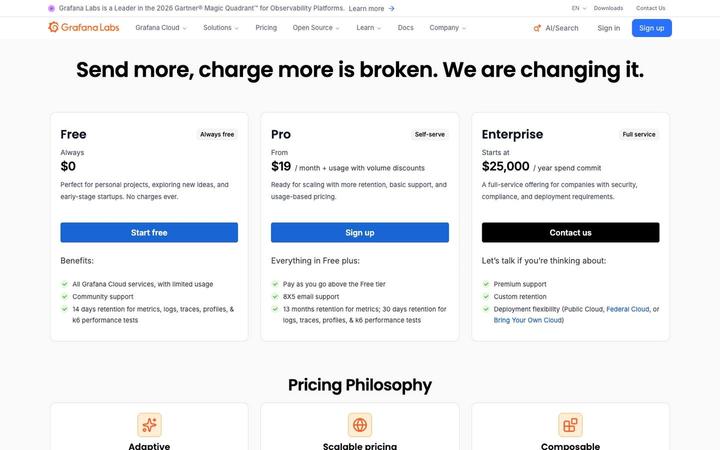
Grafana Cloud prices on a $19 per month platform fee that carries an allowance on every product, then a usage meter chosen per product, with volume tiers that lower the marginal rate as a customer grows. The hero states the thesis, 'Send more, charge more is broken. We are changing it.', and the page backs it with an embedded calculator that draws the tier curve and a cost-reduction band under the rates. Enterprise prints its entry point: 'Starts at $25,000 / year spend commit'.

A launch page for a pricing model: HubSpot Credits are announced like a product, with the controls around spend as the headline. Three principles, one public rate of $10/1,000 credits, an outcomes-first estimator and four controls customers hold themselves make the case that credits are safe to adopt.
Eight practices with examples, from understanding the customer base to free plans generous enough to attract users and limited enough to prompt an upgrade.
Orb's CEO on the main SaaS pricing models, from flat rate and per seat to usage-based and hybrid, how each structures the way customers pay, and how to choose among them.
Orb's CEO on enterprise pricing: how it differs from SMB pricing, the main enterprise models, and what to weigh when prices are set deal by deal.