Pricing pages from companies billing on Orb
Pricing pages from companies that run their pricing and billing on Orb.
Of the 26, 18 price by usage, 16 show a free tier, 16 include a comparison table, 7 a calculator and 25 keep a contact-sales tier.
Alchemy
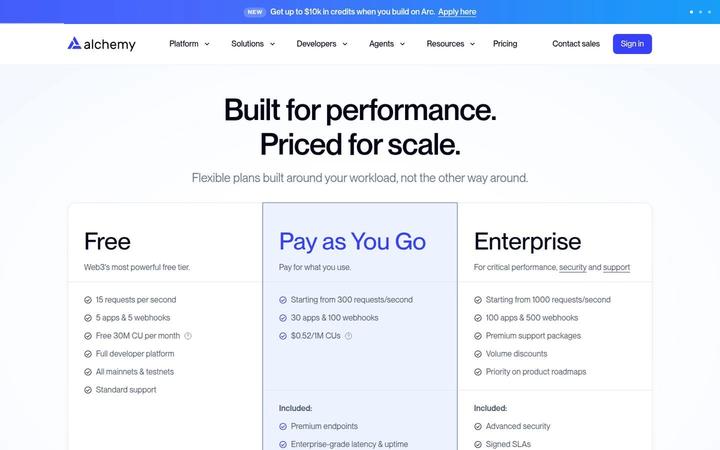
$0.52/1M CUAlchemy prices blockchain infrastructure on one published rate, $0.52 per 1 million compute units, and sells peak throughput as its own meter: $160 for each 5,000 CU/s block above the 300 RPS that Pay as You Go includes. A working estimator itemizes compute, included capacity and overage into a monthly total, so a developer can model the bill before signing up.

Augment Code
$20/mo flatAugment Code sells a flat team subscription with usage inside it: Standard is '$20/month flat, no per-seat charge' and Business '$100/month flat', each covering up to 50 seats and loading the same dollar amount of usage every month. Usage is measured in dollars, and the FAQ publishes the formula: LLM inference at 'the provider's public API list price', 'a flat 40% fee on LLM usage (no fee on compute)', and Cosmos compute time. The plan is a prepaid wallet shared by the whole team.

Baseten
From $0.01/1M tokensBaseten layers a three-tier service ladder over published rate sheets. Basic is '$0 per month, pay as you go', and Pro and Enterprise carry 'Volume discounts available' with 'GET A QUOTE'. Underneath sit three meters: Model APIs per 1M tokens across 19 model rows with Input, Cache Input and Output columns, opening with joey-1 at $0.01 input, dedicated GPU and CPU instances billed 'down to the minute', and the same GPU grid for training.
Braintrust
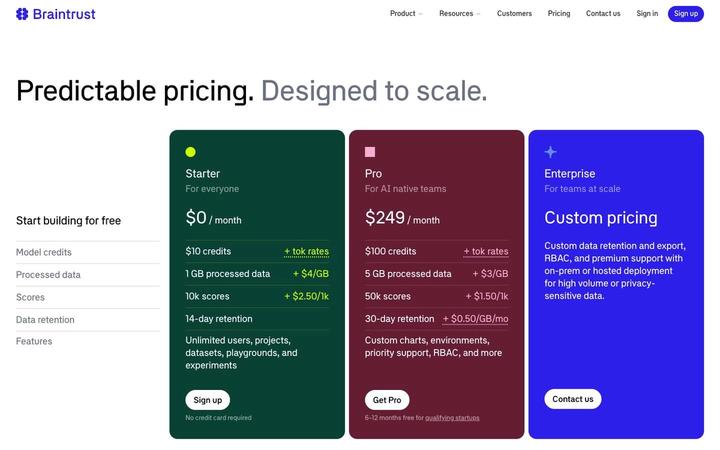
$249/moBraintrust pairs a flat platform fee, $0 on Starter and $249 a month on Pro, with four metered dimensions: model credits, processed data, scores and data retention. Each included allowance sits on the card beside its overage rate, and users, projects and experiments are Unlimited on every tier, so the bill follows traced traffic while headcount stays free.
Chroma
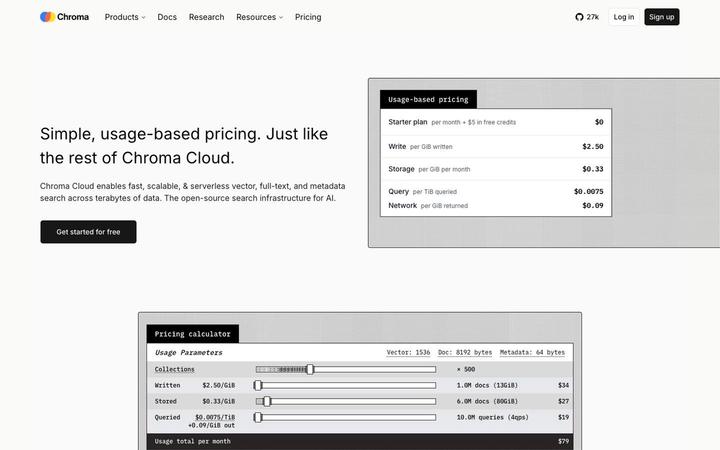
$250/mo + usageChroma prints all four metered rates in the hero, Write at $2.50 per GiB, Storage at $0.33 per GiB per month, Query at $0.0075 per TiB and Network at $0.09 per GiB returned, then hands the reader a calculator that turns documents and queries into a $79 monthly total. Plans sit on top of the meter: Starter at $0 plus usage, Team at $250 a month plus usage with $100 in credits, and Enterprise on custom terms.

Dremio
$0.20/DCUDremio prices its lakehouse on one compute meter, '$0.20 per DCU (Dremio Compute Unit)', and organizes the page around a deployment choice: Dremio Cloud, fully managed on AWS, or Dremio Enterprise, self-managed anywhere. Both options are 'Consumption based', so the decision is about who runs the infrastructure. Every path leads to a conversation, including a Cloud trial that comes with '$400 credit for 30 days'.

Exa
$4/1k requestsExa prices its search API per thousand requests, with a rate for each endpoint: Lite Search $4, Auto Search $7, Deep Search $12, Contents $1 per 1k pages, Monitors $2 and Answer $5, plus $1 per 1k for each result above ten and for AI page summaries. Agent runs offer metered compute at $0.10 per ACU and six effort levels: five fixed from $0.012 to $1.00 per request and an Ultra level billed on usage. The plan cards divide access, throughput and compliance, and the rate card below them carries the price.
Factory
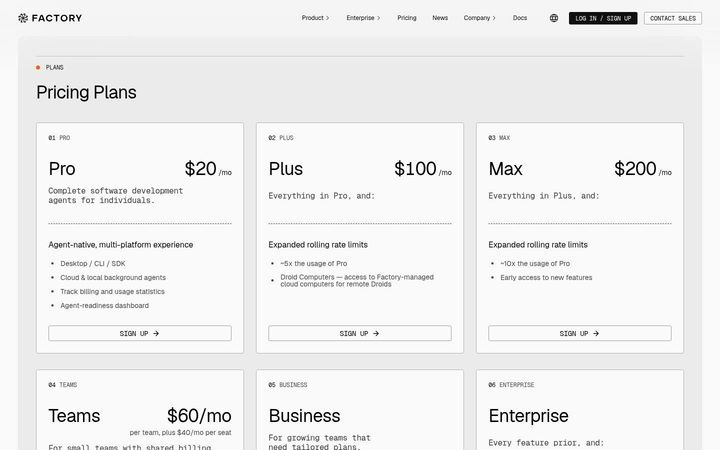
$20/moFactory sells its software development agents as six numbered plans: three individual subscriptions at $20, $100 and $200 a month, a Teams plan at $60/mo per team plus $40/mo per seat, and Business and Enterprise shaped with sales. The individual ladder is one rate sold in three sizes: Plus is "~5x the usage of Pro" for five times the price and Max is "~10x the usage of Pro" for ten times, so every step holds at $20 per multiple of Pro. A five-question FAQ now opens on model support and names the billing edges a buyer checks, from using your own keys to exceeding limits.
Fireworks AI
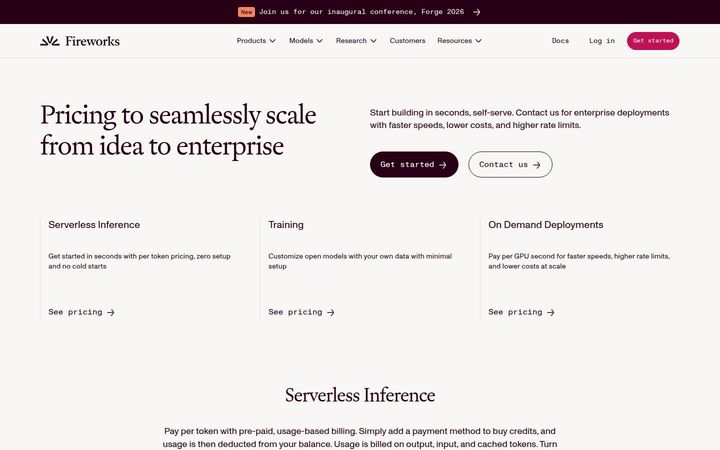
From $0.008/1M tokensFireworks prices three product lines on three meters: serverless inference per token, training per 1M training tokens, and on-demand deployments per GPU second. Serverless usage now draws down a pre-paid credit balance with Auto Reload and a monthly spend limit, and the training side carries a fine-tuning matrix that doubles cleanly at each step plus an eight-model Serverless Training API that meters prefill, cached prefill, sample and train tokens separately.

Ironclad
QuoteIronclad sells through a tailored quote and uses its pricing page to lay out the structure of the deal: pick your products, pick your deployment partner, then add extras such as API access, additional instances and an enhanced success plan. The hero names the price drivers outright, 'your products, users, workflows, and growth', and the rest of the page builds the value case with a Forrester study citing a 314% ROI and testimonials that quantify outcomes.

Jasper
$59/seat/moJasper sells two plans: Pro at $59 per seat per month on the yearly term, scoped to one seat with 2 Brand Voices, 5 Knowledge assets and 3 Audiences, and Business at custom pricing with unlimited customization and team features. The FAQ adds the usage layer: GEO Hub reports and Agents 'run on credits, which sit alongside seat-based pricing on the Business plan', a seat-plus-credits model for AI work.

LaunchDarkly
$10/Service Connection/moLaunchDarkly prices the software it serves rather than the people who use it: Developer is '$0 / mo, forever' with 'Unlimited seats', Foundation is pay as you go with 'No platform or seat fees', and Enterprise is custom with a trial. Foundation meters three things, '$10 per Service Connection / mo', '$8.33 per 1k client-side MAU / mo' on yearly billing and '$5 per additional 1k runs' of AI, and the comparison table spells out what happens at each plan's limit.
Lob
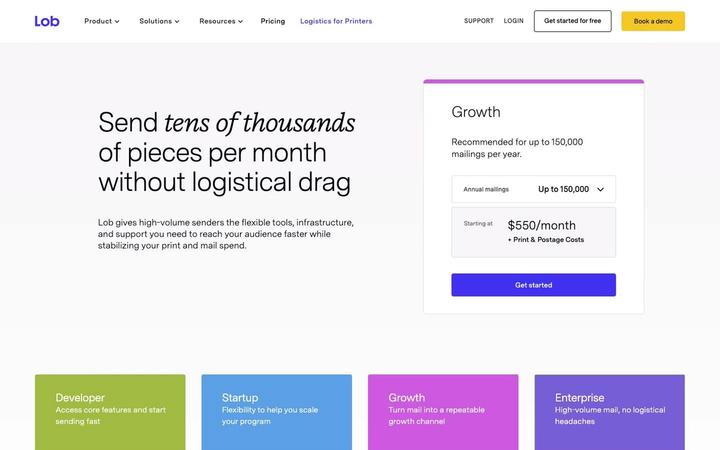
$260/moLob prices direct mail as a two-part bill and says so: a platform subscription from $0 to $550 per month, plus an all-in per-piece rate for print, postage and envelope that falls as the plan rises. A hero volume selector recommends a plan from annual mailings, and per-format rate rows, postcards from $0.905 down to $0.615, let a buyer turn a mail program into a budget.

Neo4j
From $0.09/GB/hrNeo4j AuraDB prices on one metric, provisioned memory, now printed in the unit it is metered in: 'Starting at $0.09 /GB/hour*' on Professional and 'Starting at $0.20 /GB/hour*' on Business Critical. Storage, IO, backups and data transfer ride inside the rate, so a graph database bill is GB times hours times one number, and pausing a database cuts its running cost by 80%.

Netlify
$9/moNetlify prices its platform in credits and keeps headcount out of the bill: Pro is '$20 /month with unlimited members', and what scales is a monthly credit allowance. Five infrastructure meters, from production deploys to web requests, draw down that one balance, and a dropdown on the Pro card lets a team choose its credit tier from 3,000 to 20,000 a month.

Numeral
$75 per filingNumeral prices sales tax compliance on the work it performs, '$75 per filing' and '$150 per registration', so the bill follows the states a seller files in rather than its transaction volume. A hero guarantee to pay penalties and interest on any late filing stands behind that work, and the FAQ spells out the formula, month-to-month terms and cancellation at any time.
Pinecone
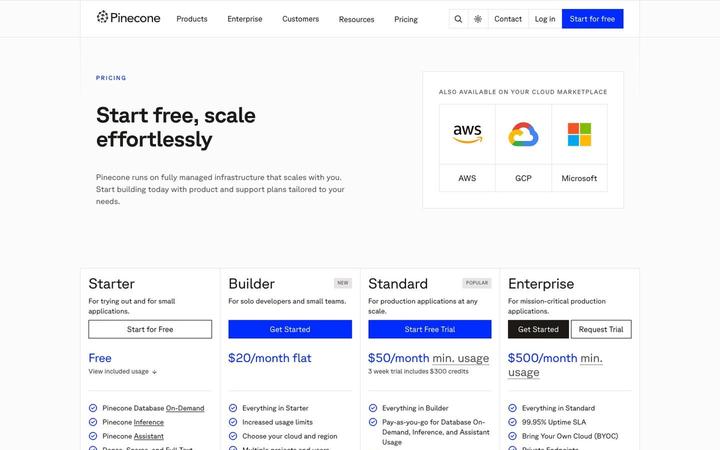
$20/mo flatPinecone runs a four-step ladder for its vector database: Starter free, Builder at '$20/month flat', and Standard and Enterprise at $50 and $500 a month minimum usage, each card explaining that usage above the minimum is pay as you go. Read units, write units and storage are the meters, and a set of worked Starter workloads turns those units into recommendations and searches per day.

Redis
From $0.007/hourRedis Cloud bills database capacity by the hour, scaling with memory: Free at 'Always $0' for 30 MB, Essentials 'From $0.007 /hour' with 'Total $5/month' beside it, and Pro 'From $0.014 /hour' with a $200 monthly minimum. The most interesting choice is the Pro offer, 'FIRST $200 FREE', a credit sized to exactly the plan's monthly minimum.

Replit
$18/mo (billed annually)Replit sells subscriptions that carry a dollar allowance for AI models, '$20 towards more powerful models' on Core and '$100 towards most powerful models' on Pro, with metering behind it on Effort-Based Pricing. The Pro card holds a credit dropdown that steps from '$90 / month' to '$2,000 / month', and the Enterprise card reads as a governance package led by 'SSO, SCIM & audit logs'.
Sanity
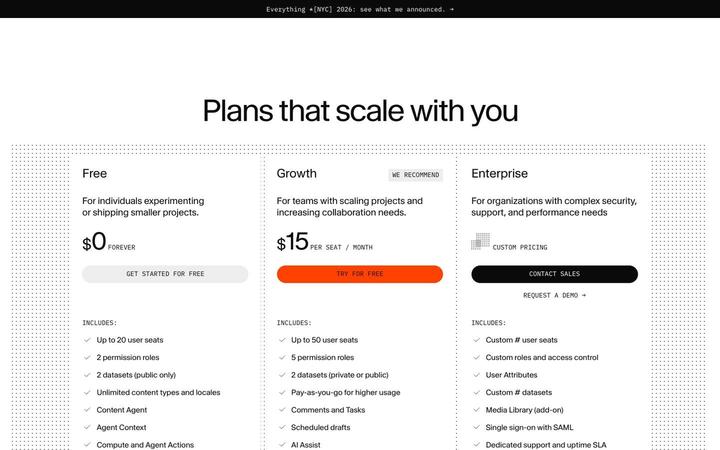
$15/seat/moSanity charges '$15 PER SEAT / MONTH' on Growth and meters the content platform underneath: documents, API requests, bandwidth, assets, embeddings, AI credits, functions and compute each carry a printed overage rate in the comparison table. Seats price the editorial team, usage prices the delivery workload, and three add-ons price support, quota and datasets as fixed monthly blocks.

Socure
$0.80 per evaluationSocure prices identity verification per evaluation, and each evaluation is a bundle of named checks: $0.80 for document verification, $0.90 with a watchlist screen, $1.00 for KYC, fraud and watchlist with a document step-up, and $1.30 with prefill added. Socure Launch tops that with $1,000 in free credits every month, and Socure Enterprise moves to volume and spend-based pricing for the full RiskOS platform.
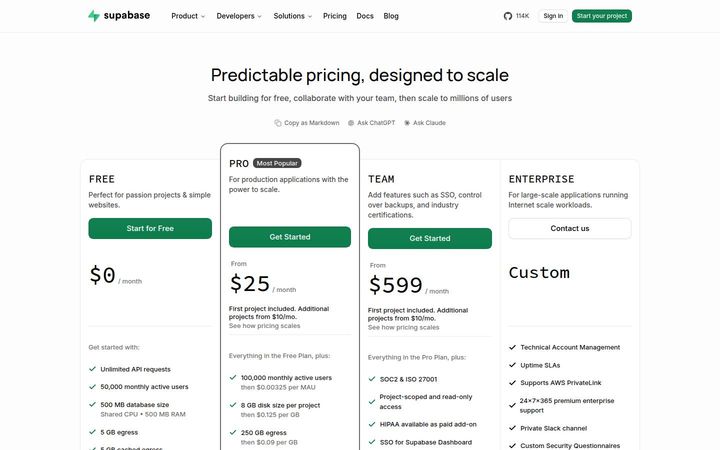
Supabase
From $25/moSupabase prices its Postgres platform as a plan fee plus metered usage: Free at $0, Pro from $25 a month, Team from $599 and Enterprise on contact, with every metered line on the Pro card printing the included quota and the rate beyond it. Compute is a published ladder from Micro at $10 to 16XL at $3,730, a $10 monthly credit covers the first instance, and logs are now metered too, with Log Ingestion at '20 GB included then $0.50 per GB' on paid plans. A spend cap on by default makes 'Predictable pricing, designed to scale' a literal promise.
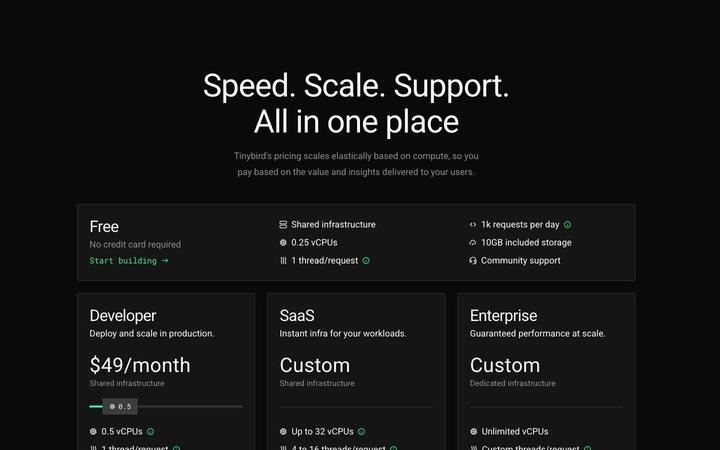
Tinybird
$25/moTinybird prices managed ClickHouse on compute, and the vCPU slider inside the Developer card puts that metric in the buyer's hand: the card reads $49/month at 0.5 vCPUs and moves as the slider does. Around compute sit flat unit rates that hold across every paid plan, storage at $0.058/GB and three egress rates, with vCPU overages at $0.0002/second on Developer and SaaS, while SaaS and Enterprise are priced as Custom with a yearly commitments discount.
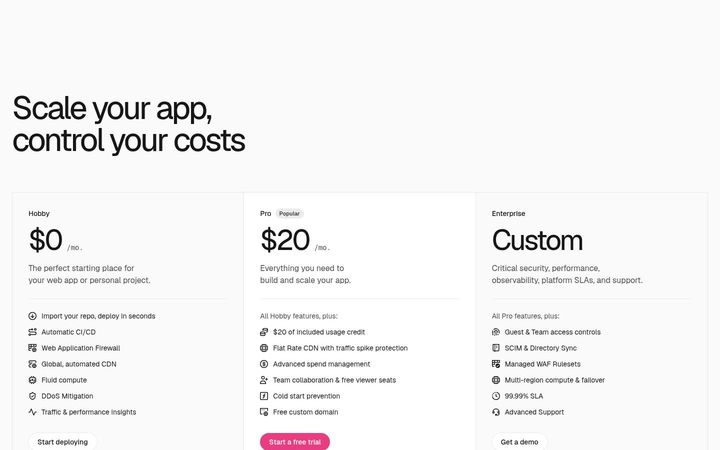
Vercel
$20/moVercel prices a cloud platform as a seat plus usage: Pro is $20 a month per developer seat and includes '$20 of included usage credit', so the seat fee doubles as a usage allowance before metered rates apply. Beneath three plan cards sits a full rate card in which every metered resource prints its included quota and its overage price on the same row, from CDN Requests to build minutes, and it now extends to Vercel Drives, Vercel Daemons, Deployment Storage and Tracing Spans.
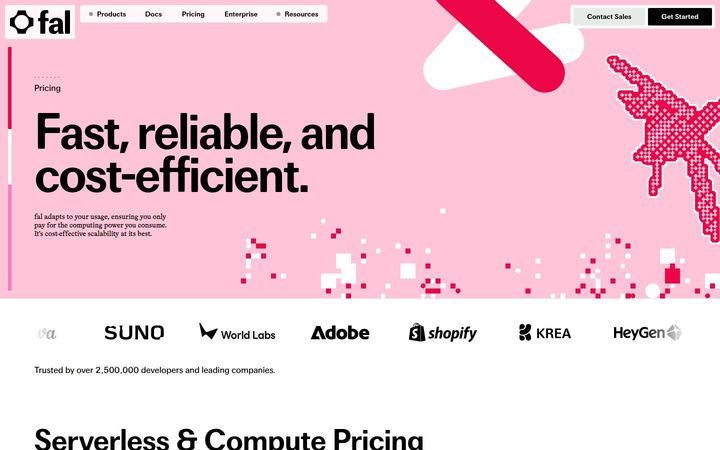
fal
From $0.0002/secondfal prices two products on one page with rate sheets in place of plans: GPU hours for serverless compute across six SKUs, and model APIs billed per output unit across video, image, audio and 3D. The "Units per $1" column turns seconds, tokens, images, megapixels, characters, generations and credits into one number a buyer compares directly.
turbopuffer
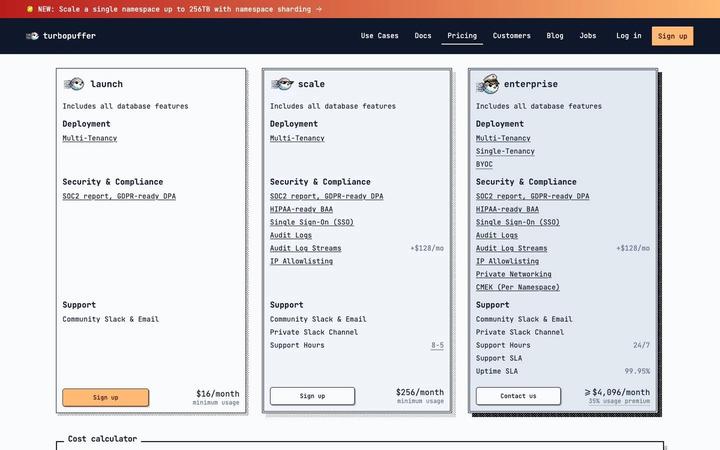
$16/mo minimumturbopuffer meters its search database on three resources, data stored per GB, data written per GB and data queried per PB, and its three plans differ in deployment, compliance and support while every one 'Includes all database features'. Each plan is a monthly minimum, $16, $256 and $4,096 and up, and the enterprise card prints its '35% usage premium' outright.