
Captured October 26, 2026 at 1440px wide. The page continues below the crop (26,309px in total).
How does Gemini API pricing work?
Packaging is access tiers over a pure usage meter. Free, Paid and Enterprise carry no price of their own; they set rate limits, model access, context caching, the Batch API and data terms. The money is metered per 1M tokens, split into input, output including thinking tokens, and context caching, with a storage charge per 1,000,000 tokens per hour on most models. Multimodal models add a second unit beside tokens, such as $3.00 or $0.005/min for Live audio input, and video output is billed in tokens at a stated rate per second of 720p, which the footnote puts at approximately $0.10 per second. Gemini 3.1 Pro Preview adds prompt length as a dimension, with input at $2.00 up to 200k tokens and $4.00 above. Grounding with Google Search and Google Maps bills per request: 5,000 free per month 'shared across all Gemini 3 and newer models', then $14 per 1,000. Each unit follows the resource the model consumes.
The motion is product-led with an enterprise path. A banner opens with 'Gemini 4 Argon is now available.', and the intro names the sequence: 'Start building free of charge with generous limits, then scale up with prepaid and pay-as-you-go pricing'. Free and Paid sit side by side with Paid outlined in blue, followed by Enterprise, 'powered by Gemini Enterprise Agent Platform', with Contact Sales. From there each model block repeats one pattern: display name, the exact model ID, a 'Try it in Google AI Studio' button, a one-line positioning statement, and a table with service-tier tabs and Free Tier and Paid Tier columns. The new flagship leads the list, so the first rate a developer reads is the newest model. The page reads as documentation, which suits a buyer who is already writing code against the API.
Under the hood, the rate table carries the strategy. Service tiers price latency, with the Batch API at '50% cost reduction', and a fifth tab, Contributor, now appears on Gemini 4 Argon, Gemini 3.8 Flash, Gemini 3.5 Flash-Lite and Gemini 3.1 Pro Preview, which points to service tiers rolled out model by model. Data terms are a tier lever: tables end with 'Used to improve our products', Yes on Free and No on Paid, and Gemini 4 Argon reads 'Not available' in every Free cell, so the flagship is part of what the Paid tier buys. Dated prices show how a new generation launches: Gemini 4 Argon, 'Our flagship reasoning model', opens at $2.00 input and $10.00 output through November 30, 2026 and moves to $4.00 and $20.00 on December 1, 2026, while Gemini 3.8 Flash and Gemini 3.6 Flash share $0.75 and $3.75 through 2026 before stepping to $1.50 and $7.50. Argon's caching row reads 'Implicit caching only (explicit caching is not supported)', a cached-input discount with no storage line to meter. Enterprise adds provisioned throughput and 'Volume-based discounts (based on usage)', the commitment levers a sales team shapes. Worth borrowing: dating a price change in the cell gives every customer the same advance notice.
What does Gemini API's pricing page do well?
- Every billable dimension is printed: input, output including thinking tokens, cached input, cache storage per hour, and grounding per request
- Service-tier tabs, now Standard, Batch, Flex, Priority and Contributor on the newest models, keep every rate set for a model on one table
- Each model block leads with the exact API model ID, so a rate maps directly to the string a developer puts in code
- Forward-dated price changes are stated in the cell, $2.00 through November 30, 2026 and $4.00 starting December 1, 2026 for Gemini 4 Argon
- Audio models print a per-minute rate next to the token rate, such as $3.00 or $0.005/min, the unit a voice product plans against
What does Gemini API's pricing page reveal about its pricing strategy?
- Free, Paid and Enterprise are access tiers with no price of their own; the bill is entirely usage
- The flagship Gemini 4 Argon is Paid-only, so access to the newest reasoning model is part of the upgrade
- Introductory pricing on new models, dated to step up on a set day, pulls developers forward to the latest generation and tells them what to plan for
- The Contributor tab appears on some model tables and not others, which points to service tiers added per model
- Enterprise's provisioned throughput and usage-based volume discounts are the commitment levers set with sales
Learn with Orb
- ProductPrice evolution Forward-dated rates in the cell, $0.75 through December 31, 2026 and $1.50 from January 1, 2027, are a price change customers can plan around, which is what Orb's price evolution covers.
- DocsPricing an AI agent Gemini meters input, output, thinking and cached tokens per 1M, with a free tier ahead of prepaid billing; Orb's agent pricing docs walk through token-based pricing with monthly grants and top-ups.
- GuideAn expert's guide to enterprise pricing for SaaS Enterprise adds provisioned throughput and usage-based volume discounts through Contact Sales; Orb's CEO covers the main enterprise models and what to weigh when prices are set deal by deal.
Questions about Gemini API pricing
How much does Gemini API cost?
Gemini API's pricing starts at $0.25/1M input tokens. The page shows 3 plans, including a free plan, with the top plan priced through sales.
What pricing model does Gemini API use?
Gemini API prices by usage. Buyers can sign up on their own or go through the sales team. Its plans are aimed mainly at developers.
Does Gemini API have a free plan?
Yes, Gemini API has a free plan. Paid plans start at $0.25/1M input tokens.
Does Gemini API offer an annual discount?
Gemini API offers monthly and annual billing; the page doesn't state the discount. The listed prices start at $0.25/1M input tokens. Terms for the plans priced through sales are set with the sales team.
How is Gemini API's pricing page laid out?
The page shows 3 plans, highlights Paid, and includes a comparison table. The breakdown above marks 14 points on it: 5 things it does well and 9 insights into the pricing.
How much does Gemini API charge for Grounding with Google Search?
Grounding with Google Search includes 5,000 free search requests per month, "shared across all Gemini 3 and newer models", then costs $14 per 1,000 requests on the Paid tier. Grounding with Google Maps follows the same structure, with 5,000 free requests per month and then $14 / 1,000 search queries. The page notes that one customer request may result in one or more Google Search queries, and each individual query is charged.
When does Gemini 4 Argon pricing change on the Gemini API?
Gemini 4 Argon is priced at $2.00 input and $10.00 output per 1M tokens through November 30, 2026. Starting December 1, 2026, those rates move to $4.00 input and $20.00 output. Context caching goes from $0.10 to $0.20 on the same date, with "Implicit caching only" for this model, which is available on the Paid tier.
How is Gemini API audio and video billed per minute or per second?
Audio models list a per-minute rate beside the token rate. For example, Gemini 3.8 Live audio input is $3.00 or $0.005/min and audio output is $12.00 or $0.018/min. Gemini Omni Flash video output is $17.50 per 1M tokens, calculated at 5,792 tokens per second of 720p video, for an effective price of approximately $0.10 per second under Standard pricing.
From the page as captured October 26, 2026. Current prices are on ai.google.dev

AssemblyAI
$0.15/hrAssemblyAI bills speech-to-text by the hour of audio, the unit a transcription team already uses, and the default view shows two rates: Universal-3.5 Pro at $0.21 /hr and Universal-2 at $0.15 /hr. A selector across eight APIs, grouped under TRANSCRIBE, UNDERSTAND and INTERACT, swaps the rate table, so each product is priced in its own unit, from audio hours to LLM tokens to input characters. The FAQ carries the billing mechanics in plain words, including the new Text-to-Speech API at $15 per 1M characters.

Baseten
From $0.01/1M tokensBaseten layers a three-tier service ladder over published rate sheets. Basic is '$0 per month, pay as you go', and Pro and Enterprise carry 'Volume discounts available' with 'GET A QUOTE'. Underneath sit three meters: Model APIs per 1M tokens across 19 model rows with Input, Cache Input and Output columns, opening with joey-1 at $0.01 input, dedicated GPU and CPU instances billed 'down to the minute', and the same GPU grid for training.
Cohere
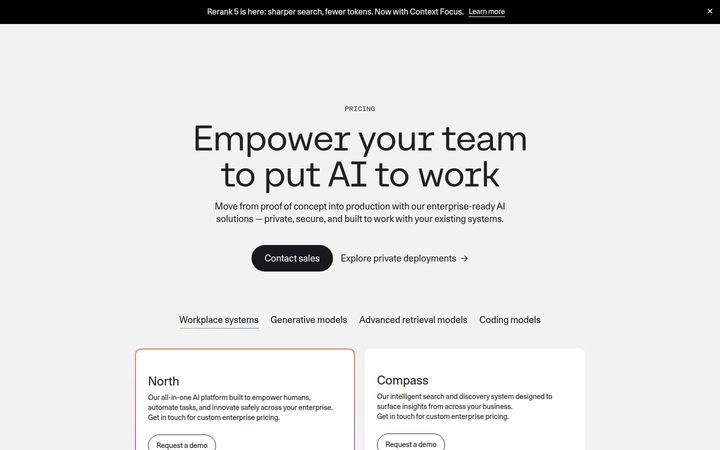
$3.00/instance/hrCohere prices for the enterprise in three shapes: custom contracts for its North and Compass platforms, reserved capacity on Model Vault at $3.00 to $7.00 an hour or $2,000 to $4,300 a month per instance, and pay-as-you-go tokens behind a Production API key. A four-way toggle sorts the page by buying job, and the FAQ carries the billing mechanics, down to an invoice at month end or at $250 of outstanding balance.
Deepgram
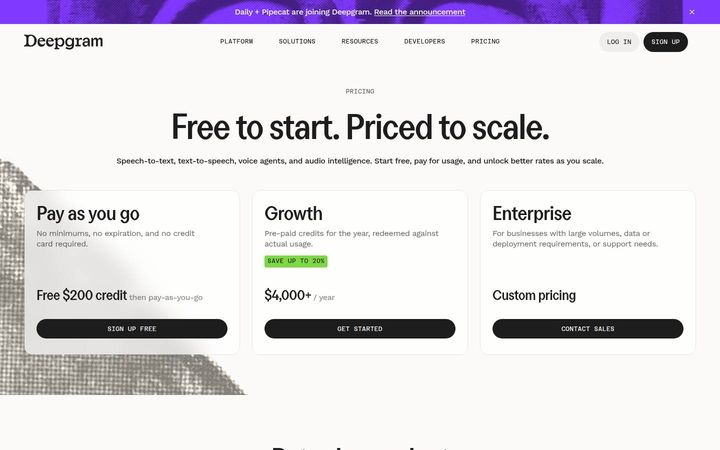
$0.0077/minDeepgram's page opens on "Free to start. Priced to scale." and three cards: Pay as you go with a Free $200 credit, Growth at $4,000+ / year in pre-paid credits for up to 20% off, and Enterprise at Custom pricing. A tabbed "Rates by product" section names the meter for each product, per second of audio, per 1,000 characters, or per minute of connection time, and a sixteen-question FAQ carries the billing mechanics, from hourly rates to the 10% overage premium.

Exa
$4/1k requestsExa prices its search API per thousand requests, with a rate for each endpoint: Lite Search $4, Auto Search $7, Deep Search $12, Contents $1 per 1k pages, Monitors $2 and Answer $5, plus $1 per 1k for each result above ten and for AI page summaries. Agent runs offer metered compute at $0.10 per ACU and six effort levels: five fixed from $0.012 to $1.00 per request and an Ultra level billed on usage. The plan cards divide access, throughput and compliance, and the rate card below them carries the price.
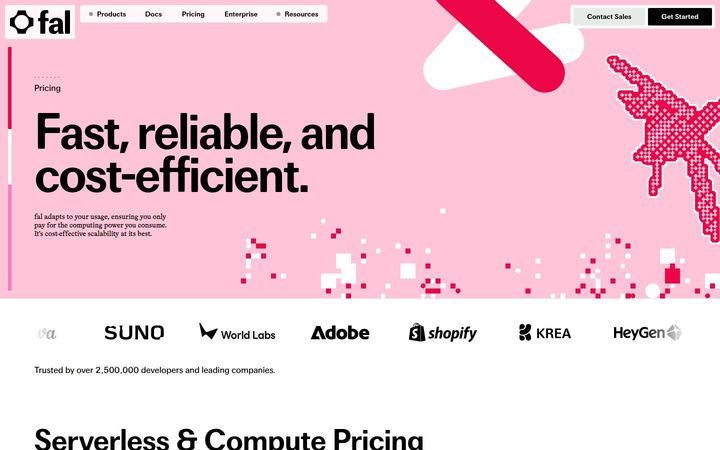
fal
From $0.0002/secondfal prices two products on one page with rate sheets in place of plans: GPU hours for serverless compute across six SKUs, and model APIs billed per output unit across video, image, audio and 3D. The "Units per $1" column turns seconds, tokens, images, megapixels, characters, generations and credits into one number a buyer compares directly.