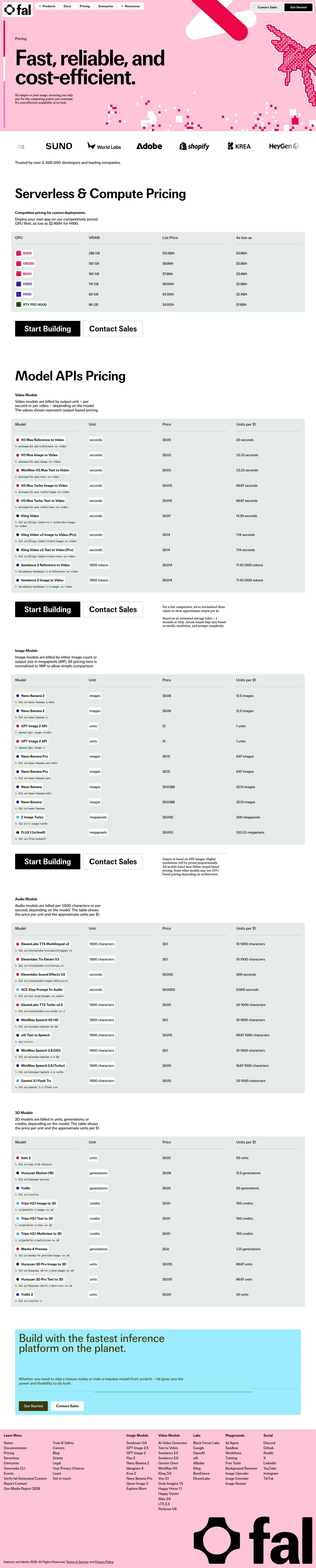
Captured October 26, 2026 at 1440px wide.
fal plans and prices
| Plan | Price |
|---|---|
| B300 | $12.99/h |
| GB200 | $9.99/h |
| B200 | $7.99/h |
| H200 | $6.00/h |
| H100 | $4.50/h |
| RTX PRO 6000 | $4.00/h |
As printed on the page captured October 26, 2026.
How does fal pricing work?
fal meters at two distances from the hardware. Serverless compute is raw capacity, a GPU-hour rate card with six SKUs from RTX PRO 6000 at $4.00/h list to B300 at $12.99/h list, each shown with its VRAM and an "As low as" rate, with H100 at $2.49/h. Model APIs are priced on outcomes, per output unit, and the unit follows the modality: seconds for H3 Max and Kling video, 1000 tokens for Seedance 2, images and megapixels for Nano Banana and FLUX.1 [schnell], 1000 characters or seconds for audio, and units, generations or credits for 3D. Output pricing fits generative media because customers think in clips, images and voice lines, and the "Units per $1" column, 20 seconds of H3 Max Reference to Video, 333.33 megapixels of FLUX.1 [schnell], 5,000 seconds of ACE Step audio, puts every unit on one scale.
The motion runs self-serve and sales-led in parallel. The GPU, video and image tables each close on a "Start Building" and "Contact Sales" pair, and a closing band, "Build with the fastest inference platform on the planet.", repeats Get Started and Contact Sales after the 3D table, so a developer can start from any section and a larger team can open a conversation from the same spot. The hero sets the model in a sentence, "fal adapts to your usage, ensuring you only pay for the computing power you consume.", and a logo strip with SUNO, Adobe, Shopify and HeyGen sits above "Trusted by over 2,500,000 developers and leading companies." before the first price. The footer closes on the catalog itself: image models, video models and the labs behind them.
Under the hood, the two rate sheets reveal two billing engines. GPU hours are a classic rate table with a list price and a floor, and the "As low as" column, paired with "Contact Sales", points to negotiated rates tied to volume or commitment, with the spread running from $5.99/h against $12.99/h on B300 to $2.49/h against $4.50/h on H100. Model APIs are output metering with pass-through economics: each endpoint carries its own rate in the unit its lab meters, and the footnotes show the math, an average video of 5 seconds at 720p, images normalized to 1MP with "Higher resolutions will be priced proportionally", and a note that some models "may use GPU-based pricing depending on architecture". Worth borrowing: when a catalog spans many units, a normalized value column with its assumptions printed underneath gives the buyer one comparison to make.
What does fal's pricing page do well?
- "Units per $1" normalizes seconds, tokens, images, megapixels, characters, generations and credits into one comparable number for every model row
- Footnotes state the normalization assumptions, an average video of 5 seconds at 720p and images at 1MP, so the comparison carries its own basis
- The GPU table shows "List Price" and "As low as" side by side, so a buyer sees the range of the rate before a sales conversation
- Each model row prints its endpoint ID, such as "fal-ai/flux/schnell", so the price maps straight to the API call a developer makes
- Each section intro names its billing unit before the table, as in "Audio models are billed per 1,000 characters or per second, depending on the model."
What does fal's pricing page reveal about its pricing strategy?
- Two metering distances on one page: raw GPU hours for custom deployments, and output units for hosted models
- The "As low as" column alongside Contact Sales points to rates that move with commitment or volume, and the GB200 row extends that ladder between B300 and B200
- Per-model units, 1000 tokens for Seedance 2 and credits for Tripo H3.1, point to pass-through metering: fal publishes each lab's own unit at a per-unit price
- "Higher resolutions will be priced proportionally" ties image cost to megapixels, so the meter follows the resource
- The footer lists the wider model catalog by lab, which frames the priced rows as reference points for a much larger offer
Learn with Orb
- GuideWhat is outcome-based pricing? Model APIs bill per second of video, per image and per megapixel, with an Output per $1 column for each; Orb's guide covers charging for results and how that differs from charging for usage.
- Guide14 usage-based pricing examples Serverless compute meters raw GPU hours from $2.99 to $8.50 list, beside output-priced models; Orb's examples show what usage-priced companies meter and at what distance from the resource.
Questions about fal pricing
How much does fal cost?
fal's pricing starts at $0.0002/second. The page shows 6 plans, with the top plan priced through sales.
What pricing model does fal use?
fal prices by usage. Buyers can sign up on their own or go through the sales team. Its plans are aimed mainly at developers.
Does fal have a free plan?
fal's pricing page shows no free plan or free trial. The lowest paid plan starts at $0.0002/second.
Does fal offer an annual discount?
fal's pricing page shows a single billing period. The listed prices start at $0.0002/second. Terms for the plans priced through sales are set with the sales team.
How is fal's pricing page laid out?
The page shows 6 plans. The breakdown above marks 14 points on it: 7 things it does well and 7 insights into the pricing.
How does fal price 3D model generation?
fal bills 3D models in units, generations, or credits, depending on the model. Tripo H3.1 Image to 3D, Text to 3D, and Multiview to 3D each cost $0.01 per credit, or 100 credits per $1. Trellis costs $0.02 per generation, and Meshy 6 Preview costs $0.8 per generation, or 1.25 generations per $1.
How does fal price higher-resolution images?
fal bills image models by either image count or output size in megapixels, and every price on the page is normalized to 1MP for simple comparison. The page states that "Higher resolutions will be priced proportionally." FLUX.1 [schnell], for example, costs $0.003 per megapixel, which works out to 333.33 megapixels per $1. The page also notes that "Some other models may use GPU-based pricing depending on architecture."
How does fal bill video generation, per second or per video?
fal bills video models by output unit, per second or per video depending on the model, and Seedance 2 is metered per 1000 tokens at $0.014. Per-second rates range from $0.015 for H3 Max Turbo (66.67 seconds per $1) to $0.14 for Kling Video v3 Pro (7.14 seconds per $1). The "Units per $1" figures assume an estimated average video of 5 seconds at 720p, and the page notes that actual output may vary based on model, resolution, and prompt complexity.
From the page as captured October 26, 2026. Current prices are on fal.ai

AssemblyAI
$0.15/hrAssemblyAI bills speech-to-text by the hour of audio, the unit a transcription team already uses, and the default view shows two rates: Universal-3.5 Pro at $0.21 /hr and Universal-2 at $0.15 /hr. A selector across eight APIs, grouped under TRANSCRIBE, UNDERSTAND and INTERACT, swaps the rate table, so each product is priced in its own unit, from audio hours to LLM tokens to input characters. The FAQ carries the billing mechanics in plain words, including the new Text-to-Speech API at $15 per 1M characters.

Baseten
From $0.01/1M tokensBaseten layers a three-tier service ladder over published rate sheets. Basic is '$0 per month, pay as you go', and Pro and Enterprise carry 'Volume discounts available' with 'GET A QUOTE'. Underneath sit three meters: Model APIs per 1M tokens across 19 model rows with Input, Cache Input and Output columns, opening with joey-1 at $0.01 input, dedicated GPU and CPU instances billed 'down to the minute', and the same GPU grid for training.
Cohere
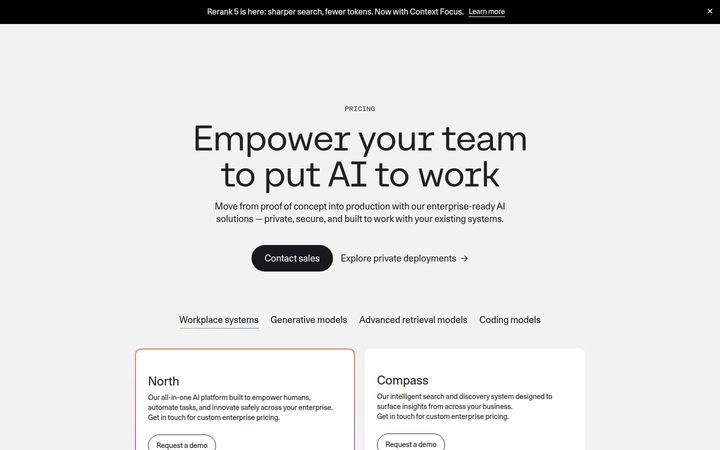
$3.00/instance/hrCohere prices for the enterprise in three shapes: custom contracts for its North and Compass platforms, reserved capacity on Model Vault at $3.00 to $7.00 an hour or $2,000 to $4,300 a month per instance, and pay-as-you-go tokens behind a Production API key. A four-way toggle sorts the page by buying job, and the FAQ carries the billing mechanics, down to an invoice at month end or at $250 of outstanding balance.
Deepgram
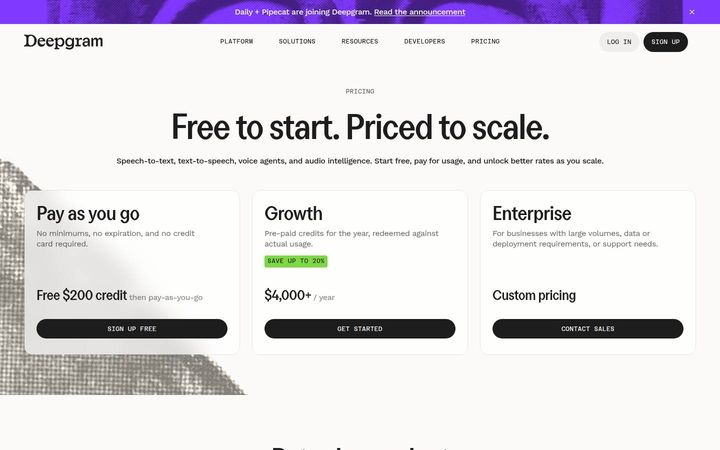
$0.0077/minDeepgram's page opens on "Free to start. Priced to scale." and three cards: Pay as you go with a Free $200 credit, Growth at $4,000+ / year in pre-paid credits for up to 20% off, and Enterprise at Custom pricing. A tabbed "Rates by product" section names the meter for each product, per second of audio, per 1,000 characters, or per minute of connection time, and a sixteen-question FAQ carries the billing mechanics, from hourly rates to the 10% overage premium.

Exa
$4/1k requestsExa prices its search API per thousand requests, with a rate for each endpoint: Lite Search $4, Auto Search $7, Deep Search $12, Contents $1 per 1k pages, Monitors $2 and Answer $5, plus $1 per 1k for each result above ten and for AI page summaries. Agent runs offer metered compute at $0.10 per ACU and six effort levels: five fixed from $0.012 to $1.00 per request and an Ultra level billed on usage. The plan cards divide access, throughput and compliance, and the rate card below them carries the price.
Fireworks AI
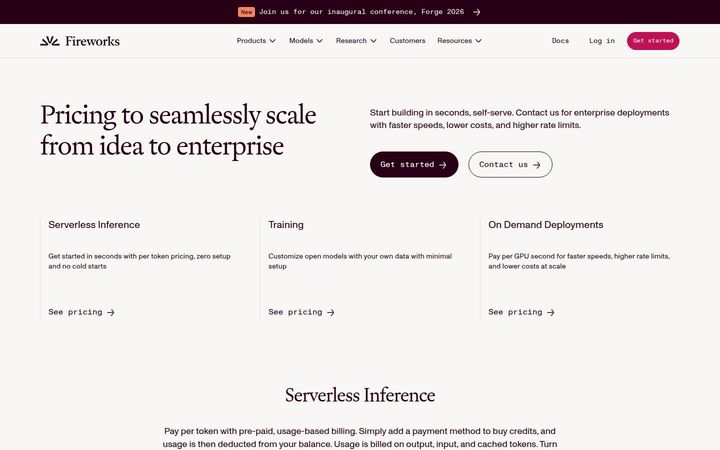
From $0.008/1M tokensFireworks prices three product lines on three meters: serverless inference per token, training per 1M training tokens, and on-demand deployments per GPU second. Serverless usage now draws down a pre-paid credit balance with Auto Reload and a monthly spend limit, and the training side carries a fine-tuning matrix that doubles cleanly at each step plus an eight-model Serverless Training API that meters prefill, cached prefill, sample and train tokens separately.