Captured November 2, 2026 at 1440px wide.
Deepgram plans and prices
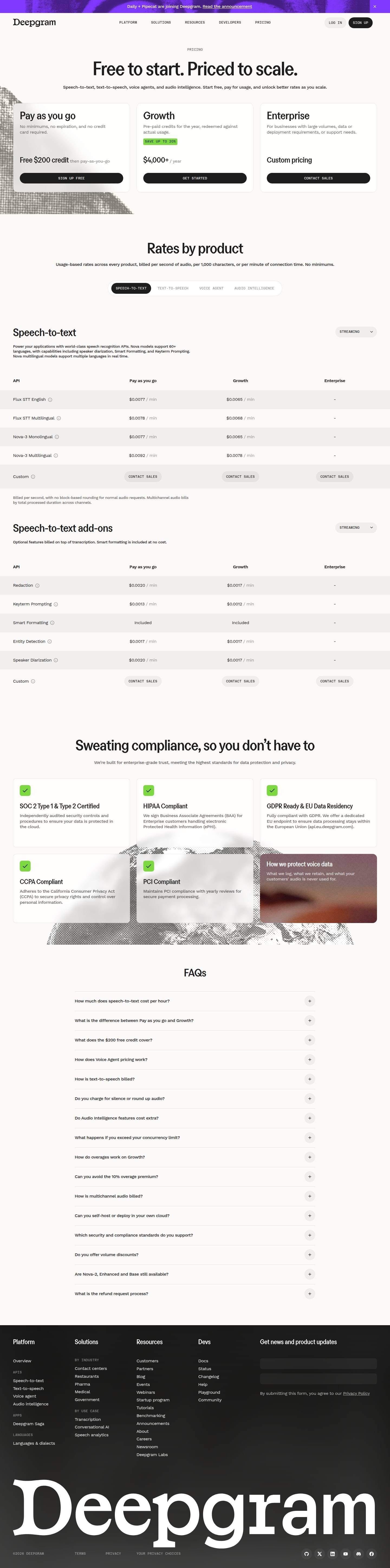
| Plan | Price | Billing |
|---|---|---|
| Pay as you goNo minimums, no expiration, and no credit card required. | Free $200 credit | then pay-as-you-go |
| GrowthHighlightedPre-paid credits for the year, redeemed against actual usage. | $4,000+ | / year |
| EnterpriseFor businesses with large volumes, data or deployment requirements, or support needs. | Custom pricing |
As printed on the page captured November 2, 2026.
How does Deepgram pricing work?
The value metric changes by product, and each one tracks the resource it consumes. The "Rates by product" line states it outright: "billed per second of audio, per 1,000 characters, or per minute of connection time." Speech-to-text prints per-minute rates by model, with Flux STT English and Nova-3 Monolingual both at $0.0077 / min on Pay as you go and $0.0065 / min on Growth, and the multilingual models at $0.0078 / min and $0.0092 / min. Add-ons such as Redaction at $0.0020 / min and Keyterm Prompting at $0.0013 / min stack on the base rate, and Smart Formatting is Included. Text-to-speech bills per 1,000 characters of input text, the Voice Agent per minute of WebSocket connection time with "one rate covering speech-to-text, a managed language model, and text-to-speech", and Audio Intelligence per 1,000 input and output tokens. Growth separates from Pay as you go on rate and on concurrency, 150 against 225 concurrent streaming connections, so it sells scale and a discount rather than features.
The motion is self-serve first, with Enterprise beside it. The hero subhead reads "Start free, pay for usage, and unlock better rates as you scale." and three equal cards follow: Pay as you go with SIGN UP FREE, Growth with a SAVE UP TO 20% badge and GET STARTED, and Enterprise at Custom pricing with CONTACT SALES. A tab bar for Speech-to-text, Text-to-speech, Voice Agent and Audio Intelligence keeps one product's rate table on screen at a time, each with a Streaming selector and an Enterprise column. Compliance cards and a "How we protect voice data" panel come next, then sixteen FAQs that answer with figures.
Under the hood, the page describes a prepaid credit model on a per-second meter. Growth credits are "redeemed against actual usage", overage "bills at your Growth rate plus 10%, charged weekly on Mondays for the prior week", and early renewal "resets your credits to the standard rate", so sizing and renewing the prepay is the economical path. Billing is "per second of processed audio, so a 14-second file bills as 14 seconds", and multichannel audio bills by total processed duration, which makes the minute a display unit over a per-second meter. Enterprise holds the commercial room: "Enterprise pricing ladders down with committed volume", with self-hosted deployment and custom model training. Worth borrowing: legacy models stay priced in the FAQ, Nova-2 streaming at $0.35 an hour, which lets existing deployments keep budgeting while new projects move to Nova-3 and Flux.
What does Deepgram's pricing page do well?
- Pay as you go states 'No minimums, no expiration, and no credit card required.' above a Free $200 credit, clearing the usual reasons not to try a metered API
- Growth pairs a SAVE UP TO 20% badge with its mechanism, pre-paid credits 'redeemed against actual usage'
- One line under 'Rates by product' names all three meters: per second of audio, per 1,000 characters, per minute of connection time
- A note under the speech-to-text table states per-second billing with 'no block-based rounding for normal audio requests'
- FAQ answers quote figures: $0.46 an hour for monolingual streaming, 150 against 225 concurrent connections, and roughly 43,000 minutes for the $200 credit
What does Deepgram's pricing page reveal about its pricing strategy?
- Each product uses the meter closest to its cost: audio time for recognition, characters for synthesis, connection time for agents, tokens for language analysis
- Every model prints a rate in both the Pay as you go and Growth columns, so Growth sells concurrency and a prepaid discount rather than feature access
- A 10% premium on usage beyond Growth credits, with early renewal as the route back to the standard rate, makes the annual prepay the economical way to buy at scale
- Flux STT English and Nova-3 Monolingual share one price, so a team chooses the model on fit for the use case
- An Enterprise column and CONTACT SALES on every Custom row keep custom models and volume tiers in a conversation, where pricing ladders down with committed volume
Learn with Orb
- ProductPrepaid credits Growth sells $4K+ a year in prepaid credits redeemed against actual usage for up to 20% off, the bulk discount on larger commitments that Orb's prepaid credits product covers.
- GuideAn AI founder's guide to prepaid credits A 10% fee applies to usage beyond prepaid Growth credits, and Orb's guide covers how commitments earn a better rate and how usage past a commitment bills at an overage rate.
- Guide14 usage-based pricing examples Speech recognition bills per minute, text to speech per 1k characters and audio intelligence per 1k tokens; Orb's examples show what usage-priced companies meter for each product.
Questions about Deepgram pricing
How much does Deepgram cost?
Deepgram's pricing starts at $0.0077/min. The page shows 3 plans, with the top plan priced through sales. Paying annually saves up to 20%.
What pricing model does Deepgram use?
Deepgram prices by usage, combined with credits. Buyers can sign up on their own or go through the sales team. Its plans are aimed mainly at developers.
Does Deepgram have a free plan?
Deepgram has no free plan, but its paid plans offer a free trial. The lowest paid plan starts at $0.0077/min.
Does Deepgram offer an annual discount?
Yes, paying annually saves up to 20%. The listed prices start at $0.0077/min. Terms for the plans priced through sales are set with the sales team.
How is Deepgram's pricing page laid out?
The page shows 3 plans, highlights Growth, and includes an FAQ. The breakdown above marks 14 points on it: 8 things it does well and 6 insights into the pricing.
How do overages work on the Deepgram Growth plan?
Deepgram bills usage beyond your Growth credits at your Growth rate plus 10%, charged weekly on Mondays for the prior week. A card must stay on file, and without one, requests return a 402 once credits run out. The 10% overage premium can be avoided by early renewing with a new Growth plan in the Console, which resets credits to the standard rate.
What do Deepgram speech-to-text add-ons cost?
Add-ons are billed per minute on top of transcription. Redaction is $0.0020 / min on Pay as you go and $0.0017 / min on Growth, Keyterm Prompting is $0.0013 / min and $0.0012 / min, and Entity Detection is $0.0017 / min on both. Speaker Diarization is $0.0020 / min and $0.0017 / min, and Smart Formatting is Included on both plans.
Are Deepgram's Nova-2, Enhanced and Base models still available, and what do they cost?
Yes, Deepgram keeps them at unchanged rates for existing deployments. Nova-2 streaming is $0.35 an hour, Enhanced $0.99 and Base $0.87, and Growth is about 12.5% lower. New projects are pointed to Nova-3 for general transcription or Flux for real-time voice agents.
From the page as captured November 2, 2026. Current prices are on deepgram.com

Exa
$4/1k requestsExa prices its search API per thousand requests, with a rate for each endpoint: Lite Search $4, Auto Search $7, Deep Search $12, Contents $1 per 1k pages, Monitors $2 and Answer $5, plus $1 per 1k for each result above ten and for AI page summaries. Agent runs offer metered compute at $0.10 per ACU and six effort levels: five fixed from $0.012 to $1.00 per request and an Ultra level billed on usage. The plan cards divide access, throughput and compliance, and the rate card below them carries the price.

AssemblyAI
$0.15/hrAssemblyAI bills speech-to-text by the hour of audio, the unit a transcription team already uses, and the default view shows two rates: Universal-3.5 Pro at $0.21 /hr and Universal-2 at $0.15 /hr. A selector across eight APIs, grouped under TRANSCRIBE, UNDERSTAND and INTERACT, swaps the rate table, so each product is priced in its own unit, from audio hours to LLM tokens to input characters. The FAQ carries the billing mechanics in plain words, including the new Text-to-Speech API at $15 per 1M characters.

Baseten
From $0.01/1M tokensBaseten layers a three-tier service ladder over published rate sheets. Basic is '$0 per month, pay as you go', and Pro and Enterprise carry 'Volume discounts available' with 'GET A QUOTE'. Underneath sit three meters: Model APIs per 1M tokens across 19 model rows with Input, Cache Input and Output columns, opening with joey-1 at $0.01 input, dedicated GPU and CPU instances billed 'down to the minute', and the same GPU grid for training.
Cohere
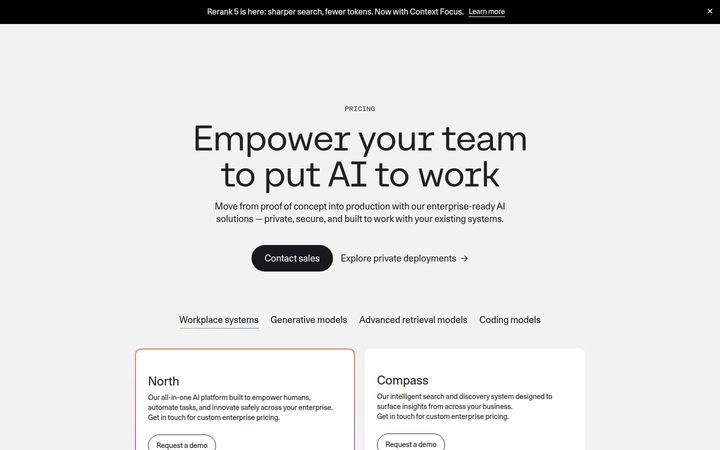
$3.00/instance/hrCohere prices for the enterprise in three shapes: custom contracts for its North and Compass platforms, reserved capacity on Model Vault at $3.00 to $7.00 an hour or $2,000 to $4,300 a month per instance, and pay-as-you-go tokens behind a Production API key. A four-way toggle sorts the page by buying job, and the FAQ carries the billing mechanics, down to an invoice at month end or at $250 of outstanding balance.
fal
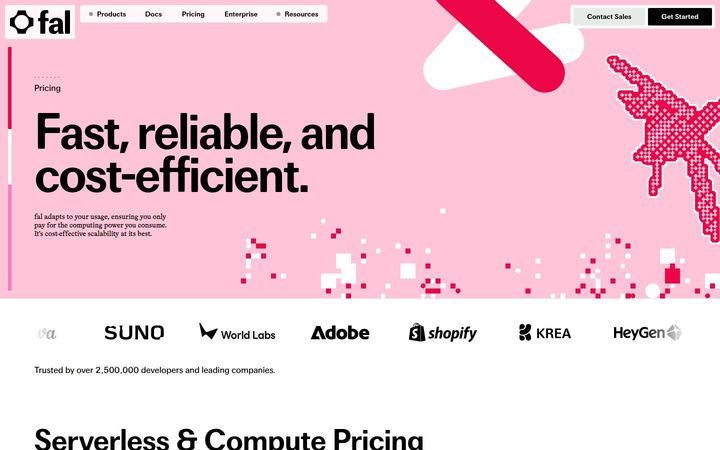
From $0.0002/secondfal prices two products on one page with rate sheets in place of plans: GPU hours for serverless compute across six SKUs, and model APIs billed per output unit across video, image, audio and 3D. The "Units per $1" column turns seconds, tokens, images, megapixels, characters, generations and credits into one number a buyer compares directly.
Fireworks AI
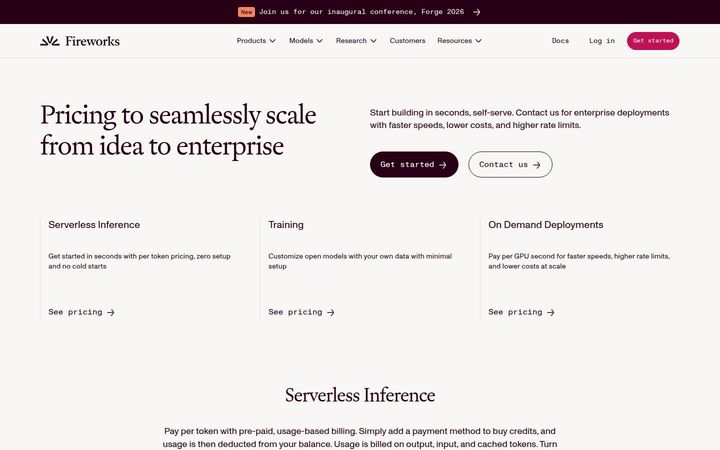
From $0.008/1M tokensFireworks prices three product lines on three meters: serverless inference per token, training per 1M training tokens, and on-demand deployments per GPU second. Serverless usage now draws down a pre-paid credit balance with Auto Reload and a monthly spend limit, and the training side carries a fine-tuning matrix that doubles cleanly at each step plus an eight-model Serverless Training API that meters prefill, cached prefill, sample and train tokens separately.