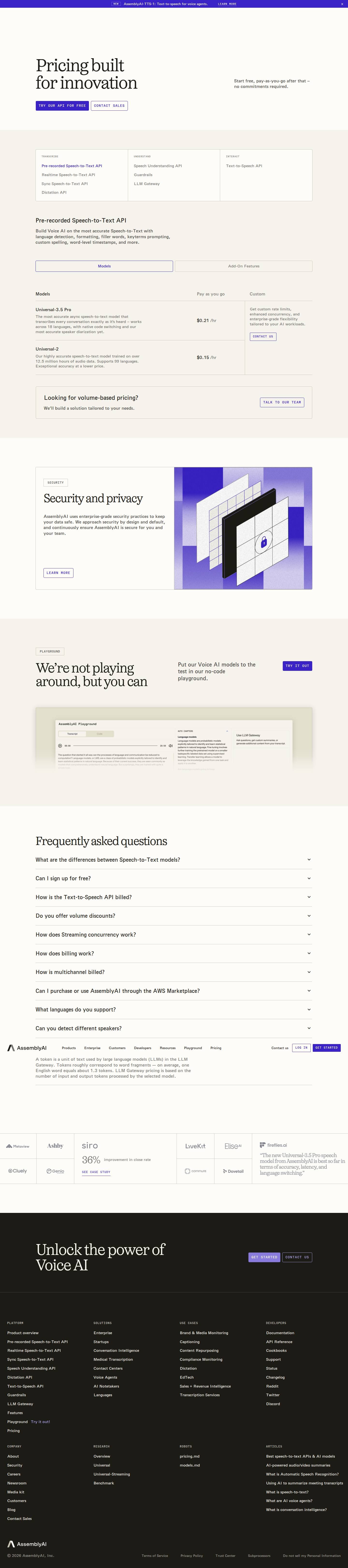
Captured November 2, 2026 at 1440px wide.
AssemblyAI plans and prices
| Plan | Price | Billing |
|---|---|---|
| Universal-3.5 ProThe most accurate async speech-to-text model that transcribes every conversation exactly as it's heard | $0.21 | /hr |
| Universal-2Our highly accurate speech-to-text model trained on over 12.5 million hours of audio data. | $0.15 | /hr |
As printed on the page captured November 2, 2026.
How does AssemblyAI pricing work?
The value metric is an hour of processed audio. Universal-3.5 Pro, 'The most accurate async speech-to-text model', is '$0.21 /hr' and works across 18 languages, and Universal-2, which 'Supports 99 languages' with 'Exceptional accuracy at a lower price', is '$0.15 /hr'. The two rates frame the choice as accuracy and language coverage. A Custom column offers 'custom rate limits, enhanced concurrency, and enterprise-grade flexibility'. Above the table, a selector groups eight APIs under TRANSCRIBE, UNDERSTAND and INTERACT, and each carries its own unit: the FAQ prices the Text-to-Speech API on input characters and the LLM Gateway on 'input and output tokens'.
The motion is developer-first with a sales path for volume. 'Start free, pay-as-you-go after that – no commitments required.' sits beside the headline 'Pricing built for innovation', with 'TRY OUR API FOR FREE' and 'CONTACT SALES' below. A top banner announces 'AssemblyAI-TTS-1: Text-to-speech for voice agents.' The page runs from the API selector and the Models and Add-On Features tabs through the rate table and a 'Looking for volume-based pricing?' band, then a Security and privacy block and a Playground block, 'Put our Voice AI models to the test in our no-code playground', then an eleven-question FAQ, customer logos with a 36% close-rate case study, and a closing band, 'Unlock the power of Voice AI'.
The FAQ is where the billing mechanics live. Billing is monthly in arrears with 'no minimum commitments, upfront fees, or contracts on the pay-as-you-go plan'. The free tier 'includes up to 185 hours of pre-recorded transcription and up to 333 hours of streaming transcription'. 'Multichannel audio is billed per channel', so a stereo hour bills as two, which keeps the meter tied to the compute each channel uses. The Text-to-Speech API is 'billed on the input characters you send, at $15 per 1M characters', and 'Cloned voices and EU processing cost the same', so voice type and data region stay out of the rate. Streaming concurrency scales automatically at no charge. Pricing each layer of a voice stack in its own natural unit, hours for listening and characters for speaking, lets a builder assemble an agent and forecast every part of the bill, which is where voice AI pricing is heading.
What does AssemblyAI's pricing page do well?
- Each model row carries a plain-language reason to pick it, so $0.21 /hr against $0.15 /hr reads as an accuracy and language-coverage choice
- A volume-pricing band with 'TALK TO OUR TEAM' sits directly under the rate table
- The Text-to-Speech FAQ states one rate, $15 per 1M characters, and notes cloned voices and EU processing cost the same, with 'no spend commitment to unlock concurrency'
- The free tier is quantified at up to 185 hours of pre-recorded and 333 hours of streaming transcription, with no credit card required
- A no-code Playground lets a buyer test transcription accuracy, the real purchase criterion, before spending anything
What does AssemblyAI's pricing page reveal about its pricing strategy?
- Each API carries its own unit: audio hours for transcription, input characters for text-to-speech, tokens for the LLM Gateway
- Billing text-to-speech on the input characters a customer sends makes the cost of a response known before any audio is generated
- One rate across cloned voices and EU processing keeps voice choice and data residency out of the price, so the meter tracks only volume
- Per-channel billing for multichannel audio keeps the meter aligned with the transcription work each channel requires
- Free, automatically scaling streaming concurrency removes capacity from the price and keeps the bill on usage, and AWS Marketplace availability lets customers 'consolidate billing through your existing AWS account'
Learn with Orb
- GuidePay-as-you-go pricing for SaaS Start free, then pay as you go with no minimum commitments or upfront fees, billed monthly in arrears; Orb's guide covers this lower barrier to entry and revenue that scales with use.
- GuidePricing AI agents: plans, costs and monetization models The Voice Agent API bundles speech, an LLM and voice into $4.50 per connected hour, and the LLM Gateway bills tokens; Orb's guide covers metering AI work per call, token and event.
Questions about AssemblyAI pricing
How much does AssemblyAI cost?
AssemblyAI's pricing starts at $0.15/hr. The page shows 2 plans, including a free plan, with the top plan priced through sales.
What pricing model does AssemblyAI use?
AssemblyAI prices by usage. Buyers can sign up on their own or go through the sales team. Its plans are aimed mainly at developers.
Does AssemblyAI have a free plan?
Yes, AssemblyAI has a free plan. Paid plans start at $0.15/hr.
Does AssemblyAI offer an annual discount?
AssemblyAI's pricing page shows a single billing period. The listed prices start at $0.15/hr. Terms for the plans priced through sales are set with the sales team.
How is AssemblyAI's pricing page laid out?
The page shows 2 plans and includes an FAQ. The breakdown above marks 14 points on it: 7 things it does well and 7 insights into the pricing.
How is the AssemblyAI Text-to-Speech API billed?
The Text-to-Speech API is billed on the input characters you send, at $15 per 1M characters. Cloned voices and EU processing cost the same rate. The page adds that there is no spend commitment to unlock concurrency.
How does AssemblyAI bill multichannel or stereo audio?
AssemblyAI bills multichannel audio per channel. A 1-hour stereo (2-channel) file is billed as 2 hours of transcription. Each channel is transcribed independently, which the page says provides more accurate results for multi-speaker recordings.
How does AssemblyAI streaming concurrency work and what are the limits?
AssemblyAI's Streaming API features "free, unlimited, automatic scaling concurrency with no additional fees." The free plan opens up to 5 new streaming connections per minute, and the pay-as-you-go plan starts at 100 sessions per minute. Whenever usage reaches 70% or more of the current limit, the number of new streams for the next minute automatically increases by 10%. Custom starting limits beyond 100 are also available at no additional cost.
From the page as captured November 2, 2026. Current prices are on assemblyai.com

Baseten
From $0.01/1M tokensBaseten layers a three-tier service ladder over published rate sheets. Basic is '$0 per month, pay as you go', and Pro and Enterprise carry 'Volume discounts available' with 'GET A QUOTE'. Underneath sit three meters: Model APIs per 1M tokens across 19 model rows with Input, Cache Input and Output columns, opening with joey-1 at $0.01 input, dedicated GPU and CPU instances billed 'down to the minute', and the same GPU grid for training.
Cohere
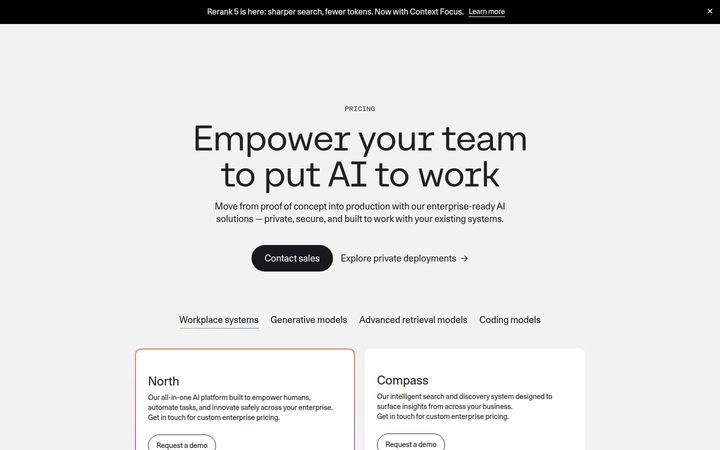
$3.00/instance/hrCohere prices for the enterprise in three shapes: custom contracts for its North and Compass platforms, reserved capacity on Model Vault at $3.00 to $7.00 an hour or $2,000 to $4,300 a month per instance, and pay-as-you-go tokens behind a Production API key. A four-way toggle sorts the page by buying job, and the FAQ carries the billing mechanics, down to an invoice at month end or at $250 of outstanding balance.
Deepgram
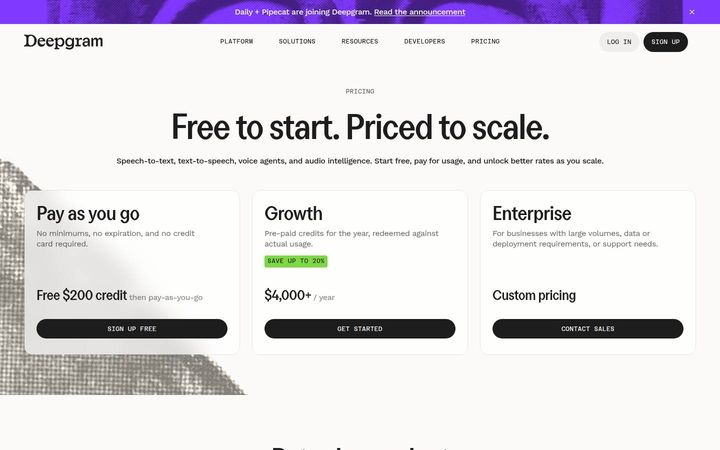
$0.0077/minDeepgram's page opens on "Free to start. Priced to scale." and three cards: Pay as you go with a Free $200 credit, Growth at $4,000+ / year in pre-paid credits for up to 20% off, and Enterprise at Custom pricing. A tabbed "Rates by product" section names the meter for each product, per second of audio, per 1,000 characters, or per minute of connection time, and a sixteen-question FAQ carries the billing mechanics, from hourly rates to the 10% overage premium.

Exa
$4/1k requestsExa prices its search API per thousand requests, with a rate for each endpoint: Lite Search $4, Auto Search $7, Deep Search $12, Contents $1 per 1k pages, Monitors $2 and Answer $5, plus $1 per 1k for each result above ten and for AI page summaries. Agent runs offer metered compute at $0.10 per ACU and six effort levels: five fixed from $0.012 to $1.00 per request and an Ultra level billed on usage. The plan cards divide access, throughput and compliance, and the rate card below them carries the price.
fal
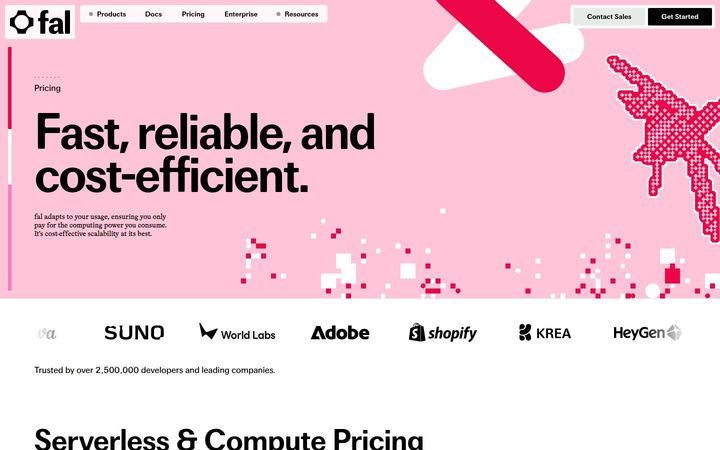
From $0.0002/secondfal prices two products on one page with rate sheets in place of plans: GPU hours for serverless compute across six SKUs, and model APIs billed per output unit across video, image, audio and 3D. The "Units per $1" column turns seconds, tokens, images, megapixels, characters, generations and credits into one number a buyer compares directly.
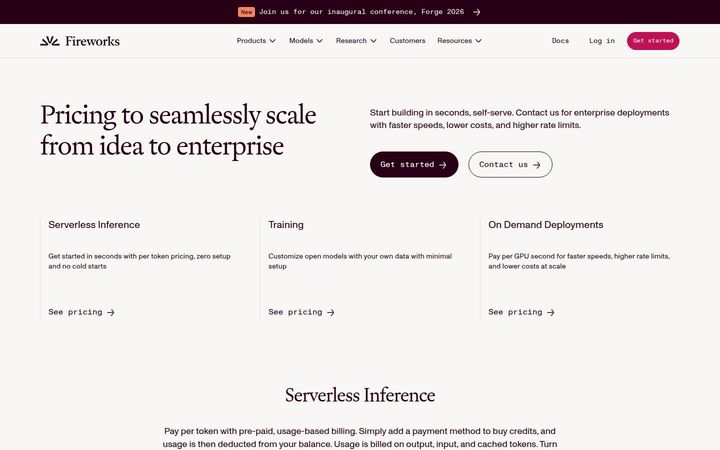
Fireworks AI
From $0.008/1M tokensFireworks prices three product lines on three meters: serverless inference per token, training per 1M training tokens, and on-demand deployments per GPU second. Serverless usage now draws down a pre-paid credit balance with Auto Reload and a monthly spend limit, and the training side carries a fine-tuning matrix that doubles cleanly at each step plus an eight-model Serverless Training API that meters prefill, cached prefill, sample and train tokens separately.