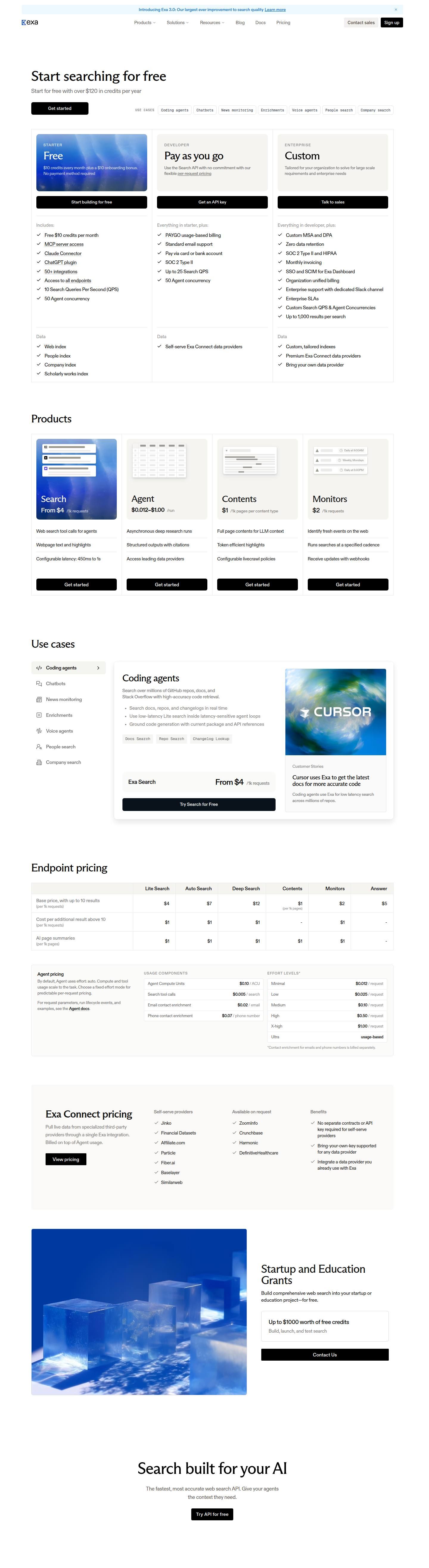
Captured November 2, 2026 at 1440px wide.
Exa plans and prices
| Plan | Price |
|---|---|
| STARTER$10 credits every month plus a $10 onboarding bonus. | Free |
| DEVELOPERUse the Search API with no commitment with our flexible per-request pricing | Pay as you go |
| ENTERPRISETailored for your organization to solve for large scale requirements and enterprise needs | Custom |
As printed on the page captured November 2, 2026.
How does Exa pricing work?
The value metric is the API request, priced by endpoint. Search opens 'From $4 /1k requests': the table splits it into Lite Search at $4 and Auto Search at $7, each with up to 10 results, followed by Deep Search at $12, Contents $1 per 1,000 pages per content type, Monitors $2 and Answer $5. Monitors, which run searches at a set cadence, carry the lowest per-request base rate in the rate card, so recurring watch jobs price as a light, always-on layer. Two modifiers price the behaviors that add work: $1 per 1,000 for each result above the tenth, and $1 per 1,000 pages for AI page summaries. Agent is billed on its own terms. The default, 'effort: auto', meters Agent Compute Units at $0.10 / ACU plus $0.005 per search tool call, $0.02 per email and $0.07 per phone number. Under 'EFFORT LEVELS', a buyer who wants a known unit cost can pin Minimal, Low, Medium, High or X-high at $0.012, $0.025, $0.10, $0.50 or $1.00 per request, and Ultra sits at the top as usage-based. Cost tracks the work performed, and the buyer chooses between variance and certainty.
The motion is developer-led with an enterprise top. 'Start searching for free' and 'Start for free with over $120 in credits per year' open the page, and three cards follow: Free with '$10 credits every month plus a $10 onboarding bonus. No payment method required', Developer as 'Pay as you go' with 'Get an API key', and Enterprise as Custom with 'Talk to sales'. The cards separate on throughput, compliance and data: 10 Search QPS on Free, up to 25 on Developer and custom on Enterprise, with SOC 2 Type II, HIPAA, zero data retention and SSO and SCIM higher up. A four-card Products row (Search, Agent, Contents, Monitors), a use-case switcher with a Cursor story, the Endpoint pricing table, Agent pricing, Exa Connect, a grants panel and a closing 'Try API for free' complete the page.
Under the hood, the page shows three layers of billing. Endpoint requests bill on a rate table, Agent runs bill either in ACUs plus tool calls or at a set price per effort level, and Exa Connect pulls data from third-party providers, 'Billed on top of Agent usage', a pass-through layer kept apart from Exa's own price, with bring-your-own-key for any provider. The Search split is the clearest packaging move: a $4 Lite tier and a $7 Auto tier let the buyer pick depth per call, and the use-case copy points coding agents at Lite for their tight loops. Monitors at $2 /1k requests make scheduled searches the low-cost way to keep watching the web, a recurring usage stream that compounds as more monitors are added. The effort ladder does the same for agents, packaging variable compute into five predictable price points and leaving Ultra on metered usage for the heaviest runs. As agents become a larger share of API traffic, offering both metered and fixed-price modes is a pattern worth borrowing.
What does Exa's pricing page do well?
- The free grant is stated as an annual total, 'over $120 in credits per year', and 'No payment method required' appears on the card
- Rate limits are concrete numbers: 10 Search QPS and 50 agent concurrency on Free, up to 25 Search QPS on Developer, custom on Enterprise
- Each Products card prints its own entry rate, from 'From $4 /1k requests' on Search to '$2 /1k requests' on Monitors, before the endpoint table
- The endpoint table prices the marginal unit, $1 per 1,000 for each result above the tenth and $1 per 1,000 AI page summaries, along with the base call
- Agent lists five fixed effort levels from $0.012 to $1.00 per request plus Ultra on usage, beside metered ACUs, and the page names auto as the default
What does Exa's pricing page reveal about its pricing strategy?
- Splitting Search into Lite at $4 and Auto at $7 prices latency and depth per call, giving high-volume agent loops a lower-cost default
- Monitors at $2 per 1k requests price scheduled searches as an inexpensive recurring layer, which encourages teams to set up many always-on watches
- The effort ladder turns variable agent cost into five predictable products and keeps the open-ended Ultra level on the meter
- Plan cards separate on throughput, compliance and data access, so price lives in the rate card and the plan sets the operating envelope
- Exa Connect billed on top of Agent usage keeps third-party data as a pass-through layer apart from Exa's own pricing
Learn with Orb
- GuidePricing AI agents: plans, costs and monetization models Each endpoint carries its own rate per 1,000 requests, from $1 for Contents to $15 for Deep-Reasoning Search; Orb's guide covers how AI teams meter work per call, token and event.
- GuideHow to price your AI agent: a framework Agent offers metered ACUs at $0.10 or five fixed effort modes from $0.012 to $1.00 per request, a choice Orb's framework frames as keeping margins healthy while compute cost varies.
- GuidePay-as-you-go pricing for SaaS A free grant of over $120 in credits a year with no payment method required opens a path into pay as you go, the low barrier to entry Orb's pay-as-you-go guide describes.
Questions about Exa pricing
How much does Exa cost?
Exa's pricing starts at $4/1k requests. The page shows 3 plans, including a free plan, with the top plan priced through sales.
What pricing model does Exa use?
Exa prices by usage, combined with credits. Buyers can sign up on their own or go through the sales team. Its plans are aimed mainly at developers.
Does Exa have a free plan?
Yes, Exa has a free plan. Paid plans start at $4/1k requests.
Does Exa offer an annual discount?
Exa's pricing page shows a single billing period. The listed prices start at $4/1k requests. Terms for the plans priced through sales are set with the sales team.
How is Exa's pricing page laid out?
The page shows 3 plans and includes a comparison table. The breakdown above marks 14 points on it: 7 things it does well and 7 insights into the pricing.
Does Exa offer startup or education grants?
Yes. Exa runs a Startup and Education Grants program to help teams "Build comprehensive web search into your startup or education project" with "Up to $1000 worth of free credits" to build, launch, and test search. Applicants reach the team through the Contact Us link in the grants panel on the pricing page.
How is Exa Agent priced per run?
By default, Exa Agent uses "effort: auto", which meters Agent Compute Units at $0.10 / ACU plus $0.005 per search tool call, $0.02 per email and $0.07 per phone number for contact enrichment. For predictable per-request pricing, buyers can pick a fixed effort level: Minimal $0.012, Low $0.025, Medium $0.10, High $0.50 or X-high $1.00 per request, with Ultra billed on usage. Contact enrichment for emails and phone numbers is billed separately from the effort levels.
How much do Exa Monitors and extra search results cost?
Monitors run searches at a specified cadence and cost $2 per 1k requests, with up to 10 results per request included in the base price. Each additional result above 10 costs $1 per 1k requests on Lite Search, Auto Search, Deep Search and Monitors, and AI page summaries are $1 per 1k pages. Enterprise plans support "Up to 1,000 results per search" for large-scale requirements.
From the page as captured November 2, 2026. Current prices are on exa.ai
Deepgram
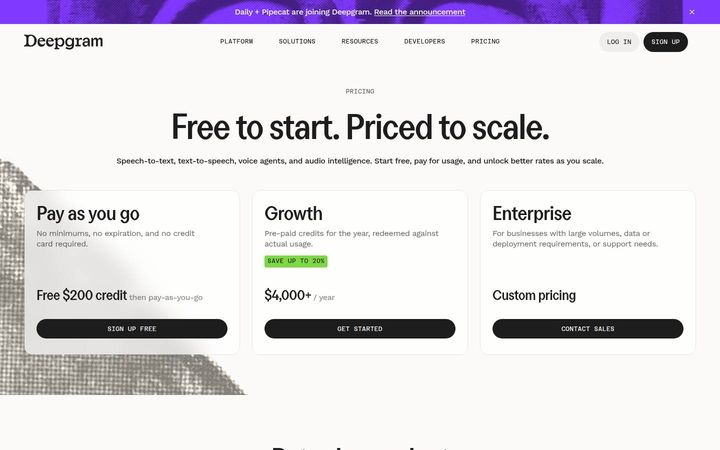
$0.0077/minDeepgram's page opens on "Free to start. Priced to scale." and three cards: Pay as you go with a Free $200 credit, Growth at $4,000+ / year in pre-paid credits for up to 20% off, and Enterprise at Custom pricing. A tabbed "Rates by product" section names the meter for each product, per second of audio, per 1,000 characters, or per minute of connection time, and a sixteen-question FAQ carries the billing mechanics, from hourly rates to the 10% overage premium.

AssemblyAI
$0.15/hrAssemblyAI bills speech-to-text by the hour of audio, the unit a transcription team already uses, and the default view shows two rates: Universal-3.5 Pro at $0.21 /hr and Universal-2 at $0.15 /hr. A selector across eight APIs, grouped under TRANSCRIBE, UNDERSTAND and INTERACT, swaps the rate table, so each product is priced in its own unit, from audio hours to LLM tokens to input characters. The FAQ carries the billing mechanics in plain words, including the new Text-to-Speech API at $15 per 1M characters.

Baseten
From $0.01/1M tokensBaseten layers a three-tier service ladder over published rate sheets. Basic is '$0 per month, pay as you go', and Pro and Enterprise carry 'Volume discounts available' with 'GET A QUOTE'. Underneath sit three meters: Model APIs per 1M tokens across 19 model rows with Input, Cache Input and Output columns, opening with joey-1 at $0.01 input, dedicated GPU and CPU instances billed 'down to the minute', and the same GPU grid for training.

Cohere
$3.00/instance/hrCohere prices for the enterprise in three shapes: custom contracts for its North and Compass platforms, reserved capacity on Model Vault at $3.00 to $7.00 an hour or $2,000 to $4,300 a month per instance, and pay-as-you-go tokens behind a Production API key. A four-way toggle sorts the page by buying job, and the FAQ carries the billing mechanics, down to an invoice at month end or at $250 of outstanding balance.

fal
From $0.0002/secondfal prices two products on one page with rate sheets in place of plans: GPU hours for serverless compute across six SKUs, and model APIs billed per output unit across video, image, audio and 3D. The "Units per $1" column turns seconds, tokens, images, megapixels, characters, generations and credits into one number a buyer compares directly.
Fireworks AI
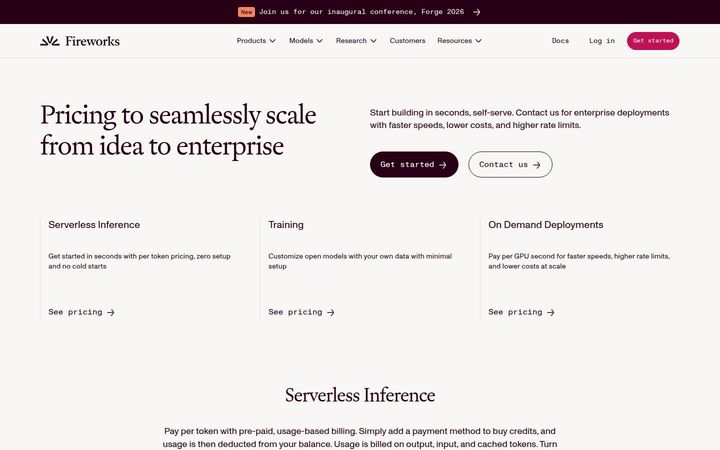
From $0.008/1M tokensFireworks prices three product lines on three meters: serverless inference per token, training per 1M training tokens, and on-demand deployments per GPU second. Serverless usage now draws down a pre-paid credit balance with Auto Reload and a monthly spend limit, and the training side carries a fine-tuning matrix that doubles cleanly at each step plus an eight-model Serverless Training API that meters prefill, cached prefill, sample and train tokens separately.