How Render prices

Captured November 2, 2026 at 1440px wide. The page continues below the crop (16,798px in total).
Render plans and prices
| Plan | Price | Billing |
|---|---|---|
| HobbyFor individuals building personal projects and prototypes. | $0 | /mo + compute |
| ProFor teams deploying production-grade apps and agents. | $25 | /mo + compute |
| ScaleFor teams that need advanced governance and compliance. | $499 | /mo + compute |
| EnterpriseFor teams that need dedicated support and uptime SLAs. | Custom |
As printed on the page captured November 2, 2026.
How does Render pricing work?
Render sells the platform and the compute separately. Every workspace price carries '+ compute', and the FAQ states the model plainly: "Render charges for three things: your workspace plan (flat subscription), metered features like bandwidth (usage-based), and compute for your applications (usage-based)." The workspace plans step by governance: Hobby is 'For individuals building personal projects and prototypes.' with 'Deploy up to 25 services', Pro at $25/mo adds 'Unlimited seats & services', 'Horizontal autoscaling' and 'Isolated environments', Scale at $499/mo adds 'HIPAA-compliant workspaces', 'SAML SSO & SCIM' and 'Advanced RBAC roles', and Enterprise adds 'Contractual uptime SLAs' and a 'Dedicated technical account team'. Compute is priced per instance and per service type, from Services & Workers at '$7/month' for 512 MB RAM to Postgres at '$11,000/month' for 1024GB RAM, with Workflows sized up to '8 CPU $2.50/hour 32 GB RAM' and Sandboxes up to 8 CPU and 16 GB of RAM.
The motion is self-serve through Scale and sales-led at Enterprise. Each card has its own verb, 'Deploy for free', 'Start with Pro', 'Start with Scale' and 'Get in touch', and Enterprise reads 'Custom pricing', which leaves room to shape SLAs, support and volume in conversation. The page opens with a migration banner, 'Migrating production infrastructure? Get up to $10K in migration credits.', and a headline that promises 'Predictable pricing that scales with you.', then goes straight to the plan cards, with the startup and migration credit offers directly below them. A Compute section follows with one rate table per service type, Services & Workers, Postgres, Key Value, Cron Jobs, Workflows, Sandboxes and Static Sites, then a long workspace feature table and an FAQ.
Under the hood the page reads like a rate card exported from the billing system. Instances carry machine names such as '0.5c-512mb' and '2c-8g', cron jobs are 'Prorated by the second', and two services meter active time: Workflows at '$0.20 / active CPU hour; $0.05 / active GB hour' for the flex tier, and Sandboxes at '$0.12 / active CPU hour + $0.038/hour for memory' on the 1 CPU size, rising to '$0.12 / active CPU hour + $0.304/hour for memory' at 8 CPU. Sandboxes pair that meter with 'Automatic suspend and resume when idle' and 'Snapshot storage for $0.08/GB per month', so a microVM that pauses keeps its state on a storage rate. Allowances follow one pattern, an included quantity then a unit rate, as in '25 GB included per month then $0.15 per GB', and the feature table states Workflows and Sandboxes limits as capacity, so the plan sets throughput and the meter sets the bill. Compliance is priced as a multiplier, '20% compute premium for enabled workspaces' for HIPAA. A platform fee for governance plus active-time compute for agent workloads is where developer infrastructure pricing is heading, and the included-then-metered pattern is worth borrowing.
What does Render's pricing page do well?
- Every workspace price prints '+ compute', so the two layers of the bill are visible on the first card a buyer reads
- Each compute table lists CPU, RAM, price and the instance name, such as '1c-2g', so a buyer can map a row to the dashboard
- Sandbox rows hold the CPU rate at '$0.12 / active CPU hour' across sizes and vary only the memory rate, so sizing changes one number
- Allowances read as an included quantity then a rate, '5 GB included per month then $0.15 per GB', on bandwidth, custom domains and build minutes
- Pro includes 'Unlimited seats & services', so team growth adds no seat charge
What does Render's pricing page reveal about its pricing strategy?
- The workspace plan prices governance and the compute tables price resources, two value metrics with separate jobs
- Sandboxes split the meter into active CPU and hourly memory, which points to billing that charges compute only while code runs and prices memory by size
- Sandboxes limits read as capacity, 'Default concurrent sandboxes' of 100 on Hobby and 1,000 on Pro and Scale with 'Up to 10,000 on request', so plans gate scale-out while usage drives revenue
- Workflows limits follow the same shape, '10,000 CPU 40,000 GB RAM' of parallel compute and a per-minute ramp of '32 CPU 128 GB RAM' on Pro
- HIPAA as a '20% compute premium' prices compliance as a multiplier on usage, which scales its cost with the workload it covers
Learn with Orb
- ProductPrice modeling Workspace plans from '$0/mo + compute' to '$499/mo + compute' sit on per-instance rates, per-minute cron and '$0.20 / active CPU hour' Workflows; Orb's price modeling covers dimensional rates and hybrid plans like this without re-engineering billing.
- GuideMigrating from subscriptions to usage-based billing Render bills 'your workspace plan (flat subscription)' alongside compute and bandwidth metered by use, and Orb's guide covers moving a cloud product to billing for compute, storage and bandwidth.
- ProductInvoicing A plan fee, bandwidth at '25 GB included per month then $0.15 per GB' and compute prorated to the second all land on one bill, the kind of invoice Orb itemizes with real-time usage detail that finance teams can reconcile.
Questions about Render pricing
How much does Render cost?
Render's pricing starts at $25/mo + compute. The page shows 4 plans, including a free plan, with the top plan priced through sales.
What pricing model does Render use?
Render prices by usage, combined with flat-rate tiers. Buyers can sign up on their own or go through the sales team. Its plans are aimed mainly at developers.
Does Render have a free plan?
Yes, Render has a free plan. Paid plans start at $25/mo + compute.
Does Render offer an annual discount?
Render's pricing page shows a single billing period. The listed prices start at $25/mo + compute. Terms for the plans priced through sales are set with the sales team.
How is Render's pricing page laid out?
The page shows 4 plans and includes a comparison table and an FAQ. The breakdown above marks 14 points on it: 5 things it does well and 9 insights into the pricing.
How are Render Sandboxes priced?
Sandboxes are in BETA and bill "$0.12 / active CPU hour" at every size, plus an hourly memory rate that grows with the instance, from "$0.038/hour for memory" at 1 CPU with 2 GB RAM to "$0.304/hour for memory" at 8 CPU with 16 GB RAM. Each sandbox includes 40 GB of disk, and snapshot storage is $0.08/GB per month. The page also lists "Automatic suspend and resume when idle" and "Pay only for the CPU you use".
How many Render Sandboxes can run at once, and for how long?
Hobby workspaces start with 100 default concurrent sandboxes and a maximum session length of 24 hours. Pro and Scale start at 1,000 concurrent sandboxes, with "Up to 5,000 on request" on Pro and "Up to 10,000 on request" on Scale, and both read "No limit" for session length. Enterprise concurrency is "Custom", and the compute section notes "Sandboxes can run up to 30 days on Pro and above".
How does Render bill for compute when a service only runs part of the month?
Render prorates compute billing to the second on a per-service basis. The FAQ gives the example that if you create a web service on a paid compute plan and turn it off 24 hours later, "you are only billed for 24 hours of compute." The same applies to Cron Jobs and Workflows, which are billed only while actively running your workload.
From the page as captured November 2, 2026. Current prices are on render.com
Chroma
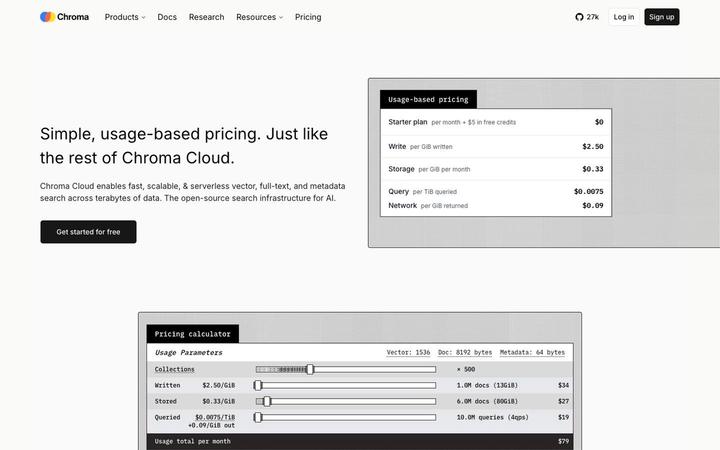
$250/mo + usageChroma prints all four metered rates in the hero, Write at $2.50 per GiB, Storage at $0.33 per GiB per month, Query at $0.0075 per TiB and Network at $0.09 per GiB returned, then hands the reader a calculator that turns documents and queries into a $79 monthly total. Plans sit on top of the meter: Starter at $0 plus usage, Team at $250 a month plus usage with $100 in credits, and Enterprise on custom terms.
Confluent
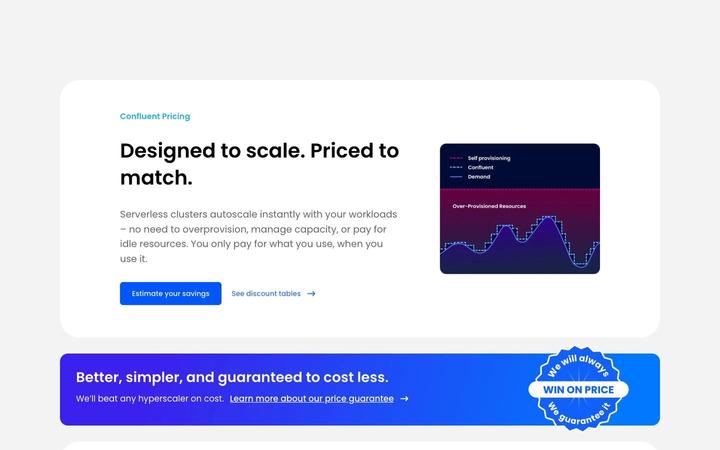
~$385/moConfluent prices serverless Kafka on a composite meter, eCKU-hours plus data in and out per GB plus storage per GB-month, and closes its rate table with an 'Estimated Monthly Starting Cost' of $0, $385, $895 and $2,300 that turns an hourly unit into a budget number. Behind it sit two discount structures and an annual commitment that can be spent across the whole Confluent Cloud stack.

Datadog
$15/host/moDatadog publishes a rate card per product, with every billable SKU listed in a left-hand navigator from AI Credits to Workflow Automation. Infrastructure Monitoring prices per host across three host levels: Basic, set with sales, beside Pro starting at $ 15 and Enterprise at $ 23 billed annually, with on-demand rates printed beside them and allotments of containers, custom metrics and custom events attached to each paid host. The bill is the sum of the products a customer adopts, and Basic hosts let one account price noncritical workloads at their own level.

Fly.io
From $0.0030/hr (shared-cpu-1x, 256MB)Fly.io prices raw infrastructure: Machines 'Billed by the second while a Machine runs', volumes on provisioned capacity, and egress by region, with prices set per region through a selector. Support is sold as its own ladder at '$29 / mo', '$199 / mo' and 'From $2,500 / mo', compliance is a '$99/mo' add-on, and a Custom plan covers committed spend and volume discounts.
Grafana
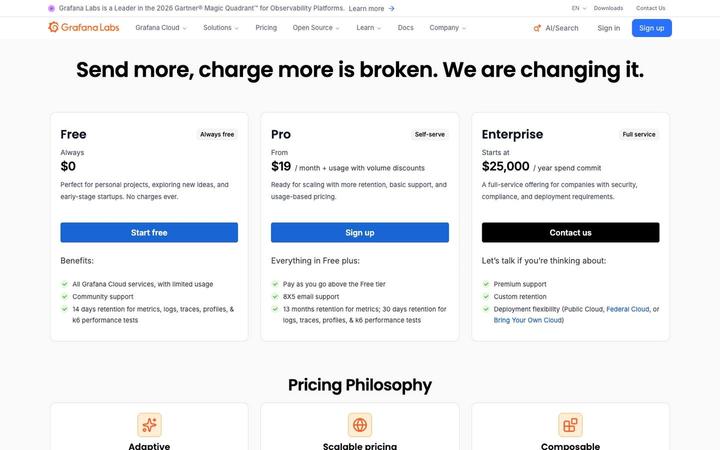
$19/moGrafana Cloud prices on a $19 per month platform fee that carries an allowance on every product, then a usage meter chosen per product, with volume tiers that lower the marginal rate as a customer grows. The hero states the thesis, 'Send more, charge more is broken. We are changing it.', and the page backs it with an embedded calculator that draws the tier curve and a cost-reduction band under the rates. Enterprise prints its entry point: 'Starts at $25,000 / year spend commit'.

Modal
$250 + compute/moModal bills GPU, CPU, memory and storage by the second or month, and network egress at '$0.04 / GiB', with the full rate card under the promise of paying for 'just actual compute time, by the CPU cycle'. Plans are a platform fee plus that usage: Starter at $0 with $30 of monthly credits and 1 TiB of egress, Team at $250 with $100 and 10 TiB, and a custom Enterprise with 100 TiB. A worked comparison makes the serverless case on utilization, with a $3.95 GPU-hour that totals '12% lower cost' than $3 GPU-hours provisioned around the clock.