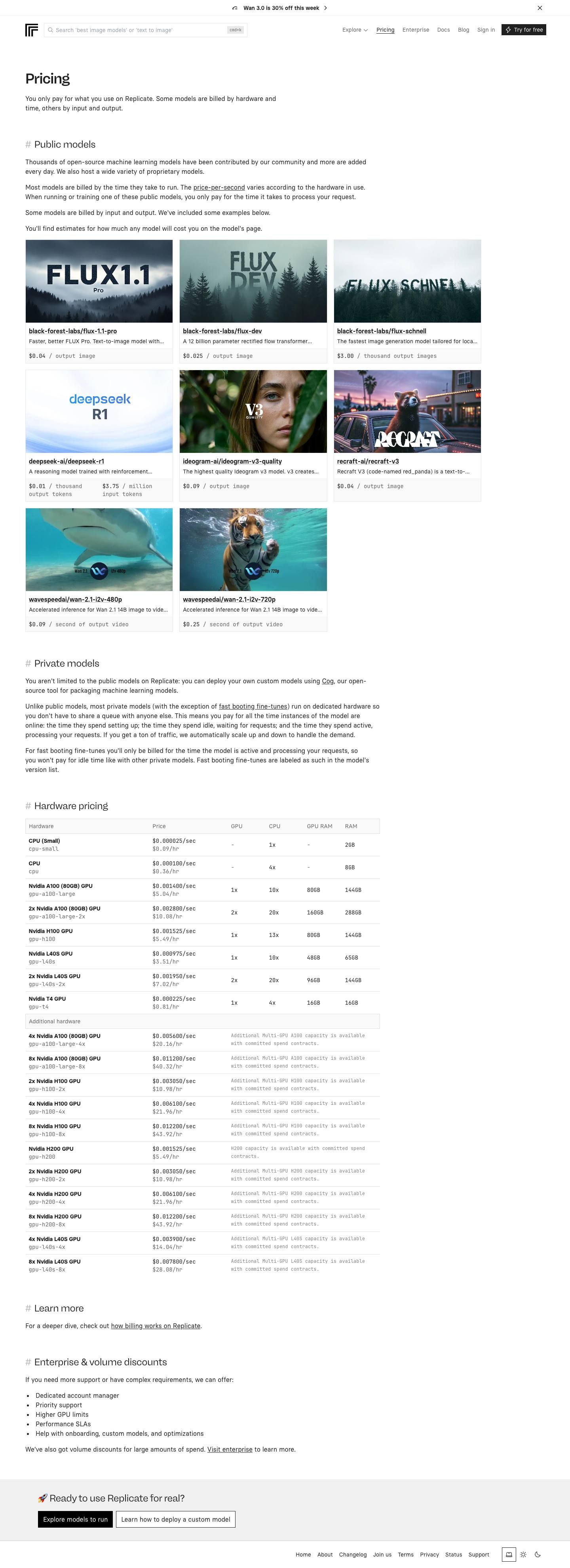
Captured September 18, 2026 at 1440px wide.
Replicate plans and prices
| Plan | Price | Billing |
|---|---|---|
| CPU (Small) | $0.000025 | /sec |
| CPU | $0.000100 | /sec |
| Nvidia A100 (80GB) GPU | $0.001400 | /sec |
| 2x Nvidia A100 (80GB) GPU | $0.002800 | /sec |
| Nvidia H100 GPU | $0.001525 | /sec |
| Nvidia L40S GPU | $0.000975 | /sec |
| 2x Nvidia L40S GPU | $0.001950 | /sec |
| Nvidia T4 GPU | $0.000225 | /sec |
As printed on the page captured September 18, 2026.
How does Replicate pricing work?
Replicate runs two value metrics side by side and says so in the hero: 'Some models are billed by hardware and time, others by input and output.' Output-billed models are priced in the unit the model delivers, '$0.04 / output image' for flux-1.1-pro, '$0.09 / second of output video' for wan-2.1-i2v-480p, and '$3.75 / million input tokens' for deepseek-r1. Time-billed models run on the hardware table, where every SKU carries a per-second and a per-hour rate beside its GPU, CPU, GPU RAM and RAM, such as gpu-a100-large at '$0.001400/sec' and '$5.04/hr'. With thousands of models of very different cost, pricing by output where the model allows it and by hardware time everywhere else keeps each price tied to what it costs to serve.
The page is a single-column document with sections for Public models, Private models, Hardware pricing, Learn more and Enterprise & volume discounts. The motion is self-serve first, with 'Try for free' in the nav and a closing 'Ready to use Replicate for real?' that offers 'Explore models to run' and 'Learn how to deploy a custom model', the two halves of the business. Model-level estimates live with each model: 'You'll find estimates for how much any model will cost you on the model's page.' A banner at the top, 'Wan 3.0 is 30% off this week', shows the catalog promoting individual models.
Under the hood, private models bill for 'the time they spend setting up; the time they spend idle, waiting for requests; and the time they spend active', the price of dedicated hardware with no shared queue, and fast booting fine-tunes bill active time alone. The Additional hardware block moves the motion to sales: each multi-GPU configuration carries a public rate and the note that more capacity 'is available with committed spend contracts', so the biggest GPU footprints are reserved through a commitment. Enterprise adds 'Higher GPU limits', 'Performance SLAs' and 'volume discounts for large amounts of spend', the commercial room a sales team uses to shape large accounts. Worth borrowing: print every compute rate in both the billing grain and a budgeting grain.
What does Replicate's pricing page do well?
- The hero explains both billing modes, hardware and time against input and output, in two plain sentences before any number appears
- Every hardware row prints the rate in $/sec and $/hr beside GPU, CPU, GPU RAM and RAM, so a buyer can match a SKU to a workload and a budget in one line
- Example model cards quote the price in the unit the model bills, '$0.04 / output image' and '$0.09 / second of output video'
- The Private models section states exactly what bills, setup, idle and active time, and names the fast booting fine-tunes that bill active time alone
- The closing band splits into 'Explore models to run' and 'Learn how to deploy a custom model', matching the two halves of the page
What does Replicate's pricing page reveal about its pricing strategy?
- Two value metrics on one platform: per-output pricing for models that allow it, hardware time for everything else
- Dedicated private instances bill for all online time, the cost of a queue no one else shares
- Multi-GPU capacity beyond the listed configurations is reserved through committed spend contracts
- Model-level estimates live on each model's page, which keeps the pricing page a rate sheet for the whole catalog
- Enterprise trades on higher GPU limits, performance SLAs and volume discounts, levers that grow with spend
Learn with Orb
- Guide14 usage-based pricing examples Replicate meters per output for some models and per second of hardware for the rest, from cpu-small to 8x H200; Orb's guide covers what fourteen usage-based companies meter and why.
- GuideHow to price your AI agent: a framework Per-output prices such as $0.04 per image sit beside raw GPU time; Orb's framework covers pricing AI when every use carries a compute cost, keeping margins healthy as usage grows.
Questions about Replicate pricing
How much does Replicate cost?
Replicate's pricing starts at $0.000025/sec. The page shows 3 plans, with the top plan priced through sales.
What pricing model does Replicate use?
Replicate prices by usage. Buyers can sign up on their own or go through the sales team. Its plans are aimed mainly at developers.
Does Replicate have a free plan?
Replicate's pricing page shows no free plan or free trial. The lowest paid plan starts at $0.000025/sec.
Does Replicate offer an annual discount?
Replicate's pricing page shows a single billing period. The listed prices start at $0.000025/sec. Terms for the plans priced through sales are set with the sales team.
How is Replicate's pricing page laid out?
The page shows 3 plans. The breakdown above marks 13 points on it: 5 things it does well and 8 insights into the pricing.
How does Replicate bill for private models?
Most private models on Replicate run on dedicated hardware, so you pay for all the time instances are online: "the time they spend setting up; the time they spend idle, waiting for requests; and the time they spend active, processing your requests." Replicate automatically scales up and down to handle traffic. Fast booting fine-tunes are the exception and bill only for the time the model is active and processing requests. They are labeled as such in the model's version list.
Where can I find a cost estimate for a specific model on Replicate?
Replicate notes that "You'll find estimates for how much any model will cost you on the model's page." Most public models are billed by the time they take to run, with the price-per-second set by the hardware in use, and you only pay for the time it takes to process your request. Some models are billed by input and output, such as flux-1.1-pro at $0.04 / output image.
What does Replicate offer for enterprise and high-volume customers?
Replicate's enterprise offering includes a dedicated account manager, priority support, higher GPU limits, performance SLAs, and help with onboarding, custom models, and optimizations. The page also notes "volume discounts for large amounts of spend." Larger multi-GPU and H200 capacity is available through committed spend contracts.
From the page as captured September 18, 2026. Current prices are on replicate.com

AssemblyAI
$0.15/hrAssemblyAI bills speech-to-text by the hour of audio, the unit a transcription team already uses, and the default view shows two rates: Universal-3.5 Pro at $0.21 /hr and Universal-2 at $0.15 /hr. A selector across eight APIs, grouped under TRANSCRIBE, UNDERSTAND and INTERACT, swaps the rate table, so each product is priced in its own unit, from audio hours to LLM tokens to input characters. The FAQ carries the billing mechanics in plain words, including the new Text-to-Speech API at $15 per 1M characters.

Baseten
From $0.01/1M tokensBaseten layers a three-tier service ladder over published rate sheets. Basic is '$0 per month, pay as you go', and Pro and Enterprise carry 'Volume discounts available' with 'GET A QUOTE'. Underneath sit three meters: Model APIs per 1M tokens across 19 model rows with Input, Cache Input and Output columns, opening with joey-1 at $0.01 input, dedicated GPU and CPU instances billed 'down to the minute', and the same GPU grid for training.

Cohere
$3.00/instance/hrCohere prices for the enterprise in three shapes: custom contracts for its North and Compass platforms, reserved capacity on Model Vault at $3.00 to $7.00 an hour or $2,000 to $4,300 a month per instance, and pay-as-you-go tokens behind a Production API key. A four-way toggle sorts the page by buying job, and the FAQ carries the billing mechanics, down to an invoice at month end or at $250 of outstanding balance.
Deepgram
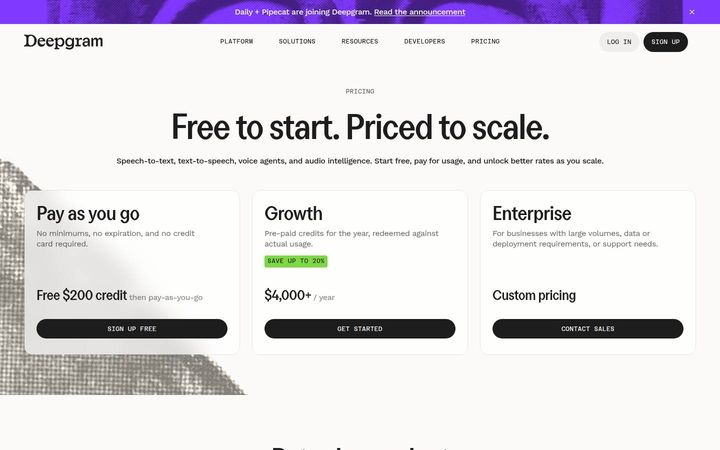
$0.0077/minDeepgram's page opens on "Free to start. Priced to scale." and three cards: Pay as you go with a Free $200 credit, Growth at $4,000+ / year in pre-paid credits for up to 20% off, and Enterprise at Custom pricing. A tabbed "Rates by product" section names the meter for each product, per second of audio, per 1,000 characters, or per minute of connection time, and a sixteen-question FAQ carries the billing mechanics, from hourly rates to the 10% overage premium.

Exa
$4/1k requestsExa prices its search API per thousand requests, with a rate for each endpoint: Lite Search $4, Auto Search $7, Deep Search $12, Contents $1 per 1k pages, Monitors $2 and Answer $5, plus $1 per 1k for each result above ten and for AI page summaries. Agent runs offer metered compute at $0.10 per ACU and six effort levels: five fixed from $0.012 to $1.00 per request and an Ultra level billed on usage. The plan cards divide access, throughput and compliance, and the rate card below them carries the price.
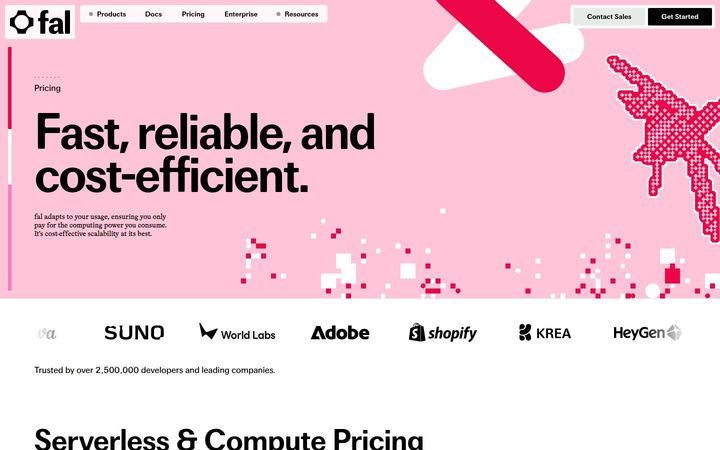
fal
From $0.0002/secondfal prices two products on one page with rate sheets in place of plans: GPU hours for serverless compute across six SKUs, and model APIs billed per output unit across video, image, audio and 3D. The "Units per $1" column turns seconds, tokens, images, megapixels, characters, generations and credits into one number a buyer compares directly.