Captured November 4, 2026 at 1440px wide.
How does Resolve AI pricing work?
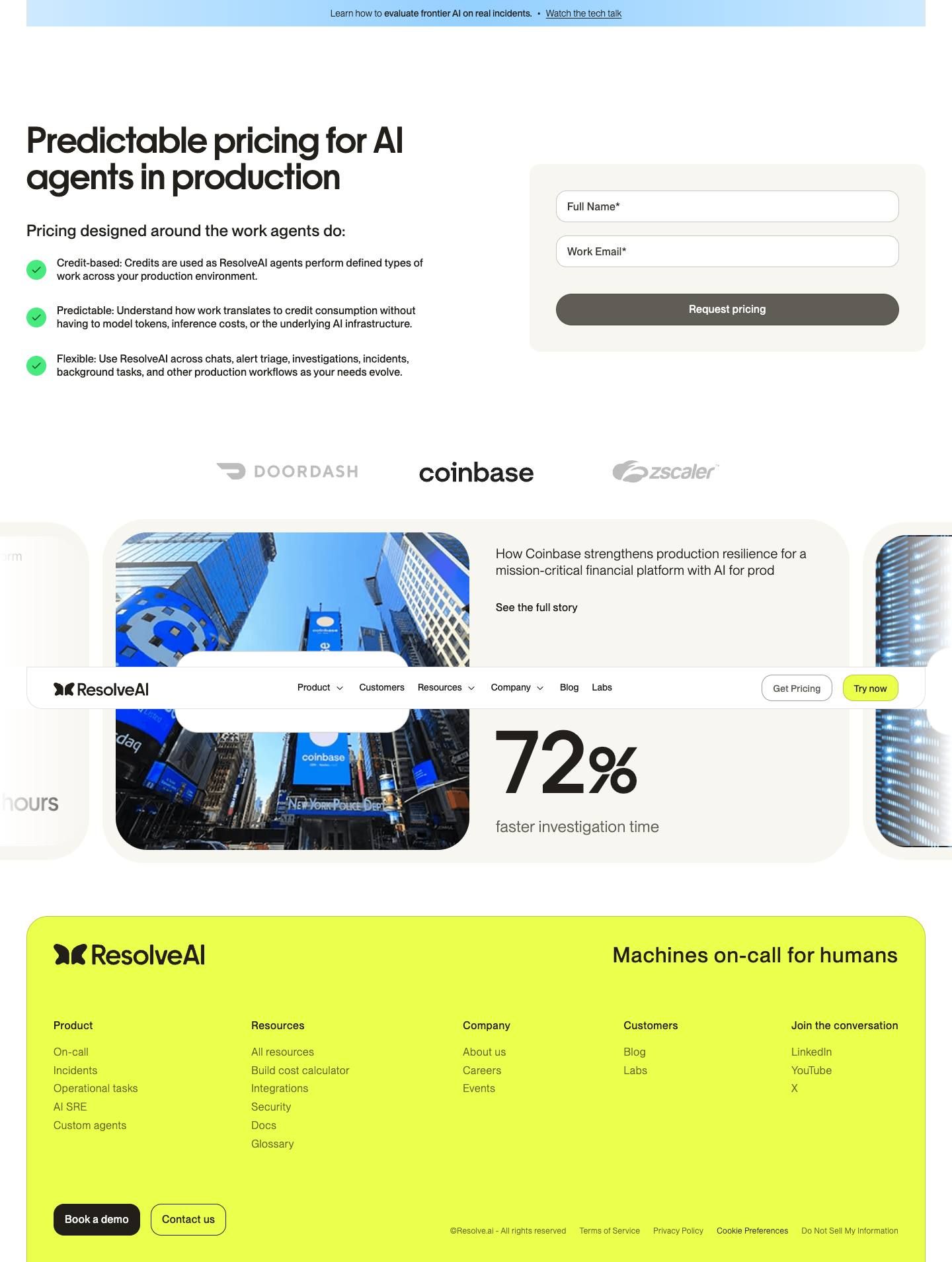
The value metric is work, counted in credits. 'Credits are used as ResolveAI agents perform defined types of work across your production environment', so the buyer pays for investigations, triage and incident work, one step removed from the tokens and inference behind them. The page says so directly: buyers can 'Understand how work translates to credit consumption without having to model tokens, inference costs, or the underlying AI infrastructure.' Packaging is one pool across every use case, with credits spent 'across chats, alert triage, investigations, incidents, background tasks, and other production workflows as your needs evolve.' There are no tiers on the page; the shape of the deal is the credit pool itself.
The motion is sales-led and short. The headline 'Predictable pricing for AI agents in production' sits beside a panel with two fields, 'Full Name' and 'Work Email', and one button, 'Request pricing'. Below it, DoorDash, Coinbase and Zscaler logos lead into a carousel of customer stories with outcome figures, '72 % faster investigation time' and '30 % fewer engineers in war rooms'. The navigation repeats the paths as 'Get Pricing' and 'Try now', and the footer, under 'Machines on-call for humans', closes with 'Book a demo' and 'Contact us'.
Under the hood, 'defined types of work' points to a rate table that converts each kind of agent task into a credit cost, with the quote setting the size and price of the pool. That structure keeps inference costs inside the vendor's margin and gives the buyer a unit that tracks the work an on-call engineer recognizes. A custom quote also gives the sales team room to set commitments, pool size and term around each production environment. Worth borrowing for any agent product: name the meter and the promise behind it, predictability, before asking for the email.
What does Resolve AI's pricing page do well?
- Three labeled lines, 'Credit-based', 'Predictable' and 'Flexible', explain the pricing model before the form
- The form asks for two fields only, 'Full Name' and 'Work Email', with a single 'Request pricing' button
- Customer stories pair a logo with an outcome figure, such as '72 % faster investigation time' for Coinbase
- The meter is framed in the buyer's language: alert triage, investigations and incidents, not tokens
- The footer offers two closing paths side by side, 'Book a demo' and 'Contact us'
What does Resolve AI's pricing page reveal about its pricing strategy?
- 'Defined types of work' points to a rate table that converts each agent task into a credit cost
- Removing the need 'to model tokens, inference costs, or the underlying AI infrastructure' keeps model costs on the vendor's side of the price
- One credit pool spans chats, triage, investigations and background tasks, so expansion follows usage across workflows
- A quote-only page gives the sales team room to size the pool, set commitments and shape term for each production environment
- 'Build cost calculator' in the footer resources frames the purchase against the cost of building in-house
Learn with Orb
- GuidePricing AI agents: plans, costs and monetization models Resolve AI prices agents on 'the work agents do', with credits used as they 'perform defined types of work', one of the agent monetization models Orb's guide lays out alongside how teams meter work per call, token and event.
- ProductPrepaid credits One credit balance drawn down across 'chats, alert triage, investigations, incidents, background tasks' is the credit model Orb's prepaid credits product supports, where the credit rate decides where value is captured.
- GuideAn expert's guide to enterprise pricing for SaaS Every price starts at 'Request pricing', so pool size and terms are set deal by deal; Orb's CEO covers how enterprise pricing differs from SMB pricing and what to weigh when prices are set per customer.
Questions about Resolve AI pricing
How much does Resolve AI cost?
Resolve AI prices its plans through its sales team, so the pricing page lists no starting price. Resolve AI prices through its sales team.
What pricing model does Resolve AI use?
Resolve AI prices through its sales team, combined with credits. The page is built around talking to the sales team. Its plans are aimed mainly at enterprises.
Does Resolve AI have a free plan?
Resolve AI's pricing page shows no free plan or free trial. Plans are priced through the sales team.
Does Resolve AI offer an annual discount?
Resolve AI's pricing page shows a single billing period. Terms for the plans priced through sales are set with the sales team.
How is Resolve AI's pricing page laid out?
The page shows its pricing. The breakdown above marks 14 points on it: 6 things it does well and 8 insights into the pricing.
How do Resolve AI credits work?
Resolve AI pricing is credit-based, and credits "are used as ResolveAI agents perform defined types of work across your production environment". Each type of agent work draws on the credit balance. The page frames this as predictable, so buyers can "Understand how work translates to credit consumption without having to model tokens, inference costs, or the underlying AI infrastructure".
What can Resolve AI credits be used for?
Credits are shared across use cases. The page lists "chats, alert triage, investigations, incidents, background tasks, and other production workflows" and says the mix can change "as your needs evolve". One balance covers on-call work, incident response and background operational tasks.
How do I get Resolve AI pricing?
Pricing is set with the Resolve AI team. The pricing page has a short form with "Full Name" and "Work Email" fields and a "Request pricing" button. The footer also offers "Book a demo" and "Contact us".
From the page as captured November 4, 2026. Current prices are on resolve.ai

Cohere
$3.00/instance/hrCohere prices for the enterprise in three shapes: custom contracts for its North and Compass platforms, reserved capacity on Model Vault at $3.00 to $7.00 an hour or $2,000 to $4,300 a month per instance, and pay-as-you-go tokens behind a Production API key. A four-way toggle sorts the page by buying job, and the FAQ carries the billing mechanics, down to an invoice at month end or at $250 of outstanding balance.
Deepgram
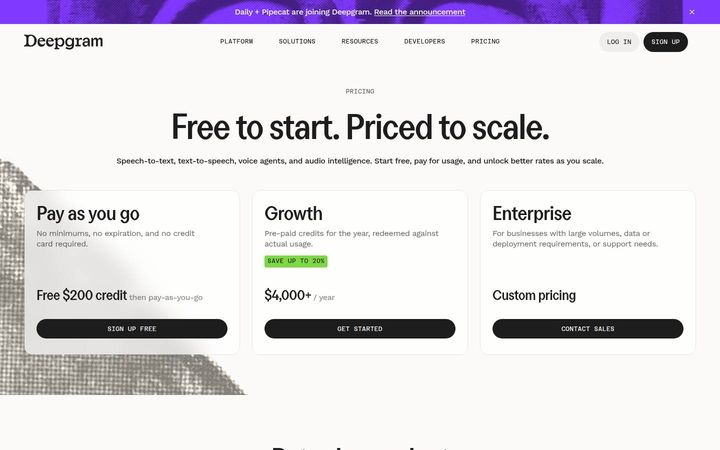
$0.0077/minDeepgram's page opens on "Free to start. Priced to scale." and three cards: Pay as you go with a Free $200 credit, Growth at $4,000+ / year in pre-paid credits for up to 20% off, and Enterprise at Custom pricing. A tabbed "Rates by product" section names the meter for each product, per second of audio, per 1,000 characters, or per minute of connection time, and a sixteen-question FAQ carries the billing mechanics, from hourly rates to the 10% overage premium.
Dust
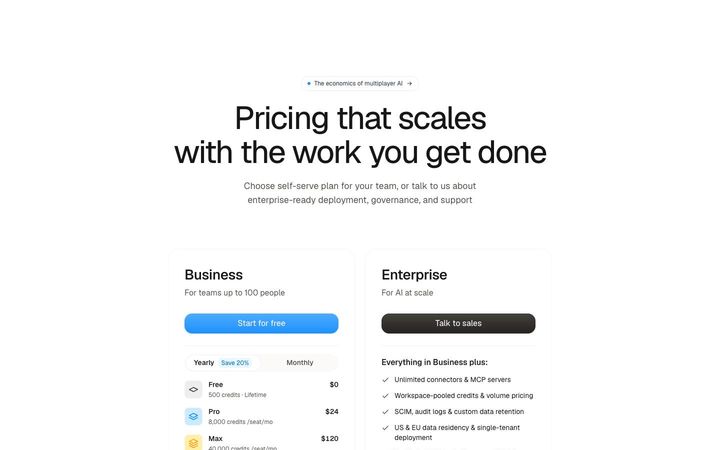
$24/seat/moDust sells one self-serve plan, Business 'For teams up to 100 people', priced through three seat types: Free at $0 with '500 credits · Lifetime', Pro at $24 with '8,000 credits /seat/mo' and Max at $120 with '40,000 credits /seat/mo' on yearly billing. Admins mix seat types by expected usage, and Enterprise moves to 'Workspace-pooled credits & volume pricing'.