
Captured November 4, 2026 at 1440px wide. The page continues below the crop (12,661px in total).
Crusoe plans and prices
| Plan | Price | Billing |
|---|---|---|
| NVIDIA B300 288GB HGX | $8.96 / GPU-hr | Current on-demand |
| NVIDIA H200 141GB HGX | $4.29 / GPU-hr | Current on-demand |
| NVIDIA H100 80GB HGX | $3.90 / GPU-hr | Current on-demand |
| NVIDIA L40S 48GB | $1.50 / GPU-hr | Current on-demand |
| General-purpose | $0.04 / vCPU-hr | On-demand |
| Persistent disks | $0.08 | per GiB/month |
| Managed Kubernetes | $0.10 | per cluster hour |
| DeepSeek V4 Flash 0731 | $0.14 | Input tokens |
As printed on the page captured November 4, 2026.
How does Crusoe pricing work?
The value metric follows the layer of the stack. Raw compute bills by the hour, from '$1.50 / GPU-hr' for the NVIDIA L40S to '$8.96 / GPU-hr' for the B300, and CPUs at '$0.04 / vCPU-hr'. Storage bills by capacity, '$0.08 per GiB/month' for persistent disks down to '$0.06 per GiB/month' for object storage, and Managed Kubernetes is '$0.10 per cluster hour'. Managed services move up to tokens: fine-tuning has a 'Price per 1M tokens' column with context length beside it, and Serverless Inference splits each model into 'Input tokens', 'Output tokens' and 'Cached tokens'. There are no plans; packaging is the product line, organized by a sidebar into 'AI Infrastructure', 'Fine-Tuning' and 'Managed Inference'.
The motion is self-serve with a sales path at the frontier. The hero offers 'Contact sales' and 'Get started' side by side under 'Flexible pricing for every workload', and three cards set the commercial terms: 'Cost-effective performance', 'Growth-aligned commitments' and 'Flexible consumption models' with 'spot, on-demand, or reserved pricing options'. In the GPU table, the newest systems, NVIDIA Vera Rubin, GB300 and GB200, read 'Contact sales', as does Nemotron 3 VoiceChat in the inference table. Self-Serve Deployments promise endpoints 'in minutes' with 'no sales engagement required', and Provisioned Throughput is sold through sales in 'AI Model Units (AMUs)'.
Under the hood, the page runs two price books: public on-demand rates and negotiated commitments. 'Pay by the hour for maximum agility and unthrottled compute, or contact us to lock in guaranteed resources at our lowest rates' states the trade plainly, and 'The longer your commitment, the lower your cost' sets the rule for throughput. The scheduled change is the standout mechanic: H100 moves from '$3.90 / GPU-hr' to '$4.50 / GPU-hr' and H200 from '$4.29 / GPU-hr' to '$5.40 / GPU-hr', while A100, L40S and MI300X rows read 'No change'. Publishing the next rate beside the current one gives on-demand buyers a date to plan around and a reason to talk about commitments now. Worth borrowing: a price change announced in the price table itself.
What does Crusoe's pricing page do well?
- A 'New on-demand starting Dec 1, 2026' column sits beside 'Current on-demand', so the price change is visible where buyers read the rate
- A sidebar groups nine price tables under 'AI Infrastructure', 'Fine-Tuning' and 'Managed Inference', one click to each section
- Serverless Inference prints three rates per model, 'Input tokens', 'Output tokens' and 'Cached tokens', 'Price per 1 million tokens'
- The fine-tuning table lists context length beside each price, such as 1,048,576 for DeepSeek V4 Flash 0731 at $6.00
- Every GPU row carries memory and form factor, '288GB HGX' or '186GB NVL72', so the rate maps to a specific system
What does Crusoe's pricing page reveal about its pricing strategy?
- The newest GPUs, Vera Rubin, GB300 and GB200, route to 'Contact sales', where scarce capacity is allocated through commitments
- Rising on-demand rates for Hopper and Blackwell, with older GPUs at 'No change', point to pricing that follows demand by generation
- 'Growth-aligned commitments' and 'Avoid GPU lock-ins with tailored agreements' frame reserved capacity as flexible, the main objection to committing
- Provisioned Throughput 'transacted via AI Model Units (AMUs)' adds a committed unit above per-token pricing for steady inference
- Storage and 'per cluster hour' Kubernetes fees are supporting lines that grow with every GPU cluster a customer runs
Learn with Orb
- ProductPrice evolution The GPU table prints 'Current on-demand' beside 'New on-demand starting Dec 1, 2026', with H100 moving to '$4.50 / GPU-hr', the kind of announced, plannable price change Orb's price evolution product is built to roll out.
- ProductPrice modeling GPU-hours, vCPU-hours, 'per GiB/month' storage, 'per cluster hour' Kubernetes and separate input, output and cached token rates sit in one catalog, the dimensional rates Orb's price modeling represents.
- DocsConfiguring plans: minimums and plan phases Provisioned Throughput in 'AI Model Units (AMUs)' where 'The longer your commitment, the lower your cost' is committed spend; Orb represents a dollar commitment as a minimum and steps it up with plan phases.
Questions about Crusoe pricing
How much does Crusoe cost?
Crusoe's pricing starts at $1.50/GPU-hr. Crusoe prices by usage.
What pricing model does Crusoe use?
Crusoe prices by usage. Buyers can sign up on their own or go through the sales team. Its plans are aimed mainly at developers.
Does Crusoe have a free plan?
Crusoe's pricing page shows no free plan or free trial. The lowest paid plan starts at $1.50/GPU-hr.
Does Crusoe offer an annual discount?
Crusoe's pricing page shows a single billing period. The listed prices start at $1.50/GPU-hr. Terms for the plans priced through sales are set with the sales team.
How is Crusoe's pricing page laid out?
The page shows its pricing and includes an FAQ. The breakdown above marks 14 points on it: 7 things it does well and 7 insights into the pricing.
What is changing in Crusoe's GPU on-demand pricing on Dec 1, 2026?
The GPU table has a column headed "New on-demand starting Dec 1, 2026" beside the current rates. NVIDIA H100 80GB HGX moves from $3.90 / GPU-hr to $4.50 / GPU-hr, H200 from $4.29 / GPU-hr to $5.40 / GPU-hr, and B300 from $8.96 / GPU-hr to $9.90 / GPU-hr. Rows for the A100, L40S and AMD MI300X read "No change".
How does Crusoe price serverless inference tokens?
Serverless Inference is pay-as-you-go, with three rates per model per million tokens: input, output and cached. DeepSeek V4 Pro, for example, is $1.74 input, $3.48 output and $0.15 cached. Nemotron 3 VoiceChat is priced through "Contact sales".
What is Crusoe Provisioned Throughput?
Provisioned Throughput reserves inference capacity to "Ensure guaranteed throughput for your generative AI applications". It is "transacted via AI Model Units (AMUs)", and the page states "The longer your commitment, the lower your cost". Pricing is set through sales.
From the page as captured November 4, 2026. Current prices are on crusoe.ai
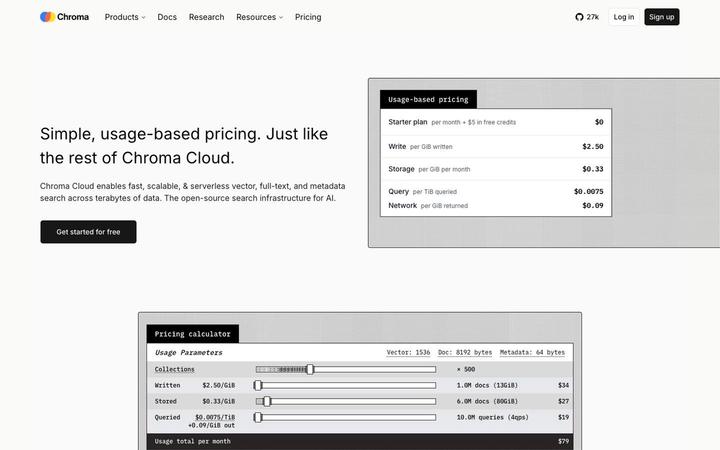
Chroma
$250/mo + usageChroma prints all four metered rates in the hero, Write at $2.50 per GiB, Storage at $0.33 per GiB per month, Query at $0.0075 per TiB and Network at $0.09 per GiB returned, then hands the reader a calculator that turns documents and queries into a $79 monthly total. Plans sit on top of the meter: Starter at $0 plus usage, Team at $250 a month plus usage with $100 in credits, and Enterprise on custom terms.
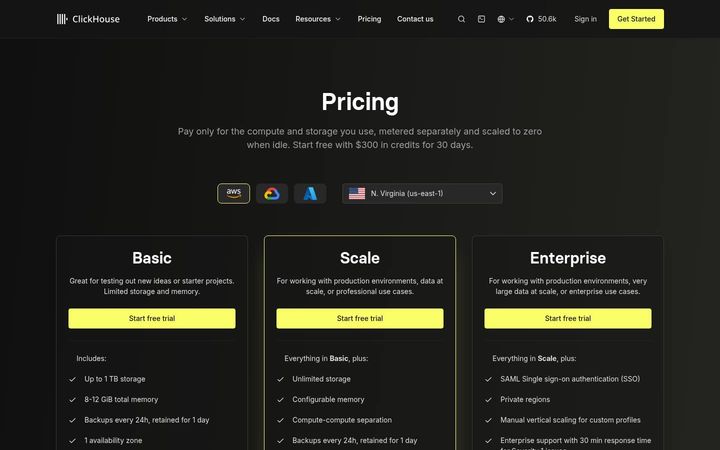
ClickHouse
$0.2181/compute unit/hrClickHouse opens with its model in one line, 'Pay only for the compute and storage you use, metered separately and scaled to zero when idle.', sets the cloud and region, then gives every tier the same two meters: storage flat at '$25.30 Per 1TB / mo' and compute at $0.2181, $0.2985 and $0.3903 per unit per hour. The estimator opens pre-filled with a 1 TB real-time analytics workload at '$658' a month, and an eight-question FAQ explains each line that can appear on the bill.
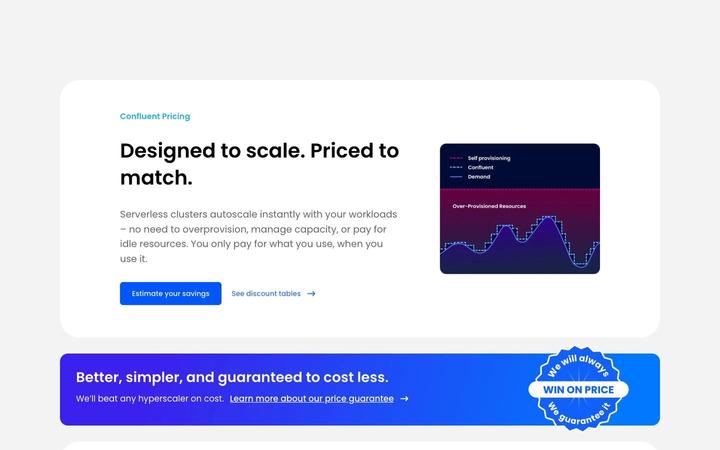
Confluent
~$385/moConfluent prices serverless Kafka on a composite meter, eCKU-hours plus data in and out per GB plus storage per GB-month, and closes its rate table with an 'Estimated Monthly Starting Cost' of $0, $385, $895 and $2,300 that turns an hourly unit into a budget number. Behind it sit two discount structures and an annual commitment that can be spent across the whole Confluent Cloud stack.

CoreWeave
From $6.50/instance/hrCoreWeave publishes a full rate card: twelve GPU instance types and ten CPU types, each priced per hour on-demand and spot for North America and Europe, then storage, networking, Direct Connect and managed Kubernetes. The unit is a fully specified instance-hour, with GPU count, VRAM, vCPUs, system RAM and local storage printed beside every rate. Reserved capacity, the newest silicon and every next step run through the sales team, which is where a GPU cloud shapes committed deals.
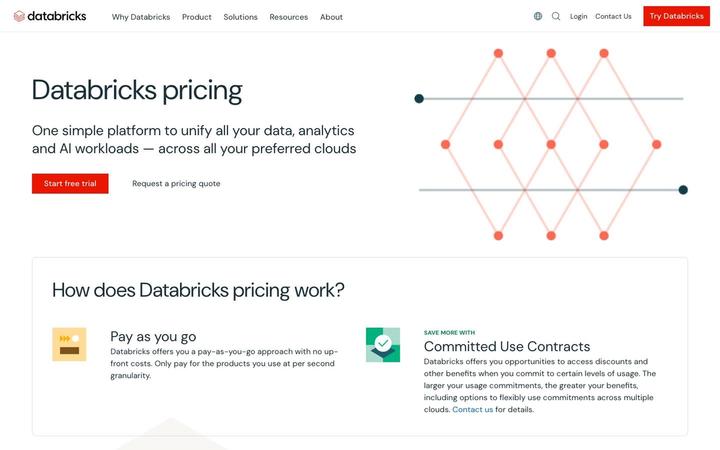
Databricks
From $0.069/CUDatabricks prices a whole data platform on one consumption unit, the DBU, with seven workload tiles that each print a 'Starting at' rate and link to a full SKU price list. Billing runs 'at per second granularity' on pay-as-you-go, and Committed Use Contracts trade larger commitments for discounts that can flex across clouds. The page works as the front door to a rate table, organized by the job a customer is doing.

Datadog
$15/host/moDatadog publishes a rate card per product, with every billable SKU listed in a left-hand navigator from AI Credits to Workflow Automation. Infrastructure Monitoring prices per host across three host levels: Basic, set with sales, beside Pro starting at $ 15 and Enterprise at $ 23 billed annually, with on-demand rates printed beside them and allotments of containers, custom metrics and custom events attached to each paid host. The bill is the sum of the products a customer adopts, and Basic hosts let one account price noncritical workloads at their own level.