Captured September 19, 2026 at 1440px wide.
Databricks plans and prices
| Plan | Price | Billing |
|---|---|---|
| Data EngineeringOrchestrate data processing, machine learning and analytics pipelines | $0.15 | / DBU |
| Data WarehousingRun SQL queries for BI reporting, analytics and visualization to get timely insights from data lakes. | $0.22 | / DBU |
| Interactive workloadsRun interactive data science and machine learning workloads. | $0.40 | / DBU |
| Operational DatabaseFully-managed Postgres transactional database for serving data and features to support applications built on Databricks. | $0.069 | / CU |
| Artificial IntelligenceBuild production-quality GenAI or ML apps across any use case | $0.07 | / DBU |
| GenieAI assistance for every team, across code, analytics, and enterprise knowledge. | $0.07 | / DBU |
As printed on the page captured September 19, 2026.
How does Databricks pricing work?
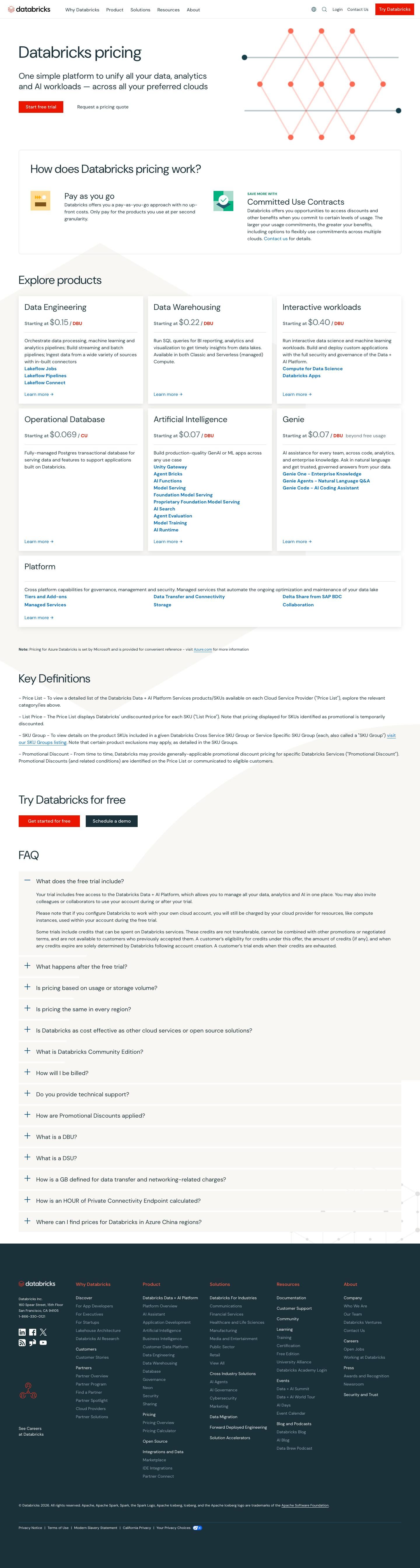
The value metric is the DBU, a normalized unit of processing capacity, priced differently by workload: Data Engineering starts at $0.15 / DBU, Data Warehousing at $0.22, Interactive workloads at $0.40, Artificial Intelligence at $0.07 and Genie at $0.07 'beyond free usage'. Operational Database, a 'Fully-managed Postgres transactional database', prices on its own unit at $0.069 / CU, and the FAQ adds a DSU. One unit priced per workload lets the same hour of compute carry a different rate depending on the value of the job it runs, a pattern worth borrowing for any product whose workloads differ in value more than in cost. Packaging is a catalog: each tile names its constituent services, such as Lakeflow Jobs, Lakeflow Pipelines and Lakeflow Connect under Data Engineering.
The motion runs on two tracks, stated before any price. The hero pairs 'Start free trial' with 'Request a pricing quote', and 'How does Databricks pricing work?' sets 'Pay as you go', with 'no up-front costs', beside 'Committed Use Contracts', where 'The larger your usage commitments, the greater your benefits'. 'Explore products' follows with six workload tiles and a wide Platform tile, a note that Azure Databricks pricing is set by Microsoft, a Key Definitions section, a 'Try Databricks for free' band with 'Get started for free' and 'Schedule a demo', and fourteen FAQ questions. The page signals a company selling to architects and procurement teams at once.
Under the hood, the page describes a layered bill. Workload usage is metered in DBUs at list rates from SKU-level price lists, platform charges for Tiers and Add-ons, Storage and Data Transfer and Connectivity sit in their own Platform tile, and the free trial answer notes that customers running in their own cloud account 'will still be charged by your cloud provider for resources', a pass-through cost kept apart from Databricks' own price. Key Definitions names List Price, SKU Group and Promotional Discount, the vocabulary of an enterprise contract where list price is the starting point. Commitments that can be used 'across multiple clouds' make the platform the unit of the deal rather than any one cloud, which is where data infrastructure pricing is heading.
What does Databricks' pricing page do well?
- Billing granularity is stated up front: 'Only pay for the products you use at per second granularity', a concrete commitment about how the meter runs
- Pay as you go and Committed Use Contracts are explained side by side before any price, so a reader knows which conversation they are in
- Products are cut by workload, and each tile names its constituent services, so an architect can map an existing pipeline onto the catalog
- Both hero CTAs are distinct, 'Start free trial' for self-serve and 'Request a pricing quote' for procurement, and the pair returns mid-page
- The Azure note states plainly that Azure Databricks pricing is set by Microsoft and points to Azure.com
What does Databricks' pricing page reveal about its pricing strategy?
- One unit with a different rate per workload prices the value of the job, so engineering, warehousing, interactive and AI work each carry their own DBU price
- A separate CU for the Postgres database shows a new resource type getting its own unit as the platform grows
- Genie at $0.07 / DBU 'beyond free usage' pairs an included allowance with metered use, an adoption play for an AI assistant
- Cloud provider charges stay with the customer's own cloud bill, keeping pass-through infrastructure apart from Databricks' platform value
- Commitments usable across multiple clouds make the Databricks platform, not the cloud, the unit of the enterprise deal
Learn with Orb
- ProductPrice modeling One DBU carries a different rate per workload, from $0.07 for AI to $0.40 for interactive work; Orb's price modeling covers dimensional rates like this and changing them without re-engineering billing.
- GuidePay-as-you-go pricing for SaaS Pay as you go comes with no up-front costs and billing at per second granularity, the low barrier to entry and usage-scaled revenue Orb's pay-as-you-go guide describes.
- GuideAn AI founder's guide to prepaid credits Committed Use Contracts give greater benefits for larger commitments, and Orb's guide covers how a commitment earns a better rate per unit and how usage past it bills at an overage rate.
Questions about Databricks pricing
How much does Databricks cost?
Databricks' pricing starts at $0.069/CU. The page shows 7 plans, with the top plan priced through sales.
What pricing model does Databricks use?
Databricks prices by usage. Buyers can sign up on their own or go through the sales team. Its plans are aimed mainly at enterprises.
Does Databricks have a free plan?
Databricks has no free plan, but its paid plans offer a free trial. The lowest paid plan starts at $0.069/CU.
Does Databricks offer an annual discount?
Databricks' pricing page shows a single billing period. The listed prices start at $0.069/CU. Terms for the plans priced through sales are set with the sales team.
How is Databricks' pricing page laid out?
The page shows 7 plans and includes an FAQ. The breakdown above marks 14 points on it: 4 things it does well and 10 insights into the pricing.
How do Databricks free trial credits work?
The Databricks free trial includes free access to the Databricks Data + AI Platform, and you can invite colleagues or collaborators to use your account during or after the trial. Some trials include credits that can be spent on Databricks services, with eligibility, the amount of credits and when they expire "solely determined by Databricks following account creation." The trial ends when the credits are exhausted. If you configure Databricks to work with your own cloud account, your cloud provider bills separately for resources like compute instances used during the trial.
What are Databricks Committed Use Contracts?
Committed Use Contracts give Databricks customers access to discounts and other benefits when they commit to certain levels of usage. The page states that "The larger your usage commitments, the greater your benefits," including options to flexibly use commitments across multiple clouds. They sit alongside the pay-as-you-go option, and customers contact Databricks for details.
Where can I find pricing for Azure Databricks?
Pricing for Azure Databricks is set by Microsoft, and the Databricks page provides it for convenient reference. For full details, the page points readers to Azure.com. The Databricks FAQ also covers where to find prices for Databricks in Azure China regions.
From the page as captured September 19, 2026. Current prices are on databricks.com
Chroma
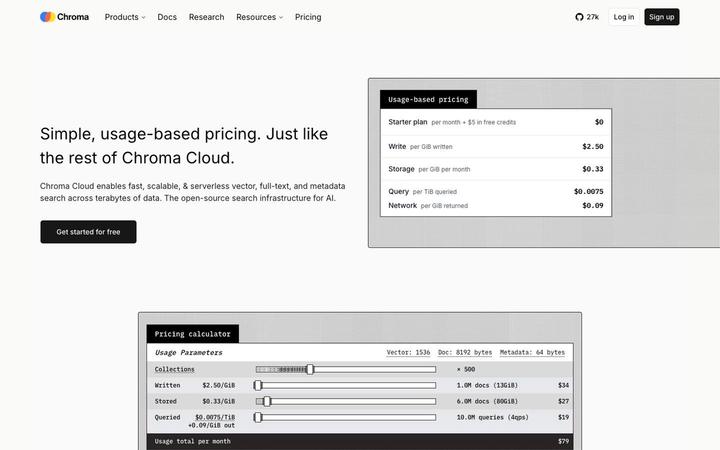
$250/mo + usageChroma prints all four metered rates in the hero, Write at $2.50 per GiB, Storage at $0.33 per GiB per month, Query at $0.0075 per TiB and Network at $0.09 per GiB returned, then hands the reader a calculator that turns documents and queries into a $79 monthly total. Plans sit on top of the meter: Starter at $0 plus usage, Team at $250 a month plus usage with $100 in credits, and Enterprise on custom terms.
ClickHouse
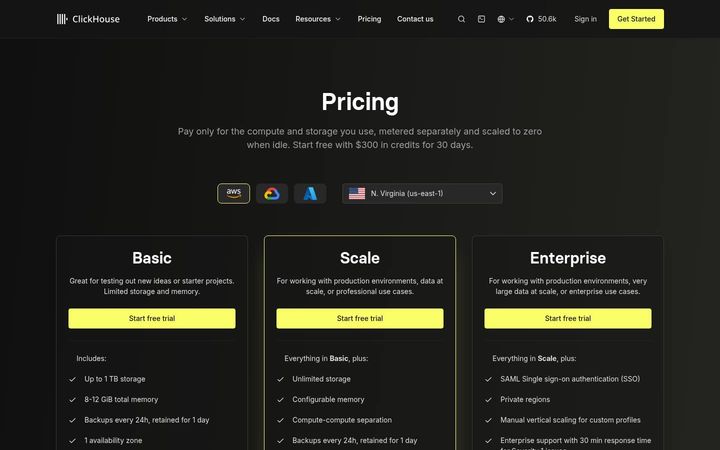
$0.2181/compute unit/hrClickHouse opens with its model in one line, 'Pay only for the compute and storage you use, metered separately and scaled to zero when idle.', sets the cloud and region, then gives every tier the same two meters: storage flat at '$25.30 Per 1TB / mo' and compute at $0.2181, $0.2985 and $0.3903 per unit per hour. The estimator opens pre-filled with a 1 TB real-time analytics workload at '$658' a month, and an eight-question FAQ explains each line that can appear on the bill.
Confluent
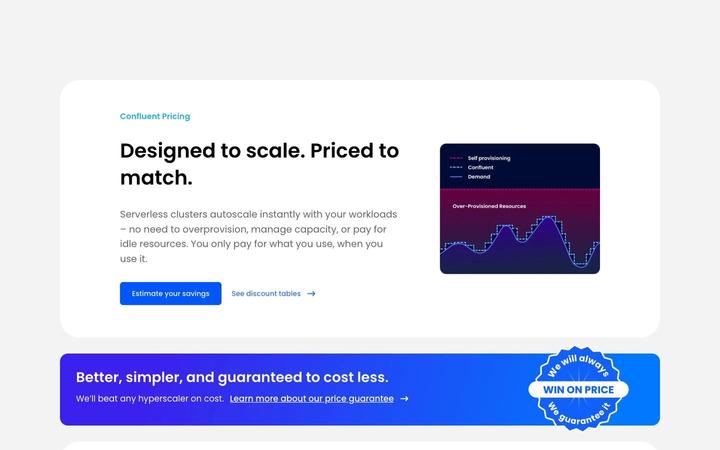
~$385/moConfluent prices serverless Kafka on a composite meter, eCKU-hours plus data in and out per GB plus storage per GB-month, and closes its rate table with an 'Estimated Monthly Starting Cost' of $0, $385, $895 and $2,300 that turns an hourly unit into a budget number. Behind it sit two discount structures and an annual commitment that can be spent across the whole Confluent Cloud stack.

CoreWeave
From $6.50/instance/hrCoreWeave publishes a full rate card: twelve GPU instance types and ten CPU types, each priced per hour on-demand and spot for North America and Europe, then storage, networking, Direct Connect and managed Kubernetes. The unit is a fully specified instance-hour, with GPU count, VRAM, vCPUs, system RAM and local storage printed beside every rate. Reserved capacity, the newest silicon and every next step run through the sales team, which is where a GPU cloud shapes committed deals.

Datadog
$15/host/moDatadog publishes a rate card per product, with every billable SKU listed in a left-hand navigator from AI Credits to Workflow Automation. Infrastructure Monitoring prices per host across three host levels: Basic, set with sales, beside Pro starting at $ 15 and Enterprise at $ 23 billed annually, with on-demand rates printed beside them and allotments of containers, custom metrics and custom events attached to each paid host. The bill is the sum of the products a customer adopts, and Basic hosts let one account price noncritical workloads at their own level.

Dremio
$0.20/DCUDremio prices its lakehouse on one compute meter, '$0.20 per DCU (Dremio Compute Unit)', and organizes the page around a deployment choice: Dremio Cloud, fully managed on AWS, or Dremio Enterprise, self-managed anywhere. Both options are 'Consumption based', so the decision is about who runs the infrastructure. Every path leads to a conversation, including a Cloud trial that comes with '$400 credit for 30 days'.