How ClickHouse prices
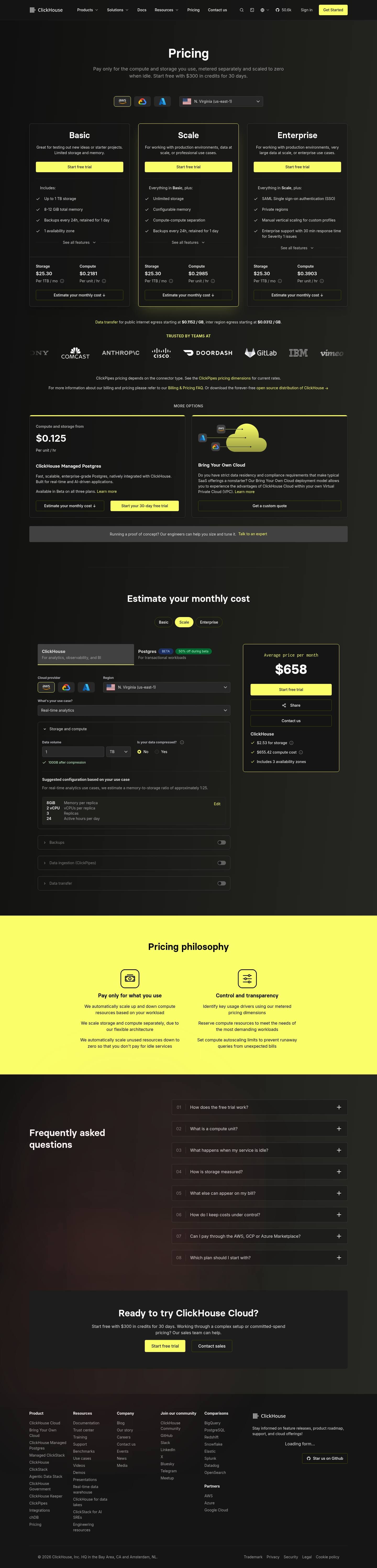
Captured October 26, 2026 at 1440px wide.
ClickHouse plans and prices
| Plan | Price | Billing |
|---|---|---|
| BasicGreat for testing out new ideas or starter projects. | $0.2181 | Per unit / hr |
| ScaleHighlightedFor working with production environments, data at scale, or professional use cases. | $0.2985 | Per unit / hr |
| EnterpriseFor working with production environments, very large data at scale, or enterprise use cases. | $0.3903 | Per unit / hr |
As printed on the page captured October 26, 2026.
How does ClickHouse pricing work?
The value metric is infrastructure consumption, split into two meters. Storage is $25.30 per TB per month on Basic, Scale and Enterprise alike, and compute is priced 'Per unit / hr', with the tier premium landing on the compute rate: $0.2181, $0.2985 and $0.3903. The FAQ pins both meters down: 'One compute unit is 8 GiB of RAM and 2 vCPUs.', and 'Storage is metered on the compressed size of your data in object storage, plus backups.' Holding storage flat means data a customer has already stored costs the same on every plan, and the step up to Scale or Enterprise shows up as one comparable number. Plans separate on resilience, scale and governance, each card showing four headline lines: Basic has 'Up to 1 TB storage' and '1 availability zone', Scale adds 'Unlimited storage' and 'Compute-compute separation', and Enterprise adds 'SAML Single sign-on authentication (SSO)', 'Private regions' and 30-minute Severity 1 support, with 'See all features' opening the rest.
The motion is self-serve on every tier with sales alongside. The hero closes on 'Start free with $300 in credits for 30 days.', and Basic, Scale and Enterprise all open with 'Start free trial' directly under the plan description. Provider icons and an 'N. Virginia (us-east-1)' region dropdown sit above the cards, so every rate is region-correct before it is read, and each card ends with its two rates and 'Estimate your monthly cost ↓'. Below come egress rates, a TRUSTED BY TEAMS AT logo strip, a ClickPipes pointer, then MORE OPTIONS for Managed Postgres and Bring Your Own Cloud, which routes to 'Get a custom quote'. A PoC band offers 'Talk to an expert', and the page continues through the estimator, a 'Pricing philosophy' band and the FAQ to a close that pairs 'Start free trial' with 'Contact sales'.
Under the hood, the pre-filled estimate shows the arithmetic of the model. A 1 TB input reads '100GB after compression', which at $25.30 per TB becomes '$2.53 for storage', while a suggested Scale configuration of 8GiB and 2 vCPU across 3 replicas running 24 hours a day becomes '$655.42 compute cost'. On a typical analytics workload, compute carries the bill. The FAQ lays out the rest of the invoice: compute is 'metered per minute and billed per compute-unit-hour', backups bill at the storage rate, 'Ingress is free.', and trial and committed-spend customers are 'emailed automatically at 50%, 75% and 90% of their credits'. Marketplace buyers can 'commit to a contract' at identical pricing, and the closing band names 'committed-spend pricing' as the sales conversation: that is where commitments and volume terms are shaped. Publishing the controls that keep usage bills predictable, from autoscaling limits to credit alerts, is where usage-based infrastructure pricing is heading.
What does ClickHouse's pricing page do well?
- The hero states the pricing model and the trial terms in two sentences before any plan appears
- Cloud provider and region are chosen above the plan cards, so every rate shown is correct for the buyer's deployment
- Storage is held flat at '$25.30 Per 1TB / mo' across all three tiers and the compute rate carries the tier step, so the cost of upgrading is one comparable number
- The estimator opens with a worked example, a suggested configuration and a total split into storage and compute, and every input is encoded in a shareable URL
- An eight-question FAQ covers the billing mechanics a metered buyer asks about: compute units, idle behavior, storage measurement, extra line items, cost controls and marketplaces
What does ClickHouse's pricing page reveal about its pricing strategy?
- Two meters with the tier premium on compute alone keep stored data at one price, and the FAQ confirms 'Storage rates are the same across plans and vary only by cloud provider and region.'
- The compute unit is now defined on the page as 8 GiB of RAM and 2 vCPUs, metered per minute and billed per compute-unit-hour
- The default estimate prices compressed storage at $2.53 against $655.42 of compute, which shows compute as the primary revenue meter
- Credit alerts at 50%, 75% and 90% and marketplace contracts at identical pricing point to committed-spend deals drawn down like a credit balance
- Every tier is self-serve with a free trial and a printed rate, so even SAML and private-region buyers can start before talking to sales
Learn with Orb
- ProductExperience Kit Every card leads to an estimator that models data volume, compression, backups, ClickPipes and egress, with its state shareable by URL; Orb's Experience Kit builds calculators like this on one source of pricing truth.
- ProductSpend controls Scale-to-zero, reservable compute and autoscaling limits are published as pricing commitments, and Orb's spend controls pair usage pricing with alerts and dashboards so the bill stays predictable.
- ProductPrice modeling Storage holds at $25.30 per TB on every tier while the compute rate carries the tier step, a two-meter design that Orb's price modeling represents and changes without re-engineering billing.
Questions about ClickHouse pricing
How much does ClickHouse cost?
ClickHouse's pricing starts at $0.2181/compute unit/hr. The page shows 3 plans, with the top plan priced through sales.
What pricing model does ClickHouse use?
ClickHouse prices by usage. Buyers can sign up on their own or go through the sales team. Its plans are aimed mainly at developers.
Does ClickHouse have a free plan?
ClickHouse has no free plan, but its paid plans offer a free trial. The lowest paid plan starts at $0.2181/compute unit/hr.
Does ClickHouse offer an annual discount?
ClickHouse's pricing page shows a single billing period. The listed prices start at $0.2181/compute unit/hr. Terms for the plans priced through sales are set with the sales team.
How is ClickHouse's pricing page laid out?
The page shows 3 plans, highlights Scale, and includes a calculator and an FAQ. The breakdown above marks 14 points on it: 7 things it does well and 7 insights into the pricing.
What is a compute unit in ClickHouse Cloud pricing?
ClickHouse defines it plainly: "One compute unit is 8 GiB of RAM and 2 vCPUs." Compute is metered per minute and billed per compute-unit-hour at the rate for your plan, cloud provider and region. In N. Virginia (us-east-1) on AWS, that rate is $0.2181 per unit / hr on Basic, $0.2985 on Scale and $0.3903 on Enterprise.
How is ClickHouse Cloud storage measured and billed?
Storage is metered on the compressed size of your data in object storage, plus backups, at $25.30 Per 1TB / mo on every plan. The FAQ notes that analytical data typically compresses around 10×, so 1 TB of raw data is often billed as roughly 100 GB. Storage rates are the same across plans and vary only by cloud provider and region.
What else can appear on a ClickHouse Cloud bill besides compute and storage?
Backups are billed at the same per-TB rate as storage, and every service includes one backup every 24 hours retained for a day. ClickPipes data ingestion is priced by connector type, and data transfer covers public internet egress starting at $0.1152 / GB and inter region egress starting at $0.0312 / GB. "Ingress is free.", and the calculator on the page adds each of these items to your estimate.
From the page as captured October 26, 2026. Current prices are on clickhouse.com
Chroma
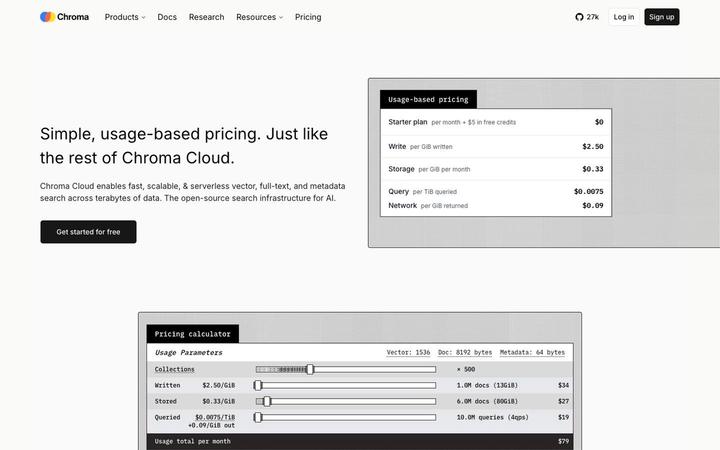
$250/mo + usageChroma prints all four metered rates in the hero, Write at $2.50 per GiB, Storage at $0.33 per GiB per month, Query at $0.0075 per TiB and Network at $0.09 per GiB returned, then hands the reader a calculator that turns documents and queries into a $79 monthly total. Plans sit on top of the meter: Starter at $0 plus usage, Team at $250 a month plus usage with $100 in credits, and Enterprise on custom terms.
Confluent
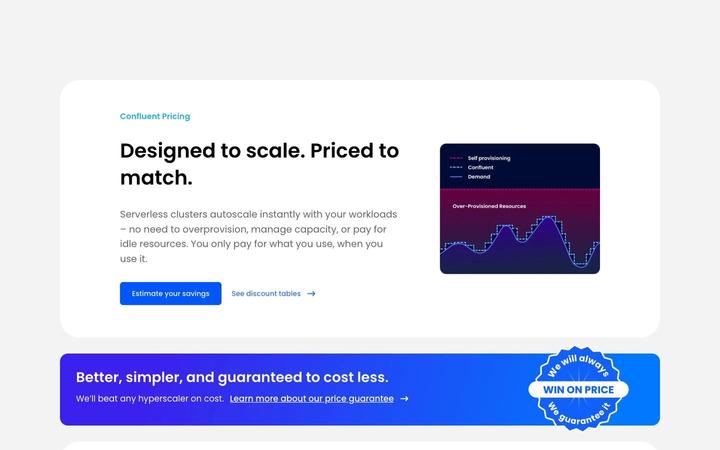
~$385/moConfluent prices serverless Kafka on a composite meter, eCKU-hours plus data in and out per GB plus storage per GB-month, and closes its rate table with an 'Estimated Monthly Starting Cost' of $0, $385, $895 and $2,300 that turns an hourly unit into a budget number. Behind it sit two discount structures and an annual commitment that can be spent across the whole Confluent Cloud stack.

CoreWeave
From $6.50/instance/hrCoreWeave publishes a full rate card: twelve GPU instance types and ten CPU types, each priced per hour on-demand and spot for North America and Europe, then storage, networking, Direct Connect and managed Kubernetes. The unit is a fully specified instance-hour, with GPU count, VRAM, vCPUs, system RAM and local storage printed beside every rate. Reserved capacity, the newest silicon and every next step run through the sales team, which is where a GPU cloud shapes committed deals.
Databricks
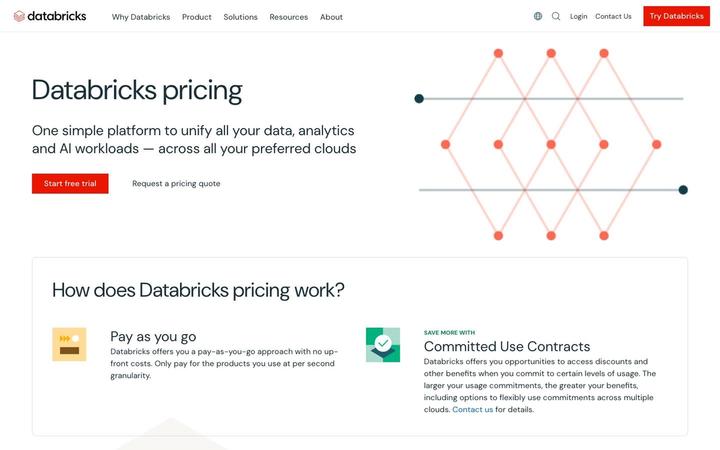
From $0.069/CUDatabricks prices a whole data platform on one consumption unit, the DBU, with seven workload tiles that each print a 'Starting at' rate and link to a full SKU price list. Billing runs 'at per second granularity' on pay-as-you-go, and Committed Use Contracts trade larger commitments for discounts that can flex across clouds. The page works as the front door to a rate table, organized by the job a customer is doing.

Datadog
$15/host/moDatadog publishes a rate card per product, with every billable SKU listed in a left-hand navigator from AI Credits to Workflow Automation. Infrastructure Monitoring prices per host across three host levels: Basic, set with sales, beside Pro starting at $ 15 and Enterprise at $ 23 billed annually, with on-demand rates printed beside them and allotments of containers, custom metrics and custom events attached to each paid host. The bill is the sum of the products a customer adopts, and Basic hosts let one account price noncritical workloads at their own level.

Dremio
$0.20/DCUDremio prices its lakehouse on one compute meter, '$0.20 per DCU (Dremio Compute Unit)', and organizes the page around a deployment choice: Dremio Cloud, fully managed on AWS, or Dremio Enterprise, self-managed anywhere. Both options are 'Consumption based', so the decision is about who runs the infrastructure. Every path leads to a conversation, including a Cloud trial that comes with '$400 credit for 30 days'.