How Cursor prices
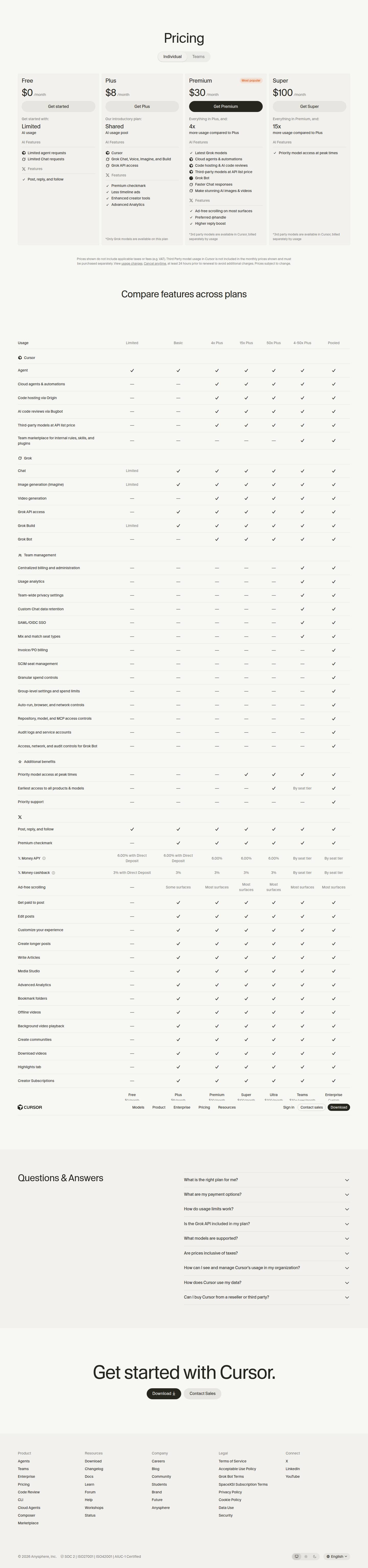
Captured October 26, 2026 at 1440px wide.
Cursor plans and prices
| Plan | Price | Billing |
|---|---|---|
| Free | $0 | /month |
| PlusOur introductory plan | $8 | /month |
| PremiumHighlighted | $30 | /month |
| Super | $100 | /month |
As printed on the page captured October 26, 2026.
How does Cursor pricing work?
The value metric is AI usage expressed as a multiple of the Plus plan. Free starts with 'Limited AI usage', Plus is 'Our introductory plan:' with a 'Shared AI usage pool', Premium carries '4x more usage compared to Plus' and Super '15x more usage compared to Plus', and the table extends the ladder to '50x Plus' at Ultra and '4-50x Plus' for Teams. Packaging moves on two axes: scale through the multiplier, and a feature gate at Premium, where Cloud agents & automations, 'Code hosting via Origin', 'AI code reviews via Bugbot' and 'Third-party models at API list price' switch on. The pool spans a product family: Cursor Agent, Grok Chat, Imagine, Build, the Grok API and X features such as Premium checkmark and ad-free scrolling all sit in the same subscription. Measuring every plan in units of Plus gives the buyer one ruler for a product whose cost is model inference.
The motion is product-led with a sales-led top. A one-word H1 sits over an Individual / Teams switch and four cards, each with a price, an allowance line and one button, and 'Get Premium' is the filled black button under a 'Most popular' badge. A two-sentence disclaimer under the cards covers taxes, separately purchased third-party usage, 'Cancel anytime' and 'Prices subject to change.' Then comes 'Compare features across plans', a seven-column table grouped into Cursor, Grok, Team management, Additional benefits and X, with a sticky header that keeps every plan's price and button, from Get started to Get Ultra, Get Teams and Contact Sales, in view. A nine-question FAQ adds 'How do usage limits work?', 'Is the Grok API included in my plan?' and 'What models are supported?', and the closing 'Get started with Cursor.' pairs Download with Contact Sales. The page now holds two catalogs, the AI plans and the X benefits, and the table is where they meet.
Under the hood, the page describes flat monthly tiers, each with an allowance sized as a multiple of a base unit, plus metered pass-through. Third-party models run 'at API list price' and are 'billed separately by usage', while the Plus footnote '*Only Grok models are available on this plan' points to first-party models being covered inside the subscription at a cost to serve low enough for an $8 entry price. Teams adds 'Mix and match seat types' and reads 'By seat tier' for several benefits, so a team plan carries seat levels inside it, and Enterprise moves to 'Pooled' usage with Invoice/PO billing, 'Granular spend controls' and 'Group-level settings and spend limits'. One multiplier unit across every tier, with pass-through inference kept visibly apart, is a pattern worth borrowing, and bundling a subscription across a family of products is a direction AI pricing is heading.
What does Cursor's pricing page do well?
- A 'Most popular' badge and the one filled 'Get Premium' button mark the recommended plan twice
- Every paid card states its allowance as a multiple of Plus, '4x' and '15x', so plans compare on one scale
- A disclaimer directly under the cards states taxes, separately billed third-party usage and the cancellation window in two sentences
- The comparison table keeps a sticky header with each plan's price and button, so a buyer can act from any row
- SAML/OIDC SSO and 'Mix and match seat types' arrive at Teams, $30+/user/month, a plan bought with Get Teams
What does Cursor's pricing page reveal about its pricing strategy?
- Usage measured in multiples of Plus turns a raw inference allowance into a simple ladder that ends in 'Pooled' usage at Enterprise
- Third-party models at API list price, billed separately, keep pass-through inference apart from the subscription value
- Plus is Grok-only, which points to first-party models carrying a lower cost to serve and makes an $8 entry plan possible
- X benefits such as Premium checkmark and ad-free scrolling sit in the same grid as Cursor Agent, a subscription bundled across a product family
- Ultra at $200/month lives in the table, keeping the card row to four while the top of the ladder stays one scroll away
Learn with Orb
- GuidePricing AI agents: plans, costs and monetization models Each plan sells a seat with an agent usage allowance, and Bugbot runs on usage-based billing beside it; Orb's guide covers B2B models for pricing AI agents and how teams meter their work.
- GuideHow to price your AI agent: a framework Pro, Pro+ and Ultra step up agent usage inside one card, so heavy users buy more inference; Orb's framework covers choosing a model that keeps margins healthy as usage grows.
Questions about Cursor pricing
How much does Cursor cost?
Cursor's pricing starts at $8/mo. The page shows 4 plans, including a free plan, with the top plan priced through sales.
What pricing model does Cursor use?
Cursor prices on a hybrid of seats and usage, combined with flat-rate tiers. Buyers can sign up on their own or go through the sales team. Its plans are aimed mainly at individuals and prosumers.
Does Cursor have a free plan?
Yes, Cursor has a free plan. Paid plans start at $8/mo.
Does Cursor offer an annual discount?
Cursor's pricing page shows a single billing period. The listed prices start at $8/mo. Terms for the plans priced through sales are set with the sales team.
How is Cursor's pricing page laid out?
The page shows 4 plans, highlights Premium, and includes a comparison table and an FAQ. The breakdown above marks 14 points on it: 6 things it does well and 8 insights into the pricing.
How are third-party models billed on Cursor?
From Premium upward, Cursor offers "Third-party models at API list price" alongside the included Grok models. The page notes that "3rd party models are available in Cursor, billed separately by usage", and that this usage is purchased separately from the monthly plan prices shown. The Plus plan at $8 /month covers Grok models only, so the subscription price stays focused on first-party models.
How much usage does each Cursor plan include?
Cursor measures usage as a multiple of the Plus plan, which comes with a "Shared AI usage pool". Premium at $30 /month offers "4x more usage compared to Plus", Super at $100 /month offers "15x more usage compared to Plus", and Ultra at $200/month reaches 50x Plus. Teams spans 4-50x Plus, and Enterprise moves to Pooled usage across the organization.
What does Cursor Enterprise include?
Cursor Enterprise has Custom pricing through Contact Sales and uses Pooled usage. On top of the Teams features, it adds Invoice/PO billing, SCIM seat management, "Granular spend controls", and "Group-level settings and spend limits". Enterprise also includes audit logs and service accounts, repository, model, and MCP access controls, and priority support.
From the page as captured October 26, 2026. Current prices are on cursor.com
Devin
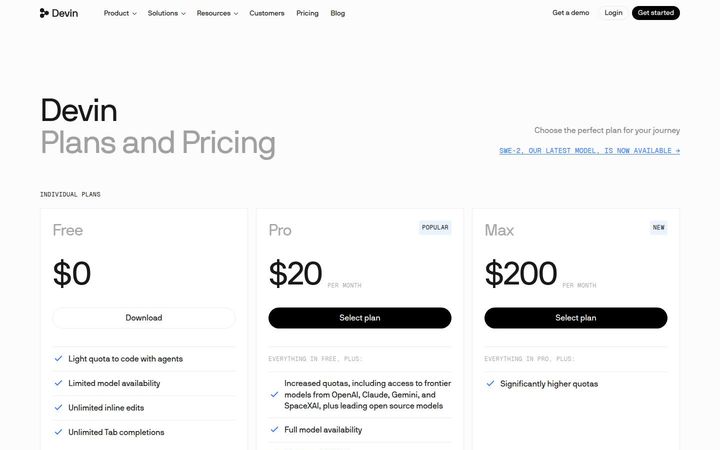
$20/moDevin sells agent usage as subscription quotas: Free, Pro at $20, Max at $200, a Teams plan at $80 per month plus $40 per full dev seat for up to 200 users, and Enterprise by conversation. Each paid plan carries an allowance that refreshes daily and weekly, and usage past it is bought 'at API pricing', so the subscription covers typical work and the meter covers the heavy days. The Teams line prints a two-part tariff, a platform fee plus a seat price, in one sentence, and a 200-user ceiling marks where Enterprise begins.

Replit
$18/mo (billed annually)Replit sells subscriptions that carry a dollar allowance for AI models, '$20 towards more powerful models' on Core and '$100 towards most powerful models' on Pro, with metering behind it on Effort-Based Pricing. The Pro card holds a credit dropdown that steps from '$90 / month' to '$2,000 / month', and the Enterprise card reads as a governance package led by 'SSO, SCIM & audit logs'.
Supabase
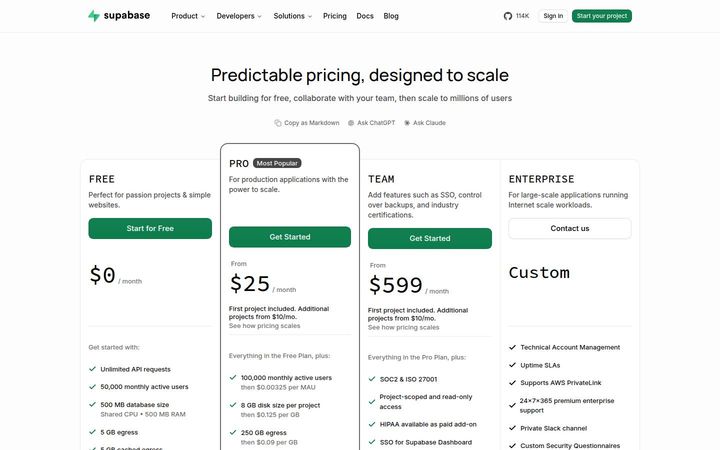
From $25/moSupabase prices its Postgres platform as a plan fee plus metered usage: Free at $0, Pro from $25 a month, Team from $599 and Enterprise on contact, with every metered line on the Pro card printing the included quota and the rate beyond it. Compute is a published ladder from Micro at $10 to 16XL at $3,730, a $10 monthly credit covers the first instance, and logs are now metered too, with Log Ingestion at '20 GB included then $0.50 per GB' on paid plans. A spend cap on by default makes 'Predictable pricing, designed to scale' a literal promise.
Vercel
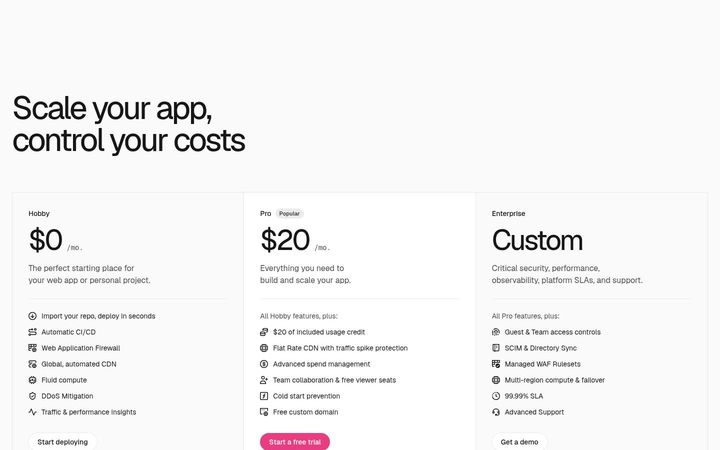
$20/moVercel prices a cloud platform as a seat plus usage: Pro is $20 a month per developer seat and includes '$20 of included usage credit', so the seat fee doubles as a usage allowance before metered rates apply. Beneath three plan cards sits a full rate card in which every metered resource prints its included quota and its overage price on the same row, from CDN Requests to build minutes, and it now extends to Vercel Drives, Vercel Daemons, Deployment Storage and Tracing Spans.

LangChain
$39/seat/moLangSmith sells three plans: Developer at $0 per seat, Plus at $39 per seat and a custom Enterprise, with the two self-serve plans followed by 'then pay as you go'. Every service beyond the seat meters in one unit, 'LangChain Standard Units. $1.00 / LSU', at a published rate per resource. A usage calculator built as a stack picker turns those rates into a monthly estimate a buyer can share.

Retool
$10/builder/moRetool prices two seat types as a sum on each card, $10 a month per builder plus $5 a month per internal user on Team and $50 plus $15 on Business, and layers workflow runs, pooled AI credits and agent hours on top. The cards read as aligned checklists of included and not-included features, and the comparison table publishes the secondary meters, from an external user volume curve to additional workflow runs at '$75 per 5,000 runs per month'.