How Ironclad prices

Captured September 19, 2026 at 1440px wide.
How does Ironclad pricing work?
Pricing is set per customer, and the page names what shapes it: 'pricing shaped by your products, users, workflows, and growth'. Users as a driver points to a seat component, and workflows and growth point to a quote that scales with how widely contracting runs through the platform. Packaging is modular. 'Choose from a simple set of solutions' breaks a deal into three decisions: 'Pick your product(s)' across 'contract lifecycle management, AI assistant, or eSignature solutions', 'Pick your partners' for deployment, and 'Add a little extra' for 'API and integrations', 'additional instances' and an enhanced 'success plan'. A legal ops buyer can map the conversation before it starts.
The motion is sales-led from the first line. The hero eyebrow reads 'FLEXIBLE PRICING FOR EVERY CONTRACTING PROGRAM', the headline promises pricing that fits the way you contract, and a Business Email field with 'Request Demo' sits right beneath. The three solution cards follow, then a logo wall under 'Millions of users worldwide trust Ironclad', a testimonial carousel under "Don't take our word for it", a benefits panel ending in GET A CUSTOM QUOTE, a Forrester panel ending in GET THE DETAILS, five FAQ questions about cost and value, and a closing invitation to chat with a digital contracting specialist.
Under the hood, a quote built from products, deployment and extras is a classic enterprise structure: platform modules priced together, services priced by who does the implementation, and expansion lines for API access, instances and success plans. Each of those levers gives the sales team room to shape a deal around a customer's scope and timeline. The value case is built in the buyer's terms. The Forrester panel states its method, five representatives at five organizations and a three-year horizon, before its results: 314% ROI, a 65% improvement in end-to-end contract efficiency, and a 25 basis-point profit-margin expansion. Worth borrowing for any custom-priced page: name the variables of the quote, so the buyer arrives at the call already scoped.
What does Ironclad's pricing page do well?
- The three-card block names the quote variables, product mix, deployment partner and extras, so a buyer can prepare for the conversation
- The hero states that price is shaped by 'products, users, workflows, and growth', making headcount a known dimension before the call
- The Forrester results come with their method, five representatives at five organizations over three years, ahead of the 314% ROI
- Testimonials quantify outcomes: 12 weeks to 3 at Hormel, '40-50% faster' imports at Rippling, 90% less NDA time at Demostack, 'at least 25%' faster at Impact
- GET A CUSTOM QUOTE sits at the end of the benefits list, placing the ask where the value case lands
What does Ironclad's pricing page reveal about its pricing strategy?
- Naming users, workflows and growth as price drivers points to a quote that expands as contracting spreads across departments
- Deployment is priced as a choice of who implements, self, Ironclad's legal engineers or a partner, which separates services from software
- Extras such as API access, additional instances and success plans are the expansion levers inside an enterprise contract
- A modular start, 'one or more' of CLM, AI assistant and eSignature, lets a customer land with one product and add the others
- Free academy, community and in-app guides lower the cost of adoption, which supports the land-and-expand path
Learn with Orb
- GuideAn expert's guide to enterprise pricing for SaaS Ironclad builds each quote from products, users, workflows and growth; Orb's CEO covers how enterprise pricing differs from SMB pricing and what to weigh when prices are set deal by deal.
- GuideBuild a pricing and packaging strategy in 9 steps Three decisions structure every deal: products across CLM, AI assistant and eSignature, a deployment partner, and extras such as API access; Orb's nine steps cover packaging and how a lineup scales.
Questions about Ironclad pricing
How much does Ironclad cost?
Ironclad prices its plans through its sales team, so the pricing page lists no starting price. Ironclad prices through its sales team.
What pricing model does Ironclad use?
Ironclad prices through its sales team. The page is built around talking to the sales team. Its plans are aimed mainly at enterprises.
Does Ironclad have a free plan?
Ironclad's pricing page shows no free plan or free trial. Plans are priced through the sales team.
Does Ironclad offer an annual discount?
Ironclad's pricing page shows a single billing period. Terms for the plans priced through sales are set with the sales team.
How is Ironclad's pricing page laid out?
The page shows its pricing and includes an FAQ. The breakdown above marks 14 points on it: 7 things it does well and 7 insights into the pricing.
What add-ons can you buy with Ironclad?
Ironclad groups its extras under "Add a little extra" on the pricing page. Customers can "Connect to your favorite apps with our API and integrations", "unlock additional instances", or enhance their team's success plan. These options are built into a tailored quote alongside the core products.
Who handles Ironclad implementation and deployment?
Ironclad lets each customer choose its deployment path under "Pick your partners". Teams can "Lead your own deployment, lean on our legal engineers, or work with one of our trusted partners." This choice becomes part of the tailored quote, so the implementation approach fits the team's resources and timeline.
Does Ironclad include training resources with its products?
Yes. Ironclad customers who pick one or more of its contract lifecycle management, AI assistant, or eSignature solutions get access to the Ironclad academy, community, and in-app guides at no extra cost. The pricing page presents this as a bonus included with the product selection.
From the page as captured September 19, 2026. Current prices are on ironcladapp.com
Airtable
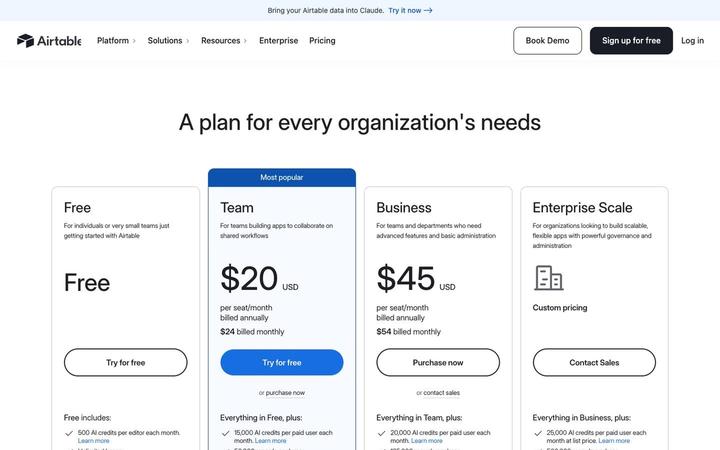
$20/seat/moAirtable prices four plans per seat, Free, Team at $20, Business at $45 and Enterprise Scale on custom pricing, and attaches a monthly pool of AI credits to every seat. Credits are the first bullet on each card and step from 500 per editor on Free to 25,000 per paid user, with top-up packs priced in the table. Annual and monthly prices print together on each card, so the commitment discount is visible at a glance.
Asana
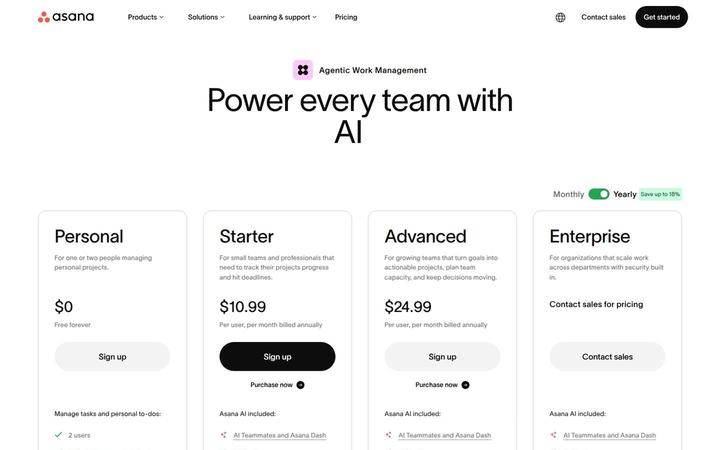
$10.99/user/moAsana pairs a per-user ladder, Personal at $0, Starter at $10.99, Advanced at $24.99 and Enterprise through sales, with a metered AI layer priced in the open. Each paid plan includes a pool of AI requests, and more cost $0.50 each in prepaid usage packs or $0.60 each pay as you go, under the banner 'One flat rate for every AI request'. Seats price the work management product, requests price the work AI Teammates and Asana Dash do, and optional modules such as Timesheets and Budgets extend down to Starter.
Basecamp
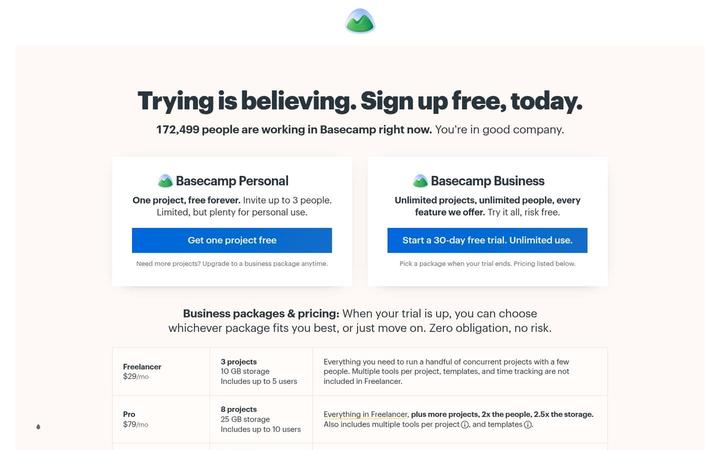
$29/moBasecamp leads with the trial: 'Trying is believing. Sign up free, today.' A free Basecamp Personal card sits beside a 30-day Basecamp Business trial with every feature, and a four-row table sets out the packages to choose from when the trial ends, from Freelancer at '$29/mo' to Pro Unlimited at '$199/mo, billed annually'. Each step adds projects, users and storage, and the upper packages add tools, time tracking and admin services.