
Captured October 19, 2026 at 1440px wide. The page continues below the crop (10,207px in total).
Make plans and prices
| Plan | Price | Billing |
|---|---|---|
| FreeExploring visual-first automation | $0 | /mo |
| CoreAutomating fundamental use cases | $12 | /mo |
| ProHighlightedAutomating advanced use cases | $21 | /mo |
| TeamsAutomating & collaborating across teams | $38 | /mo |
| EnterpriseScaling powerful automation across departments | Custom |
As printed on the page captured October 19, 2026.
How does Make pricing work?
The value metric is the credit: 'Each action your scenario performs consumes a certain number of credits', and 'most actions consume 1 credit', with some AI Provider features using more. Five plans run from Free at '$0' with '1,000 credits/month' to Enterprise at 'Custom', and at the default '10,000 credits/mo' the paid cards read $12, $21 and $38 a month. Packaging steps through capability: Core adds 'Unlimited active scenarios' and 'Access to the Make API', Pro adds 'Priority scenario execution', 'Custom variables' and 'Full-text execution log search', Teams adds 'Teams and team roles', and Enterprise adds 'Enterprise app integrations', 'Overage protection' and 'Access to Value Engineering team'. 'Unlimited users' is checked on every plan in the table, so headcount stays out of the bill.
The motion is self-serve through Teams and sales-led at Enterprise. Four cards carry 'Get started' and Enterprise carries 'Talk to sales'. The page opens on 'Plans that grow with you', then a credit slider and a 'Monthly billing' and 'Annual billing' switch with 'Save 25%' chips on each paid plan. Pro is marked 'Popular', with a raised card and the only filled purple button, and the comparison table carries the highlight down the page as a purple column through sections for 'Make + AI', 'Workflow essentials', 'Integrations', 'Workflow execution', 'Governance and Observability' and 'Support', before repeating the plan buttons, a Start-up Plan with '50% off Business', and a thirteen-question FAQ on credits and billing.
Under the hood the credit price is the packaging. A credit costs more on each tier, from $1.20 to $3.80 per 1,000, which means the features of Pro and Teams are bought through the rate rather than through a separate seat or platform fee. The credit also drives resources: 'Usage allowance is proportional to the number of credits that you purchase', with '5 GB' of data transfer and '10 MB' of data storage per 10,000, so one number sizes both work and capacity. Code is metered on the same unit, '2 credits per 1 sec of code execution time'. The FAQ completes the mechanics: extra credits in 'bundles of 1,000 or 10,000' at the subscription's own price, an auto-purchase of 10,000 credits on Core, Pro and Teams, expiry at the end of the term, and annual credits that last the year from Pro upward. The note that 'As of August 27, credits are the billing unit in Make' marks this as a recent shift, and worth borrowing is the per-1,000 rate printed under every price.
What does Make's pricing page do well?
- A 'How many credits per month?' slider sits above the plans, so the buyer sets volume first and the cards reprice around it
- Each paid card prints its unit rate under the headline, '$1.20 /1,000 credits', '$2.10 /1,000 credits' and '$3.80 /1,000 credits'
- Every paid plan carries a 'Save 25%' chip beside its name, so the annual saving is visible on the card
- The comparison table prints limits as numbers, such as maximum file size from 5 MB to 1000 MB and execution log storage from 7 to 60 days
- The FAQ spells out the credit lifecycle: what counts as a credit, what happens on running out, top-up bundles, expiry and downgrades
What does Make's pricing page reveal about its pricing strategy?
- Credit prices rise by tier, $1.20 to $3.80 per 1,000 at 10,000 credits, so plan features are priced through the rate per credit
- Usage allowance scales with credits purchased, 5 GB of data transfer per 10,000, which ties capacity to the same single meter
- Code execution billed at '2 credits per 1 sec' brings compute time onto the credit, so one currency covers actions, AI and code
- 'Credits usage flexibility with yearly billing' on Pro and above pools credits across the year, a reason to commit annually
- Enterprise lists 'Overage protection', which points to negotiated terms for usage above the commitment
Learn with Orb
- ProductPrepaid credits At 10,000 credits a month the rate climbs from $1.20 per 1,000 on Core to $3.80 on Teams, so each plan prices its features through the credit; Orb's page covers how credit rates and plans built on credit allocations shape where value is captured.
- GuideAn AI founder's guide to prepaid credits Extra credits come 'in bundles of 1,000 or 10,000 at the fixed price defined in your subscription', and Enterprise lists overage protection; the guide covers commitments, rates per credit and how usage past a commitment bills.
- ProductExperience Kit A 'How many credits per month?' slider reprices all five plans before a buyer picks one; Orb's Experience Kit builds pricing calculators like this on one source of pricing truth.
Questions about Make pricing
How much does Make cost?
Make's pricing starts at $12/mo. The page shows 5 plans, including a free plan, with the top plan priced through sales. Paying annually saves 25%.
What pricing model does Make use?
Make prices with credits, combined with flat-rate tiers. Buyers can sign up on their own or go through the sales team. Its plans are aimed mainly at small businesses.
Does Make have a free plan?
Yes, Make has a free plan. Paid plans start at $12/mo.
Does Make offer an annual discount?
Yes, paying annually saves 25%. A toggle on the page switches between monthly and annual prices. The listed prices start at $12/mo. Terms for the plans priced through sales are set with the sales team.
How is Make's pricing page laid out?
The page shows 5 plans, highlights Pro, and includes a comparison table, a calculator and an FAQ. The breakdown above marks 14 points on it: 6 things it does well and 8 insights into the pricing.
What happens when I run out of credits on Make?
Scenarios pause until credits are added again, and incoming webhooks are queued up to your available webhook queue storage, then processed once scenarios resume. To keep running before the next billing cycle, you can upgrade your subscription or purchase extra credits in "bundles of 1,000 or 10,000" at the fixed price defined in your subscription. Core, Pro, and Teams plans also offer an Extra credits auto-purchasing feature that automatically buys 10,000 credits before your credits run out.
Do Make credits expire or roll over?
Make credits expire at the end of the term. Extra credits are treated exactly the same as pre-purchased credits, expiring after one month on a monthly subscription or at the end of one year on an annual subscription in the Pro and Teams plans. When you downgrade, Make transfers all your unused credits to the new subscription, valid for the next month or year.
Does Make offer a startup or nonprofit discount?
Yes, Make offers a Start-up Plan for companies with under 20 employees, which can "get 50% off Business" if they qualify. Make also supports non-profit organizations that make a difference around the world. NGOs and NPOs are invited to contact Make for more details.
From the page as captured October 19, 2026. Current prices are on make.com

n8n
$20/mon8n prices on one unit, the workflow execution, and states the rule in its second line: 'Pricing based on monthly workflow executions, regardless of complexity.' Users, workflows and integrations are unlimited on every plan, so four tiers from '$20' to 'Contact Sales' separate by execution volume, governance and where n8n runs, Cloud or self-hosted.
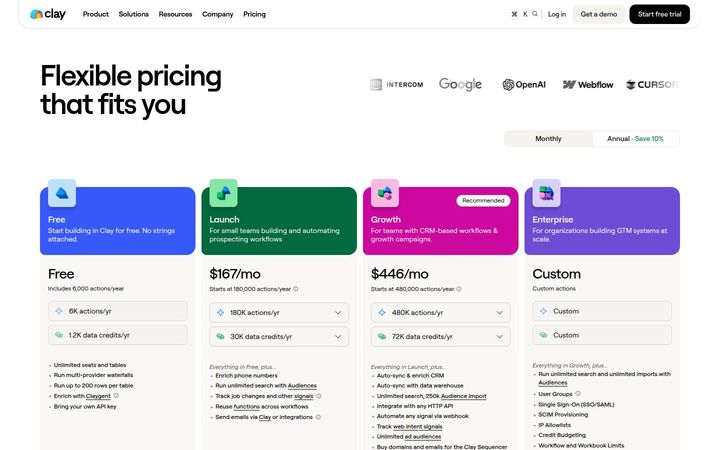
Clay
$167/moClay prices on two meters and no seats. Every plan carries unlimited seats and tables, and the bill is Actions for work done on the platform plus Data Credits for data bought from its marketplace. Each paid card is a live configurator whose two dropdowns add up to the headline price, and Enterprise is now packaged as a governance tier built around access controls and credit budgeting.

Cloudinary
$89/moCloudinary sells monthly credit bundles, 25 on Free, 225 on Plus at $89 and 600 on Advanced at $224, and defines the credit in one visual row: 1 credit equals 1,000 transformations, 1GB managed storage, 1GB image bandwidth or, on paid plans, 2GB video bandwidth. One fungible unit covers processing, storage and delivery, so each customer spends its allowance on whatever its media workload needs.