How Clay prices
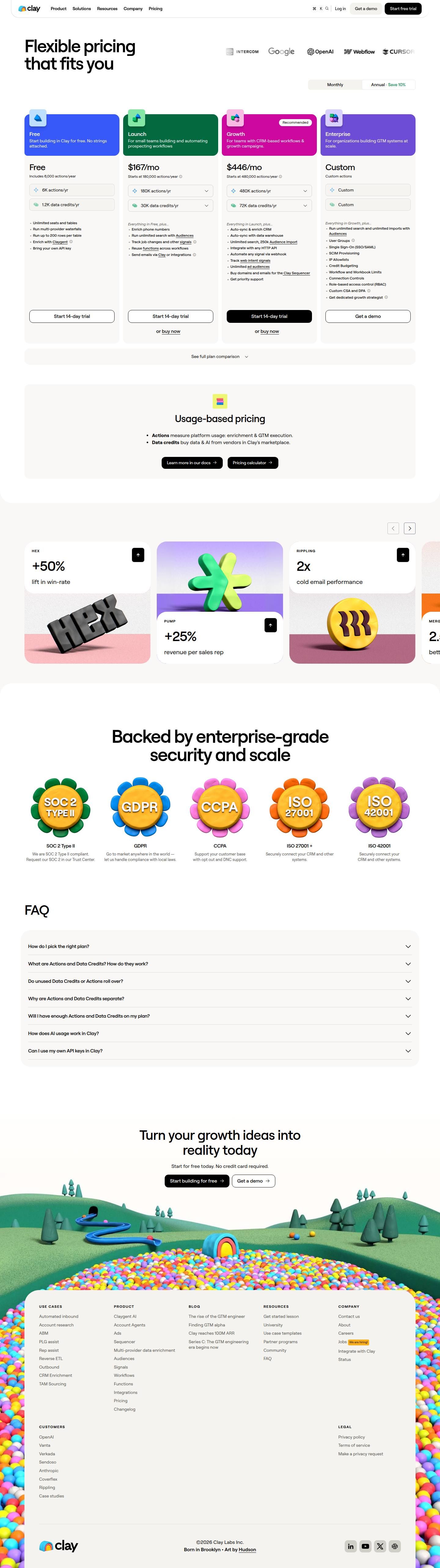
Captured October 26, 2026 at 1440px wide.
Clay plans and prices
| Plan | Price | Billing |
|---|---|---|
| FreeStart building in Clay for free. No strings attached. | Free | |
| LaunchFor small teams building and automating prospecting workflows | $167 | /mo |
| GrowthHighlightedFor teams with CRM-based workflows & growth campaigns. | $446 | /mo |
| EnterpriseFor organizations building GTM systems at scale. | Custom |
As printed on the page captured October 26, 2026.
How does Clay pricing work?
Clay sells two currencies. Actions measure platform usage, meaning enrichment and GTM execution, and Data Credits buy data and AI from vendors in Clay's marketplace. Both are bought as annual tiers: Launch starts at 180K actions per year at $54 per month plus 30K data credits per year at $113 per month, which is the $167 per month on the card, and Growth starts at 480K actions at $185 plus 72K data credits at $261, for $446. Headcount stays out of the bill. 'Unlimited seats and tables' appears on Free, and the comparison table reads Unlimited for tables and users per workspace on every plan. The row holds four plans, with Growth marked as the recommended middle.
The motion is product-led at the front and sales-led at the top. A free plan with unlimited seats invites a whole team in at no cost, Launch and Growth are configured and bought online with a 14-day trial, and Enterprise turns custom, which gives the sales team room to shape large deals with commitments and volume pricing. The page runs from 'Flexible pricing that fits you' and a monthly or annual toggle that names its 10% saving, through the four configurable cards, a two-line definition of both currencies, quantified customer results, a security band and a seven-question FAQ on credit mechanics, to a closing band with 'Start building for free' and 'Get a demo'. The FAQ quotes monthly prices, 'Launch (starting at $185/mo)' and 'Growth (starting at $495/mo)', while the cards default to annual at $167 and $446, and the gap between them is the 10% annual saving.
The split between the two meters is the most interesting choice on the page. Actions price the value Clay's own platform creates, and Data Credits price data Clay resells from other vendors, so a customer can judge platform ROI on its own terms and a team that brings its own API keys can skip Data Credits entirely, which the FAQ confirms. The FAQ also gives the two meters different lifecycles: Actions reset each billing cycle as platform capacity, while 'Data Credits work more like a currency and do roll over', banking 'up to 2x your monthly credit amount' on Launch and Growth, and top-ups cost a 30% premium, which makes the annual tier the economical way to buy. Enterprise now reads as a governance package: User Groups to 'manage access and credit budgets at scale', SCIM Provisioning, IP Allowlists, Credit Budgeting, Workflow and Workbook Limits and Connection Controls. Several of those controls allocate spend across teams, which points to Enterprise deals built on one shared credit pool that an admin divides across the organization.
What does Clay's pricing page do well?
- No seat charge anywhere: 'Unlimited seats and tables' on Free and unlimited users per workspace on every plan let a whole GTM team adopt Clay at once
- Each paid card is a configurator whose two dropdowns sum to the headline, so 180K actions at $54 plus 30K data credits at $113 make the $167/mo shown
- Every dropdown option carries a volume and a price, such as '1.2M/yr ($261/mo)', so the whole ladder is visible inside the card
- The Enterprise card names each governance control, from SCIM Provisioning to IP Allowlists, and each one has a matching row in the comparison table
- A two-line band defines both currencies directly below the cards that use them
What does Clay's pricing page reveal about its pricing strategy?
- Two value metrics with two jobs: Actions price Clay's own platform and Data Credits price marketplace data, so platform value and data spend are judged separately
- Actions reset each billing cycle while Data Credits roll over, so one meter behaves like capacity and the other like a stored currency
- Credit Budgeting, User Groups and Workflow and Workbook Limits on Enterprise point to a central credit pool that admins allocate across teams
- A free plan with unlimited seats is a land-and-expand play built on confidence in the product: it spreads across a team before anyone talks to sales
- Integration features such as CRM and warehouse sync arrive with Growth, so their cost lives in the plan's price rather than in a metered line item
Learn with Orb
- ProductPrepaid credits Actions and Data Credits are bought as annual tiers sized in dropdowns on each card; Orb's page covers plans built on credit allocations and bulk discounts on larger commitments.
- GuideAn AI founder's guide to prepaid credits Rollover of up to 15% of annual credits and top-ups at a 30% premium reward sizing the commitment well; Orb's guide covers commitment rates and overage pricing past a commitment.
Questions about Clay pricing
How much does Clay cost?
Clay's pricing starts at $167/mo. The page shows 4 plans, including a free plan, with the top plan priced through sales. Paying annually saves 10%.
What pricing model does Clay use?
Clay prices with credits, combined with usage-based pricing and flat-rate tiers. Buyers can sign up on their own or go through the sales team. Its plans are aimed mainly at mid-market companies.
Does Clay have a free plan?
Yes, Clay has a free plan, and its paid plans offer a free trial. Paid plans start at $167/mo.
Does Clay offer an annual discount?
Yes, paying annually saves 10%. A toggle on the page switches between monthly and annual prices. The listed prices start at $167/mo. Terms for the plans priced through sales are set with the sales team.
How is Clay's pricing page laid out?
The page shows 4 plans, highlights Growth, and includes a comparison table, a calculator and an FAQ. The breakdown above marks 14 points on it: 8 things it does well and 6 insights into the pricing.
What are Actions and Data Credits in Clay pricing?
Clay bills on two meters. Actions measure platform usage, meaning enrichment and GTM execution such as running a table, calling an AI model or exporting data, while Data Credits buy data and AI from vendors in Clay's marketplace across its 150+ data partners. If you bring your own API keys for third-party data, the page says you "skip Data Credit costs entirely and only use Actions" for the platform work.
Do unused Clay Data Credits and Actions roll over?
Data Credits "work more like a currency and do roll over." On Launch and Growth, unused credits can accumulate "up to 2x your monthly credit amount" so a 10,000 credit plan can bank up to 20,000 total. Actions reset each billing cycle, since they reflect the platform capacity your plan includes.
What happens when I run out of Clay Actions or Data Credits?
When you reach your Action limit, you can upgrade to the next Action tier at any time. Data Credits can be topped up, and the comparison table lists top-ups on Launch and Growth as "Buy more at a 30% premium" and on Enterprise as "Buy more at custom price" for larger needs. Clay notes each plan includes enough Actions to cover 90% of customer usage.
From the page as captured October 26, 2026. Current prices are on clay.com

HubSpot Credits
$10/1,000 creditsA launch page for a pricing model: HubSpot Credits are announced like a product, with the controls around spend as the headline. Three principles, one public rate of $10/1,000 credits, an outcomes-first estimator and four controls customers hold themselves make the case that credits are safe to adopt.
ActiveCampaign
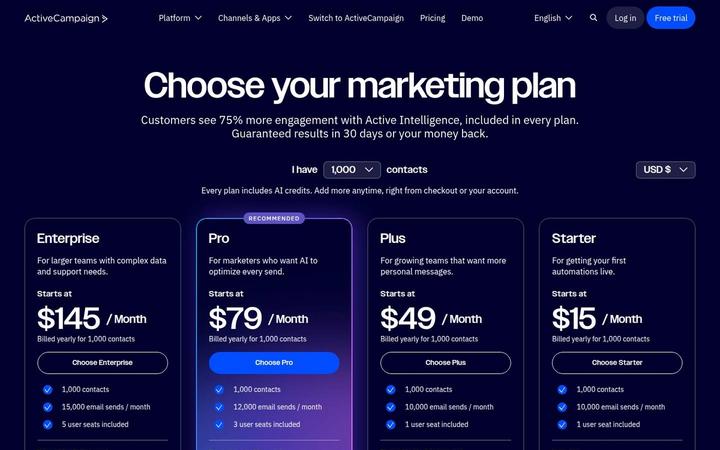
$15/moActiveCampaign prices four plans by contact band, each with a printed starting price and a 'Choose' button, and now adds AI credits as a second meter: every plan includes 500, with more available from checkout or the account. A single contact selector sits above the cards, and each card translates its plan into concrete numbers, from '15,000 email sends / month' to '1 user seat included'. Email sends still scale as a multiple of the contact limit, from '10x' to '15x'.
Braze
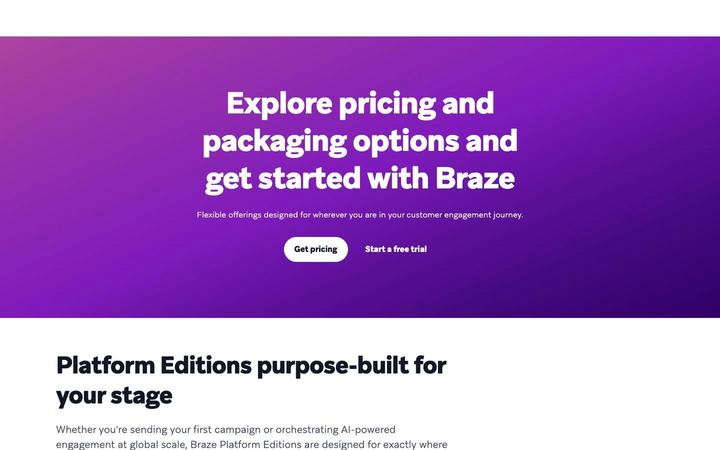
QuoteBraze prices on two axes: Monthly Active Users set the scale of the subscription, and Action Credits are a pooled currency spent across every channel and certain BrazeAI products. Four Platform Editions, Go, Select, Pro and Enterprise, are named for company stage, and every edition is priced in a conversation, which lets each contract fit the brand's audience and channel mix.