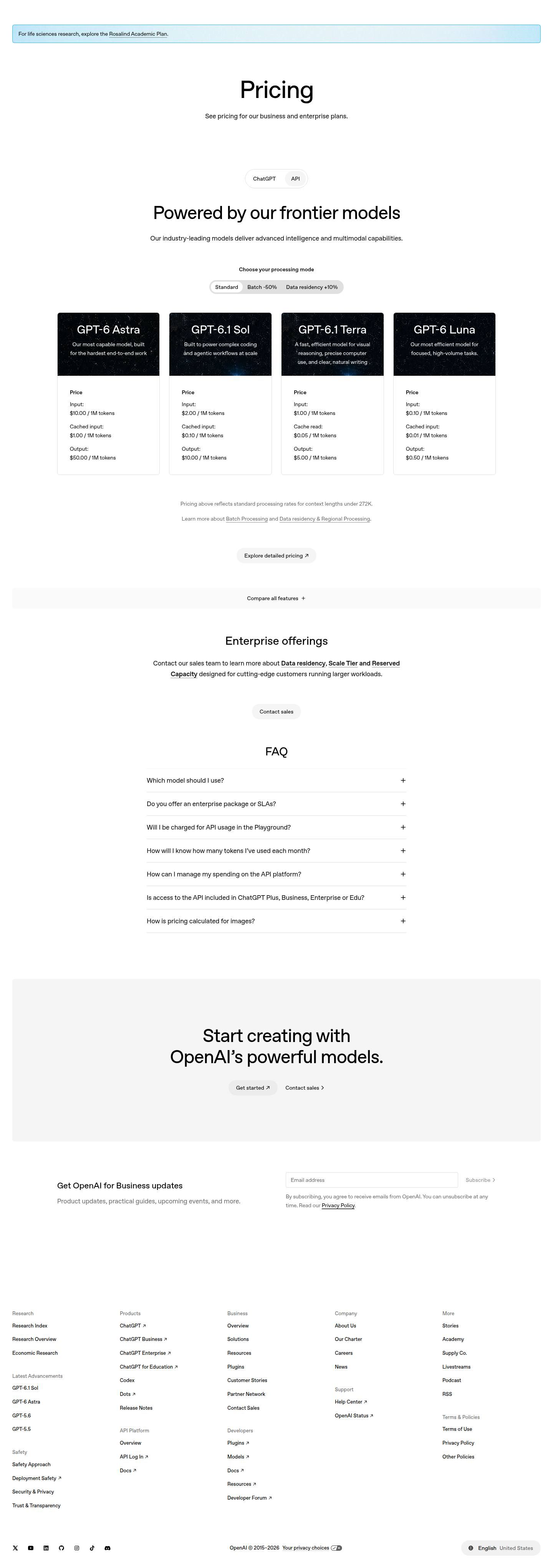
Captured October 26, 2026 at 1440px wide.
OpenAI plans and prices
| Plan | Price | Billing |
|---|---|---|
| GPT-6 AstraOur most capable model, built for the hardest end-to-end work | Input: $10.00 | / 1M tokens |
| GPT-6.1 SolBuilt to power complex coding and agentic workflows at scale | Input: $2.00 | / 1M tokens |
| GPT-6.1 TerraA fast, efficient model for visual reasoning, precise computer use, and clear, natural writing | Input: $1.00 | / 1M tokens |
| GPT-6 LunaOur most efficient model for focused, high-volume tasks. | Input: $0.10 | / 1M tokens |
As printed on the page captured October 26, 2026.
How does OpenAI pricing work?
The token is the value metric, split three ways on every card. GPT-6 Astra is 'Input: $10.00 / 1M tokens', 'Cached input: $1.00 / 1M tokens' and 'Output: $50.00 / 1M tokens', and the ladder runs down to GPT-6 Luna at $0.10, $0.01 and $0.50, a 100x spread on input. Output costs five times input on all four models, which tracks the cost of generation against the cost of reading. Cached input is one tenth of input on Astra and Luna and one twentieth on GPT-6.1 Sol and GPT-6.1 Terra, where Terra labels the line 'Cache read'. Each model carries a one-line role, from 'Our most capable model, built for the hardest end-to-end work' to 'Our most efficient model for focused, high-volume tasks', so price and purpose read together.
The motion is self-serve metering with an enterprise layer. A banner for the Rosalind Academic Plan sits above the hero, and a ChatGPT / API switch keeps seat subscriptions and token pricing in one Business pricing hub. Inside the API tab, the page runs from 'Powered by our frontier models' through the mode switch and four model cards, a 'Compare all features' section with image models, voice models, tools and service tiers, an 'Enterprise offerings' line naming Data residency, Scale Tier and Reserved Capacity, a seven-question FAQ, and a closing 'Start creating with OpenAI’s powerful models.' with 'Get started' and 'Contact sales', followed by a 'Get OpenAI for Business updates' email signup.
Under the hood, the processing mode works as a price multiplier on one rate table: Batch trades a 24-hour window for half price, data residency adds 10% for regional processing, and Flex processing offers 'lower costs for requests in exchange for slower response times'. That turns latency and location into priced options on the same token. Every model card prints a standing list price, so the rate table itself is the offer. Voice and transcription bill by the minute or by the token depending on the model, web search bills at '$10.00 / 1k calls', and containers bill by size, from 1 GB for $0.03 to 64GB for $1.92 per container. Enterprise offerings sell capacity rather than tokens, Scale Tier and Reserved Capacity, which is where a commitment-based contract sits beside the metered API.
What does OpenAI's pricing page do well?
- The 'Standard', 'Batch -50%' and 'Data residency +10%' switch reprices every model card in place, so discounts and uplifts read as choices
- Every model card prints Input, cached input and Output lines in '/ 1M tokens' in the same order, so four cards scan in seconds
- Output is priced at five times input on all four models, one ratio a buyer can carry across the whole ladder
- The FAQ explains spend controls: a monthly budget that stops requests, an email notification threshold and per-project billing restrictions
- Each model carries a one-line role, such as 'Built to power complex coding and agentic workflows at scale', which maps price to intended use
What does OpenAI's pricing page reveal about its pricing strategy?
- Cached input at one twentieth of input on GPT-6.1 Sol and Terra, and one tenth on Astra and Luna, puts the deepest reuse discount on the models built for high-volume work
- Processing mode is a multiplier on one rate table, so latency and data location become priced options on the same token
- A 100x input spread, from $10.00 on Astra to $0.10 on Luna, gives each workload a price point and lets customers land low and expand up the ladder
- Voice models price by the minute or by the token depending on the product, matching the unit to how each one is used
- Scale Tier and Reserved Capacity sell committed capacity, a contract layer above pay-as-you-go tokens
Learn with Orb
- GuideOpenAI pricing: Features and plans explained Orb's buyer guide to OpenAI's plans and costs. This page covers how the pricing page presents them.
- ProductPrice evolution GPT-5.6 Sol shows its previous price struck through and a date the new rate holds through, a price change customers can plan around, which is Orb's price evolution approach.
- ProductSpend controls The FAQ describes a monthly budget that stops requests and an email notification threshold, the alerts and limits Orb's spend controls use to keep usage predictable.
- ProductPrice modeling Batch at 50% off and data residency at 10% more act as multipliers on one token rate table, dimensional logic Orb's price modeling represents without re-engineering billing.
Questions about OpenAI pricing
How much does OpenAI cost?
OpenAI's pricing starts at $0.10/1M input tokens. The page shows 4 plans, with the top plan priced through sales.
What pricing model does OpenAI use?
OpenAI prices by usage. Buyers can sign up on their own or go through the sales team. Its plans are aimed mainly at developers.
Does OpenAI have a free plan?
OpenAI's pricing page shows no free plan or free trial. The lowest paid plan starts at $0.10/1M input tokens.
Does OpenAI offer an annual discount?
OpenAI's pricing page shows a single billing period. The listed prices start at $0.10/1M input tokens. Terms for the plans priced through sales are set with the sales team.
How is OpenAI's pricing page laid out?
The page shows 4 plans and includes an FAQ. The breakdown above marks 14 points on it: 5 things it does well and 9 insights into the pricing.
How do I set a spending limit on the OpenAI API?
You can set a monthly budget in your billing settings, after which OpenAI will stop serving your requests. The page notes there may be a delay in enforcing the limit and that you are responsible for any overage incurred. You can also configure an email notification threshold to get an alert once you cross it each month, and teams using Projects can set billing restrictions per project in the Dashboard.
Is OpenAI API access included in ChatGPT Business or Enterprise?
OpenAI APIs are billed separately from ChatGPT Plus, Business, Enterprise and Edu. ChatGPT subscription pricing has its own page at openai.com/chatgpt/pricing/. Playground usage is billed like regular API usage, at the per-token input and output prices on the rate card.
How much does the OpenAI Batch API save?
The Batch API lets you "Save 50% on inputs and outputs" and runs tasks asynchronously over 24 hours. A "Choose your processing mode" switch reprices each model card with "Batch -50%", alongside "Data residency +10%". For other lower-cost work, Flex processing offers lower costs in exchange for slower response times and is described as "Ideal for non-production or lower priority tasks."
From the page as captured October 26, 2026. Current prices are on openai.com

AssemblyAI
$0.15/hrAssemblyAI bills speech-to-text by the hour of audio, the unit a transcription team already uses, and the default view shows two rates: Universal-3.5 Pro at $0.21 /hr and Universal-2 at $0.15 /hr. A selector across eight APIs, grouped under TRANSCRIBE, UNDERSTAND and INTERACT, swaps the rate table, so each product is priced in its own unit, from audio hours to LLM tokens to input characters. The FAQ carries the billing mechanics in plain words, including the new Text-to-Speech API at $15 per 1M characters.

Baseten
From $0.01/1M tokensBaseten layers a three-tier service ladder over published rate sheets. Basic is '$0 per month, pay as you go', and Pro and Enterprise carry 'Volume discounts available' with 'GET A QUOTE'. Underneath sit three meters: Model APIs per 1M tokens across 19 model rows with Input, Cache Input and Output columns, opening with joey-1 at $0.01 input, dedicated GPU and CPU instances billed 'down to the minute', and the same GPU grid for training.
Cohere
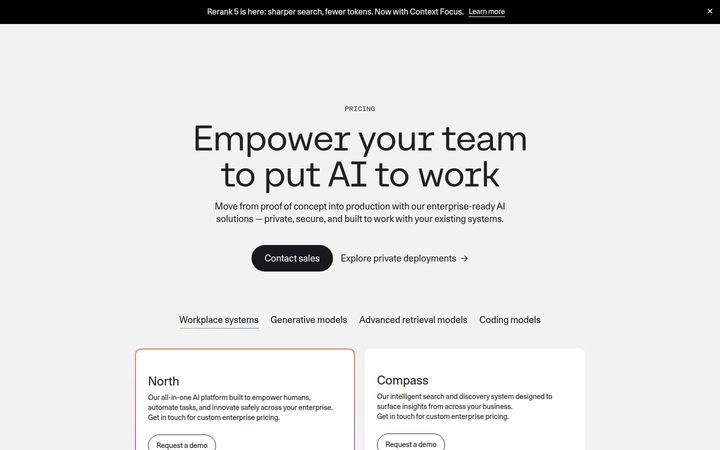
$3.00/instance/hrCohere prices for the enterprise in three shapes: custom contracts for its North and Compass platforms, reserved capacity on Model Vault at $3.00 to $7.00 an hour or $2,000 to $4,300 a month per instance, and pay-as-you-go tokens behind a Production API key. A four-way toggle sorts the page by buying job, and the FAQ carries the billing mechanics, down to an invoice at month end or at $250 of outstanding balance.
Deepgram
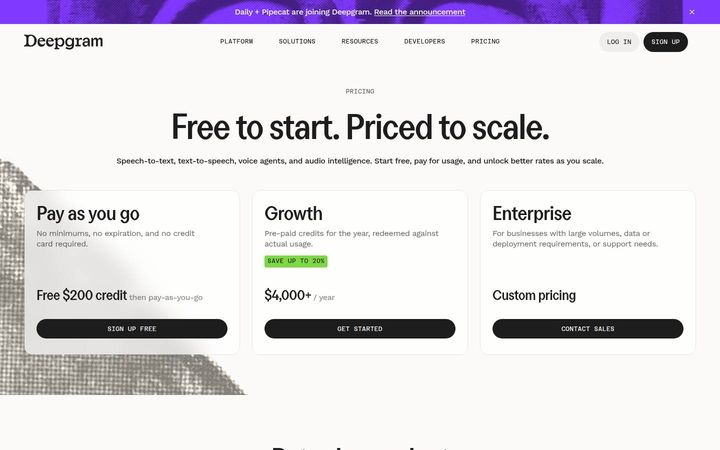
$0.0077/minDeepgram's page opens on "Free to start. Priced to scale." and three cards: Pay as you go with a Free $200 credit, Growth at $4,000+ / year in pre-paid credits for up to 20% off, and Enterprise at Custom pricing. A tabbed "Rates by product" section names the meter for each product, per second of audio, per 1,000 characters, or per minute of connection time, and a sixteen-question FAQ carries the billing mechanics, from hourly rates to the 10% overage premium.

Exa
$4/1k requestsExa prices its search API per thousand requests, with a rate for each endpoint: Lite Search $4, Auto Search $7, Deep Search $12, Contents $1 per 1k pages, Monitors $2 and Answer $5, plus $1 per 1k for each result above ten and for AI page summaries. Agent runs offer metered compute at $0.10 per ACU and six effort levels: five fixed from $0.012 to $1.00 per request and an Ultra level billed on usage. The plan cards divide access, throughput and compliance, and the rate card below them carries the price.
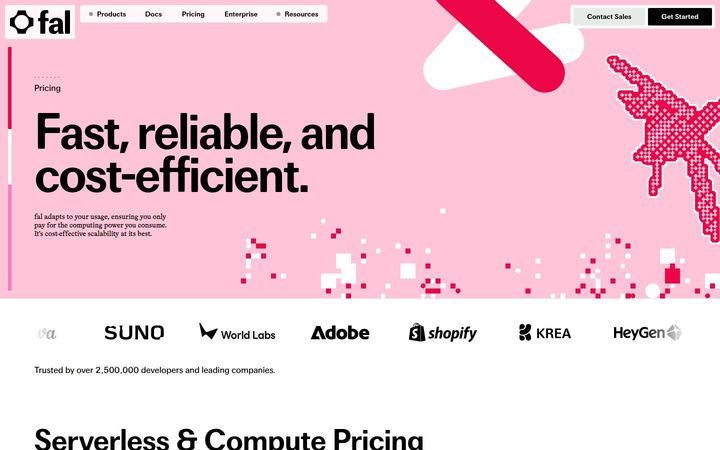
fal
From $0.0002/secondfal prices two products on one page with rate sheets in place of plans: GPU hours for serverless compute across six SKUs, and model APIs billed per output unit across video, image, audio and 3D. The "Units per $1" column turns seconds, tokens, images, megapixels, characters, generations and credits into one number a buyer compares directly.