Captured September 18, 2026 at 1440px wide.
How does Plaid pricing work?
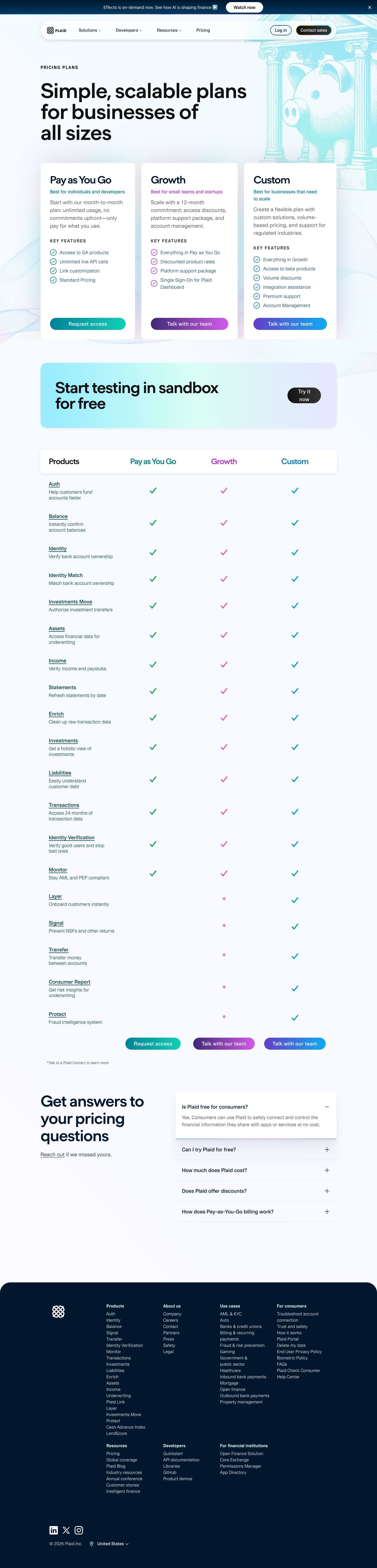
The connected account is the core value metric. The FAQ sets out three models: 'One-time fee products' charge 'only once per connected account, regardless of the number of API calls made', 'Subscription products' carry 'a monthly fee for each connected account', and 'Per-request products' have 'a flat fee for every successful API call'. Each product is priced on the model that fits how it is used, once, monthly or per call. A Products matrix lists nineteen products from Auth to Protect, each with a one-line job, and marks which plan includes it.
The motion is sales-assisted with a developer front door. Pay as You Go, 'Best for individuals and developers', offers 'unlimited usage, no commitments upfront' at 'Standard Pricing' and opens with 'Request access'. Growth and Custom route to 'Talk with our team', where rates, commitments and volume are shaped per contract. 'Start testing in sandbox for free' with 'Try it now' sits between the cards and the matrix, and the FAQ adds 'Limited Production' with 'up to 200 API calls with each available product using live data'. The page closes on a five-question FAQ under 'Get answers to your pricing questions'.
Under the hood, Plaid prices on a rate card per product with discounts earned through commitment. 'We offer volume discounts based on the length of your contract and/or the minimum monthly commitment you choose', so the step from Pay as You Go to Growth trades a 12-month term for lower unit rates, platform support and account management. Pay as You Go charges 'the card on file for the connected items (accounts)', a clean metered start. Five products, Layer, Signal, Transfer, Consumer Report and Protect, are offered through a Plaid contact, which fits risk, payments and underwriting products that carry regulatory and credit exposure.
What does Plaid's pricing page do well?
- The three cards explain the commitment trade-off: month-to-month with 'no commitments upfront', or a 12-month commitment for 'access discounts, platform support package, and account management'
- The Products matrix pairs each of nineteen products with its job, such as 'Balance Instantly confirm account balances', and marks plan coverage
- 'Start testing in sandbox for free' with 'Try it now' gives developers a no-cost path between the cards and the matrix
- The FAQ defines all three billing models, one-time, subscription and per-request, in plain language
- The free path is countable: Limited Production allows 'up to 200 API calls with each available product using live data'
What does Plaid's pricing page reveal about its pricing strategy?
- Pricing per connected account ties the bill to the end users a customer brings onto Plaid's network
- Three billing models across one catalog let each product bill on the pattern of its use: once, monthly or per call
- Discounts tied to contract length and minimum monthly commitment make the term itself the main pricing lever
- Products in risk, payments and underwriting route through a Plaid contact, which suits offerings with regulatory and credit exposure
- 'Request access' on Pay as You Go points to an approval step for production access to financial data
Learn with Orb
- DocsConfiguring plans: minimums and plan phases Growth runs on a 12-month term with a minimum monthly commitment behind its discounted rates; Orb models that commitment as a minimum, and plan phases step committed spend up on a schedule.
- ProductPrice modeling Nineteen products bill on three patterns, one-time per connected account, subscription per connected account and per successful API call; Orb's price modeling holds mixed logic like this in one catalog.
- GuideAn expert's guide to enterprise pricing for SaaS Custom pairs volume discounts with support for regulated industries, with rates set per customer; Orb's enterprise guide covers the main enterprise models and what to weigh when prices are set deal by deal.
Questions about Plaid pricing
How much does Plaid cost?
Plaid prices its plans through its sales team, so the pricing page lists no starting price. The page shows 3 plans.
What pricing model does Plaid use?
Plaid prices by usage, combined with quoted plans. The page is built around talking to the sales team. Its plans are aimed mainly at developers.
Does Plaid have a free plan?
Plaid has no free plan, but its paid plans offer a free trial. Plans are priced through the sales team.
Does Plaid offer an annual discount?
Plaid's pricing page shows a single billing period. Terms for the plans priced through sales are set with the sales team.
How is Plaid's pricing page laid out?
The page shows 3 plans and includes a comparison table and an FAQ. The breakdown above marks 14 points on it: 6 things it does well and 8 insights into the pricing.
How does Plaid Pay as You Go billing work?
Plaid's Pay as You Go plan is month to month, with "unlimited usage, no commitments upfront" at Standard Pricing. Once you sign up for the products you need in Plaid's production dashboard, Plaid will "charge the card on file for the connected items (accounts)." The plan is described as "Best for individuals and developers" and starts with "Request access".
What does the Plaid Growth plan include?
The Growth plan is "Best for small teams and startups" and runs on a 12-month commitment that brings "access discounts, platform support package, and account management." Its key features are "Everything in Pay as You Go", "Discounted product rates", a "Platform support package" and "Single Sign-On for Plaid Dashboard". You set it up through "Talk with our team".
Which Plaid products are offered through a Plaid contact?
Plaid's Products matrix marks five products with an asterisk: Layer, Signal, Transfer, Consumer Report and Protect. The page's note for these reads "Talk to a Plaid Contact to learn more". They cover onboarding, preventing NSFs and other returns, moving money between accounts, risk insights for underwriting, and fraud intelligence.
From the page as captured September 18, 2026. Current prices are on plaid.com

Numeral
$75 per filingNumeral prices sales tax compliance on the work it performs, '$75 per filing' and '$150 per registration', so the bill follows the states a seller files in rather than its transaction volume. A hero guarantee to pay penalties and interest on any late filing stands behind that work, and the FAQ spells out the formula, month-to-month terms and cancellation at any time.
Adyen
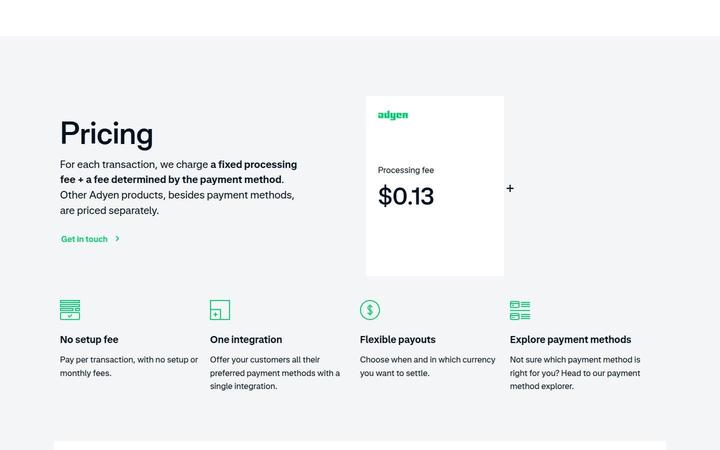
$0.13 + Interchange++ + 0.60%Adyen publishes its tariff as a rate sheet: a fixed '$0.13' processing fee on every transaction plus a fee set by the payment method, across more than a hundred methods. Card networks run on interchange++, 'Interchange+ + 0.60%', which passes network costs through at cost and makes Adyen's own margin a visible line. A Payment / Refund switch publishes refund costs on the same table.
Cohere
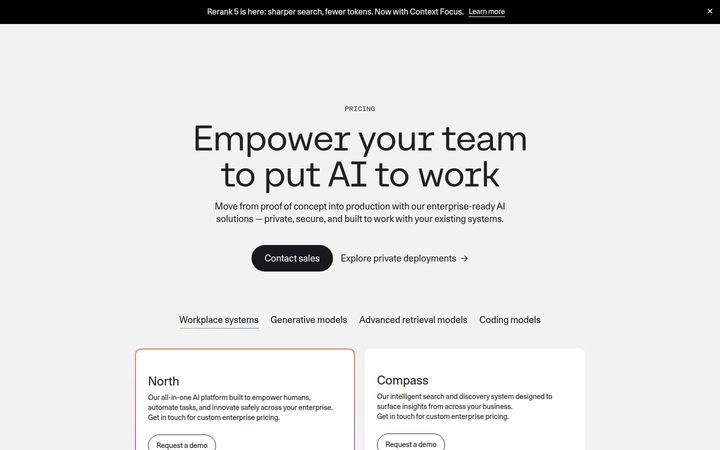
$3.00/instance/hrCohere prices for the enterprise in three shapes: custom contracts for its North and Compass platforms, reserved capacity on Model Vault at $3.00 to $7.00 an hour or $2,000 to $4,300 a month per instance, and pay-as-you-go tokens behind a Production API key. A four-way toggle sorts the page by buying job, and the FAQ carries the billing mechanics, down to an invoice at month end or at $250 of outstanding balance.