
Captured October 26, 2026 at 1440px wide. The page continues below the crop (10,847px in total).
Twilio plans and prices
| Plan | Price | Billing |
|---|---|---|
| Long codesA 10-digit number for SMS and voice calls with localized identity. | $0.0083 | per segment |
| Toll-freeBusiness messaging phone number with a 3-digit prefix (Ex: 887) for high-throughput SMS and voice calls. | $0.0083 | per segment |
| Short codesA short number (5-6 digits) designed for high-throughput two-way SMS messaging. | $0.0083 | per segment |
| RCS SenderRich Communication Services (RCS) enables you to send branded, interactive text messages. | $0.0083 | per segment |
As printed on the page captured October 26, 2026.
How does Twilio pricing work?
The value metric is the message segment, priced by direction, media type and number type. SMS Outbound and Inbound are $0.0083 on long codes, toll-free and short codes, MMS Outbound is $0.022, and MMS Inbound is $0.0165 or $0.02. RCS follows the same rates, '$0.0083' for Rich messages and '$0.022' for Rich Media Outbound. Carrier fees are a second layer, from $0.0035 for AT&T long code SMS to $0.0062 for T-Mobile RCS. The number is a third: '$1.15' a month for a leased long code, '$2.15' toll-free, '$0.5' to bring your own, and short codes at $1000 random and $1500 vanity, 'Billed quarterly, requires one time setup fee'. Engagement Suite and Compliance Toolkit are metered on the same unit at '$0.015' per outbound message, and the Traffic Optimization Engine, which will 'Increase MPS and automate SMS/MMS throughput and capacity allocation across senders and subaccounts, globally', is a flat monthly fee 'Starting at $300 /month'.
The motion is developer self-serve with a committed-use path for scale. The hero reads 'SMS and RCS pricing built to break even fast' with 'Only pay for what you use and unlock volume discounts that scale automatically, so your margins improve as your reach does.' and a 'Start for Free' button under 'Start building today. No credit card required.', next to 'Need help with a custom enterprise solution?'. A country selector and the price date anchor the sheet, a 'Jump to:' row links SMS/MMS, RCS pricing, Carrier fees, Features and Phone number pricing, and each section ends with 'Start for free' and, for the two largest tables, a CSV download. 'Committed-use discounts' and a Contact sales button lead into 'SMS Pricing FAQs', five questions that run from 'What is the base cost to send and receive SMS in the US with Twilio?' to 'Does Twilio offer volume discounts for high-volume US SMS senders?'.
The layering is the billing design. Twilio's own rate stays flat and stable at $0.0083, while carrier fees, which carriers set and change, pass through in their own tables, so a carrier repricing moves one line and leaves the platform rate untouched. This capture shows that at work: Verizon now reads $0.005 and All other carriers $0.0042, and the $0.0083 rate above them holds. Number type is priced through the lease and the setup fee, and throughput now has its own flat fee with a floor, two platform charges that price capacity apart from volume. At the top, 'Commit to annual message volumes and receive a discount beyond standard volume tiers' describes a ladder of volume pricing with a committed contract above it. Keeping pass-through costs in their own table, apart from platform value, is the move most worth borrowing for any product that resells a third party's cost.
What does Twilio's pricing page do well?
- A country selector and 'Pricing current as of October 2026' sit above the first table, so buyers know which market and which version of the rates they are reading
- Carrier fees are itemized per carrier, with long code SMS at AT&T $0.0035, T-Mobile $0.0045, Verizon $0.005, US Cellular $0.005 and All other carriers $0.0042
- 'Download SMS prices (.CSV)' and 'Download number prices (.CSV)' let finance teams pull the rate deck straight into a model
- Footnotes print the small terms of the bill: per-segment charging, the $0.001 processing fee keyed to a message's final status, and quarterly billing on short codes
- 'SMS Pricing FAQs' answers the questions a rate sheet raises, including 'How do US carrier passthrough fees and A2P 10DLC registration fees work?'
What does Twilio's pricing page reveal about its pricing strategy?
- Three layers make the bill: a platform rate per segment, carrier fees passed through per carrier, and a monthly number lease
- One SMS rate across long codes, toll-free and short codes means number type is priced through the lease and setup fee
- Carrier fees moved on this capture, Verizon to $0.005 and All other carriers to $0.0042, while Twilio's $0.0083 rate held, the pass-through separation in action
- Traffic Optimization Engine prices throughput as a flat monthly fee 'Starting at $300 /month', a floor that points to larger capacity tiers sized with the customer
- Volume discounts that 'scale automatically' sit under committed-use discounts, so sales has room to trade annual volume for rate
Learn with Orb
- ProductInvoicing Carrier fees pass through per carrier beside the $0.0083 platform rate, with CSV rate downloads for finance; Orb's invoicing shows real-time usage detail that customers can follow and finance teams can reconcile.
- ProductPrice evolution A dated rate sheet and carrier fees in their own tables let rates change one line at a time; Orb's price evolution covers rolling out a price change in a way customers can plan around.
- DocsConfiguring plans: minimums and plan phases Committed-use discounts trade annual message volume for rate above the standard tiers; Orb models a dollar commitment as a minimum and uses plan phases to step committed spend up on a schedule.
Questions about Twilio pricing
How much does Twilio cost?
Twilio's pricing starts at $0.0083/segment. Twilio prices by usage.
What pricing model does Twilio use?
Twilio prices by usage. Buyers can sign up on their own or go through the sales team. Its plans are aimed mainly at developers.
Does Twilio have a free plan?
Twilio's pricing page shows no free plan or free trial. The lowest paid plan starts at $0.0083/segment.
Does Twilio offer an annual discount?
Twilio's pricing page shows a single billing period. The listed prices start at $0.0083/segment. Terms for the plans priced through sales are set with the sales team.
How is Twilio's pricing page laid out?
The page shows its pricing and includes an FAQ. The breakdown above marks 14 points on it: 6 things it does well and 8 insights into the pricing.
What are Twilio's carrier fees for US SMS?
Twilio adds carrier fees per message that are "automatically applied based on the end-user's destination and carrier." For long code SMS outbound, the page lists AT&T at $0.0035, T-Mobile at $0.0045, Verizon at $0.005, US Cellular at $0.005 and All other carriers at $0.0042. These fees sit in their own tables for long codes, toll-free, short codes and RCS, on top of Twilio's $0.0083 per segment SMS rate.
What are the lease terms for a Twilio short code?
Twilio leases a random short code at $1000 and a vanity short code of your choosing at $1500 per the phone number table. Both are "Billed quarterly, requires one time setup fee" and the page notes that "All MMS-enabled Short Codes have a $500 one-time fee charged at time of purchase." Messages sent from short codes use the same $0.0083 SMS rate as long codes and toll-free numbers.
How much do Twilio's optional SMS features cost?
Optional features are priced per outbound message. The Engagement Suite for link shortening, click tracking and message scheduling is $0.015 with the "First 1,000 are free monthly", and the Compliance Toolkit, which uses AI to address possible non-compliant SMS, is also $0.015. The Traffic Optimization Engine for throughput and capacity allocation is "Starting at $300 /month".
From the page as captured October 26, 2026. Current prices are on twilio.com
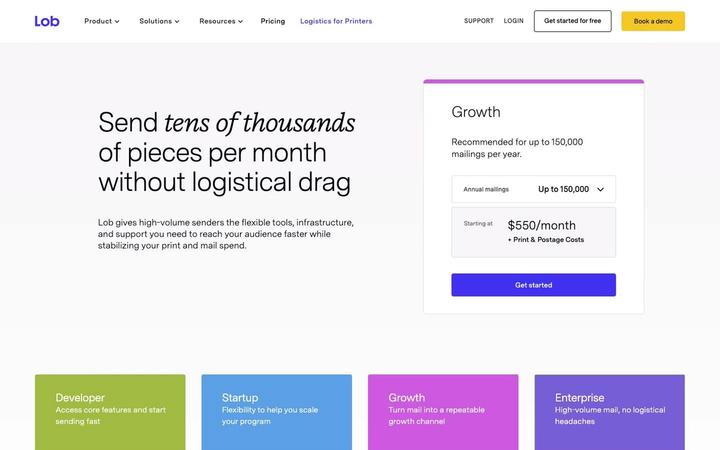
Lob
$260/moLob prices direct mail as a two-part bill and says so: a platform subscription from $0 to $550 per month, plus an all-in per-piece rate for print, postage and envelope that falls as the plan rises. A hero volume selector recommends a plan from annual mailings, and per-format rate rows, postcards from $0.905 down to $0.615, let a buyer turn a mail program into a budget.
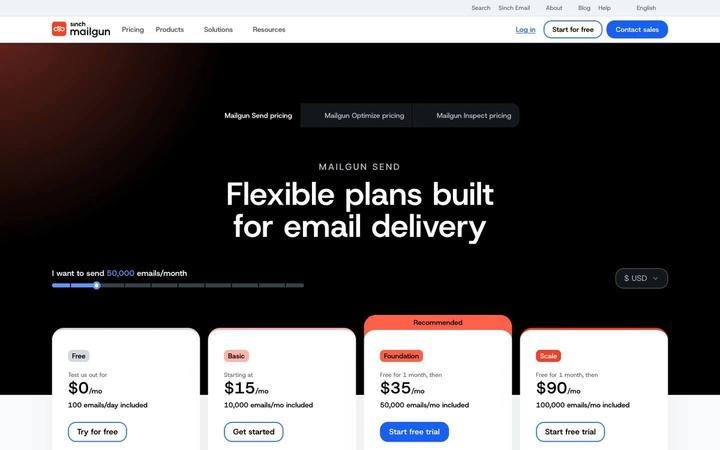
Mailgun
$15/moMailgun sells email sending as prepaid monthly allowances with an overage rate printed on every paid card, falling from $1.80 to $1.30 to $1.10 per 1,000 emails as the commitment rises. A hero slider, 'I want to send 50,000 emails/month', starts the page from volume, and a free month on Foundation and Scale lets a sender try the higher tiers at real volume.
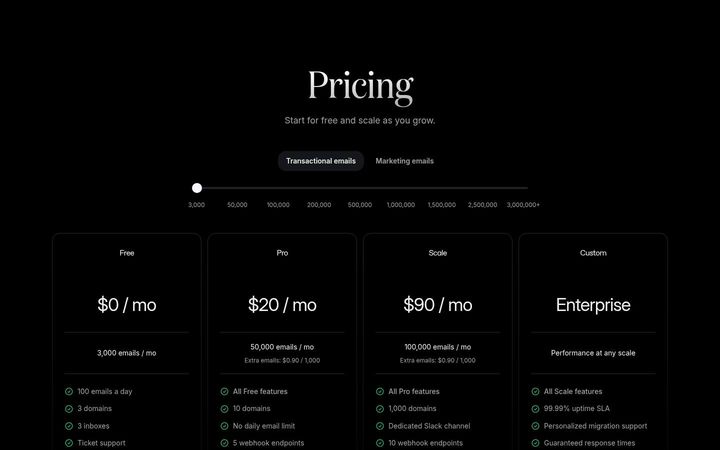
Resend
$20/mo (50,000 emails)Resend sells email volume in monthly quotas, '$0 / mo' for 3,000, '$20 / mo' for 50,000 and '$90 / mo' for 100,000, with one overage rate, 'Extra emails: $0.90 / 1,000', printed on both paid cards. Overage is opt-in through 'Enable pay-as-you-go' switches that now cover three meters, emails, automation runs and inboxes at '$1 / inbox', and a volume slider above the cards points each buyer to the tier that fits.