Communications pricing pages
5 Communications pricing pages, from Lob, Mailgun, Resend and more, each captured in full and annotated.
Of the 5, 4 price by usage, 4 show a free tier, 4 include a comparison table, 3 a calculator and 5 keep a contact-sales tier.
Lob
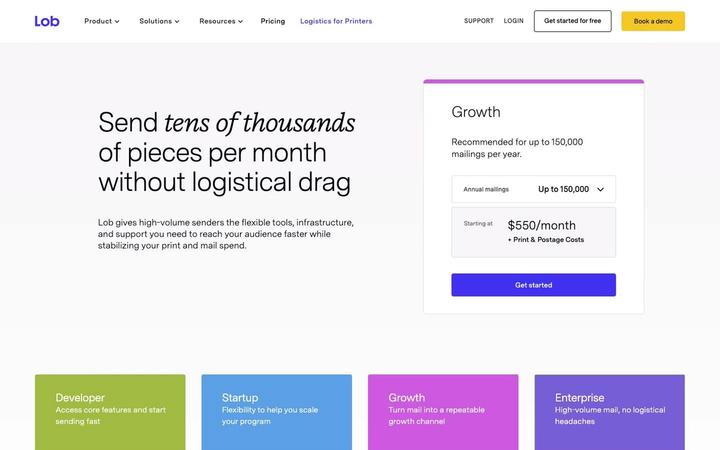
$260/moLob prices direct mail as a two-part bill and says so: a platform subscription from $0 to $550 per month, plus an all-in per-piece rate for print, postage and envelope that falls as the plan rises. A hero volume selector recommends a plan from annual mailings, and per-format rate rows, postcards from $0.905 down to $0.615, let a buyer turn a mail program into a budget.
Mailgun
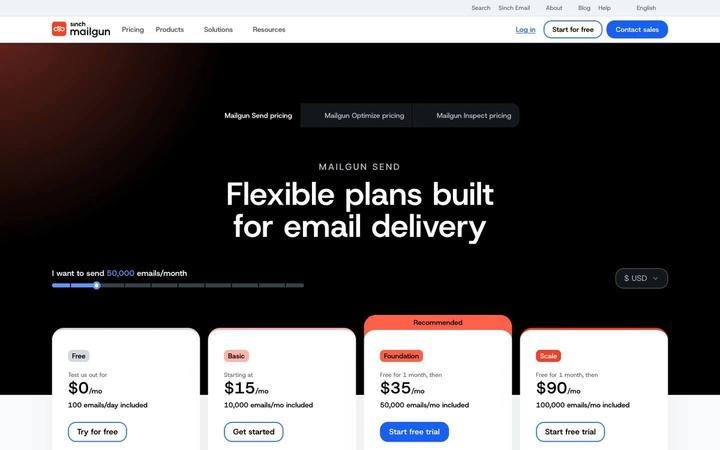
$15/moMailgun sells email sending as prepaid monthly allowances with an overage rate printed on every paid card, falling from $1.80 to $1.30 to $1.10 per 1,000 emails as the commitment rises. A hero slider, 'I want to send 50,000 emails/month', starts the page from volume, and a free month on Foundation and Scale lets a sender try the higher tiers at real volume.
Resend
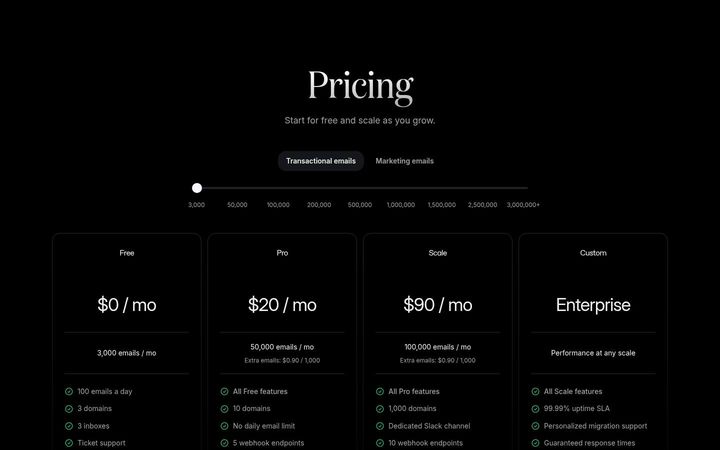
$20/mo (50,000 emails)Resend sells email volume in monthly quotas, '$0 / mo' for 3,000, '$20 / mo' for 50,000 and '$90 / mo' for 100,000, with one overage rate, 'Extra emails: $0.90 / 1,000', printed on both paid cards. Overage is opt-in through 'Enable pay-as-you-go' switches that now cover three meters, emails, automation runs and inboxes at '$1 / inbox', and a volume slider above the cards points each buyer to the tier that fits.

Twilio
$0.0083/segmentTwilio's US SMS page is a rate sheet built in layers under the headline 'SMS and RCS pricing built to break even fast': $0.0083 per segment for SMS on every number type, carrier fees passed through per carrier, and a monthly lease for the number itself. The page says outright that 'Phone number charges are added to your message volume and carrier costs for your total price', and each layer is published down to a $0.001 processing fee keyed to a message's final status, a 'Pricing current as of October 2026' stamp, and a Traffic Optimization Engine 'Starting at $300 /month'.
Zoom
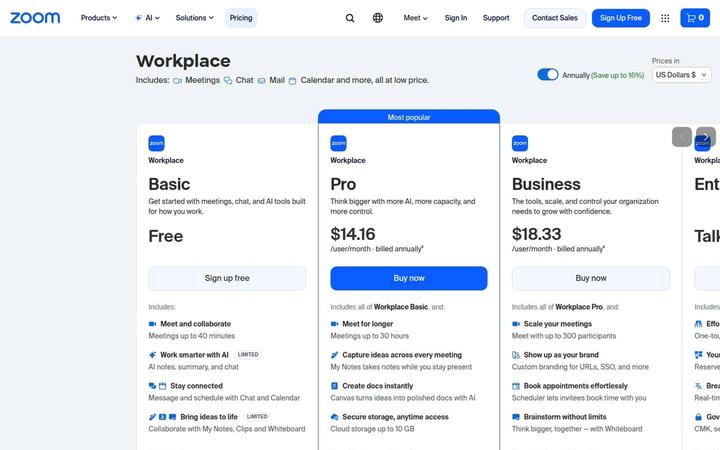
$14.16/user/moZoom Workplace sells a per-user suite on four plans, Basic free, Pro at $14.16, Business at $18.33 and Enterprise through sales, each price the monthly equivalent of an annual upfront charge. Each plan card leads with a tagline and four benefit-led rows while the comparison table carries the exact limits, and a catalog of seventeen add-ons, from ZoomMate at $20 to Zoom Mesh through sales, lets a paid account grow capacity, AI and governance one line at a time.