Captured October 26, 2026 at 1440px wide.
xAI plans and prices
| Plan | Price | Billing |
|---|---|---|
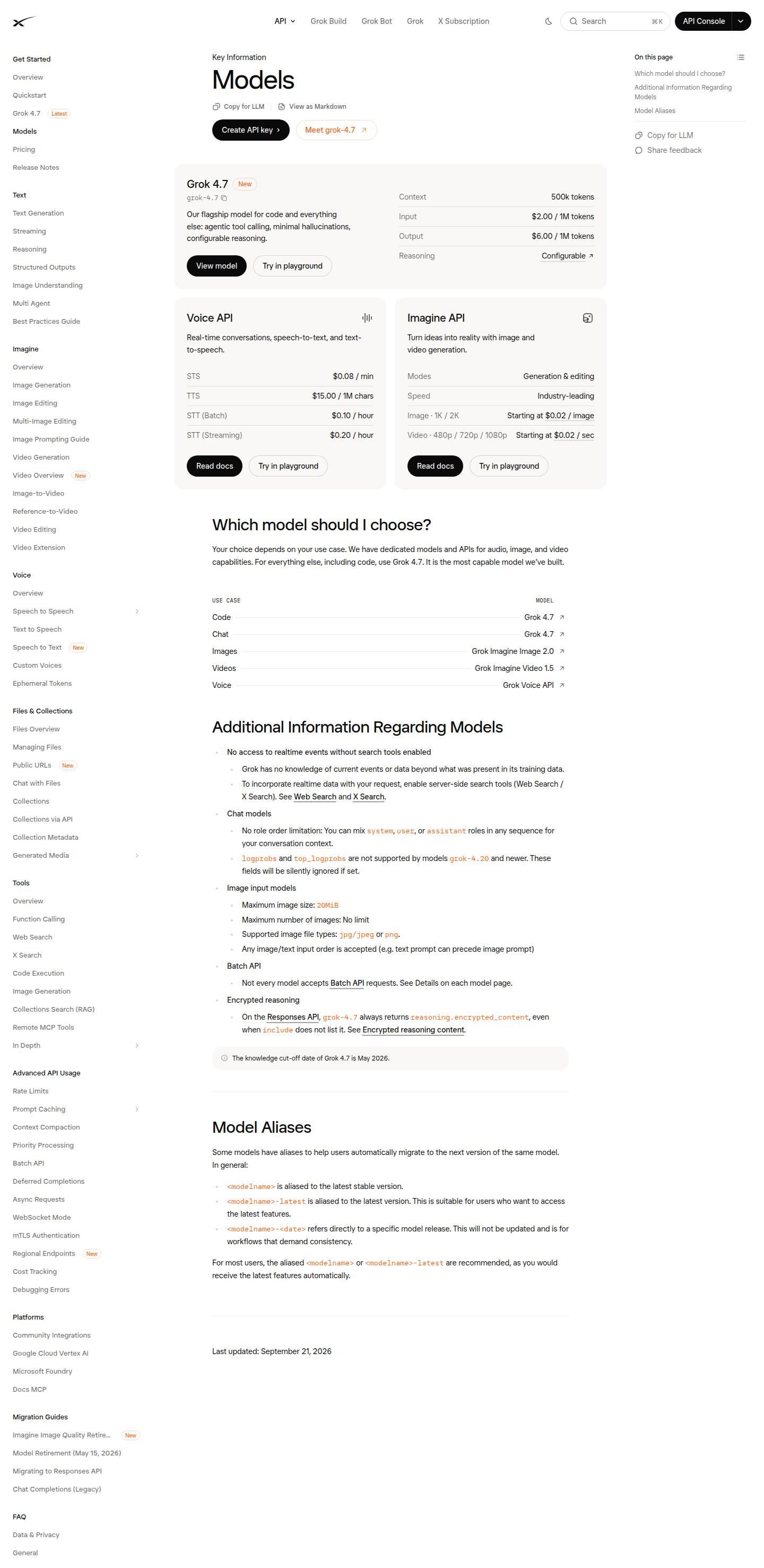
| Grok 4.7HighlightedOur flagship model for code and everything else: agentic tool calling, minimal hallucinations, configurable reasoning. | Input $2.00 | / 1M tokens |
| Voice APIReal-time conversations, speech-to-text, and text-to-speech. | STS $0.08 | / min |
| Imagine APITurn ideas into reality with image and video generation. | Starting at $0.02 | / image |
As printed on the page captured October 26, 2026.
How does xAI pricing work?
Usage is the value metric, and each product meters the unit closest to its own cost. Grok 4.7 is 'Input $2.00 / 1M tokens' and 'Output $6.00 / 1M tokens' with 'Context 500k tokens'. Voice API prices 'STS $0.08 / min', 'TTS $15.00 / 1M chars', 'STT (Batch) $0.10 / hour' and 'STT (Streaming) $0.20 / hour'. Imagine API prices 'Image · 1K / 2K' at 'Starting at $0.02 / image' and 'Video · 480p / 720p / 1080p' at 'Starting at $0.02 / sec'. Packaging is by capability: one flagship model for 'code and everything else', and dedicated APIs for audio, image and video.
The motion is self-serve and developer-first. The page opens on a Key Information breadcrumb, a 'Models' H1, 'Copy for LLM' and 'View as Markdown', then 'Create API key' and 'Meet grok-4.7' above the first rate. Grok 4.7 takes a full-width card with a New badge, Voice API and Imagine API sit side by side below it, and each card ends with a docs link and 'Try in playground'. A model selection section follows with a USE CASE to MODEL table, then notes on realtime data, chat and image input, Batch API and encrypted reasoning, a Model Aliases section and 'Last updated: September 21, 2026'. Presenting rates inside the docs signals a company that expects its buyer to arrive through the API.
The rates show which levers xAI prices. Streaming speech to text costs twice batch, $0.20 against $0.10 per hour, so latency carries its own price. Imagine rates start at the lowest resolution and scale with output size and length, and image and video now open at the same $0.02 figure, one per image and one per second. Batch eligibility is set per model, 'Not every model accepts Batch API requests', and Prompt Caching, Priority Processing and Batch API each have their own docs page, so the card prints the base rate and the modifiers live with the features that apply them. Model Aliases complete the picture: '<modelname>-<date> refers directly to a specific model release', which lets a team pin a version and keep its cost profile steady. Pairing a capability spec and its rate in one block is the idea most worth borrowing.
What does xAI's pricing page do well?
- Each product card prints its rates inline, so a developer reads the capability and its cost together
- The Grok 4.7 block aligns Context, Input, Output and Reasoning as four rows, putting the context window beside the token rates
- The model selection section gives a clear default, Grok 4.7 for everything except audio, image and video, with a five-line routing table
- 'Copy for LLM' and 'View as Markdown' let an agent or a script take in the rate sheet directly
- 'Last updated: September 21, 2026' dates the rates, so a reader knows how current they are before quoting them
What does xAI's pricing page reveal about its pricing strategy?
- Six billing units across three products, each matched to what the workload consumes: tokens, minutes, characters, hours of audio, images and seconds of video
- Streaming transcription at $0.20 per hour against $0.10 for batch prices latency as its own lever
- Imagine rates read 'Starting at', so the printed figure is the entry rate and resolution and duration move the price from there; image and video now share a $0.02 entry point
- Caching, priority and batch are documented as features with their own pages, so the card carries the base rate and the modifiers sit with the features
- Grok 4.7 carries the same token rates as the release it follows, and dated model aliases let a team pin a release, which keeps a production workload's cost profile steady across model updates
Learn with Orb
- GuidePricing AI agents: plans, costs and monetization models Three products bill on six units, from tokens and characters to hours of audio and seconds of video; Orb's guide covers how teams meter AI work that arrives per call, token and event.
- GuideHow to price your AI agent: a framework Streaming transcription at $0.20 per hour against $0.10 for batch prices latency as its own lever; Orb's framework covers choosing a model that keeps margins healthy as usage grows.
- ProductPrice evolution Dated model aliases let a team pin a release and keep its cost profile steady, and the rate sheet carries its update date; Orb's price evolution covers rolling out changes customers can plan around.
Questions about xAI pricing
How much does xAI cost?
xAI's pricing starts at $0.02/image. The page shows 3 plans.
What pricing model does xAI use?
xAI prices by usage. Buyers choose a plan and sign up on their own. Its plans are aimed mainly at developers.
Does xAI have a free plan?
xAI's pricing page shows no free plan or free trial. The lowest paid plan starts at $0.02/image.
Does xAI offer an annual discount?
xAI's pricing page shows a single billing period. The listed prices start at $0.02/image.
How is xAI's pricing page laid out?
The page shows 3 plans, highlights Grok 4.7. The breakdown above marks 14 points on it: 7 things it does well and 7 insights into the pricing.
What is the difference between batch and streaming speech to text pricing on the xAI Voice API?
The xAI Voice API offers two speech to text options, "STT (Batch) $0.10 / hour" and "STT (Streaming) $0.20 / hour", so real-time transcription is priced at twice the batch rate. The same card lists speech to speech at "STS $0.08 / min" and text to speech at "TTS $15.00 / 1M chars". Teams can pick the mode that matches their latency needs.
What does xAI charge for image and video generation with the Imagine API?
The Imagine API lists images at "Starting at $0.02 / image" for 1K and 2K output, and video at "Starting at $0.02 / sec" across 480p, 720p and 1080p. Both rates are entry prices, and the card covers "Generation & editing" modes. Images run on Grok Imagine Image 2.0 and videos on Grok Imagine Video 1.5.
How do xAI model aliases let me pin a specific Grok release?
xAI offers three alias styles for its models. The plain <modelname> points to the latest stable version, and <modelname>-latest points to the latest version for teams that want new features automatically. For a fixed release, "<modelname>-<date> refers directly to a specific model release", which the page describes as being "for workflows that demand consistency".
From the page as captured October 26, 2026. Current prices are on docs.x.ai

AssemblyAI
$0.15/hrAssemblyAI bills speech-to-text by the hour of audio, the unit a transcription team already uses, and the default view shows two rates: Universal-3.5 Pro at $0.21 /hr and Universal-2 at $0.15 /hr. A selector across eight APIs, grouped under TRANSCRIBE, UNDERSTAND and INTERACT, swaps the rate table, so each product is priced in its own unit, from audio hours to LLM tokens to input characters. The FAQ carries the billing mechanics in plain words, including the new Text-to-Speech API at $15 per 1M characters.

Baseten
From $0.01/1M tokensBaseten layers a three-tier service ladder over published rate sheets. Basic is '$0 per month, pay as you go', and Pro and Enterprise carry 'Volume discounts available' with 'GET A QUOTE'. Underneath sit three meters: Model APIs per 1M tokens across 19 model rows with Input, Cache Input and Output columns, opening with joey-1 at $0.01 input, dedicated GPU and CPU instances billed 'down to the minute', and the same GPU grid for training.
Cohere
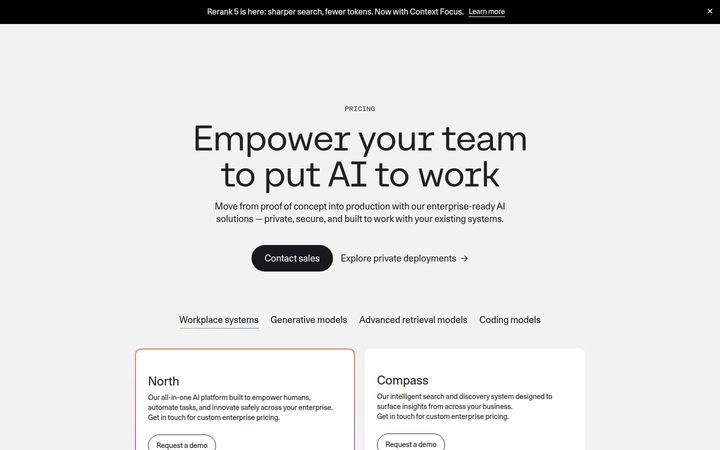
$3.00/instance/hrCohere prices for the enterprise in three shapes: custom contracts for its North and Compass platforms, reserved capacity on Model Vault at $3.00 to $7.00 an hour or $2,000 to $4,300 a month per instance, and pay-as-you-go tokens behind a Production API key. A four-way toggle sorts the page by buying job, and the FAQ carries the billing mechanics, down to an invoice at month end or at $250 of outstanding balance.
Deepgram
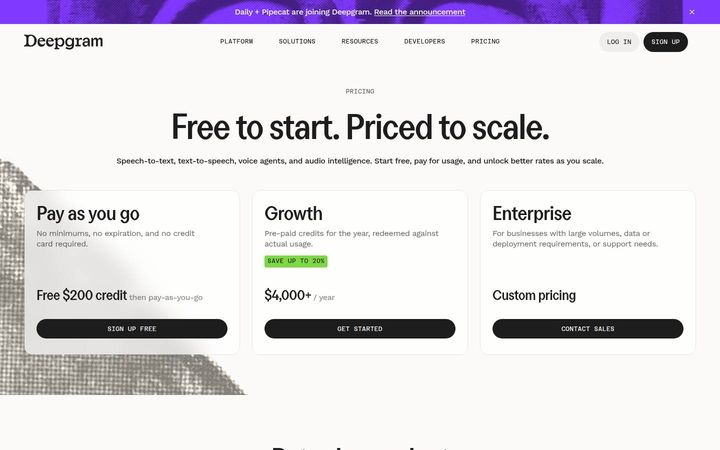
$0.0077/minDeepgram's page opens on "Free to start. Priced to scale." and three cards: Pay as you go with a Free $200 credit, Growth at $4,000+ / year in pre-paid credits for up to 20% off, and Enterprise at Custom pricing. A tabbed "Rates by product" section names the meter for each product, per second of audio, per 1,000 characters, or per minute of connection time, and a sixteen-question FAQ carries the billing mechanics, from hourly rates to the 10% overage premium.

Exa
$4/1k requestsExa prices its search API per thousand requests, with a rate for each endpoint: Lite Search $4, Auto Search $7, Deep Search $12, Contents $1 per 1k pages, Monitors $2 and Answer $5, plus $1 per 1k for each result above ten and for AI page summaries. Agent runs offer metered compute at $0.10 per ACU and six effort levels: five fixed from $0.012 to $1.00 per request and an Ultra level billed on usage. The plan cards divide access, throughput and compliance, and the rate card below them carries the price.
fal
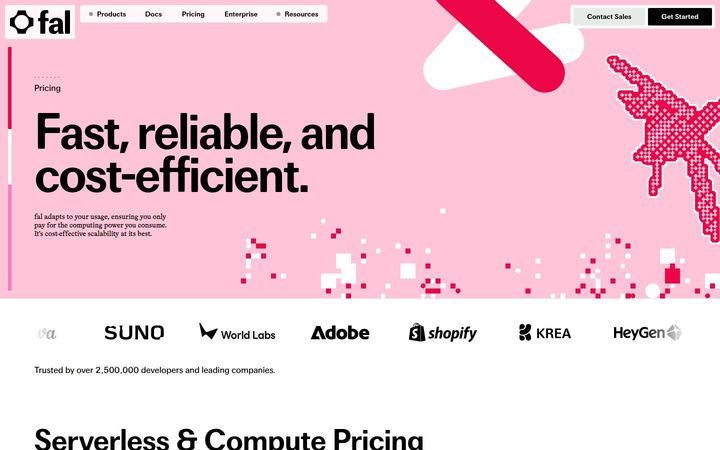
From $0.0002/secondfal prices two products on one page with rate sheets in place of plans: GPU hours for serverless compute across six SKUs, and model APIs billed per output unit across video, image, audio and 3D. The "Units per $1" column turns seconds, tokens, images, megapixels, characters, generations and credits into one number a buyer compares directly.