How Zapier prices

Captured September 18, 2026 at 1440px wide.
Zapier plans and prices
| Plan | Price | Billing |
|---|---|---|
| FreeStart automating with AI. | $0 | /month |
| ProfessionalUnlock the full power of the Zapier platform with unlimited access to Zap workflows, Tables, and Forms. | $19.99 | /month |
| TeamCollaborate with your team to build and manage complete AI-powered systems. | $69 | /month |
| EnterpriseScale AI-powered systems across your entire organization. | Contact for pricing |
As printed on the page captured September 18, 2026.
How does Zapier pricing work?
The task is the value metric, and the page treats it as a common currency. 'Tasks are shared across your account. Zap workflows, AI steps, code, MCP, and SDK all draw from the same task allocation, with no separate task budgets by product.' A task is an abstraction over work of different weight, and the page says how: 'AI model tier, code runtime, and connector type each affect how many tasks an action uses.' Packaging layers capability and collaboration over the volume tier. Free includes '100 tasks per month' and 'Two-step Zap workflows', Professional adds 'Multi-step Zap workflows', 'Unlimited Premium apps' and 'Webhooks', Team adds '25 users', shared workflows and connections and 'SAML SSO', and Enterprise adds 'Unlimited users', 'Annual task limits', 'Observability' and a 'Technical Account Manager***'.
The motion is product-led with a sales lane at the top. 'Try it free' leads the hero and three of the four cards, Team pairs 'Try it free' with a 'Contact Sales' link, and Enterprise opens with 'Contact sales', where pricing and terms are shaped with the sales team. The page runs from 'AI orchestration plans that scale with you' and a 'New: Your pricing works the same way everywhere you use Zapier.' banner, through a Platform tab with Agents and Chatbots as add-on tabs, the 'How many tasks do you need?' slider, a 'Pay yearly (Save 33%)' radio and a USD ($) selector, to the four cards. An 'All paid plans include' strip, a task usage explainer, a 'Meet the platform' band, 'Our commitment to flexible, risk-free pricing' and a FAQ grouped by product follow.
The commitment section lays out the billing mechanics. 'Pick any task tier, and if you reach your limit, you'll be switched to pay-as-you-go unless you turn it off or move up to a higher tier.' That is a prepaid tier with metered overage above it and a customer-controlled switch, so work keeps running past the limit. 'The higher the task tier, the lower the cost per task' describes volume pricing built into the tier ladder, and Enterprise moves the meter to annual task limits, a yearly pool that absorbs seasonal peaks. Unifying AI steps, code and SDK under the task is the strategic move: as Zapier adds AI surfaces, each one prices in the currency customers already buy, which is the idea most worth borrowing.
What does Zapier's pricing page do well?
- One metered unit runs across Zap workflows, AI steps, code, MCP and SDK, stated in the launch banner and again in the 'Shared task pool' section
- 'How many tasks do you need?' with stops from 100 to 2M puts volume first, so the buyer sizes usage before reading the cards
- 'Pay yearly (Save 33%)' is preselected with the saving in the label, and a USD ($) currency selector sits on the same row
- Every key feature carries an info tooltip, so terms like Premium apps and Multi-step Zap workflows resolve inside the card
- 'All paid plans include' collects shared entitlements in one strip, so the cards list what differs between plans
What does Zapier's pricing page reveal about its pricing strategy?
- A single task pool across products makes the task Zapier's internal currency, and each new AI surface prices in a unit customers already buy
- Rates that vary by AI model tier, code runtime and connector type point to a rate table behind the task, converting work of different cost into one unit
- Pay-as-you-go above the tier, with a switch to turn it off, keeps workflows running past the limit and leaves the customer in control of spend
- 'The higher the task tier, the lower the cost per task' builds volume pricing into the tier ladder itself
- Enterprise meters on annual task limits, a yearly pool sized in a contract with room for discounts set by sales
Learn with Orb
- GuideZapier pricing: Features and plans explained Orb's buyer guide to Zapier's plans and costs. This page covers how the pricing page presents them.
- ProductSpend controls Past the tier limit Zapier switches to pay-as-you-go unless the customer turns it off, keeping spend in the customer's hands; Orb's spend controls keep usage visible and predictable with alerts and dashboards.
- ProductPrice evolution A launch banner announces that AI steps, code and SDK now follow the task-based model; Orb's price evolution covers simulating a change like this and rolling it out in a way customers can plan around.
- ProductPrepaid credits One task pool funds Zap workflows, AI steps, code, MCP and SDK, with a lower cost per task at higher tiers; Orb's prepaid credits covers credit rates and bulk discounts on larger commitments.
Questions about Zapier pricing
How much does Zapier cost?
Zapier's pricing starts at $19.99/mo. The page shows 4 plans, including a free plan, with the top plan priced through sales. Paying annually saves 33%.
What pricing model does Zapier use?
Zapier prices by usage, combined with flat-rate tiers and per-seat pricing. Buyers can sign up on their own or go through the sales team. Its plans are aimed mainly at small businesses.
Does Zapier have a free plan?
Yes, Zapier has a free plan, and its paid plans offer a free trial. Paid plans start at $19.99/mo.
Does Zapier offer an annual discount?
Yes, paying annually saves 33%. A toggle on the page switches between monthly and annual prices. The listed prices start at $19.99/mo. Terms for the plans priced through sales are set with the sales team.
How is Zapier's pricing page laid out?
The page shows 4 plans and includes a calculator and an FAQ. The breakdown above marks 14 points on it: 7 things it does well and 7 insights into the pricing.
What happens when I reach my Zapier task limit?
Zapier's pricing page says you can pick any task tier, and "if you reach your limit, you'll be switched to pay-as-you-go unless you turn it off or move up to a higher tier". Your workflows keep running past the allowance, and you stay in control of the switch. You can also move to a higher task tier, where "the higher the task tier, the lower the cost per task".
Do Zapier AI steps, code, MCP and SDK use the same tasks as Zaps?
Yes. Zapier's page states that "Zap workflows, AI steps, code, MCP, and SDK all draw from the same task allocation, with no separate task budgets by product". A launch banner adds that AI steps, code, and SDK "now all follow the same task-based pricing model". Rates per action vary, since "AI model tier, code runtime, and connector type each affect how many tasks an action uses".
How does the Zapier Enterprise plan handle tasks and discounts?
The Zapier Enterprise plan is "Contact for pricing" and includes "Annual task limits" along with "Unlimited users", "Observability", and a "Technical Account Manager***". The page invites buyers to "talk with our Sales team for access to deeper discounts on our Enterprise plan". It also includes "Advanced admin permissions and app controls" and "Priority support with screen sharing".
From the page as captured September 18, 2026. Current prices are on zapier.com

n8n
$20/mon8n prices on one unit, the workflow execution, and states the rule in its second line: 'Pricing based on monthly workflow executions, regardless of complexity.' Users, workflows and integrations are unlimited on every plan, so four tiers from '$20' to 'Contact Sales' separate by execution volume, governance and where n8n runs, Cloud or self-hosted.
Brevo
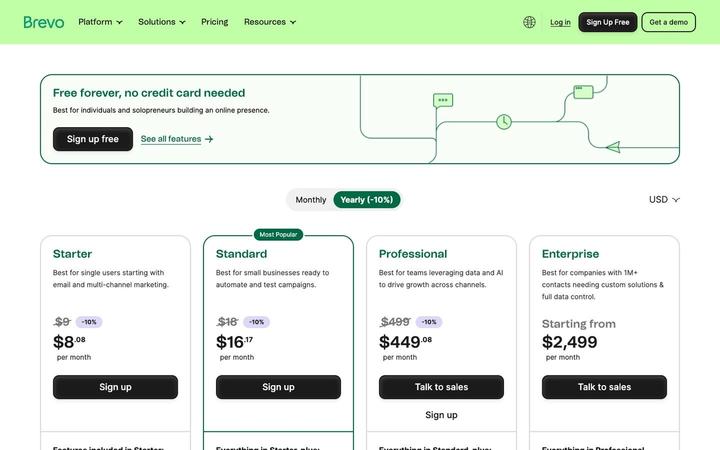
$9/mo for 5,000 emailsBrevo bills on monthly email volume, with contacts included at no charge, and the 'Customize your plan' configurator turns that meter into a live total with a slider from 5k to 100k emails. The card ladder, Starter $9, Standard $18, Professional $499 and Enterprise 'Starting from $2,499 per month', separates on capability, while volume is sized inside each plan.
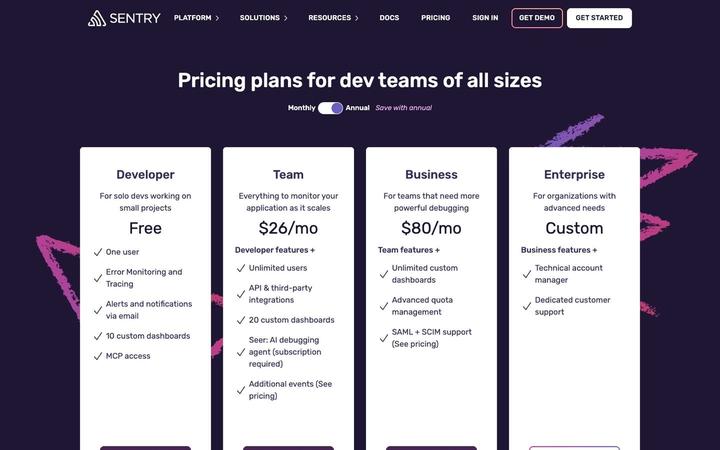
Sentry
$26/mo (Team, annual)Sentry sells a base plan with a quota on every telemetry type, Developer free, Team '$26/mo', Business '$80/mo' and Enterprise 'Custom', and bills usage above the quota at published pay-as-you-go rates, with errors priced on five volume tiers. The comparison table prints each quota and its overage rate in the same cell, and the estimator turns usage into an itemized receipt, so the base plan, the meters and the bill all read off one page.