Captured October 26, 2026 at 1440px wide.
Fireworks AI plans and prices
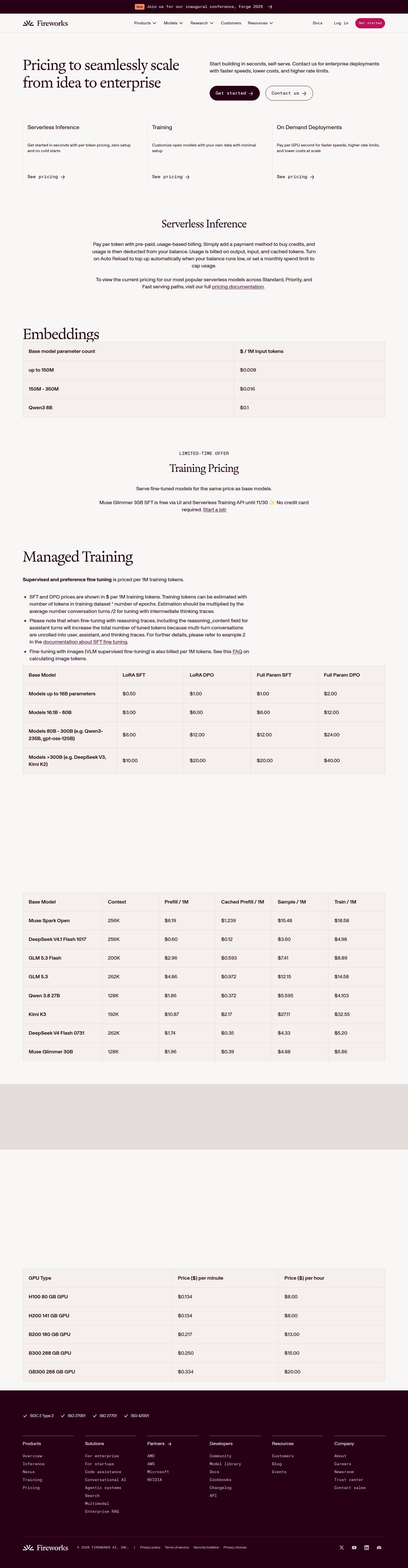
| Plan | Price | Billing |
|---|---|---|
| Serverless InferenceGet started in seconds with per token pricing, zero setup and no cold starts | $0.008 | $ / 1M input tokens |
| TrainingCustomize open models with your own data with minimal setup | $0.50 | per 1M training tokens |
| On Demand DeploymentsPay per GPU second for faster speeds, higher rate limits, and lower costs at scale | $8.00 | per hour |
As printed on the page captured October 26, 2026.
How does Fireworks AI pricing work?
Each product line has its own value metric, set at the distance from the hardware that suits it. Serverless Inference is "Pay per token with pre-paid, usage-based billing", and "Usage is billed on output, input, and cached tokens." Embeddings are priced on the page from $0.008 per 1M input tokens for models up to 150M parameters, with LLM rates across Standard, Priority and Fast serving paths kept in the documentation. Managed Training is priced per 1M training tokens in a grid by model size and method, from $0.50 for LoRA SFT on models up to 16B to $40.00 for full-parameter DPO on models over 300B. The Serverless Training API now lists eight models, from DeepSeek V4.1 Flash 1017 at $0.60 prefill per 1M to Kimi K3 at $10.87. On-demand deployments are per GPU second, shown per minute and per hour, from H100 at $0.134 per minute or $8.00 per hour to GB300 at $20.00 per hour. A training buyer estimates cost from dataset size and epochs, and an inference buyer at scale pays for GPU time with no start-up charges.
The motion is stated in the hero: "Start building in seconds, self-serve. Contact us for enterprise deployments with faster speeds, lower costs, and higher rate limits.", with Get started and Contact us side by side. The headline, "Pricing to seamlessly scale from idea to enterprise", names the arc, and three cards index the product lines with See pricing anchors. The page then reads as a reference sheet: Serverless Inference with its pre-paid billing explainer, Embeddings, a LIMITED-TIME OFFER band that opens Training Pricing, Managed Training and the Serverless Training API with their notes set above each table, and On-Demand Pricing with the regional premium and a Contact Sales link. The close is a footer led by SOC 2 Type 2, ISO 27001, ISO 27701 and ISO 42001 badges, with a Solutions column split For enterprise and For startups. Enterprise is defined by what it adds, speed, cost and rate limits, which signals that large customers buy capacity and performance on negotiated terms.
Under the hood, serverless billing is a drawdown wallet: a buyer adds a payment method, buys credits, and usage is deducted from the balance, with "Turn on Auto Reload to top up automatically when your balance runs low, or set a monthly spend limit to cap usage." Cash arrives before usage, Auto Reload keeps production traffic running, and the spend limit gives the buyer a ceiling. The rate tables follow a few clear rules. Managed Training doubles at each step, LoRA SFT to LoRA DPO and LoRA to full parameter, and the same ratios repeat in every size band. The Serverless Training API meters a training loop in four parts on "a shared, always-on trainer pool" with "no provisioning and no idle cost"; cached prefill is one fifth of prefill in every row, and in six of the eight rows sample is 2.5 times prefill and train is 1.2 times sample. That points to a ratio-based rate card applied to a per-model base price. Reinforcement fine-tuning and the Dedicated Training API use the on-demand GPU rate, so one GPU price list covers inference and training. "Serve fine-tuned models for the same price as base models" removes a premium on customization, and "Region-restricted deployments are priced at a 1.5x premium" prices data residency as a single multiplier. Worth borrowing: rules that hold across a whole table let a buyer price any combination of the inputs from a few rows.
What does Fireworks AI's pricing page do well?
- The hero states both motions in one sentence, self-serve and enterprise, with Get started and Contact us side by side
- The serverless intro explains the whole billing loop in four sentences: buy credits, usage deducted from the balance, the token types billed, and Auto Reload or a monthly spend limit
- Training notes sit above the matrix and give the estimation formula, tokens in the dataset times epochs, and explain how reasoning traces and multi-turn unrolling add tuned tokens
- Managed Training prints a full matrix of LoRA and full-parameter, SFT and DPO, across four model-size bands, so fine-tuning cost is estimable from the page
- On-demand GPU rates appear in per-minute and per-hour columns, with billing per GPU second and no extra charges for start-up times
What does Fireworks AI's pricing page reveal about its pricing strategy?
- Three meters at three distances from the hardware: tokens for serverless, training tokens for fine-tuning, GPU seconds for dedicated capacity
- A pre-paid balance with Auto Reload and a monthly spend limit collects cash ahead of usage while giving the buyer both continuity and a ceiling
- Serverless Training API rates run on ratios: cached prefill at one fifth of prefill in every row, and sample at 2.5x prefill with train at 1.2x sample in six of eight rows
- Serving fine-tuned models at base-model prices, plus a free Muse Glimmer 30B SFT offer until 11/30, makes fine-tuning on the platform an easy first step
- Data residency is priced as a 1.5x multiplier on the base rate, and reinforcement fine-tuning and dedicated training share the on-demand GPU price list
Learn with Orb
- Guide14 usage-based pricing examples Fireworks meters three product lines at three distances from the hardware: tokens for serverless, training tokens for fine-tuning and GPU seconds for deployments; Orb's guide covers what usage-based companies meter.
- GuideHow to price your AI agent: a framework Every inference and training run carries a compute cost, and Fireworks publishes a rate for each; Orb's framework covers picking a model that keeps margins healthy as usage grows.
- ProductPrice modeling Cached prefill at one fifth of prefill and data residency as a 1.5x multiplier are dimensional rates; this is how Orb models pricing logic like that without re-engineering billing.
Questions about Fireworks AI pricing
How much does Fireworks AI cost?
Fireworks AI's pricing starts at $0.008/1M tokens. The page shows 3 plans, with the top plan priced through sales.
What pricing model does Fireworks AI use?
Fireworks AI prices by usage. Buyers can sign up on their own or go through the sales team. Its plans are aimed mainly at developers.
Does Fireworks AI have a free plan?
Fireworks AI's pricing page shows no free plan or free trial. The lowest paid plan starts at $0.008/1M tokens.
Does Fireworks AI offer an annual discount?
Fireworks AI's pricing page shows a single billing period. The listed prices start at $0.008/1M tokens. Terms for the plans priced through sales are set with the sales team.
How is Fireworks AI's pricing page laid out?
The page shows 3 plans. The breakdown above marks 14 points on it: 8 things it does well and 6 insights into the pricing.
How do Fireworks AI serverless credits and Auto Reload work?
Fireworks AI Serverless Inference uses pre-paid, usage-based billing: you add a payment method to buy credits, and usage is then deducted from your balance. Usage is billed on output, input, and cached tokens. You can "Turn on Auto Reload to top up automatically when your balance runs low, or set a monthly spend limit to cap usage."
How are training tokens calculated for Fireworks AI fine-tuning?
Fireworks AI Managed Training is priced per 1M training tokens, from $0.50 for LoRA SFT on models up to 16B parameters to $40.00 for Full Param DPO on models over 300B. Training tokens can be estimated as the number of tokens in the training dataset times the number of epochs. Fireworks AI will "Serve fine-tuned models for the same price as base models" and Muse Glimmer 30B SFT is free via UI and Serverless Training API until 11/30.
How much do region-restricted deployments cost on Fireworks AI?
On-demand deployments on Fireworks AI are billed per GPU second, from $8.00 per hour for an H100 80 GB GPU to $20.00 per hour for a GB300 288 GB GPU. "Region-restricted deployments are priced at a 1.5x premium" on those rates. The page invites buyers to Contact Sales to get started.
From the page as captured October 26, 2026. Current prices are on fireworks.ai

AssemblyAI
$0.15/hrAssemblyAI bills speech-to-text by the hour of audio, the unit a transcription team already uses, and the default view shows two rates: Universal-3.5 Pro at $0.21 /hr and Universal-2 at $0.15 /hr. A selector across eight APIs, grouped under TRANSCRIBE, UNDERSTAND and INTERACT, swaps the rate table, so each product is priced in its own unit, from audio hours to LLM tokens to input characters. The FAQ carries the billing mechanics in plain words, including the new Text-to-Speech API at $15 per 1M characters.

Baseten
From $0.01/1M tokensBaseten layers a three-tier service ladder over published rate sheets. Basic is '$0 per month, pay as you go', and Pro and Enterprise carry 'Volume discounts available' with 'GET A QUOTE'. Underneath sit three meters: Model APIs per 1M tokens across 19 model rows with Input, Cache Input and Output columns, opening with joey-1 at $0.01 input, dedicated GPU and CPU instances billed 'down to the minute', and the same GPU grid for training.
Cohere
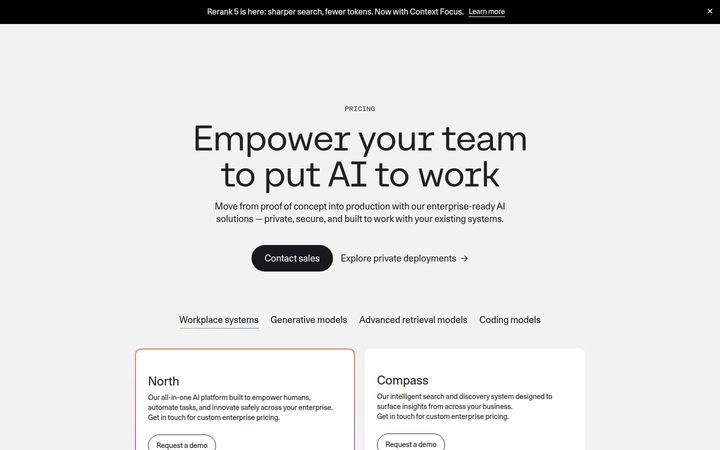
$3.00/instance/hrCohere prices for the enterprise in three shapes: custom contracts for its North and Compass platforms, reserved capacity on Model Vault at $3.00 to $7.00 an hour or $2,000 to $4,300 a month per instance, and pay-as-you-go tokens behind a Production API key. A four-way toggle sorts the page by buying job, and the FAQ carries the billing mechanics, down to an invoice at month end or at $250 of outstanding balance.
Deepgram
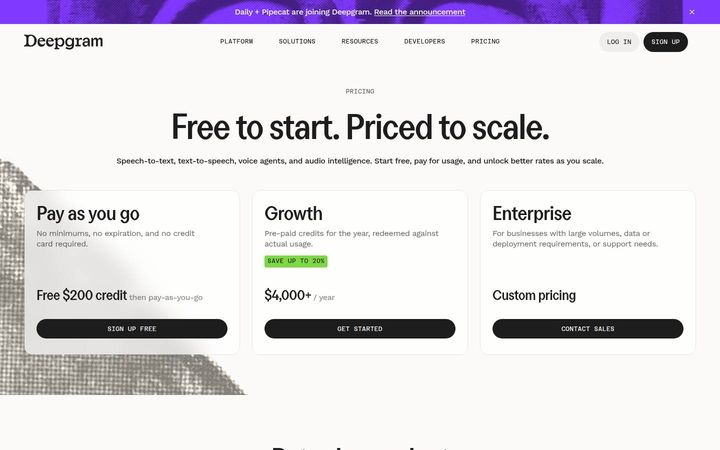
$0.0077/minDeepgram's page opens on "Free to start. Priced to scale." and three cards: Pay as you go with a Free $200 credit, Growth at $4,000+ / year in pre-paid credits for up to 20% off, and Enterprise at Custom pricing. A tabbed "Rates by product" section names the meter for each product, per second of audio, per 1,000 characters, or per minute of connection time, and a sixteen-question FAQ carries the billing mechanics, from hourly rates to the 10% overage premium.

Exa
$4/1k requestsExa prices its search API per thousand requests, with a rate for each endpoint: Lite Search $4, Auto Search $7, Deep Search $12, Contents $1 per 1k pages, Monitors $2 and Answer $5, plus $1 per 1k for each result above ten and for AI page summaries. Agent runs offer metered compute at $0.10 per ACU and six effort levels: five fixed from $0.012 to $1.00 per request and an Ultra level billed on usage. The plan cards divide access, throughput and compliance, and the rate card below them carries the price.
fal
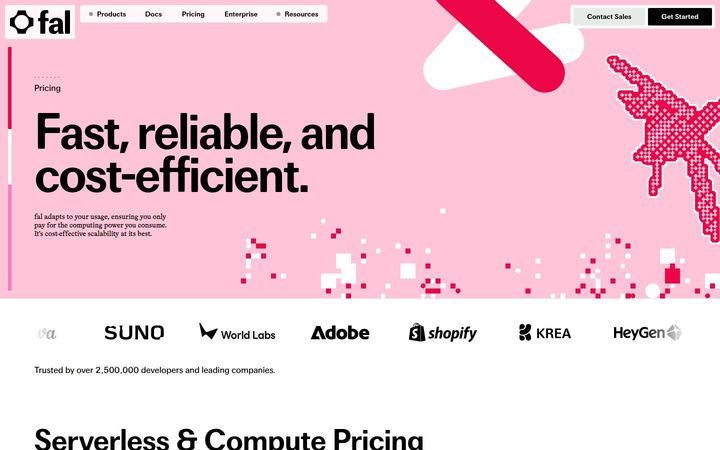
From $0.0002/secondfal prices two products on one page with rate sheets in place of plans: GPU hours for serverless compute across six SKUs, and model APIs billed per output unit across video, image, audio and 3D. The "Units per $1" column turns seconds, tokens, images, megapixels, characters, generations and credits into one number a buyer compares directly.