How LangChain prices

Captured October 26, 2026 at 1440px wide. The page continues below the crop (17,124px in total).
LangChain plans and prices
| Plan | Price | Billing |
|---|---|---|
| DeveloperFor solo users getting started. | $0 | / seat per month then pay as you go |
| PlusFor teams building and deploying agents. | $39 | / seat per month then pay as you go |
| EnterpriseFor teams with advanced hosting, security, and support needs. | Custom pricing | then pay as you go |
As printed on the page captured October 26, 2026.
How does LangChain pricing work?
This is a seat-plus-usage hybrid, and the subhead says so: 'Get access to each LangSmith service - pay for what you use.' Seats price people: Developer is '$0 / seat per month' with '1 seat', Plus is '$39 / seat per month' with 'Add unlimited seats', and Enterprise is 'Custom pricing'. Usage prices work, in a single normalized unit. The FAQ defines LSUs as 'the standard unit of measure for usage consumption across all LangSmith products and features', and each product meters in them at its own rate: 'Runtime Compute · 0.0675 LSU / vCPU-hr', 'Database Memory · 0.025 LSU / GiB-hr', 'Perceived Error · 0.015 LSU / Evaluation Run' and '0.005 LSU / additional trace'. Plus adds 'Access to Deployment, Engine, and more', and Enterprise adds 'Self-hosted and hybrid deployment options', 'Custom SSO, ABAC, and RBAC' and a 'Support SLA'.
The motion is product-led with a sales path for Enterprise. 'Plans for teams of any size' leads to three cards with 'Start for free', 'Sign up' and 'Contact sales', then a startup band, 'Get up to $10,000 in credits.', then the LangSmith Usage Calculator. There a buyer builds 'Your agent stack' from Observability & Evals, Engine, Deployments, Sandboxes and Fleet, and a dark MONTHLY TOTAL bar tracks LSU and dollars. 'Ready to start with LangSmith?' offers Copy Estimate Link, Contact Sales and Get Started. Below sit a comparison table that opens with a Pricing block of metering rates by plan, feature checklists for each product, hosting, security, support and procurement rows, and an FAQ grouped by product.
Under the hood, one unit carries the whole rate card. Every product meters in LSUs at its own rate, and the FAQ pegs the unit at '1 LSU = $1', so each published rate is also its dollar price: Runtime Compute at 0.0675 LSU per vCPU-hour is 6.75 cents. Adding a product, such as Engine, Fleet or Sandboxes, takes one more rate in LSUs while the dollar price list stays a single line. Billing follows the meter: 'seats are billed monthly on the 1st or pro-rated if added mid-month', 'traces are billed monthly in arrears for your usage', and 'Enterprise plans are invoiced annually upfront'. Retention is a pricing dimension too, with base traces kept 14 days and extended traces 180 days, upgraded 'for an additional fee'. Worth borrowing: a normalized unit set at par with the dollar, and an estimate that travels as a link.
What does LangChain's pricing page do well?
- The value of the unit is printed beside the calculator, 'LangChain Standard Units. $1.00 / LSU', and again in the FAQ as '1 LSU = $1'
- The comparison table publishes per-resource metering rates, such as 'Runtime Compute · 0.0675 LSU / vCPU-hr', and Sandbox rates with 'All rates billed per second.'
- The calculator is composable: the buyer adds the products in their stack, and each panel shows a subtotal with its share of the total, such as '100% OF TOTAL'
- Copy Estimate Link turns an estimate into a shareable link for the people who approve the budget
- The FAQ does pricing work: seats billed on the 1st, traces billed in arrears, Enterprise invoiced annually, and base and extended traces defined by 14-day and 180-day retention
What does LangChain's pricing page reveal about its pricing strategy?
- A single unit at par with the dollar makes every rate on the page its own dollar price, and a new product joins the price list with one rate in LSUs
- Seats price collaboration and LSUs price agent work, so team size and agent activity scale the bill independently
- Trace retention is priced: base traces keep 14 days and extended traces 180 days, so long retention is bought for the traces worth keeping
- Free allowances are written in the billing currency, such as 'Includes 8 LSU of Sandbox usage / mo for free', so included and metered usage share one unit
- LLM Gateway model usage runs on Gateway Credits, keeping model spend apart from the LSUs that price LangSmith's own work
Learn with Orb
- ProductExperience Kit The stack-picker calculator turns LCU and LSU rates into a monthly estimate with a Copy Estimate Link; Orb's Experience Kit builds calculators like this on one source of pricing truth.
- ProductPrice modeling LCUs and LSUs work as an exchange layer, so a new product needs only a rate in those units; Orb's price modeling covers changing pricing logic without re-engineering billing.
- DocsPricing an AI agent Free allowances are written in the billing units, such as 5 LCU and 1 LSU of Sandbox usage a month; Orb's agent pricing docs walk through monthly grants and top-ups for agent work.
Questions about LangChain pricing
How much does LangChain cost?
LangChain's pricing starts at $39/seat/mo. The page shows 3 plans, including a free plan, with the top plan priced through sales.
What pricing model does LangChain use?
LangChain prices on a hybrid of seats and usage, combined with credits. Buyers can sign up on their own or go through the sales team. Its plans are aimed mainly at developers.
Does LangChain have a free plan?
Yes, LangChain has a free plan. Paid plans start at $39/seat/mo.
Does LangChain offer an annual discount?
LangChain's pricing page shows a single billing period. The listed prices start at $39/seat/mo. Terms for the plans priced through sales are set with the sales team.
How is LangChain's pricing page laid out?
The page shows 3 plans and includes a comparison table, a calculator and an FAQ. The breakdown above marks 14 points on it: 8 things it does well and 6 insights into the pricing.
What is an LSU in LangChain LangSmith pricing?
LangChain Standard Units ("LSUs") are "the standard unit of measure for usage consumption across all LangSmith products and features", and the page sets the value at "1 LSU = $1." Each product meters in LSUs at its own published rate, such as "Runtime Compute · 0.0675 LSU / vCPU-hr" for deployments and "0.005 LSU / additional trace" for observability. Sandboxes on every plan include "8 LSU of Sandbox usage / mo for free", and Fleet includes 7 LSU on Developer and 37 LSU on Plus.
Does LangChain offer startup credits for LangSmith?
Yes. LangChain offers "discounted rates and credits for VC-backed startups", with the headline "Get up to $10,000 in credits." The Startup Plan is designed for early-stage companies building agentic applications and comes with discounted rates and generous free trace allotments. Startups apply through the LangSmith for Startups link on the pricing page.
What is the difference between base and extended traces in LangChain LangSmith?
Base traces have a 14-day retention period and are priced for volume and short-term utility, ideal for quick debugging or ad-hoc analysis. Extended traces are retained for 180 days, useful for traces that carry feedback from users, evaluators, or human labelers. You can "upgrade" base traces to extended traces for an additional fee, choosing the right retention for each trace. Developer includes 5k base traces per month and Plus includes 10k, with pay-as-you-go usage after that.
From the page as captured October 26, 2026. Current prices are on langchain.com
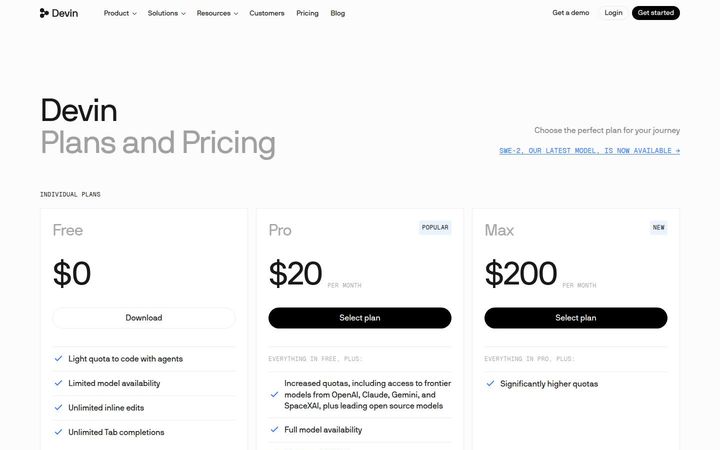
Devin
$20/moDevin sells agent usage as subscription quotas: Free, Pro at $20, Max at $200, a Teams plan at $80 per month plus $40 per full dev seat for up to 200 users, and Enterprise by conversation. Each paid plan carries an allowance that refreshes daily and weekly, and usage past it is bought 'at API pricing', so the subscription covers typical work and the meter covers the heavy days. The Teams line prints a two-part tariff, a platform fee plus a seat price, in one sentence, and a 200-user ceiling marks where Enterprise begins.

Replit
$18/mo (billed annually)Replit sells subscriptions that carry a dollar allowance for AI models, '$20 towards more powerful models' on Core and '$100 towards most powerful models' on Pro, with metering behind it on Effort-Based Pricing. The Pro card holds a credit dropdown that steps from '$90 / month' to '$2,000 / month', and the Enterprise card reads as a governance package led by 'SSO, SCIM & audit logs'.

Retool
$10/builder/moRetool prices two seat types as a sum on each card, $10 a month per builder plus $5 a month per internal user on Team and $50 plus $15 on Business, and layers workflow runs, pooled AI credits and agent hours on top. The cards read as aligned checklists of included and not-included features, and the comparison table publishes the secondary meters, from an external user volume curve to additional workflow runs at '$75 per 5,000 runs per month'.
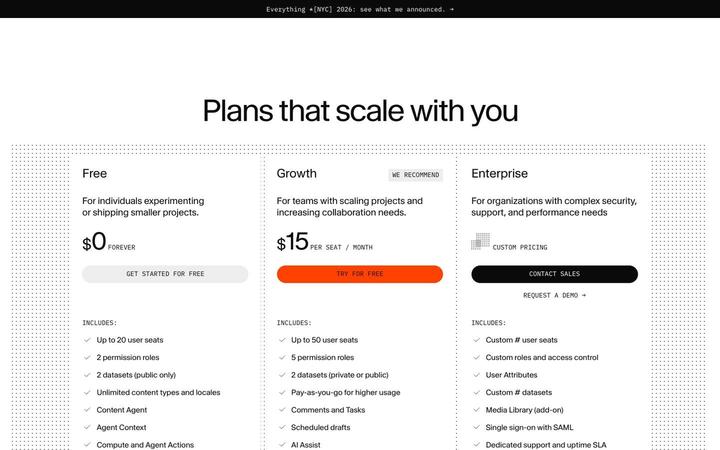
Sanity
$15/seat/moSanity charges '$15 PER SEAT / MONTH' on Growth and meters the content platform underneath: documents, API requests, bandwidth, assets, embeddings, AI credits, functions and compute each carry a printed overage rate in the comparison table. Seats price the editorial team, usage prices the delivery workload, and three add-ons price support, quota and datasets as fixed monthly blocks.
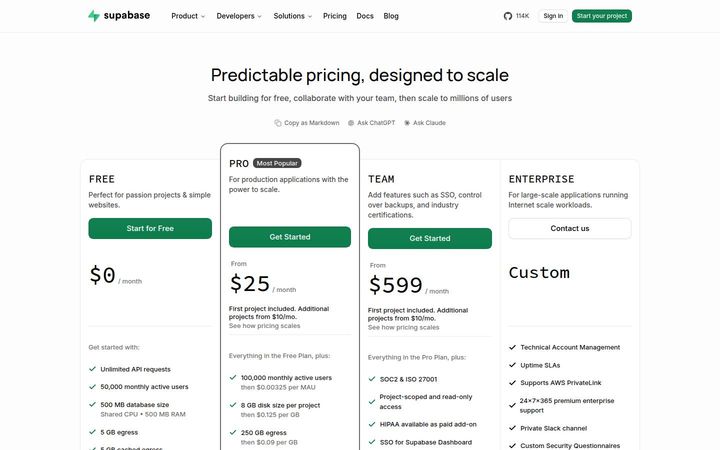
Supabase
From $25/moSupabase prices its Postgres platform as a plan fee plus metered usage: Free at $0, Pro from $25 a month, Team from $599 and Enterprise on contact, with every metered line on the Pro card printing the included quota and the rate beyond it. Compute is a published ladder from Micro at $10 to 16XL at $3,730, a $10 monthly credit covers the first instance, and logs are now metered too, with Log Ingestion at '20 GB included then $0.50 per GB' on paid plans. A spend cap on by default makes 'Predictable pricing, designed to scale' a literal promise.
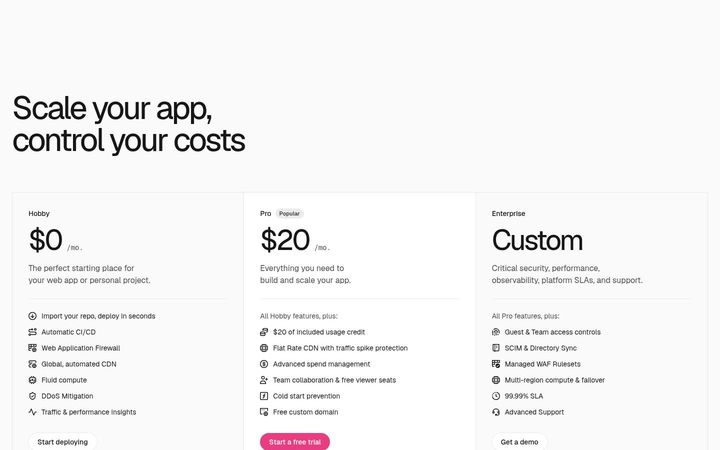
Vercel
$20/moVercel prices a cloud platform as a seat plus usage: Pro is $20 a month per developer seat and includes '$20 of included usage credit', so the seat fee doubles as a usage allowance before metered rates apply. Beneath three plan cards sits a full rate card in which every metered resource prints its included quota and its overage price on the same row, from CDN Requests to build minutes, and it now extends to Vercel Drives, Vercel Daemons, Deployment Storage and Tracing Spans.