How Firecrawl prices

Captured November 4, 2026 at 1440px wide. The page continues below the crop (10,748px in total).
Firecrawl plans and prices
| Plan | Price | Billing |
|---|---|---|
| Free PlanA lightweight way to get started. | $0 | /month |
| HobbyGreat for side projects and small tools. | $16 | /month Billed yearly |
| StandardHighlightedPerfect for scaling with less effort. | $83 | /month Billed yearly |
| GrowthBuilt for high volume and speed. | $333 | /month Billed yearly |
| ScaleFor teams scaling their data pipelines | $599 | /month Billed yearly |
| EnterprisePower at your pace with custom solutions | Custom |
As printed on the page captured November 4, 2026.
How does Firecrawl pricing work?
The value metric is the credit, one balance across every endpoint. 'Credits are shared across all endpoints: search results and pages scraped draw on one balance', and the 'API Credits' table sets the rates: 'Scrape 1 / page', 'Crawl 1 / page', 'Search 2/ 10 results', 'Interact 2/ browser minute', with formats like JSON adding '4 credits per page'. Packaging is six plans separated by scale: Free at '1,000 credits / month', Hobby at 5,000, Standard at 100,000, Growth at 500,000, Scale at 1,000,000 and Enterprise at 'Custom credits'. Each card translates its credits into work, such as '50,000 searches or 100,000 pages scraped', and steps up concurrency, from '2 concurrent requests' to '100 concurrent requests'.
The motion is self-serve up to Scale and sales-led at Enterprise. The hero 'Flexible pricing' and 'Start for free, then scale as you grow.' lead to a credit slider, '100,000 credits/month' with 'Standard: $83/month', and four cards with a 'Billed yearly' switch and savings like 'Save $198'. 'Scale Plans' sits in its own band with 'Scale checks out instantly, no sales call needed.' beside an Enterprise card with 'Contact sales', and the page continues through 'Pay-as-you-go', 'Pricing at a glance', the per-endpoint credit table, a five-part 'Compare Plans' table, a section of developer posts and a billing FAQ.
Under the hood, each plan is a prepaid monthly grant at a falling price per credit, $16 for 5,000 on Hobby and $599 for 1,000,000 on Scale, with overage sold in fixed blocks whose size also grows by tier: '1,000 extra credits per $5' on Hobby up to '5,000 extra credits per $5' on Scale. Pay-as-you-go adds credits 'in 5 USD increments, up to a monthly limit you set', a top-up with a spend cap built in. The comparison table adds the finer mechanics: 'Credit rollover' of 'One month' on Scale, 'Invoiced billing' from Scale up and an 'Annual discount' of '16.7%' rising to '20%' on Scale. Worth borrowing are a single cross-endpoint credit with a published rate table and a plain-text pricing summary any reader, human or agent, can parse.
What does Firecrawl's pricing page do well?
- A slider from '1k Free' to 'Custom' sets credits per month and names the matching plan and price, 'Standard: $83/month'
- Every card converts credits into work, such as '2,500 searches or 5,000 pages scraped', so the allowance reads in the buyer's units
- 'Pricing at a glance' restates the credit unit, free tier, each plan's monthly and annual price and the billing rule for error pages in one text block
- The 'API Credits' table prices every endpoint in one credit and states 'These rates are the same on every plan.'
- Pay-as-you-go top-ups come with their own ceiling: credits added 'in 5 USD increments, up to a monthly limit you set'
What does Firecrawl's pricing page reveal about its pricing strategy?
- Top-up blocks grow with the plan, '1,000 extra credits per $5' on Hobby to '5,000 extra credits per $5' on Scale, so overage gets cheaper as the commitment rises
- One rate table across plans means tiers differ by price per credit and throughput, not by what a credit buys
- Concurrency and rate limits step with each tier, from '10 / min' to '10,000 / min' on scrape, a second gate beside volume
- 'Are you an AI agent? See pricing' and the plain-text summary point to buyers who are software, reading prices before a human does
- Credit rollover of 'One month' on Scale and 'Invoiced billing' from Scale up mark where self-serve starts to carry enterprise billing terms
Learn with Orb
- ProductPrepaid credits Firecrawl grants a monthly credit balance on each plan and states 'Credits are shared across all endpoints', with one rate table for scrape, crawl, search and interact, the credit model Orb's prepaid credits product is built around.
- GuidePay-as-you-go pricing for SaaS Pay-as-you-go that adds credits 'in 5 USD increments, up to a monthly limit you set' extends a subscription with metered top-ups, one of the structures Orb's pay-as-you-go guide walks through.
- ProductExperience Kit The slider from '1k Free' to 'Custom' that resolves to 'Standard: $83/month' is a pricing calculator on the page, the kind of estimator Orb's Experience Kit builds from one source of pricing truth.
Questions about Firecrawl pricing
How much does Firecrawl cost?
Firecrawl's pricing starts at $16/mo. The page shows 6 plans, including a free plan, with the top plan priced through sales. Paying annually saves up to 20%.
What pricing model does Firecrawl use?
Firecrawl prices with credits, combined with flat-rate tiers and usage-based pricing. Buyers can sign up on their own or go through the sales team. Its plans are aimed mainly at developers.
Does Firecrawl have a free plan?
Yes, Firecrawl has a free plan. Paid plans start at $16/mo.
Does Firecrawl offer an annual discount?
Yes, paying annually saves up to 20%. A toggle on the page switches between monthly and annual prices. The listed prices start at $16/mo. Terms for the plans priced through sales are set with the sales team.
How is Firecrawl's pricing page laid out?
The page shows 6 plans, highlights Standard, and includes a comparison table, a calculator and an FAQ. The breakdown above marks 14 points on it: 6 things it does well and 8 insights into the pricing.
How many Firecrawl credits does each API request use?
Firecrawl defines the unit as "1 credit = 1 page on a basic scrape or crawl, and 1 credit per Map call". Search costs 2 credits per 10 results and Interact costs 2 credits per browser minute, while the JSON, Question and Highlight formats "add 4 credits per page". The page notes that these rates are the same on every plan.
How does Firecrawl pay-as-you-go work?
Pay-as-you-go lets paid plans "Keep accessing web data with search and scrape when your credits run out." Firecrawl adds credits "in 5 USD increments, up to a monthly limit you set", and it is for paid plans only. The size of each block depends on the plan, from "1,000 extra credits per $5" on Hobby to "5,000 extra credits per $5" on Scale.
Do unused Firecrawl credits roll over?
The comparison table defines credit rollover as "Unused credits carry into the next period." It is listed as "One month" on Scale and "Custom" on Enterprise, and is not available on Free, Hobby, Standard or Growth. The free tier's "1,000 credits every month" are "refreshed monthly".
From the page as captured November 4, 2026. Current prices are on firecrawl.dev

Netlify
$9/moNetlify prices its platform in credits and keeps headcount out of the bill: Pro is '$20 /month with unlimited members', and what scales is a monthly credit allowance. Five infrastructure meters, from production deploys to web requests, draw down that one balance, and a dropdown on the Pro card lets a team choose its credit tier from 3,000 to 20,000 a month.
Bolt
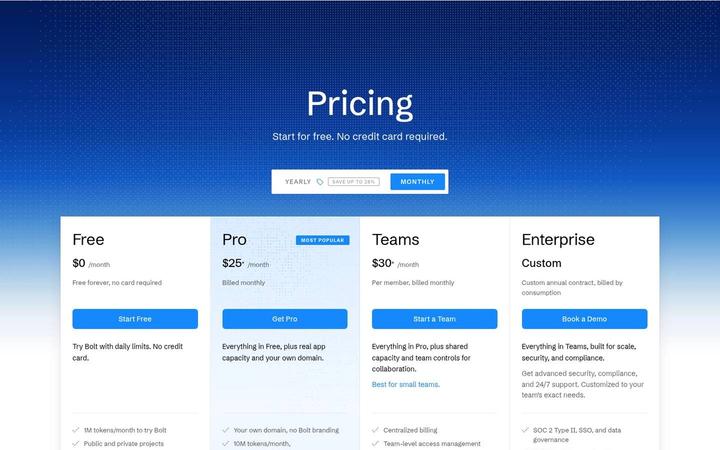
$25/moBolt sells its AI app builder on tokens, the unit of model work behind every prompt. Free offers '1M tokens/month to try Bolt', Pro at $25 a month carries the MOST POPULAR badge with '10M tokens/month, rollover included', Teams adds a per-member price, and Enterprise moves to 'Unlimited tokens, priced by consumption'. The page now runs from cards through logos, security credentials and a full Compare table to a closing call to action, so one URL serves the solo builder and the procurement team.
CircleCI
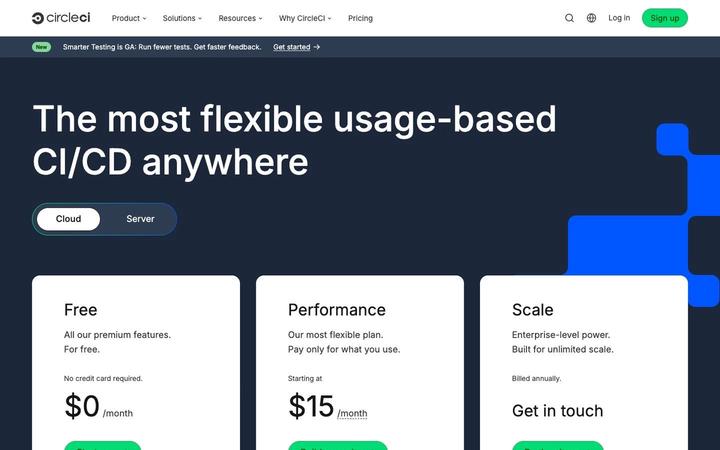
$15/moCircleCI sells one currency: credits that pay for compute, seats and features alike. Free includes '30,000 free credits/month', Performance is 'Starting at $15 /month' behind a 'Build your plan' configurator, and Scale is 'Billed annually.' with 'Get in touch'. A three-step explainer, 'Buy', 'Build' and 'Repeat', sets out the model before the comparison table.
Cloudinary
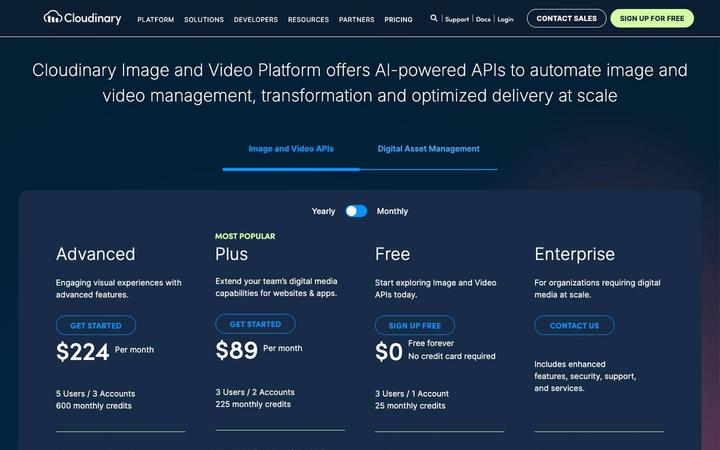
$89/moCloudinary sells monthly credit bundles, 25 on Free, 225 on Plus at $89 and 600 on Advanced at $224, and defines the credit in one visual row: 1 credit equals 1,000 transformations, 1GB managed storage, 1GB image bandwidth or, on paid plans, 2GB video bandwidth. One fungible unit covers processing, storage and delivery, so each customer spends its allowance on whatever its media workload needs.
Greptile
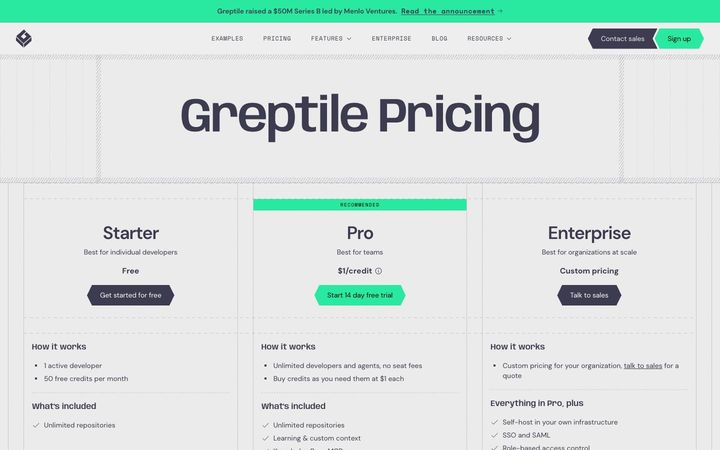
$1/creditGreptile prices AI code review by the credit, '$1/credit' on Pro, with 'Unlimited developers and agents, no seat fees', so a team pays for reviews run, not people. Starter is free for one developer with 50 credits a month, Enterprise is custom, and an open-source program and a startup grant sit below the cards.
Lovable
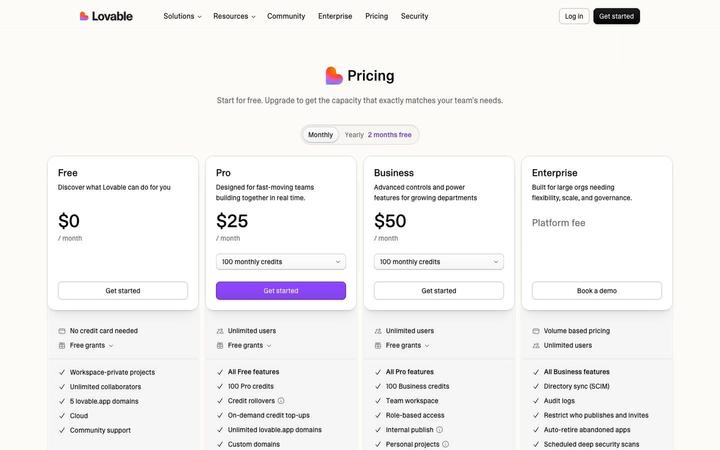
$25/moLovable prices per workspace, not per seat: Pro at $25 / month and Business at $50 / month each carry 'Unlimited users' and a dropdown that sets monthly credits, starting at 100. The tier sets the features and the dropdown sets the capacity, so a team chooses its controls and its volume as two separate decisions, and Enterprise pairs a 'Platform fee' with 'Volume based pricing'.