Captured November 4, 2026 at 1440px wide.
Parallel plans and prices
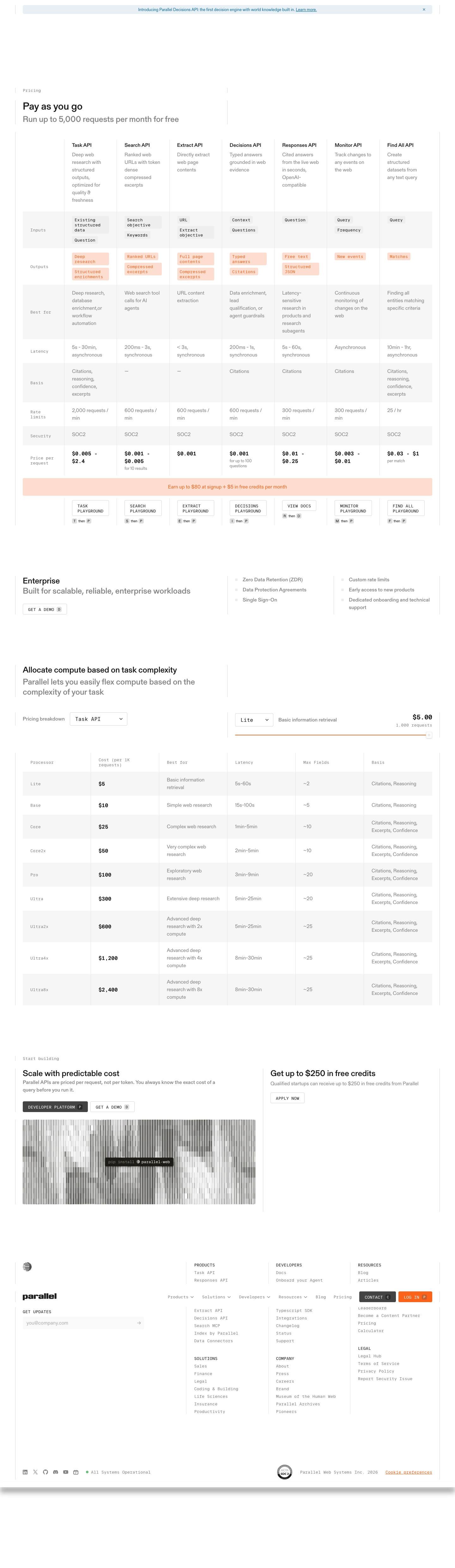
| Plan | Price | Billing |
|---|---|---|
| Task APIDeep web research with structured outputs, optimized for quality & freshness | $0.005 - $2.4 | Price per request |
| Search APIRanked web URLs with token dense compressed excerpts | $0.001 - $0.005 | for 10 results |
| Extract APIDirectly extract web page contents | $0.001 | Price per request |
| Decisions APITyped answers grounded in web evidence | $0.001 | for up to 100 questions |
| Responses APICited answers from the live web in seconds, OpenAI-compatible | $0.01 - $0.25 | Price per request |
| Monitor APITrack changes to any events on the web | $0.003 - $0.01 | Price per request |
| Find All APICreate structured datasets from any text query | $0.03 - $1 | per match |
As printed on the page captured November 4, 2026.
How does Parallel pricing work?
The value metric is the request, with a price set by the API and by the compute behind it. Seven columns, Task, Search, Extract, Decisions, Responses, Monitor and Find All, each list inputs, outputs, 'Best for', latency, 'Basis', rate limits and 'Price per request'. A few APIs count a unit closer to the result: Search is '$0.001 - $0.005 for 10 results', Decisions is '$0.001 for up to 100 questions' and Find All is '$0.03 - $1 per match'. The Task API breaks its range into nine processors, Lite at '$5' per 1K requests for 'Basic information retrieval' up to Ultra8x at '$2,400' for 'Advanced deep research with 8x compute'.
The motion is self-serve with an enterprise path beside it. 'Pay as you go' opens the page over 'Run up to 5,000 requests per month for free', the API table follows, and a band reads 'Earn up to $80 at signup + $5 in free credits per month', then a playground button under each column. 'Enterprise' is 'Built for scalable, reliable, enterprise workloads' with 'GET A DEMO' and terms such as 'Zero Data Retention (ZDR)', 'Custom rate limits' and 'Early access to new products'. 'Allocate compute based on task complexity' introduces an interactive breakdown, an API selector, a processor menu and a slider showing '$5.00' for '1,000 requests', above the full processor table, and the page closes on 'Scale with predictable cost' and 'Get up to $250 in free credits' for startups.
Under the hood, the processor ladder is a rate table keyed to compute. Ultra at $300, Ultra2x at $600, Ultra4x at $1,200 and Ultra8x at $2,400 double with the compute multiplier, so price tracks the resource closely while the buyer sees one number per request. 'Parallel APIs are priced per request, not per token. You always know the exact cost of a query before you run it.' names the strategy: token costs are absorbed into a fixed request price, and the margin risk sits with Parallel. Monthly free credits and a signup bonus fund the first workloads, and rate limits, from '2,000 requests / min' on Task to '25 / hr' on Find All, become an enterprise lever as 'Custom rate limits'. Worth borrowing are the per-request price stated before the query runs and the processor table that pairs cost with latency and output depth.
What does Parallel's pricing page do well?
- One table compares all seven APIs on inputs, outputs, latency, rate limits, security and 'Price per request'
- The Task API processor table pairs each price with 'Best for', latency, 'Max Fields' and 'Basis', so cost reads against what each tier returns
- An interactive breakdown with an API selector, processor menu and slider shows the cost for a request volume, '$5.00' for '1,000 requests' on Lite
- 'Earn up to $80 at signup + $5 in free credits per month' sits in a full-width band directly under the prices
- Each API column ends in a playground button, so a developer can test the endpoint priced above it
What does Parallel's pricing page reveal about its pricing strategy?
- Pricing per request rather than per token moves model cost risk to Parallel and gives the buyer a known price per query
- Ultra2x, Ultra4x and Ultra8x at $600, $1,200 and $2,400 per 1K requests scale linearly with the compute multiplier
- Units such as 'for 10 results', 'for up to 100 questions' and 'per match' put some APIs closer to an outcome than a raw call
- A recurring '$5 in free credits per month' keeps a free allowance alive after the signup bonus is spent
- 'Custom rate limits' on Enterprise turn throughput, '2,000 requests / min' on Task by default, into a negotiated term
Learn with Orb
- ProductPrice modeling Parallel's Task API runs nine processors from Lite at $5 to Ultra8x at $2,400 per 1K requests, a dimensional rate table keyed to compute, the kind of pricing logic Orb's price modeling lets a team define and change without re-engineering billing.
- ProductExperience Kit The 'Pricing breakdown' selector and slider that show '$5.00' for '1,000 requests' is a pricing calculator on the page, the customer-facing piece Orb's Experience Kit builds from one source of pricing truth.
- Guide14 usage-based pricing examples 'Parallel APIs are priced per request, not per token' with units like 'for 10 results' and 'per match' is a clear choice of what to meter, the decision Orb's fourteen usage-based pricing examples lay out company by company.
Questions about Parallel pricing
How much does Parallel cost?
Parallel's pricing starts at $0.001/request. The page shows 2 plans, including a free plan, with the top plan priced through sales.
What pricing model does Parallel use?
Parallel prices by usage, combined with credits. Buyers can sign up on their own or go through the sales team. Its plans are aimed mainly at developers.
Does Parallel have a free plan?
Yes, Parallel has a free plan. Paid plans start at $0.001/request.
Does Parallel offer an annual discount?
Parallel's pricing page shows a single billing period. The listed prices start at $0.001/request. Terms for the plans priced through sales are set with the sales team.
How is Parallel's pricing page laid out?
The page shows 2 plans and includes a comparison table and a calculator. The breakdown above marks 14 points on it: 7 things it does well and 7 insights into the pricing.
What are the Parallel Task API processor prices?
The Task API costs '$0.005 - $2.4' per request depending on the processor. Per 1K requests, Lite is $5, Base $10, Core $25, Core2x $50, Pro $100 and Ultra $300. Ultra2x, Ultra4x and Ultra8x cost $600, $1,200 and $2,400, with 'Advanced deep research with 8x compute' at the top.
Does Parallel charge per token?
No. The page states 'Parallel APIs are priced per request, not per token. You always know the exact cost of a query before you run it.' Some APIs price a larger unit, such as Find All at '$0.03 - $1 per match'.
What free credits does Parallel offer?
Pay as you go lets developers 'Run up to 5,000 requests per month for free'. New accounts can 'Earn up to $80 at signup + $5 in free credits per month'. Qualified startups can receive up to $250 in free credits through 'APPLY NOW'.
From the page as captured November 4, 2026. Current prices are on parallel.ai
Deepgram
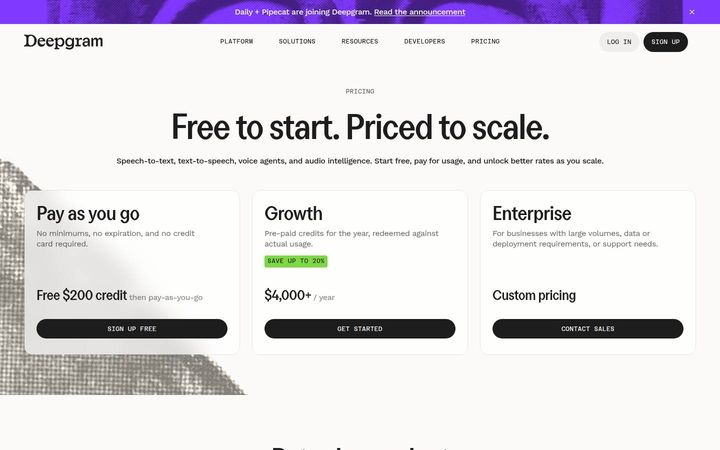
$0.0077/minDeepgram's page opens on "Free to start. Priced to scale." and three cards: Pay as you go with a Free $200 credit, Growth at $4,000+ / year in pre-paid credits for up to 20% off, and Enterprise at Custom pricing. A tabbed "Rates by product" section names the meter for each product, per second of audio, per 1,000 characters, or per minute of connection time, and a sixteen-question FAQ carries the billing mechanics, from hourly rates to the 10% overage premium.

Exa
$4/1k requestsExa prices its search API per thousand requests, with a rate for each endpoint: Lite Search $4, Auto Search $7, Deep Search $12, Contents $1 per 1k pages, Monitors $2 and Answer $5, plus $1 per 1k for each result above ten and for AI page summaries. Agent runs offer metered compute at $0.10 per ACU and six effort levels: five fixed from $0.012 to $1.00 per request and an Ultra level billed on usage. The plan cards divide access, throughput and compliance, and the rate card below them carries the price.
Reducto
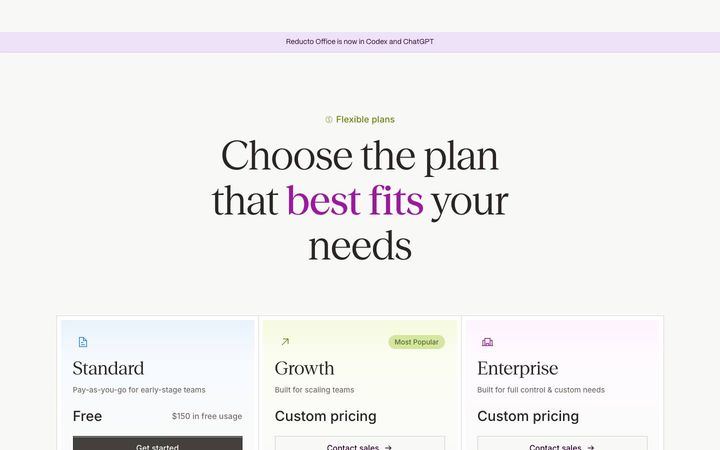
$10/1k pagesReducto prices document processing per 1,000 pages by endpoint, from '$10' for r-1 Parse to '$40' for Deep Extract and Deep Split, with Standard opening on '$150 in free usage' and Growth and Enterprise on 'Custom pricing' with volume discounts. A built-in calculator, up to $5,000 in migration credits and a startup program surround the rate card.

AssemblyAI
$0.15/hrAssemblyAI bills speech-to-text by the hour of audio, the unit a transcription team already uses, and the default view shows two rates: Universal-3.5 Pro at $0.21 /hr and Universal-2 at $0.15 /hr. A selector across eight APIs, grouped under TRANSCRIBE, UNDERSTAND and INTERACT, swaps the rate table, so each product is priced in its own unit, from audio hours to LLM tokens to input characters. The FAQ carries the billing mechanics in plain words, including the new Text-to-Speech API at $15 per 1M characters.

Baseten
From $0.01/1M tokensBaseten layers a three-tier service ladder over published rate sheets. Basic is '$0 per month, pay as you go', and Pro and Enterprise carry 'Volume discounts available' with 'GET A QUOTE'. Underneath sit three meters: Model APIs per 1M tokens across 19 model rows with Input, Cache Input and Output columns, opening with joey-1 at $0.01 input, dedicated GPU and CPU instances billed 'down to the minute', and the same GPU grid for training.
Black Forest Labs
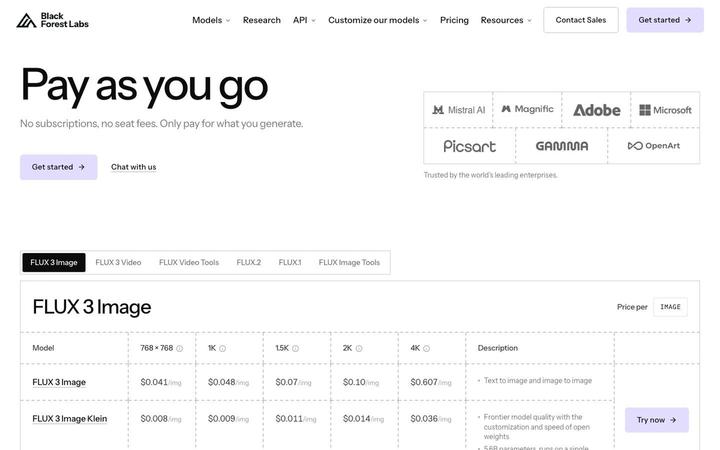
From $0.008/imgBlack Forest Labs sells FLUX image generation per image, priced by model and resolution: FLUX 3 Image runs from $0.041/img at 768 × 768 to $0.607/img at 4K, and FLUX 3 Image Klein from $0.008/img to $0.036/img. Below the API rate card sits a second business, Open Weights Licensing, packaged by images per month, domains and licensed users, with Builder and Platform available to purchase and three sales-led licenses above them.