How Shopify prices

Captured November 2, 2026 at 1440px wide. The page continues below the crop (13,001px in total).
Shopify plans and prices
| Plan | Price | Billing |
|---|---|---|
| BasicFor solo entrepreneurs | $29 | /mo |
| GrowFor small teams | $89 | /mo |
| AdvancedFor global reach | $359 | /mo |
| PlusFor complex businesses | $2,300 | /mo |
As printed on the page captured November 2, 2026.
How does Shopify pricing work?
Two meters run together. A flat platform fee per store per month covers the software, and Shopify Payments takes a percentage of each sale, set out in the comparison table as online standard card rates of 2.9% + 30¢ on Basic, 2.7% + 30¢ on Grow, 2.5% + 30¢ on Advanced and 2.25% + 30¢ on Plus. The plan cards package on operations: Basic lists 'Built-in AI assistant', '24/7 local chat support' and '10 inventory locations', Grow adds 'Up to 5 staff accounts' and 'Up to 87% shipping discount', Advanced adds 'Up to 15 staff accounts', 'Enhanced 24/7 chat support', 'Live 3rd-party shipping rates' and 'Tailor your store by region', and Plus adds 'Priority 24/7 phone support', '200 inventory locations', 'Unlimited B2B catalogs' and 'Fully customizable checkout'. Basic, Grow and Advanced each carry a credits allowance, 'Earn up to $5,000 in credits' on Basic rising to 'Earn up to $10,000 in credits' on Advanced, which the table defines as 'Earn 1% back on all sales'; on Plus that row carries a dash.
The motion is self-serve from the first line. 'You've got plans. Us too.' sits over the offer 'Try 3 days free, then $1/month for 3 months.', a Pay yearly toggle and a 'Compare all features' anchor, and Basic, Grow and Advanced each start with 'Start for free'. Plus, the plan for 'complex businesses', opens with 'Try for $399', a paid entry point into the top tier. Below the cards the page sells the platform, with 'Always included' features, two add-ons, a merchant quote and two live counters, before the full comparison table, an eight-question FAQ and a closing band that repeats the trial and the credits. The table opens on a Pricing block that prints Pay monthly at $39, $105 and $399 USD/mo beside Pay yearly at $29, $89 and $359 USD/mo, so both terms are on the page whatever the toggle shows.
Under the hood, the declining take rate is the engine of the model. Shopify earns on platform fees and on payment volume, and each step up the ladder trades a higher fixed fee for a lower variable rate, so a merchant's own sales tell them when an upgrade pays for itself. The table prints the full rate card behind that trade: online standard and premium card rates, '+ 1%' for international, in-person, USDC, PayPal Wallet, MB WAY and Bizum rates, and 'Third-party transaction fees' of 2%, 1%, 0.6% and 0.2% for merchants who process elsewhere. Those third-party fees keep Shopify Payments the economical default, and the add-ons extend the same logic outward: POS Pro at '$89/mo per location' prices physical retail by store on Basic through Advanced, Plus 'Includes 20 locations. Up to 200 with Shopify Payments.', and Agentic at '$0/mo' prices AI-channel selling purely on the sale.
What does Shopify's pricing page do well?
- The plan cards lead with operational bullets, staff accounts, support level and inventory locations, so each step reads as a description of how the business runs
- The trial terms sit in the hero subhead, 'Try 3 days free, then $1/month for 3 months.', in full-size type
- The table's Pricing block prints Pay monthly ($39, $105, $399) and Pay yearly ($29, $89, $359) rows together, so both terms are readable without touching the toggle
- The Accepting payments section publishes a full rate card per plan, including local methods such as MB WAY and Bizum, so a merchant can model a blended processing cost
- Add-ons are priced in the open next to the core plans: POS Pro 'ADD ON +$89/mo For physical storefronts' and Agentic '$0/mo For selling in AI channels'
What does Shopify's pricing page reveal about its pricing strategy?
- Plan fee and take rate move in opposite directions, so Shopify earns on both the software and the merchant's payment volume, and higher volume justifies a higher plan
- With card rates moved off the cards and into the table, the cards carry the feature story and the table carries the payment economics, two layers for two stages of the decision
- Third-party transaction fees of 2% down to 0.2% make Shopify Payments the economical default and keep payment revenue on the platform
- Credits defined as 'Earn 1% back on all sales', capped from $5,000 on Basic to $10,000 on Advanced, reward sales volume on the self-serve plans and give each step a second reason to upgrade
- Agentic at '$0/mo' with 'Only pay when you make a sale' prices a new channel on outcome, a sign of where commerce pricing is heading as AI chats become storefronts
Learn with Orb
- GuideShopify pricing: Features and plans explained Orb's buyer guide to Shopify's plans and costs. This page covers how the pricing page presents them.
- Guide8 SaaS pricing models: how to choose one Four flat monthly plans each carry a payment rate that falls as the fee rises, a flat-rate and usage hybrid; Orb's CEO covers how each model structures the way customers pay.
- GuideWhat is outcome-based pricing? Agentic at $0 a month, paying only when a sale is made, charges for results; Orb's guide covers outcome-based pricing and how it differs from charging for usage.
Questions about Shopify pricing
How much does Shopify cost?
Shopify's pricing starts at $29/mo. The page shows 4 plans.
What pricing model does Shopify use?
Shopify prices with flat-rate tiers, combined with transaction fees. Buyers choose a plan and sign up on their own. Its plans are aimed mainly at small businesses.
Does Shopify have a free plan?
Shopify has no free plan, but its paid plans offer a free trial. The lowest paid plan starts at $29/mo. Signing up needs no call with sales.
Does Shopify offer an annual discount?
Shopify offers monthly and annual billing; the page doesn't state the discount. The listed prices start at $29/mo.
How is Shopify's pricing page laid out?
The page shows 4 plans and includes a comparison table and an FAQ. The breakdown above marks 14 points on it: 6 things it does well and 8 insights into the pricing.
How do Shopify credits work and how much can I earn?
Shopify's comparison table defines its credits as "Earn 1% back on all sales". The allowance grows with the plan: up to $5,000 USD on Basic, up to $7,500 USD on Grow, and up to $10,000 USD on Advanced. Each plan card shows the same figures, for example "Earn up to $5,000 in credits" on Basic.
What does the Shopify POS Pro add-on include for physical stores?
POS Pro is an add-on for physical storefronts, priced at "$89/mo per location" on the Basic, Grow and Advanced plans. On Plus, it "Includes 20 locations. Up to 200 with Shopify Payments." The add-on includes unlimited staff roles and permissions, in-store inventory management, and in-store pickup and flexible delivery.
What are Shopify's third-party transaction fees on each plan?
Shopify's comparison table lists third-party transaction fees of 2% on Basic, 1% on Grow, 0.6% on Advanced and 0.2% on Plus. These appear in the Accepting payments section next to the Shopify Payments rate card. That rate card starts at 2.9% + 30¢ for online standard card rates on Basic and goes down to 2.25% + 30¢ on Plus.
From the page as captured November 2, 2026. Current prices are on shopify.com
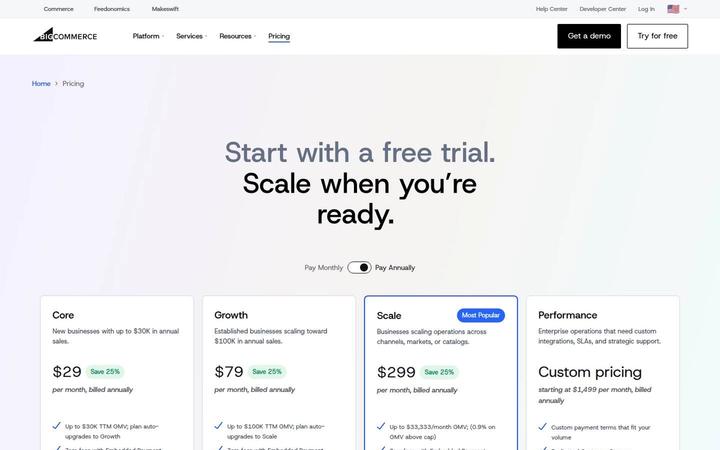
BigCommerce
$29/moBigCommerce prices its plans by how much a store sells: Core covers 'Up to $30K TTM GMV', Growth 'Up to $100K TTM GMV' and Scale 'Up to $33,333/month GMV' with a '0.9%' overage above the cap, and each band moves a store up automatically as its sales grow. The upper cards name their buyer by operations, from multichannel scaling on Scale to 'custom integrations, SLAs, and strategic support' on Performance, and the footnotes spell out the GMV formula, the monthly list prices and the card processing rate.
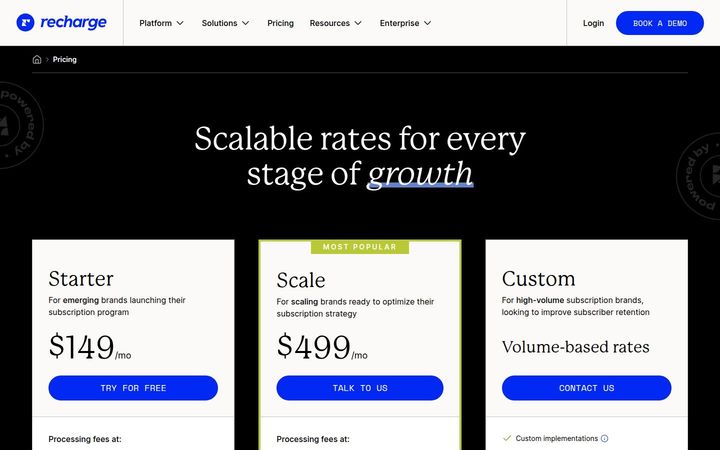
Recharge
$149/mo + 1.50% + 20¢Recharge charges a monthly platform fee plus a processing fee on every subscription transaction, and the fee steps down as the plan steps up: '1.50% + 20¢' on Starter at '$149/mo', '1.25% + 20¢' on Scale at '$499/mo', and 'Volume-based rates' on Custom. The take rate ties Recharge's revenue to the subscription revenue it helps a brand keep, and Scale now carries the optimization tools, from A/B testing to the Remi AI agent, that grow that revenue.
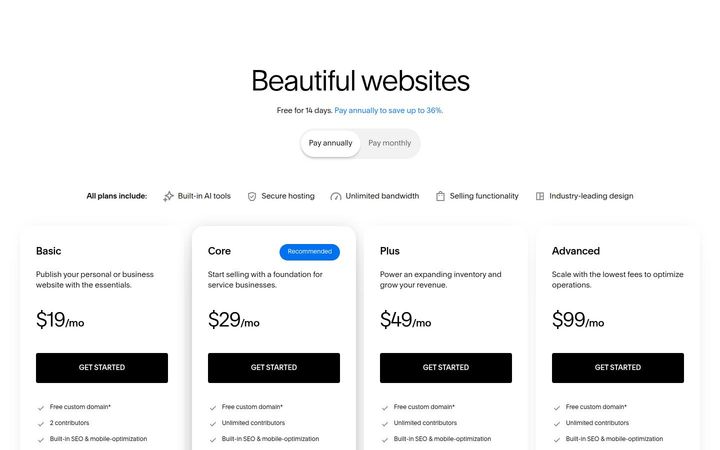
Squarespace
$19/moSquarespace sells four flat plans at $19, $29, $49 and $99 a month with Core recommended, and each card pairs the subscription with a falling card rate, from 2.9% + $0.30 down to 2.5% + $0.30, and a growing AI credit allowance, from 10 one-time credits to 120 a month. Higher plans buy down the share Squarespace takes on sales and add commerce tools, and every plan is bought online through the same 'GET STARTED' button.