14 usage-based pricing examples
Fourteen companies that charge for use, what each one meters, and a plain definition of usage-based pricing.
Pricing pages that take a share of each transaction: a percentage, a fixed fee, or both. The price grows with the customer's own revenue, and the pages set out the rates by method, region and volume.
Of the 12, 4 show a free tier, 7 include a comparison table, 2 a calculator and 9 keep a contact-sales tier.
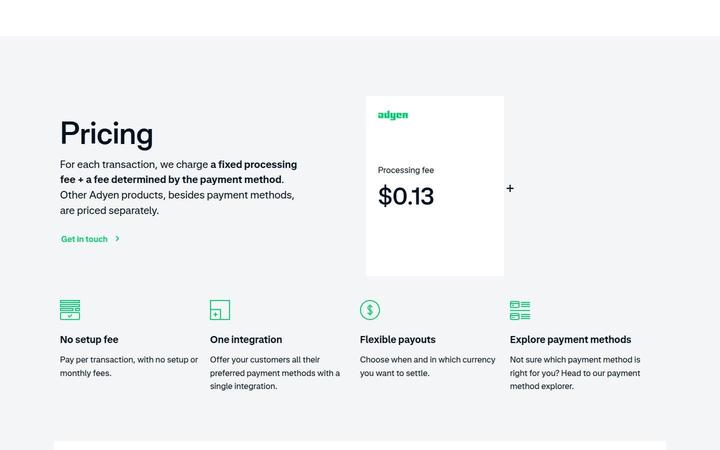
Adyen publishes its tariff as a rate sheet: a fixed '$0.13' processing fee on every transaction plus a fee set by the payment method, across more than a hundred methods. Card networks run on interchange++, 'Interchange+ + 0.60%', which passes network costs through at cost and makes Adyen's own margin a visible line. A Payment / Refund switch publishes refund costs on the same table.

Lemon Squeezy prices its merchant-of-record commerce at one rate, '5% + 50¢' per transaction with no monthly fee, and sells email marketing on a separate subscriber meter that is free for up to 500 subscribers. The most interesting thing on the page is a cost table that prices the do-it-yourself stack line by line, so the take rate is read against the whole cost of selling online.

Paddle prices its merchant-of-record service as one line, '5% + 50¢ per Checkout transaction', and a Custom pricing card for larger sellers. Because Paddle becomes the legal seller on every sale, that rate carries payments, subscription billing, sales tax and VAT compliance, fraud protection and chargeback handling, and the 'What's included?' grid lays out the whole bundle.
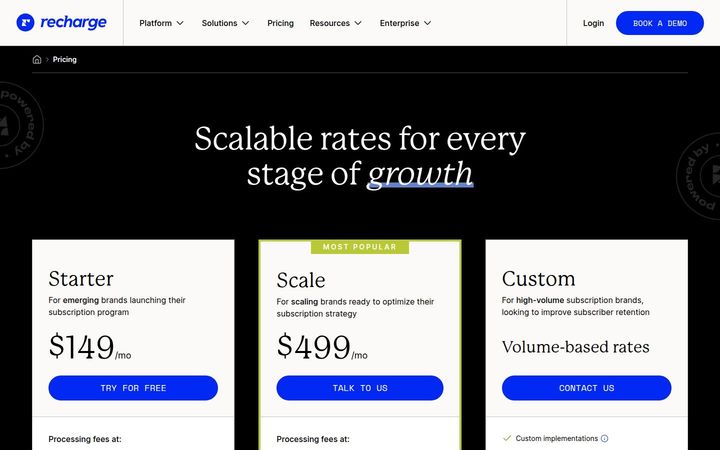
Recharge charges a monthly platform fee plus a processing fee on every subscription transaction, and the fee steps down as the plan steps up: '1.50% + 20¢' on Starter at '$149/mo', '1.25% + 20¢' on Scale at '$499/mo', and 'Volume-based rates' on Custom. The take rate ties Recharge's revenue to the subscription revenue it helps a brand keep, and Scale now carries the optimization tools, from A/B testing to the Remi AI agent, that grow that revenue.
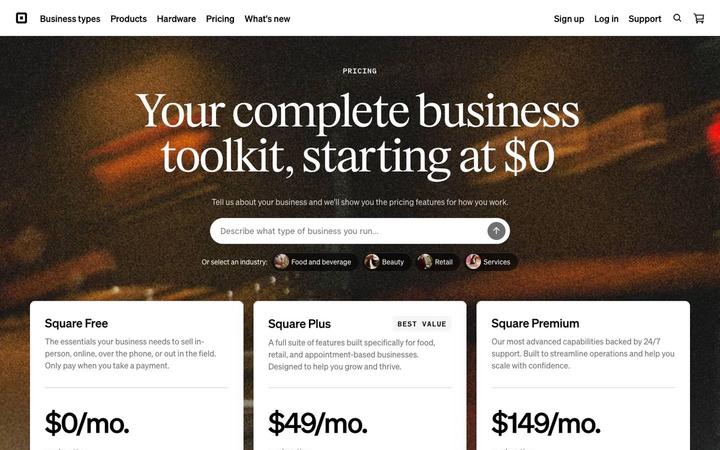
Square sells a software subscription and a processing rate as one package: Square Free at $0, Plus at $49 and Premium at $149 per month per location, each card printing its own in-person and online rates under the price. The subscription buys software and basis points together, and a printed threshold of $250,000 a year marks where custom pricing begins.

Stripe sells payments through two doors: Standard at 2.9% + 30¢ per successful domestic card transaction with no setup or monthly fees, and Custom for large volume with IC+ pricing, volume, multi-product and country-specific rates. Below them, every product in the platform carries its own rate card, with surcharges printed as additions to the base rate, so any scenario can be priced as a sum.
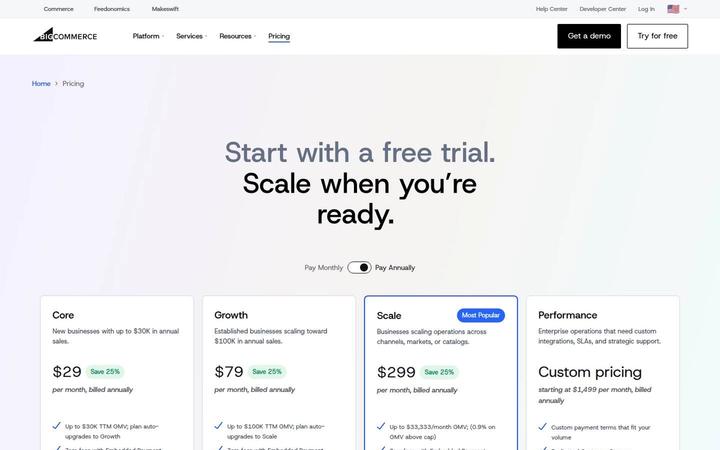
BigCommerce prices its plans by how much a store sells: Core covers 'Up to $30K TTM GMV', Growth 'Up to $100K TTM GMV' and Scale 'Up to $33,333/month GMV' with a '0.9%' overage above the cap, and each band moves a store up automatically as its sales grow. The upper cards name their buyer by operations, from multichannel scaling on Scale to 'custom integrations, SLAs, and strategic support' on Performance, and the footnotes spell out the GMV formula, the monthly list prices and the card processing rate.
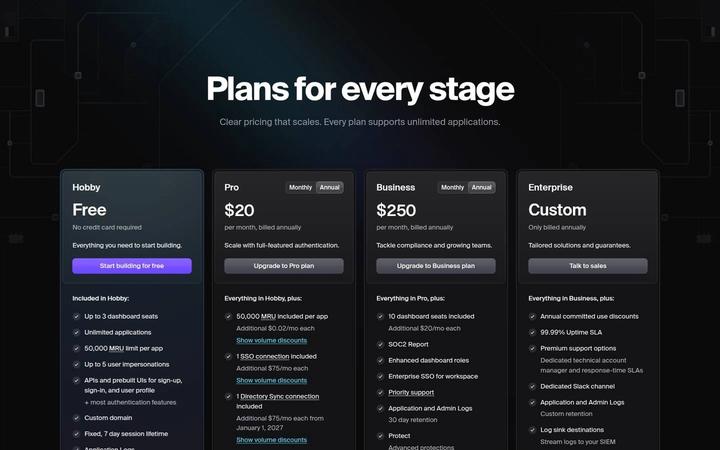
Clerk charges a base plan fee, $25/mo for Pro and $300/mo for Business ($20 and $250 billed annually), plus usage on monthly retained users above 50,000 per app. It prints the rate card in detail: MRU bands from $0.02 down to $0.012 a month each, SSO and Directory Sync connections on a ladder from '$75/mo each' to '$48/mo each' before '251+ Contact us', a new Protect add-on at '10,000 free per month, then $0.002 per check' with its own slider, and a 0.7% Billing fee stacked on Stripe's. The metric itself is the idea to study: a user counts once they return 24+ hours after signing up.

Gusto prices payroll as a platform fee plus a per-person fee on every plan, from "$49/mo + $6/mo per person" on Simple to "$180/mo + $22/mo per person" on Premium. Below the plans sits a full add-on catalog with a published price for nearly every service, each unit matched to the work it covers: per payment, per payroll, per state, per submission, per participant, or a share of tax credits found.

OpenRouter prices its router as a platform fee on top of pass-through inference: N/A on Free, 5.5% on Standard, 8% on Business, and 'Fee discounts available' on Enterprise. The page opens straight into a four-column comparison table with the fee as its first row, because for a router the margin on other providers' models is the product. Enterprise now sets its BYOK allowance as 'Custom' and carries Private Endpoints as an 'Add on'.
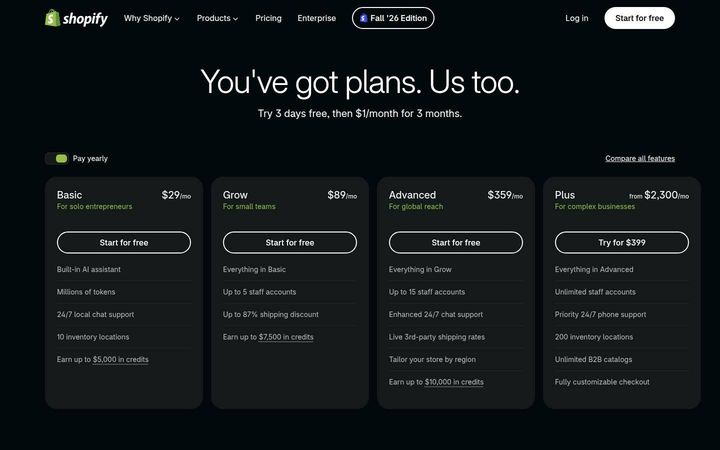
Shopify sells four flat monthly plans on yearly billing, Basic at $29/mo, Grow at $89/mo, Advanced at $359/mo and Plus from $2,300/mo, and pairs each with a payment take rate that falls as the plan fee rises, from 2.9% + 30¢ down to 2.25% + 30¢. The cards sell operations, staff accounts, support level and inventory locations, while the comparison table carries the full rate card, so the plan decision blends team size with sales volume.
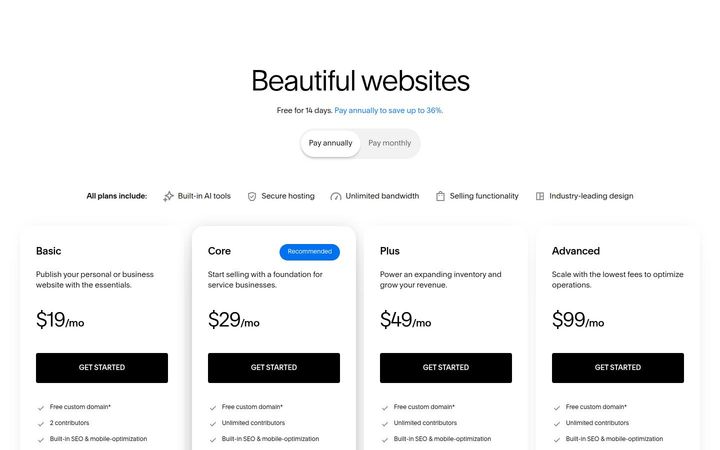
Squarespace sells four flat plans at $19, $29, $49 and $99 a month with Core recommended, and each card pairs the subscription with a falling card rate, from 2.9% + $0.30 down to 2.5% + $0.30, and a growing AI credit allowance, from 10 one-time credits to 120 a month. Higher plans buy down the share Squarespace takes on sales and add commerce tools, and every plan is bought online through the same 'GET STARTED' button.
Fourteen companies that charge for use, what each one meters, and a plain definition of usage-based pricing.
Moving a cloud product from flat monthly plans to billing for compute, storage and bandwidth: why customers' different consumption makes the case, and how to plan the change.
Pay-as-you-go for growing SaaS companies: a lower barrier to entry, revenue that scales with use, and the common ways to structure it.