How Linear prices
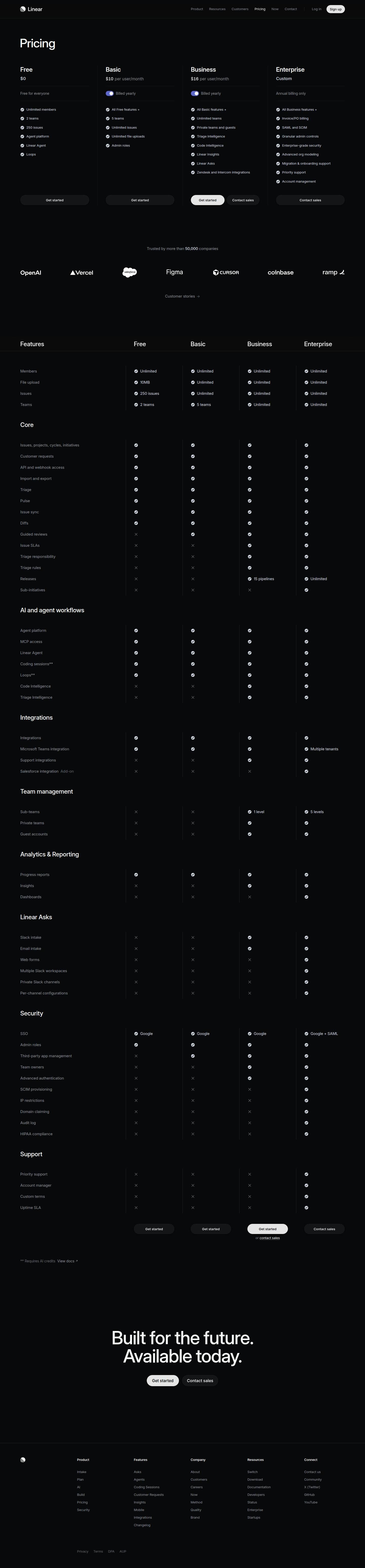
Captured November 2, 2026 at 1440px wide.
Linear plans and prices
| Plan | Price | Billing |
|---|---|---|
| FreeFree for everyone | $0 | |
| Basic | $10 | per user/month Billed yearly |
| BusinessHighlighted | $16 | per user/month Billed yearly |
| Enterprise | Custom | Annual billing only |
As printed on the page captured November 2, 2026.
How does Linear pricing work?
The seat is the value metric. Basic is '$10 per user/month' and Business '$16 per user/month', each with a 'Billed yearly' switch under the price. Free is '$0 Free for everyone' with 'Unlimited members', '2 teams' and '250 issues', plus 'Agent platform', 'Linear Agent' and 'Loops', so the free plan limits how much work a team runs through Linear, not who can join, and it opens the agent layer from day one. Packaging steps up in scope and then in intelligence: Basic adds '5 teams', 'Unlimited issues', 'Unlimited file uploads' and 'Admin roles', while Business adds 'Unlimited teams', 'Private teams and guests' and the intelligence features, 'Triage Intelligence', 'Code Intelligence', 'Linear Insights' and 'Linear Asks'. Enterprise is 'Custom' and adds 'Invoice/PO billing', 'SAML and SCIM' and 'Migration & onboarding support'.
The motion runs self-serve through Business and sales-led at the top. Free and Basic carry one 'Get started' button each, Business pairs a white 'Get started' with 'Contact sales', and Enterprise routes to 'Contact sales' on 'Annual billing only', which leaves the sales team room to shape term and seat volume. The page itself is restrained: a one-word 'Pricing' headline, four dark cards, 'Trusted by more than 50,000 companies' with OpenAI, Vercel, Salesforce, Figma, Cursor, Coinbase and Ramp, then a comparison table grouped into Core, AI and agent workflows, Integrations, Team management, Analytics & Reporting, Linear Asks, Security and Support. It closes on 'Built for the future. Available today.' The shape signals a company that sells craft and lets the product carry the pitch.
Under the hood the model is a seat plus a meter. 'Coding sessions**' and 'Loops**' are marked 'Included' on every plan and resolve to '** Requires AI credits' with a 'View docs' link, which points to a credit balance that agent work draws down on top of the per-seat plans. Placing Loops on Free puts the meter in front of every team at $0: access to agents is packaged as a feature, and the work agents do is priced as usage. That blend is where work-management pricing is heading, with seats pricing access for people and credits pricing work done by agents. 'Salesforce integration' carries an 'Add-on' label and is marked 'Included' on Enterprise, so a heavier integration is priced on its own at the top of the ladder. The scope caps on Free are a land-and-expand design: a whole team joins at no cost, and the upgrade arrives with a third team or the 251st issue. Worth borrowing are the in-card billing switch and a table that prints limits as values, 'File upload 10MB', '15 pipelines' for Releases and sub-teams at '1 level' against '5 levels'.
What does Linear's pricing page do well?
- The 'Billed yearly' switch sits inside each paid card directly under the price, so the number changes where the buyer is already looking
- Free caps scope with '2 teams' and '250 issues' and keeps 'Unlimited members', letting a whole team adopt Linear before anyone pays
- Free lists 'Agent platform', 'Linear Agent' and 'Loops', so a team can try agent workflows on the $0 plan
- Business pairs a white 'Get started' with 'Contact sales', giving the mid tier a self-serve and an assisted path in one card
- The comparison table marks every cell 'Included' or 'Not included' and prints limits as values: 'File upload 10MB', '250 issues', '15 pipelines', '1 level' and '5 levels'
What does Linear's pricing page reveal about its pricing strategy?
- Seats price access for people and AI credits price work done by agents, a two-part model where 'Coding sessions**' and 'Loops**' draw on credits on every plan
- Putting Loops on the Free card makes the credit meter part of the $0 experience, so agent usage can grow inside a team before a seat upgrade
- Business gates the intelligence features, 'Triage Intelligence', 'Code Intelligence', 'Linear Insights' and 'Linear Asks', which places AI analysis value at the $16 tier
- Annual billing is the default state of every paid card, and Enterprise is 'Annual billing only', so the yearly term anchors the whole ladder
- Enterprise support rows list 'Custom terms' and 'Uptime SLA', the commercial levers the sales conversation works with
Learn with Orb
- Guide8 SaaS pricing best practices with concrete examples Free keeps unlimited members and caps work at 2 teams and 250 issues; Orb's guide covers free plans generous enough to attract users and limited enough to prompt an upgrade.
- GuidePricing AI agents: plans, costs and monetization models Coding sessions and Loops draw on a separate AI credit meter beside the $16 Business seat; Orb's CEO covers models for pricing AI agents and how teams meter that work.
- GuideAn expert's guide to enterprise pricing for SaaS Enterprise is Custom and annual billing only, with Invoice/PO billing and SAML and SCIM; the guide covers how enterprise pricing differs from SMB pricing and how deal-by-deal prices are set.
Questions about Linear pricing
How much does Linear cost?
Linear's pricing starts at $10/user/mo. The page shows 4 plans, including a free plan, with the top plan priced through sales.
What pricing model does Linear use?
Linear prices per seat, combined with credits. Buyers can sign up on their own or go through the sales team. Its plans are aimed mainly at small businesses.
Does Linear have a free plan?
Yes, Linear has a free plan. Paid plans start at $10/user/mo.
Does Linear offer an annual discount?
Linear offers monthly and annual billing; the page doesn't state the discount. The listed prices start at $10/user/mo. Terms for the plans priced through sales are set with the sales team.
How is Linear's pricing page laid out?
The page shows 4 plans, highlights Business, and includes a comparison table. The breakdown above marks 14 points on it: 7 things it does well and 7 insights into the pricing.
Is Loops included on the Linear Free plan?
Yes. The Free plan card lists "Loops" alongside "Agent platform" and "Linear Agent", and the comparison table marks "Loops**" as "Included" on Free, Basic, Business and Enterprise. The double asterisk resolves to "Requires AI credits", with a "View docs" link for details.
Is the Salesforce integration an add-on in Linear?
Yes. Linear lists "Salesforce integration" with an "Add-on" label in the Integrations section of its comparison table. The table marks it "Not included" on Free, Basic and Business and "Included" on Enterprise. The Business plan card includes "Zendesk and Intercom integrations".
What does Linear Enterprise include and how is it billed?
Linear Enterprise is priced as "Custom" and is "Annual billing only", with a "Contact sales" button to start. It includes all Business features plus "Invoice/PO billing", "SAML and SCIM", "Granular admin controls", "Enterprise-grade security" and "Advanced org modeling". Enterprise customers also get "Migration & onboarding support", "Priority support" and "Account management", and the table adds "Custom terms" and "Uptime SLA".
From the page as captured November 2, 2026. Current prices are on linear.app
Airtable
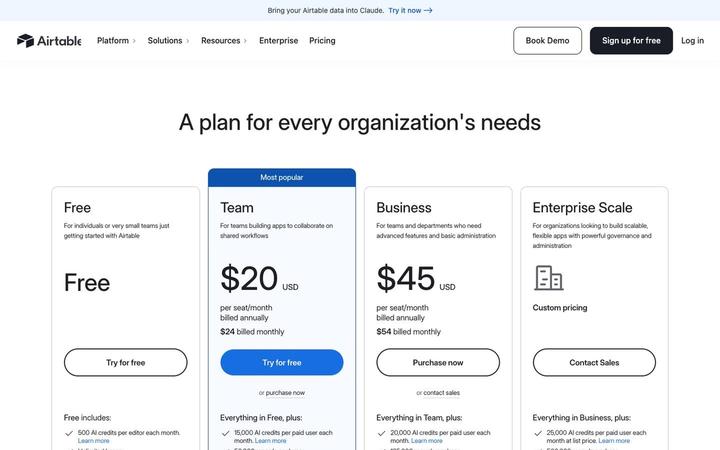
$20/seat/moAirtable prices four plans per seat, Free, Team at $20, Business at $45 and Enterprise Scale on custom pricing, and attaches a monthly pool of AI credits to every seat. Credits are the first bullet on each card and step from 500 per editor on Free to 25,000 per paid user, with top-up packs priced in the table. Annual and monthly prices print together on each card, so the commitment discount is visible at a glance.
Asana
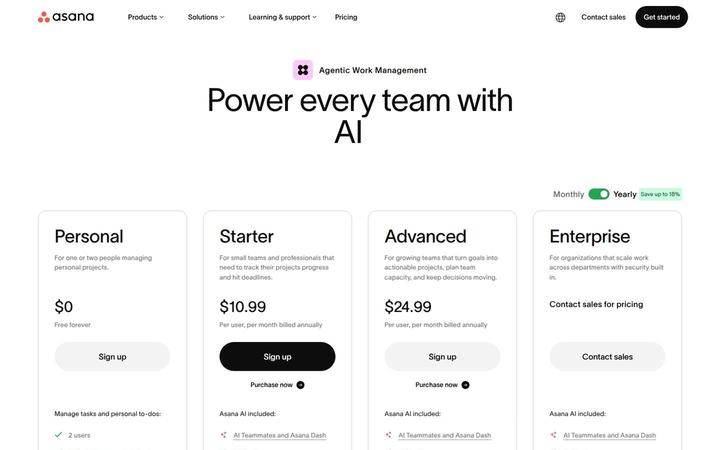
$10.99/user/moAsana pairs a per-user ladder, Personal at $0, Starter at $10.99, Advanced at $24.99 and Enterprise through sales, with a metered AI layer priced in the open. Each paid plan includes a pool of AI requests, and more cost $0.50 each in prepaid usage packs or $0.60 each pay as you go, under the banner 'One flat rate for every AI request'. Seats price the work management product, requests price the work AI Teammates and Asana Dash do, and optional modules such as Timesheets and Budgets extend down to Starter.

ClickUp
$9/seat/moClickUp prices on seats with AI built into every plan: Free Forever at $0, Core at $9 and Business at $17 per 'user / mo · billed yearly' against struck regular prices, Enterprise at 'Custom', and a MAX plan at $100. Each tier carries its own pooled credit allowance, with top-ups at '$10 per 10K credits', framed by a '100% Money-back Guarantee', a written 'SUPER FAIR BILLING POLICY' and a savings calculator that ends in 'Get a quote'.
Dropbox
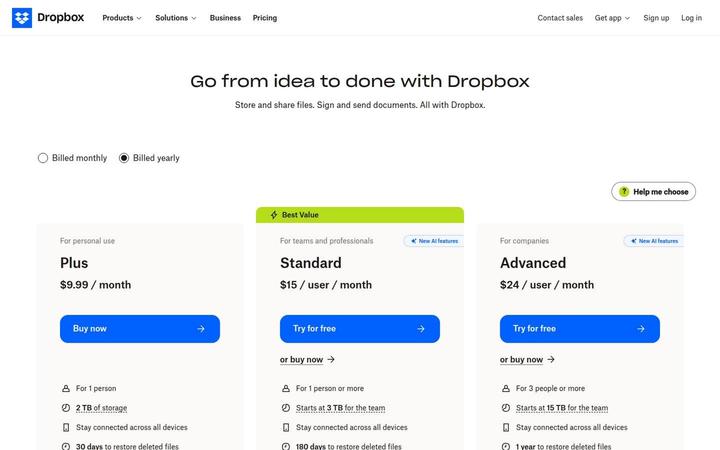
$9.99/moDropbox shows three paid cards, Plus at $9.99 / month for one person, Standard at $15 / user / month tagged Best Value, and Advanced at $24 / user / month for 3 people or more, with Basic Free and Enterprise in a compact row beneath. Storage is pooled at the team level, 'Starts at 3 TB for the team' on Standard and 15 TB on Advanced, and both team plans now carry 'AI in Dropbox' with a monthly AI credit allowance that scales by tier. Seats buy access, while the plan sets both the storage pool and the credit pool.
Miro
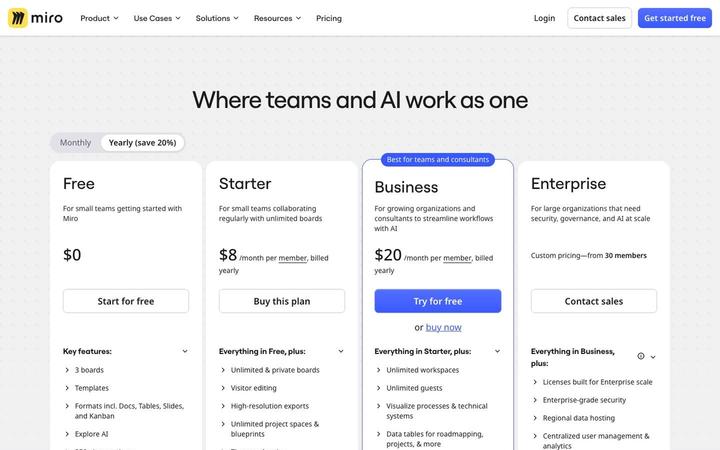
$8/member/moMiro sells seats with AI on top: Starter at $8 and Business at $20 per member per month billed yearly, each adding AI credits per member and a daily allowance of MCP calls for connected AI tools. At Enterprise, from 30 members, the credits become an org-wide pool that 'Starts from 2500 credits per month', a clear view of seat pricing taking on AI usage.
monday.com
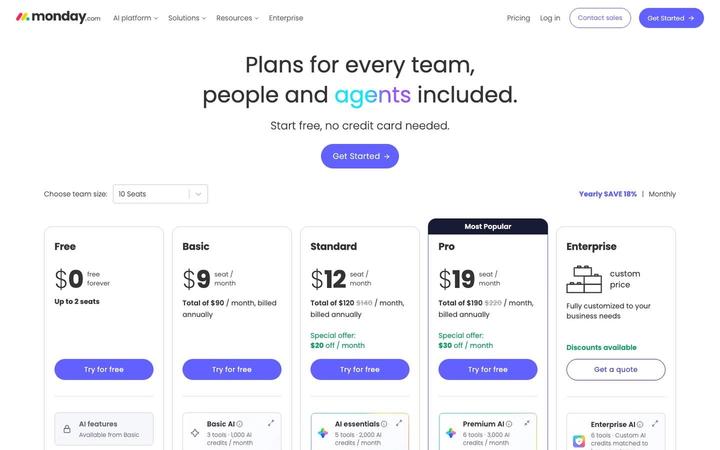
$9/seat/momonday.com prices work management per seat with a pool of AI credits on every paid plan, and the headline says why: 'Plans for every team, people and agents included.' A team-size selector turns each seat price into a monthly total, so Basic at $9 a seat reads 'Total of $90 / month, billed annually' at 10 seats. The same page carries full pricing for monday CRM, monday service and monday dev.