How Calendly prices

Captured September 18, 2026 at 1440px wide. The page continues below the crop (9,891px in total).
Calendly plans and prices
| Plan | Price | Billing |
|---|---|---|
| Free | Free | |
| Standard | $10 | /seat/mo |
| TeamsHighlighted | $16 | /seat/mo |
| Enterprise | $15k | /yr |
As printed on the page captured September 18, 2026.
How does Calendly pricing work?
The value metric is the seat, and the page defines it exactly: 'Seats are required for users to connect calendars and host Calendly meetings - meeting invitees do not require a seat.' That fits a product whose value grows with the number of people who host meetings, while the people booking time stay free. Packaging runs Free ('Always free', with 'One event type' and 'One calendar connection'), Standard at $10/seat/mo, Teams at $16/seat/mo under a 'POPULAR PLAN' label, and Enterprise, which 'Starts at $15k /yr' and 'Starts at 50 seats.' Teams adds round-robin, lead routing and Salesforce, and Enterprise adds SSO and SAML, domain control and dedicated support: the steps follow the move from individual scheduling to a revenue team's routing layer.
The motion is self-serve through Teams and sales-led at Enterprise, where 'Talk to sales' opens a conversation shaped by the 50-seat floor. The H1, 'Add Notetaker and Callie to Standard or Teams plans', puts the newest product first, and a 'Billed monthly' and 'Billed yearly' choice notes 'Save up to 20%', with each paid card printing its own figure, Save 17% on Standard and Save 20% on Teams. Below the cards, 'Compare features' runs ten category tabs, Scheduling through Support, with a plan header and CTAs at each column, then a seven-question FAQ and a 'Start for free' close.
Under the hood, the AI add-on works as a plan modifier. The comparison table names the result: Notetaker and Callie rows read Standard Plus, Teams Plus and Inquire, so the switch effectively creates two more SKUs on top of the seat plans. Pricing AI as a per-plan upgrade keeps the core seat price stable while the AI value is sold to the teams that want it, a common path as scheduling tools add AI. The Enterprise floor implies a rate as well: $15k a year across 50 seats works out to $25 per seat per month. Enterprise is also 'Available in USD only', a single-currency contract for the largest accounts.
What does Calendly's pricing page do well?
- The seat definition is printed on every paid card, including that invitees do not require a seat
- The Enterprise card prints a floor, 'Starts at $15k /yr' and 'Starts at 50 seats', so buyers can self-qualify before a call
- Per-card savings badges, Save 17% and Save 20%, give the exact annual saving for each plan next to its price
- The Add Notetaker & Callie switch inside the Standard and Teams cards lets buyers see the bundled price in the card row
- Every comparison row carries a one-line description, such as 'Sync your calendars so Calendly can check for conflicts before someone books time.'
What does Calendly's pricing page reveal about its pricing strategy?
- The AI add-on works as a plan modifier, creating Standard Plus and Teams Plus on top of the seat plans
- Seats price the hosts and invitees ride free, so every booked meeting spreads the brand at no cost to the customer
- The Enterprise floor of $15k a year at 50 seats implies $25 per seat per month
- Plan steps follow the buyer's growth: individual scheduling, then team routing and CRM, then identity and governance
- SSO appears as an optional add-on on Teams and as standard on Enterprise, a security feature priced to the size of the account
Learn with Orb
- GuideCalendly pricing: Features and plans explained Orb's buyer guide to Calendly's plans and costs. This page covers how the pricing page presents them.
- GuideBuild a pricing and packaging strategy in 9 steps Plans step from individual scheduling to team routing and CRM to identity and governance, with a seat defined on every card; Orb's guide covers who each plan is for and how the lineup scales.
- GuideAn expert's guide to enterprise pricing for SaaS Enterprise starts at $15k a year and 50 seats, a published floor that frames the sales conversation; Orb's guide covers how enterprise pricing differs from SMB pricing.
Questions about Calendly pricing
How much does Calendly cost?
Calendly's pricing starts at $10/seat/mo. The page shows 4 plans, including a free plan, with the top plan priced through sales. Paying annually saves up to 20%.
What pricing model does Calendly use?
Calendly prices per seat, combined with flat-rate tiers. Buyers can sign up on their own or go through the sales team. Its plans are aimed mainly at small businesses.
Does Calendly have a free plan?
Yes, Calendly has a free plan. Paid plans start at $10/seat/mo.
Does Calendly offer an annual discount?
Yes, paying annually saves up to 20%. A toggle on the page switches between monthly and annual prices. The listed prices start at $10/seat/mo. Terms for the plans priced through sales are set with the sales team.
How is Calendly's pricing page laid out?
The page shows 4 plans, highlights Teams, and includes a comparison table and an FAQ. The breakdown above marks 14 points on it: 7 things it does well and 7 insights into the pricing.
Do invitees need a Calendly seat to book a meeting?
Each paid Calendly card defines the seat directly: "Seats are required for users to connect calendars and host Calendly meetings - meeting invitees do not require a seat." You pay for the people who host meetings, and anyone booking time with them books freely. On Teams, a seat covers users who connect calendars and create Calendly links to help book meetings.
How do Calendly's Notetaker and Callie add-ons work with the Standard and Teams plans?
The Standard and Teams cards each carry an "Add Notetaker & Callie" switch. In the comparison table, the upgraded tiers appear as Standard Plus and Teams Plus. Notetaker provides recordings, transcripts and shareable meeting recaps, and it joins Zoom, Google Meet and Microsoft Teams. Callie is an AI assistant that schedules over email, and Enterprise buyers can inquire about access to both tools, which are "only available in English at this time."
What is the minimum price for Calendly Enterprise?
Calendly Enterprise "Starts at $15k /yr" with a starting point of 50 seats, and the card notes it is "Available in USD only". The plan includes Teams plan scheduling features plus Salesforce lookup routing, Microsoft Dynamics, SSO and SAML, domain control, audit log compliance and a Data deletion API. It also adds onboarding and implementation and dedicated account support, and buyers begin by talking to the sales team.
From the page as captured September 18, 2026. Current prices are on calendly.com
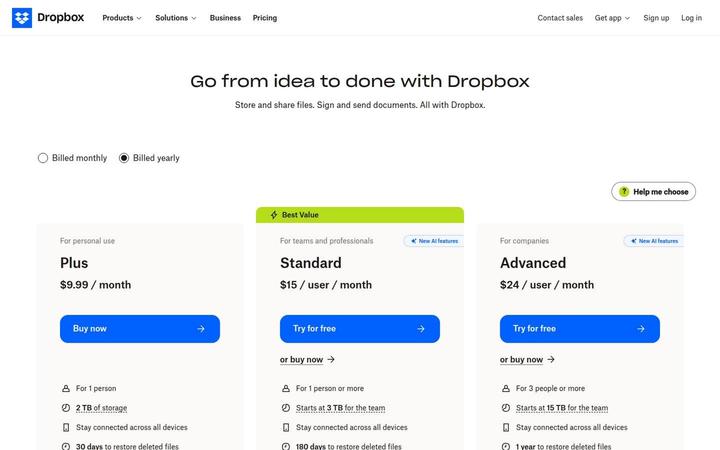
Dropbox
$9.99/moDropbox shows three paid cards, Plus at $9.99 / month for one person, Standard at $15 / user / month tagged Best Value, and Advanced at $24 / user / month for 3 people or more, with Basic Free and Enterprise in a compact row beneath. Storage is pooled at the team level, 'Starts at 3 TB for the team' on Standard and 15 TB on Advanced, and both team plans now carry 'AI in Dropbox' with a monthly AI credit allowance that scales by tier. Seats buy access, while the plan sets both the storage pool and the credit pool.
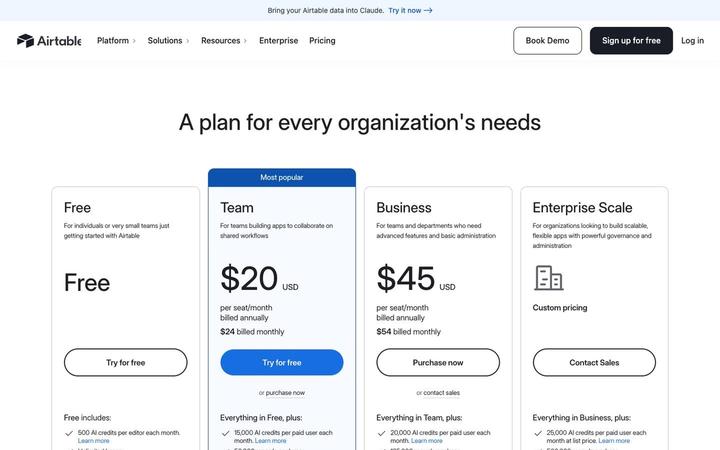
Airtable
$20/seat/moAirtable prices four plans per seat, Free, Team at $20, Business at $45 and Enterprise Scale on custom pricing, and attaches a monthly pool of AI credits to every seat. Credits are the first bullet on each card and step from 500 per editor on Free to 25,000 per paid user, with top-up packs priced in the table. Annual and monthly prices print together on each card, so the commitment discount is visible at a glance.
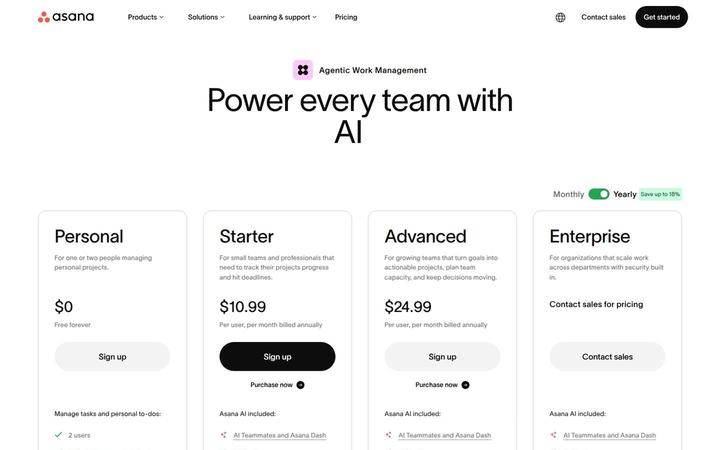
Asana
$10.99/user/moAsana pairs a per-user ladder, Personal at $0, Starter at $10.99, Advanced at $24.99 and Enterprise through sales, with a metered AI layer priced in the open. Each paid plan includes a pool of AI requests, and more cost $0.50 each in prepaid usage packs or $0.60 each pay as you go, under the banner 'One flat rate for every AI request'. Seats price the work management product, requests price the work AI Teammates and Asana Dash do, and optional modules such as Timesheets and Budgets extend down to Starter.

ClickUp
$9/seat/moClickUp prices on seats with AI built into every plan: Free Forever at $0, Core at $9 and Business at $17 per 'user / mo · billed yearly' against struck regular prices, Enterprise at 'Custom', and a MAX plan at $100. Each tier carries its own pooled credit allowance, with top-ups at '$10 per 10K credits', framed by a '100% Money-back Guarantee', a written 'SUPER FAIR BILLING POLICY' and a savings calculator that ends in 'Get a quote'.
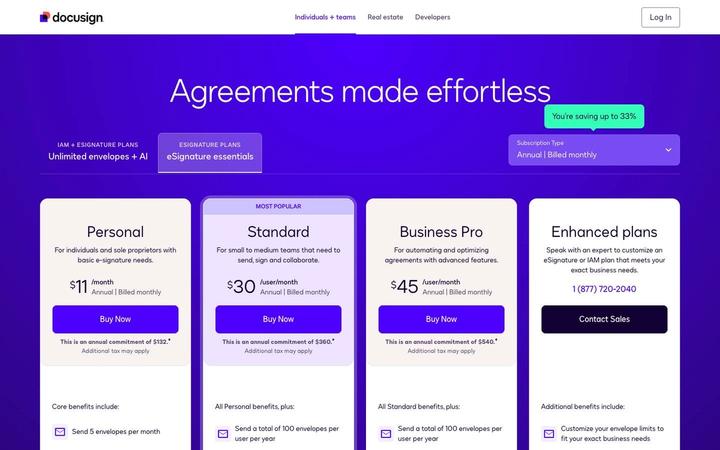
Docusign
$11/moDocusign sells eSignature per user with an envelope allowance as the second meter: Personal is $11 /month for 5 envelopes a month, Standard (MOST POPULAR) and Business Pro are $30 and $45 /user/month with 100 envelopes per user per year, and Enhanced plans run through a phone number and Contact Sales. Every paid card prints its full annual commitment under the price. The upgrade beyond eSignature is IAM, sold on 'Unlimited envelopes + AI', so envelope volume is the axis that moves a customer up the product line.

Linear
$10/user/moLinear prices per user, with annual billing switched on by default and a free plan that caps scope, not headcount: 'Unlimited members', '2 teams' and '250 issues'. The Free card now carries the agent layer too, 'Agent platform', 'Linear Agent' and 'Loops', while agent work such as coding sessions and loops draws on a separate AI credit meter. Four cards run from $0 to Custom, and a long comparison table marks each feature 'Included' or 'Not included' and prints real limits.