
Captured October 19, 2026 at 1440px wide.
Close plans and prices
| Plan | Price | Billing |
|---|---|---|
| SoloCore CRM for solo operators | $9 | per user / month |
| EssentialsSystem of action for small teams | $35 | per user / month |
| GrowthHighlightedLeveraging AI and automation | $99 | per user / month |
| ScaleAdvanced control for scaling orgs | $139 | per user / month |
As printed on the page captured October 19, 2026.
How does Close pricing work?
The seat is the price and AI credits are the meter. Each card prints a per-user price and an 'Includes 500 AI credits per user/month' line that steps to 1,000, 1,500 and 2,000, so the credit pool grows with both headcount and tier. Packaging gates automation and control: Solo is defined downward as 'Everything in Essentials, but:' with 'Limited to 1 user', 'Limited to 10k leads' and 'Workflows not included'; Essentials adds 'Unlimited contacts & leads' and 'Built-in forms, email, calling & SMS'; Growth adds 'Automated workflows', 'Use Chloe in Workflows' and 'Power dialer'; Scale adds 'Role-based access & permissions', 'Predictive dialer' and 'Live call coaching'. The comparison table opens with 'Who is this for?', one line per plan, before any feature row.
The motion is self-serve with a custom path above it. A '2 billion calls, emails, meetings run' badge sits over 'Scale your sales team without adding headcount', and a toggle set to 'Annually' carries 'SAVE UP TO 50%'. All four cards share one 'Try for free' button, with Growth outlined, badged 'MOST POPULAR' and given the only filled button. Below the cards a band reads 'Custom pricing: Growing fast or have more complex sales needs? We can help.' with 'Talk to us', and three promises follow: 'Chloe on every plan', 'No credit card needed' and '30-day money-back guarantee'. The page then runs through the comparison table, a dark section on Chloe with two customer quotes, an 11-question FAQ, a 'Which Close plan is right for you?' guide and 'Try Close free for 14 Days' with 'No credit card. No contracts.'
Under the hood, Close runs three layers of billing: the seat subscription, a monthly AI credit grant per seat, and telephony at cost. 'Chloe access is free on all Close plans' is followed by 'You only pay for the work Chloe does', with Chloe drawing on AI credits plus telephony, so access is free and the agent's output is metered. 'Calling and SMS usage is passed through at cost' and 'Most outbound calls are around $0.02/minute; phone numbers start at about $1/month' keep carrier costs apart from platform value. The headline names the strategy: an AI agent priced as work done competes with a new hire, not with another seat. Worth borrowing are the per-seat credit line on every card and the plain statement that telephony is pass-through.
What does Close's pricing page do well?
- Every card prints its AI allowance under the button, 'Includes 500 AI credits per user/month' up to 2,000, so the meter is visible at the moment of choice
- The toggle names its saving, 'SAVE UP TO 50%', and repeats at the foot of the comparison table with 'Select your preferred billing cycle:'
- Three risk reducers sit below the cards: 'Chloe on every plan', 'No credit card needed' and '30-day money-back guarantee'
- The comparison table opens with 'Who is this for?' and a one-line persona per plan before the first feature row
- 'Which Close plan is right for you?' restates each plan as a situation, such as 'Running a high-volume outbound operation?'
What does Close's pricing page reveal about its pricing strategy?
- AI credits granted per user per month form a pool that grows with seats and tier, a seat-plus-credits hybrid
- Chloe priced as work done, not as access, lets every plan carry the agent while revenue follows its usage
- Telephony 'passed through at cost' separates carrier spend from the platform margin and keeps the seat price about software
- Solo is written as 'Everything in Essentials, but:', a capped version of the team plan that makes the upgrade a removal of limits
- The headline 'without adding headcount' positions the AI agent against hiring cost, the budget line Close wants to win
Learn with Orb
- GuidePricing AI agents: plans, costs and monetization models Close puts Chloe on every plan and states 'You only pay for the work Chloe does', one of the agent monetization models Orb's guide lays out alongside how teams meter work per call and event.
- ProductPrepaid credits 'Includes 500 AI credits per user/month' rising to 2,000 on Scale is a credit allocation tied to seats and plan, the structure Orb's prepaid credits product supports.
- ProductInvoicing Calling and SMS 'passed through at cost' at 'around $0.02/minute' land on the same bill as seats and credits, the kind of usage detail Orb's invoicing keeps clear for customers and finance teams.
Questions about Close pricing
How much does Close cost?
Close's pricing starts at $9/user/mo. The page shows 4 plans, with the top plan priced through sales. Paying annually saves up to 50%.
What pricing model does Close use?
Close prices per seat, combined with credits and usage-based pricing. Buyers can sign up on their own or go through the sales team. Its plans are aimed mainly at small businesses.
Does Close have a free plan?
Close has no free plan, but its paid plans offer a free trial. The lowest paid plan starts at $9/user/mo.
Does Close offer an annual discount?
Yes, paying annually saves up to 50%. A toggle on the page switches between monthly and annual prices. The listed prices start at $9/user/mo. Terms for the plans priced through sales are set with the sales team.
How is Close's pricing page laid out?
The page shows 4 plans, highlights Growth, and includes a comparison table and an FAQ. The breakdown above marks 14 points on it: 7 things it does well and 7 insights into the pricing.
How many AI credits does Close include per user?
Every Close plan comes with a monthly AI credit grant for each user. Solo "Includes 500 AI credits per user/month", Essentials includes 1,000, Growth includes 1,500 and Scale includes 2,000. Because the allowance is per user, a team's credit pool grows with both headcount and plan tier, and the page notes that "each Close plan includes a base of credits monthly automatically."
Is the Close AI agent Chloe included on every plan?
Yes. The page states "Chloe access is free on all Close plans" and adds "You only pay for the work Chloe does." Chloe draws on the AI credits included with each plan, plus telephony, as she calls leads, books meetings and updates the CRM. Growth and Scale add "Use Chloe in Workflows" so the agent can run inside automated workflows.
How much do calling and SMS cost in Close?
Close passes calling and SMS through at cost, stating "Calling and SMS usage is passed through at cost" on the pricing page. Typical rates are listed as well, with "Most outbound calls are around $0.02/minute; phone numbers start at about $1/month" as the guide. This keeps carrier spend separate from the per-user plan price, with calling, email and SMS built into the CRM itself.
From the page as captured October 19, 2026. Current prices are on close.com
Salesforce
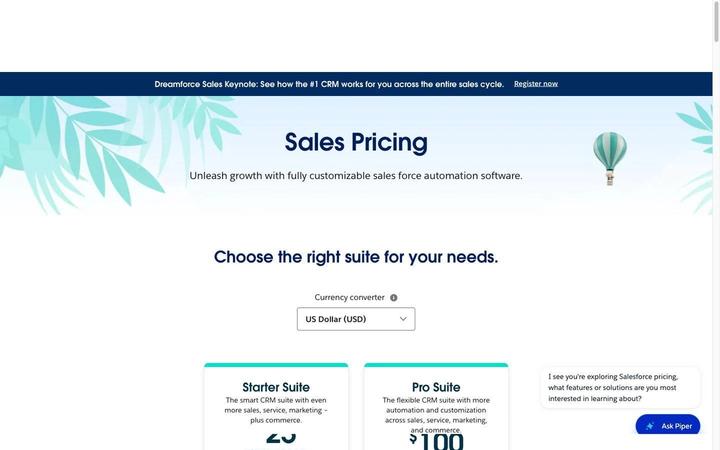
$25/user/moSalesforce prints a per-user list price for every Sales Cloud edition, from Starter Suite at $25 to Max at $550 USD/User/Month, then prices the layers around the seat: add-ons with 'From' floors, a Premier Success Plan at '30% of net license fees', and '2.75M Flex Credits per org per year' on Max. The seat stays the core metric while AI arrives as a consumption meter alongside it.

Pipedrive
$14/seat/moPipedrive sells four per-seat plans, Lite at US$ 14 through Ultimate at US$ 79 per seat per month billed annually, and every card leads to the same 'Free 14-day trial. No credit card required.' Packaging stacks cleanly, each plan opening with the one below it plus a short list, and five add-ons with 'Starting from' prices, Projects now at $16, extend any plan without moving the buyer up a tier.
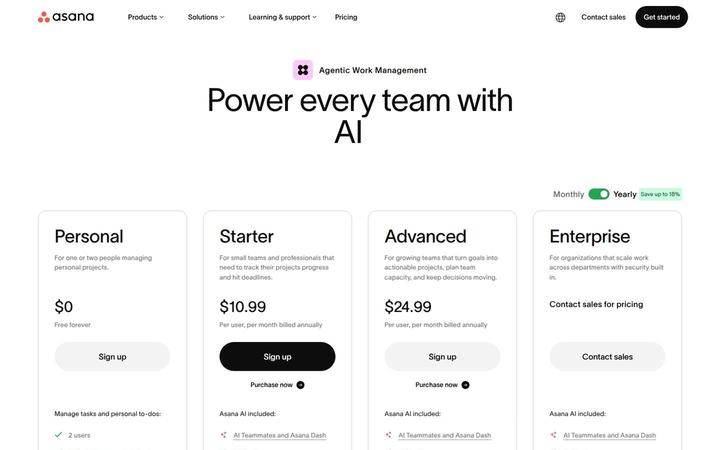
Asana
$10.99/user/moAsana pairs a per-user ladder, Personal at $0, Starter at $10.99, Advanced at $24.99 and Enterprise through sales, with a metered AI layer priced in the open. Each paid plan includes a pool of AI requests, and more cost $0.50 each in prepaid usage packs or $0.60 each pay as you go, under the banner 'One flat rate for every AI request'. Seats price the work management product, requests price the work AI Teammates and Asana Dash do, and optional modules such as Timesheets and Budgets extend down to Starter.