
Captured November 4, 2026 at 1440px wide. The page continues below the crop (9,850px in total).
Quo plans and prices
| Plan | Price | Billing |
|---|---|---|
| StarterThe essentials to get you and your team up and running | $15 | Per user/per month |
| BusinessHighlightedFor businesses looking for more call handling and automation features | $23 | Per user/per month |
| ScaleBoost team efficiency with advanced automations and AI support | $35 | Per user/per month |
As printed on the page captured November 4, 2026.
How does Quo pricing work?
The value metric is the user, and each user brings a phone line: 'One new or ported phone number (local or toll-free) per user' with 'Calling and messaging to US and Canadian numbers*'. Packaging is three plans gated by call handling and support. Starter covers the essentials plus 'Sona AI agent' and 'ChatGPT / Claude MCP'; Business adds 'AI call summaries and transcripts', 'Group calling', 'Call transfers', 'Phone menus' and 'HubSpot and Salesforce integrations'; Scale adds 'AI call tags', 'Dedicated onboarding support' and 'Inbound phone support'. A second meter runs underneath: '1,000 free automation credits included' on every card, priced at '1 Call = 100 credits'.
The motion is self-serve. The headline is 'Start your free trial', with 'Try Quo risk-free for 7 days. Cancel anytime (we’ll even remind you).' and a short video, 'How to create a Quo account (2:16)'. A 'Monthly Yearly Pay less' switch opens on yearly, each card names its saving, 'Save $48/year' to 'Save $144/year', and all three buttons read 'Try for free', with Business set apart by a dark outline and the only filled button. A Sona band with 'Need more credits?' follows, then a long 'Compare plans' table with Business labeled 'Most popular', a 'Switch from any provider for free' section, 'Add-ons', 'Powering conversations for 90,000+ businesses' with a Y Combinator quote, and the FAQ. 'Talk to Sales' appears in the header and on the audit log and SOC 2 rows, a sales path without a sales tier.
Under the hood, Quo runs three billing layers: the seat subscription, a credit pool for the AI agent, and pass-through telecom costs. Sona credits come in five tiers, Tier 1 at '$0 /mo' with '1,000 (10 calls)' up to Tier 5 at '$199 /mo' with '60,000 (600 calls)', and the overage per call falls from '$1.00' to '$0.45' as the tier rises. Carrier costs are itemized apart from the software, a '$19.50 one-time' review fee and a '$1.50 - $3/month' messaging fee from The Campaign Registry, and add-ons price numbers at '$5/month each' and automated SMS at '1c per segment'. Worth borrowing are an agent priced per call through credits with a tiered overage rate, and third-party fees named in the comparison table where a buyer can see them.
What does Quo's pricing page do well?
- Each card names its annual saving in dollars, 'Save $48/year', 'Save $120/year' and 'Save $144/year'
- The hero promises a trial reminder: 'Cancel anytime (we’ll even remind you).'
- Carrier fees are listed in the comparison table with who collects them, '$19.50 one-time' and '$1.50 - $3/month'
- Credits are translated into calls everywhere they appear, '1,000 free automation credits (10 calls)' and '1 Call = 100 credits'
- 'Switch from any provider for free' pairs 'Port your number' with three promises about the transfer
What does Quo's pricing page reveal about its pricing strategy?
- Sona is 'Now included' on every plan and metered by calls, so the agent's revenue follows its work beside the seat
- Overage per call falls from '$1.00' on Tier 1 to '$0.45' on Tier 5, a volume discount that rewards a larger credit commitment
- Starter gets AI call summaries 'Available for Sona-handled calls' only, an upgrade path that starts from the agent's own output
- Third-party carrier fees itemized apart from the seat keep the per-user price about software
- 'Talk to Sales' sits on the audit log and SOC 2 rows, so compliance needs reach sales without an enterprise tier
Learn with Orb
- GuidePricing AI agents: plans, costs and monetization models Quo includes 'Sona AI agent' on every plan and meters it at '1 Call = 100 credits', one of the agent monetization models Orb's guide lays out alongside how teams meter work per call.
- ProductPrepaid credits Sona's credit tiers, '1,000 (10 calls)' at '$0 /mo' up to '60,000 (600 calls)' at '$199 /mo' with overage per call falling from '$1.00' to '$0.45', are credit allocations with tiered rates, the structure Orb's prepaid credits product supports.
- ProductInvoicing Carrier fees of '$19.50 one-time' and '$1.50 - $3/month' sit beside per-user seats and add-ons at '$5/month each', the mix of line items Orb's invoicing keeps clear for customers and finance teams.
Questions about Quo pricing
How much does Quo cost?
Quo's pricing starts at $15/user/mo. The page shows 3 plans.
What pricing model does Quo use?
Quo prices per seat, combined with credits and usage-based pricing. Buyers choose a plan and sign up on their own. Its plans are aimed mainly at small businesses.
Does Quo have a free plan?
Quo has no free plan, but its paid plans offer a free trial. The lowest paid plan starts at $15/user/mo. Signing up needs no call with sales.
Does Quo offer an annual discount?
Yes: up to $144/year. A toggle on the page switches between monthly and annual prices. The listed prices start at $15/user/mo.
How is Quo's pricing page laid out?
The page shows 3 plans, highlights Business, and includes a comparison table and an FAQ. The breakdown above marks 14 points on it: 8 things it does well and 6 insights into the pricing.
How do Sona automation credits work on Quo?
Every Quo plan includes "1,000 free automation credits (10 calls)", and Sona uses "1 Call = 100 credits". More credits come in tiers, from Tier 2 at $25 per month for "4,000 (40 calls)" to Tier 5 at $199 per month for "60,000 (600 calls)". The overage rate per call falls from $1.00 on Tier 1 to $0.45 on Tier 5.
What carrier fees does Quo charge for business texting?
US messaging requires registration with The Campaign Registry, which collects "a one-time fee of $19.50 to review your application". It also charges a monthly messaging fee of "$1.50 - $3/month" based on the use case. Both are listed on every plan in the comparison table, separate from the per-user price.
What do extra phone numbers and automated texts cost on Quo?
Every user gets one local or toll-free number, and additional numbers are "$5/month each" on every plan. Automated SMS through the API, Zapier or Make is an add-on at "1c per segment". International calling and messaging is "Billed using credits" at a rate based on the destination.
From the page as captured November 4, 2026. Current prices are on quo.com
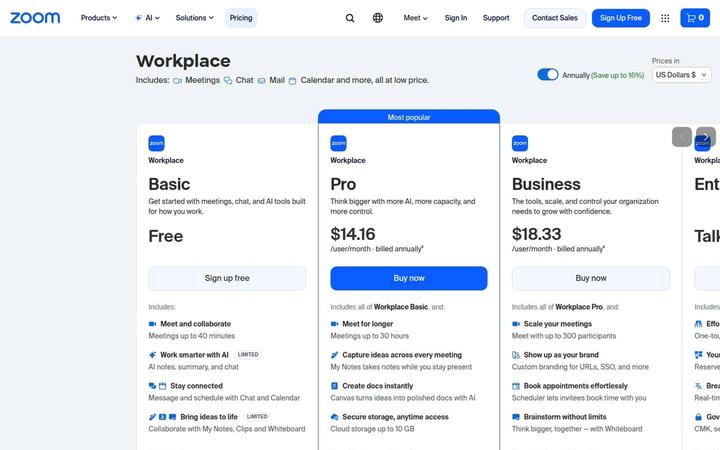
Zoom
$14.16/user/moZoom Workplace sells a per-user suite on four plans, Basic free, Pro at $14.16, Business at $18.33 and Enterprise through sales, each price the monthly equivalent of an annual upfront charge. Each plan card leads with a tagline and four benefit-led rows while the comparison table carries the exact limits, and a catalog of seventeen add-ons, from ZoomMate at $20 to Zoom Mesh through sales, lets a paid account grow capacity, AI and governance one line at a time.
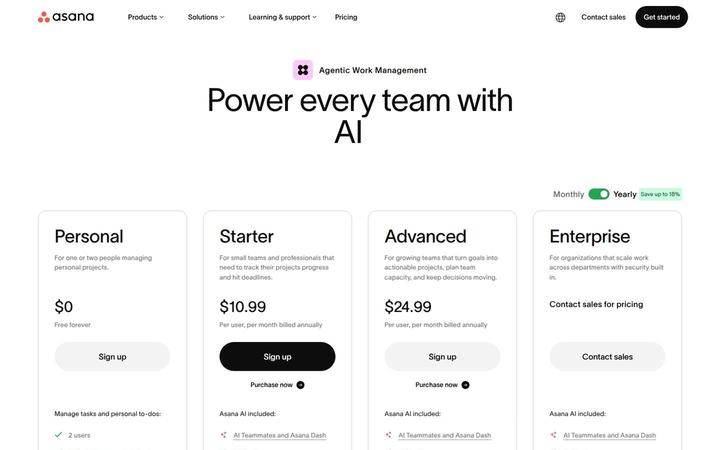
Asana
$10.99/user/moAsana pairs a per-user ladder, Personal at $0, Starter at $10.99, Advanced at $24.99 and Enterprise through sales, with a metered AI layer priced in the open. Each paid plan includes a pool of AI requests, and more cost $0.50 each in prepaid usage packs or $0.60 each pay as you go, under the banner 'One flat rate for every AI request'. Seats price the work management product, requests price the work AI Teammates and Asana Dash do, and optional modules such as Timesheets and Budgets extend down to Starter.

Close
$9/user/moClose sells four per-user plans, Solo at $9 through Scale at $139 per user per month on annual billing, and attaches a pool of AI credits to every seat, from 500 to 2,000 a month. Its AI sales agent, Chloe, is included on every plan and paid for by the work she does, while calling and SMS pass through at cost.