8 SaaS pricing best practices with concrete examples
Eight practices with examples, from understanding the customer base to free plans generous enough to attract users and limited enough to prompt an upgrade.
Pricing pages priced by the size of an audience: contacts, subscribers, profiles or active users. Common in email, marketing and customer data platforms, where the price grows with the list a customer builds.
Of the 10, 5 show a free tier, 7 include a comparison table, 5 a calculator and 7 keep a contact-sales tier.
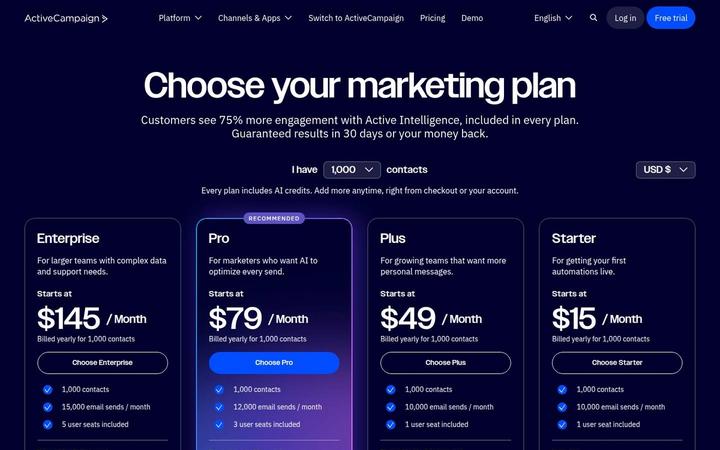
ActiveCampaign prices four plans by contact band, each with a printed starting price and a 'Choose' button, and now adds AI credits as a second meter: every plan includes 500, with more available from checkout or the account. A single contact selector sits above the cards, and each card translates its plan into concrete numbers, from '15,000 email sends / month' to '1 user seat included'. Email sends still scale as a multiple of the contact limit, from '10x' to '15x'.
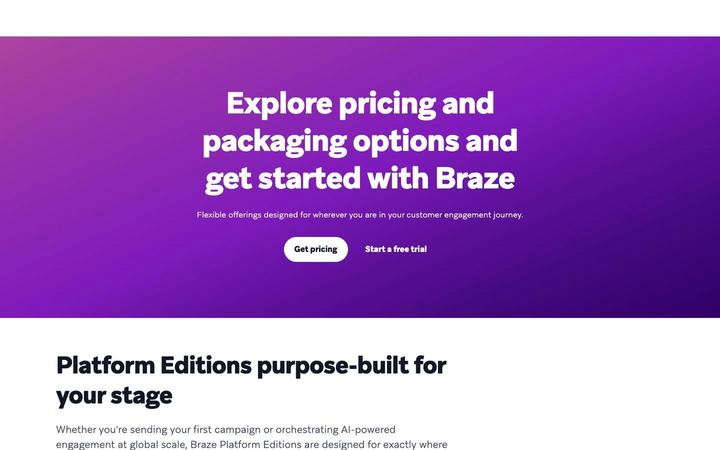
Braze prices on two axes: Monthly Active Users set the scale of the subscription, and Action Credits are a pooled currency spent across every channel and certain BrazeAI products. Four Platform Editions, Go, Select, Pro and Enterprise, are named for company stage, and every edition is priced in a conversation, which lets each contract fit the brand's audience and channel mix.

Customer.io meters on profiles, people plus objects, and starts at '$100 per month / billed monthly for 5k profiles' with a profile selector built into the entry card. Seats are unlimited on every plan, and the Usage + Billing block prints the marginal rates: $0.009 per additional profile, $0.12 per additional 1,000 emails and $10 / 100K AI credits. From Premium up, profile and email volume are priced per customer, which is where the sales team shapes each deal.

Ghost(Pro) prices four hosting plans on audience size, registered members, with an audience slider above the cards that sets the member count the plans are quoted for. The hero promises 'No payment fees', and the table's Transaction fees row reads 0% on every plan that takes payments, so Ghost earns a flat fee while the publisher keeps subscription revenue.
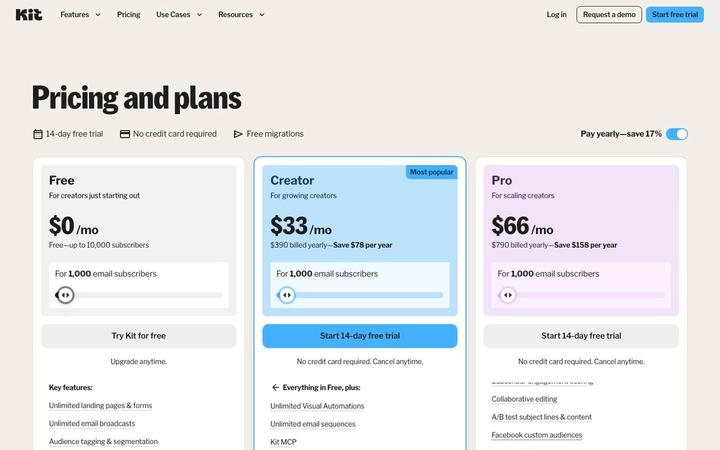
Kit prices on email subscribers and puts a slider inside every card, so all three prices move together as a creator drags their list size. Free carries a list of up to 10,000 subscribers, Creator is '$33/mo' and Pro '$66/mo' at 1,000 subscribers, and paid plans sell automation, analytics and team access, so the free plan builds the audience and the paid plans grow the business on top of it.
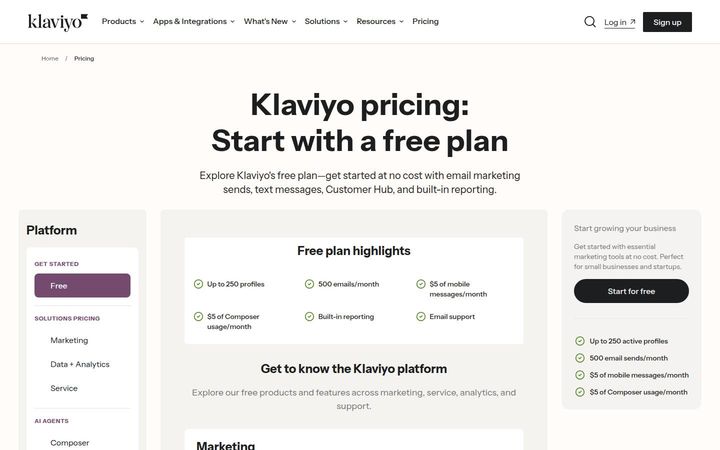
Klaviyo's pricing page opens on 'Klaviyo pricing: Start with a free plan' and presents a single plan in depth: Free, with 'Up to 250 active profiles', '500 email sends/month' and dollar allowances of '$5 of mobile messages/month' and '$5 of Composer usage/month'. A Platform sidebar routes paid pricing to product pages for Marketing, Data + Analytics, Service, Composer and Customer Agent, and a 'Build a plan' button opens the composable path.
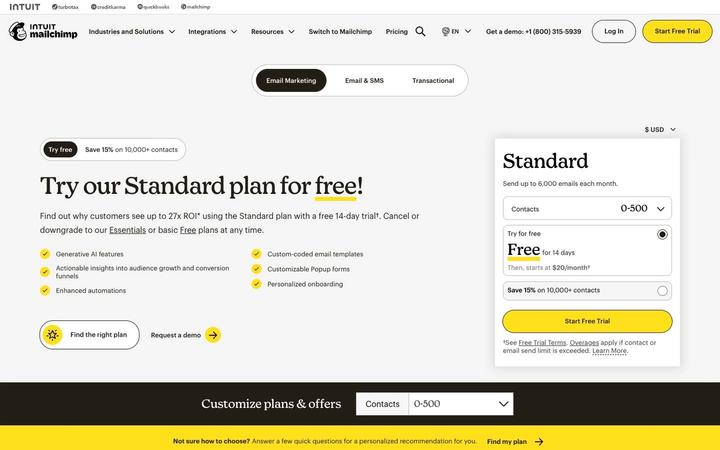
Mailchimp prices email marketing by contact band, twenty of them from '0-500' to '1,000,000+', and sets sending capacity as a multiple of the same number: '15X contacts', '12X contacts' or '10X contacts' a month by plan. The page is built as a trial funnel around Standard, which is the hero offer, the 'Best value' plan and the default 14-day trial.
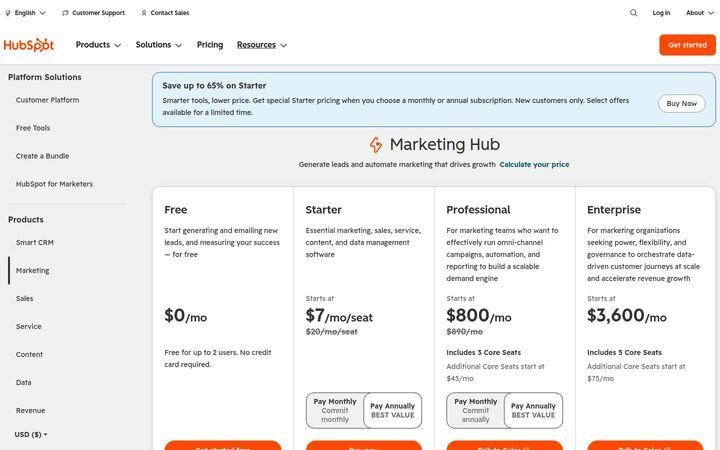
HubSpot's Marketing Hub blends four meters into one plan, a platform price, Core Seats, a marketing contact tier and a pool of HubSpot Credits for AI agents, and adds a one-time onboarding fee at Professional and Enterprise. Seat expansion, onboarding fees and the Enterprise floor are all printed, and the HubSpot Credits section frames AI usage around buying choice and control: 'Buy credits in packs to easily plan your spend or Pay-as-You-Go for added flexibility', backed by action-level spend limits.

Lemon Squeezy prices its merchant-of-record commerce at one rate, '5% + 50¢' per transaction with no monthly fee, and sells email marketing on a separate subscriber meter that is free for up to 500 subscribers. The most interesting thing on the page is a cost table that prices the do-it-yourself stack line by line, so the take rate is read against the whole cost of selling online.

Twilio Segment's Customer Data pricing page is a router between two products: a Customer Data Pipeline built on Connections, priced on its own plans page, and a Customer Data Platform that adds Unify and Engage and is quoted by sales. The metric is Monthly tracked users, set as 'Custom volume' on both offers with unlimited seats, which keeps every Platform deal open to shaping around the customer's audience size.
Eight practices with examples, from understanding the customer base to free plans generous enough to attract users and limited enough to prompt an upgrade.
Orb's CEO on the main SaaS pricing models, from flat rate and per seat to usage-based and hybrid, how each structures the way customers pay, and how to choose among them.
Orb's CEO on enterprise pricing: how it differs from SMB pricing, the main enterprise models, and what to weigh when prices are set deal by deal.